


More news on this day
Irish holidaymakers heading abroad this summer are being urged to allow extra time for journeys, as new EU border rules, stretched airport capacity and ongoing strike risks combine to create the prospect of long queues and disruption at several of the most popular gateways for travellers from Ireland.
Get the latest news straight to your inbox!
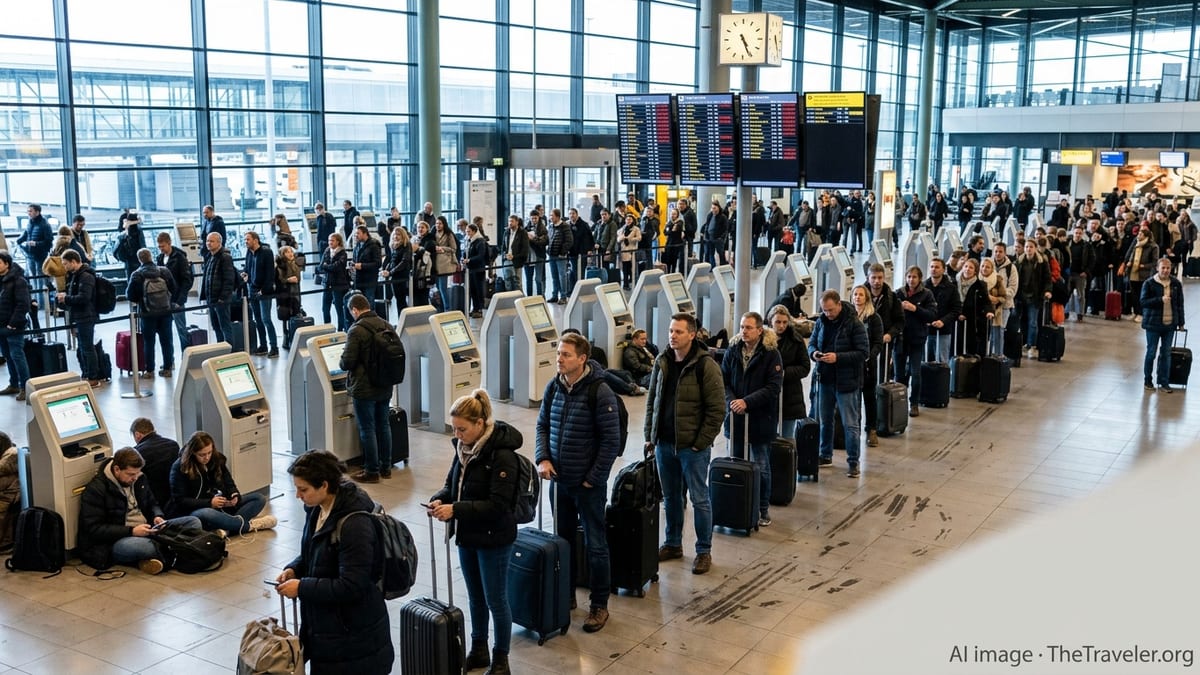
New EU border system reshapes queues for Irish passengers
The biggest single change affecting Irish holidaymakers in 2026 is the full roll-out of the European Union’s new Entry/Exit System, a biometric border database that is now operating at all external Schengen checkpoints. Publicly available information shows that the system, which replaces manual passport stamping for non-EU visitors, has lengthened processing times at many airports as passengers are registered with facial scans and fingerprints for the first time.
Industry briefings and recent travel coverage indicate that airports have reported waiting times at border control stretching from one to three hours during busy periods since the system became fully operational in April. For Irish citizens, the impact is most visible when travelling on non-EU passports, accompanying non-EU family members, or holding dual nationality and choosing to enter on a non-EU document. Travellers from Ireland who enter Schengen on UK or other third-country passports are now treated as non-EU arrivals and must complete the full biometric process.
Airline advisories aimed at the Irish market have highlighted that the new rules apply on routes between Ireland or the UK and Schengen destinations, even when passengers are simply connecting onwards. Guidance circulated to customers recommends arriving earlier than usual and watching for separate lanes marked for the new system at passport control, particularly at peak weekend and school-holiday times.
Travel analysts note that while the system is intended eventually to speed up crossings, the first full summer under the new regime is likely to see uneven performance and pinch points at airports where infrastructure and staffing have not yet caught up with demand.
Portuguese hotspots among the hardest hit so far
For Irish sun-seekers, Portugal is emerging as one of the main trouble spots. Reports from local travel outlets in May described severe congestion at Lisbon and Faro airports following the national switch to full biometric checks in April. At times, queues at border control in Lisbon were reported to have stretched to several hours, forcing temporary suspension of the system and causing passengers to miss onward connections.
Faro, gateway to the Algarve and a key summer route for Irish airlines, has also seen delays as arriving non-EU passengers are funnelled through new kiosks and booths. Coverage from aviation and tourism publications notes that the surge in leisure traffic has collided with the early bedding-in phase of the technology, leaving airport operators and border staff under intense pressure.
Irish-linked carriers have been vocal about the impact. Statements reported in Portuguese and Irish media show Ryanair calling on the Portuguese government to pause full enforcement of the system until after the summer peak, warning that families arriving from Ireland and the UK risk “unnecessary” waits at passport control in already crowded terminals. The airline has urged customers to build in extra time at departure and to expect congestion on arrival at Portugal’s main holiday airports.
Travel advisers suggest that passengers routing to smaller Portuguese airports or flying at off-peak times in the early morning or late evening may experience smoother journeys, but caution that conditions can change quickly as demand fluctuates.
Spanish and French hubs under pressure from biometric checks and strikes
Spain, traditionally the top overseas destination for Irish holidaymakers, is also bracing for a busy and potentially bumpy summer. Major entry points such as Málaga, Barcelona and Palma de Mallorca are now processing non-EU arrivals through the new biometric system, and airport associations have warned that processing times at some Schengen hubs have already increased significantly. Travel reports from the early season describe sporadic queues as terminals adapt their layouts and staffing patterns.
For Irish travellers, the main pressure points are likely to be on flights from Dublin, Cork, Shannon and Belfast to the Mediterranean coast and Balearic Islands, which often arrive in concentrated waves around the same time of day. Publicly available planning documents from airport trade bodies note that if multiple flights carrying large numbers of non-EU passengers land together, waiting times at passport control can rapidly escalate.
France presents a slightly different challenge. Coverage from aviation analysts highlights that repeated air traffic control strikes in recent years have had a disproportionate effect on north-south routes in Europe, including services between Ireland, the UK and Spain or Italy that overfly French airspace. Even when Irish holidaymakers are not travelling to France itself, industrial action there can cause knock-on delays, diversions and missed connections at hubs across the continent.
Outlook reports for the 2026 summer season suggest that further periods of industrial unrest cannot be ruled out. Airlines serving Ireland have responded by building more slack into schedules and by cautioning customers that arrival times may vary when French or Italian airspace is disrupted at short notice.
Dublin and UK airports adjust to new travel realities
While the new biometric system is applied at the Schengen border rather than in Ireland, departures from Irish airports are not immune from the knock-on effects. Dublin, which handles the vast majority of Ireland’s holiday traffic, is managing a summer marked by changing airline schedules, tighter capacity and evolving document requirements on certain routes.
Network changes by major low-cost carriers have removed some planned flights for the 2026 season, reducing flexibility for passengers who are disrupted or miss connections due to delays at European hubs. At the same time, updated identification rules on services between Ireland and Great Britain mean more travellers are now required to present passports where previously they might have used other forms of ID, adding a further layer of checks at the airport.
Across the Irish Sea, UK airports that act as gateways to Europe for Irish travellers are grappling with their own pressures. British terminals are in the midst of a transition to new-generation security scanners that allow larger quantities of liquids and electronics to remain in bags, but implementation has been uneven. Travel coverage from the UK in recent months has described periods of congestion as older equipment is phased out and passengers adapt to differing rules between airports.
For Irish passengers connecting via London, Manchester or other British hubs to reach Schengen destinations, this can mean facing both longer security lines on departure and potential queues at passport control when entering Europe, particularly if flights are bunched together around peak times.
How Irish holidaymakers can reduce the risk of disruption
Travel organisations and consumer advisers are increasingly urging Irish holidaymakers to build more resilience into their summer plans. The most consistent recommendation is to arrive earlier at the airport than in previous years, especially for flights to Portugal, Spain, France and other Schengen destinations that are now fully using biometric border checks.
Passengers are also being encouraged to pay particular attention to connection times. Guidance drawn from airline and airport advisories suggests allowing a wider margin for onward flights within Europe, especially when the first arrival point is a busy holiday airport such as Lisbon, Faro, Málaga, Barcelona or Palma. Where possible, choosing itineraries with longer layovers may reduce the risk of missed connections caused by unexpectedly long queues at passport control.
Another theme in recent travel commentary is the importance of documentation. Irish residents travelling on non-EU passports, or with family members who do, are advised to read airline guidance carefully and to keep passports, boarding passes and any required supporting documents easily accessible in queues. Families with children may wish to factor in extra time at border control, as first-time biometric enrolment can take longer for larger groups.
Finally, seasoned observers of European aviation recommend monitoring airport and airline channels regularly in the days before departure. While the precise extent of queues and delays is likely to vary from one week to the next, the combination of a new border regime, busy terminals and the ongoing risk of industrial action means Irish holidaymakers should be prepared for a more demanding travel environment than in pre-pandemic summers.