


Rising above Oslo’s harbor with thick stone walls and copper‑topped towers, Akershus Fortress is one of Norway’s most recognizable historic landmarks. For many travelers it becomes an unexpected highlight of their time in the capital, combining sweeping fjord views, free public access and a deep dive into more than 700 years of Norwegian history in one compact, walkable site. If you are wondering whether Akershus Fortress is worth adding to your Oslo itinerary, it helps to understand what the experience is actually like on the ground today.
Get the latest updates straight to your inbox!
Why Akershus Fortress Matters to Oslo and to Travelers
Akershus Fortress sits on a rocky promontory right in central Oslo, a few minutes on foot from the City Hall and the Aker Brygge waterfront. Construction began in the late 13th century as a royal castle defending the harbor, and over the centuries it has served as a royal residence, a military stronghold, a prison and now the symbolic heart of Norway’s armed forces. Today the Ministry of Defence and Armed Forces headquarters still occupy parts of the complex, while the rest is a public park and heritage site open to visitors most of the day for free.
That combination of living military base and relaxed city park is part of what makes the place memorable. On a spring afternoon you might see uniformed staff heading into modern offices while locals walk their dogs along the ramparts and tourists photograph the skyline. The official visitor materials describe Akershus as one of Norway’s key national fortifications, and for Oslo residents it functions much like a historic commons: a green lung, a shortcut between neighborhoods and a stage for everything from concerts to political events.
For travelers, this means Akershus rarely feels like a closed‑off museum. You can enter through the main gate near the waterfront, wander up through cobbled lanes and grassy bastions, and drop out again near the National Theatre or Rådhusplassen without ever buying a ticket. Many visitors on short city breaks report that an hour or two here gives them more sense of Oslo’s story than several smaller museums combined, particularly when they combine a rampart stroll with a quick stop at one of the on‑site museums.
What Visitors Love Most: Atmosphere, Views and Free Access
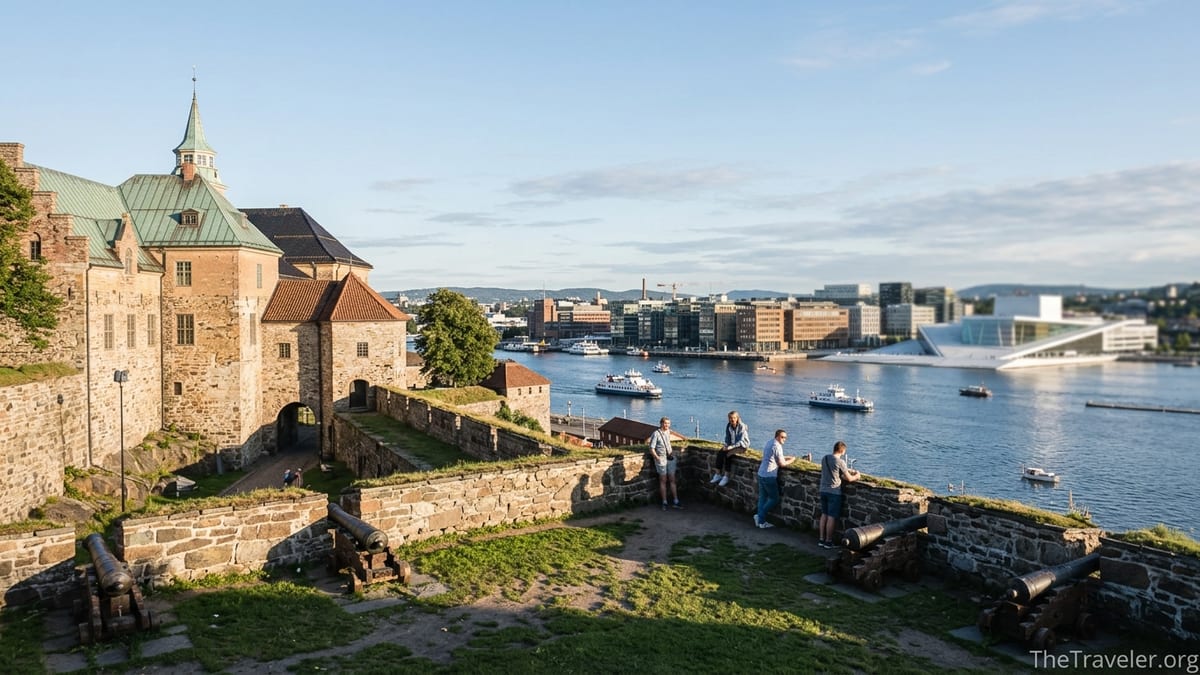
Ask recent visitors what stood out at Akershus and three themes come up again and again: the quiet atmosphere in the middle of the city, the panoramic views over the Oslofjord and the fact that much of the experience costs nothing. The fortress lawns and terraces overlook the harbor, the modern Oslo Opera House to the east and the ferries cruising in and out of the fjord. In clear summer light, cruise passengers, backpackers and office workers all drift to the same low stone walls to watch sailboats and island ferries pass below.
Because entrance to the grounds is free and they are open long hours, Akershus often becomes an informal picnic spot. On a July evening you are likely to see couples sitting with supermarket strawberries and takeaway sushi from nearby Karl Johans gate, using the fortress walls as an al fresco dining bench. In winter, the mood is completely different: crisp air, early dusk and snow edging the ramparts, with only a few bundled‑up visitors pausing for photographs before retreating to a café.
The visual drama of the medieval walls surrounded by modern glass buildings is another highlight. Travelers arriving on DFDS or other ferries into Oslo often get their first glimpse of Norway when they see Akershus’ silhouette from the water. Several recent photo essays and travel blogs describe timing their walk to catch sunset from the western bastion, when the low sun hits the stonework and the opera house glows across the bay.
Inside the Castle and Museums: When Paying Extra Is Worth It
Within the outer walls, Akershus Castle itself is a ticketed attraction with period‑furnished halls, a chapel and the Royal Mausoleum. The castle interiors trace Norwegian history from the Middle Ages through the union with Denmark and Sweden to the modern constitutional monarchy. For travelers who enjoy palaces and historic interiors, the small scale can be a positive: instead of endless state rooms, there are a few carefully curated spaces with explanatory panels in Norwegian and English.
Admission prices change periodically, but expect a typical adult ticket for the castle to sit in the range that is common for Norwegian state museums, with discounts for students, seniors and children, and free entry for young kids on some days. Many visitors report spending about an hour inside, looking at the banquet hall, chapel and lower‑level dungeons. Because the castle is used for official events, there are occasional closures or shorter opening hours, so it is worth checking the day’s schedule at the visitor center before planning your day around an interior visit.
Two additional museums on the grounds, the Norwegian Armed Forces Museum and Norway’s Resistance Museum, have separate tickets but are also reasonably priced. Travelers interested in the Second World War and Norway’s occupation often find the Resistance Museum particularly powerful, with exhibits on underground newspapers, sabotage operations and the fate of political prisoners. Those with a broader interest in military history and technology tend to gravitate toward the Armed Forces Museum, which covers everything from Viking‑age weaponry to Cold War equipment. If your time is limited, many people choose one of the two based on interest, then spend the rest of their visit outdoors on the ramparts.
History in the Stones: From Medieval Fortress to World War II
Akershus tells Norway’s story in layers, and that narrative is a major reason history‑minded travelers rate it so highly. The oldest sections date back to about 1299 under King Håkon V, when the capital moved from Tønsberg to Oslo and a defensible stronghold was needed above the harbor. Later rulers rebuilt the castle in Renaissance style, adding the red‑roofed buildings and towers that dominate today’s skyline.
Over the centuries the fortress withstood sieges, fires and political change. Guides like to point out that whoever controlled Akershus effectively controlled Norway, because of its location above the main supply routes by sea. Walking through the gates, you move past heraldic coats of arms and cannon positions that speak to that long military role. The thick outer walls that once faced Swedish armies now look out over electric harbor trams and modern office blocks.
The Second World War is particularly present here. During the Nazi occupation of Norway, Akershus served as a prison and execution site for members of the resistance, and memorial plaques on the walls and in small courtyards mark where Norwegian prisoners were shot in 1945. After the war, the fortress was restored, and the castle church again became a site of royal ceremonies and state funerals. Many visitors find that spending a few minutes at these memorials, then visiting the Resistance Museum, turns a scenic walk into a much deeper encounter with Norway’s 20th‑century history.
Planning Your Visit: Practical Details and Real‑World Tips
Because Akershus sits in the center of Oslo, planning a visit is straightforward. From Oslo S railway station it is roughly a 15‑minute walk through the central streets toward the waterfront. The western gate near the City Hall is the most common entry point, but you can also approach from the east by walking along the harbor promenade from the Opera House. The fortress is open daily, with longer hours in summer and somewhat reduced opening times in the darker months. Although there are security cameras and occasional patrols, entrance to the park areas is typically unsupervised and free.
Accessibility is improving but still mixed. Some of the lower areas and museums are reachable with ramps and paved paths, yet the steep cobbled lanes up to the castle and sections of the ramparts can be challenging for visitors with limited mobility or strollers. The visitor center provides up‑to‑date information on which routes are most manageable. Good footwear is essential, especially if you visit in autumn or winter when paths may be slippery with rain, ice or compacted snow.
Facilities inside the fortress include toilets, a visitor center and, in season, small cafés or kiosks. Many travelers prefer to bring a coffee and pastry from bakeries on nearby Rådhusgata, then find a quiet bench overlooking the fjord. Official guidance in recent years has reminded visitors that the fortress is an active government and military site, so flying drones or climbing restricted walls can lead to fines or worse. Photography is welcomed in most outdoor spaces, but as always in Norway you should avoid photographing specific security installations or personnel where signs restrict it.
When Akershus Fortress Is Most Worth It
One of the reasons Akershus appears so often in Oslo itineraries is that it works well in a variety of trip styles. For budget travelers and backpackers, it offers several hours of free sightseeing in an expensive city, with minimal extra costs unless you decide to add museum tickets. For families, the open lawns, cannons and towers give children room to burn off energy while adults enjoy the views, and there are plenty of low walls and grassy slopes that become impromptu picnic spots in good weather.
Photography enthusiasts often visit more than once, catching both morning light on the opera house and evening glow over the harbor. Cruise passengers with just a day in port like that they can combine Akershus with the Nobel Peace Center or ferry trips to the Oslofjord islands without wasting time on long transfers. In the height of summer, guided walking tours sometimes include brief stops at the fortress as part of a longer loop through the city center, but many independent travelers prefer to explore on their own so they can linger in quiet corners away from groups.
Even if your time in Oslo is short, Akershus usually justifies at least a quick visit because you pass so close to it when moving between other big draws like the MUNCH museum, the Opera House and the harborfront neighborhoods of Aker Brygge and Tjuvholmen. Travelers who stay nearby in central hotels often end up returning at different times of day, using the fortress as an atmospheric shortcut between the waterfront and the upper city streets.
Who Might Skip It (and What to Do Instead)
Despite its popularity, Akershus will not appeal equally to every traveler. If you are not especially interested in history, architecture or views, and your schedule in Oslo is extremely tight, you might choose to prioritize other experiences. For example, some visitors focused on contemporary culture prefer to spend their limited hours in the Barcode district, at MUNCH or with a fjord sauna session instead of walking the ramparts.
Similarly, travelers with very limited mobility or those pushing heavy strollers may find the steep approach and cobblestones frustrating, especially in bad weather. While parts of the fortress are accessible, much of its charm lies in clambering up to the outer defenses and exploring uneven paths. In that case, a waterfront stroll around the Opera House, where you can actually walk up the sloping roof, may provide easier access to harbor views without the same physical demands.
Winter travelers arriving on short city breaks in deep December also sometimes decide to give Akershus a shorter slot, using it mainly for a daylight walk rather than a full historical visit. With only a few hours of light and temperatures often below freezing, indoor attractions such as the National Museum or the Viking Ship Museum’s exhibits can feel more appealing. That said, those who do bundle up are often rewarded with atmospheric photos of the castle dusted with snow against a blue‑hour sky.
The Takeaway
Is Akershus Fortress worth visiting? For most travelers, the answer is yes, and often enthusiastically so. The combination of free public access, commanding views over the Oslofjord and an unusually layered history makes it a rare site that works both as a local park and as a national symbol. You can invest half a day with museum visits and guided tours, or simply wander the ramparts on your way between other city center sights.
What visitors love most about Akershus is not any single attraction, but the way the elements come together: medieval walls, quiet lawns, memorials to the wartime resistance, present‑day military offices and an ever‑changing harbor panorama. Few European capitals offer such an accessible sense of continuity between past and present in a space that also functions as a relaxed gathering place.
If you have at least a couple of hours in Oslo and are curious about how Norway became the country it is today, Akershus Fortress is very likely to reward your time. Go during daylight, wear decent shoes, bring a snack or coffee, and leave room in your schedule to sit for a while on the western bastion, watching ferries come and go beneath the same walls that have guarded this harbor for more than seven centuries.
FAQ
Q1. Is Akershus Fortress free to visit?
The fortress grounds are free to enter and open to the public, while the interior of Akershus Castle and the on‑site museums charge separate admission fees.
Q2. How much time should I plan for Akershus Fortress?
Most visitors spend one to two hours walking the grounds and enjoying the views, and up to half a day if they also tour the castle and one or both museums.
Q3. What is the best time of day to visit Akershus Fortress?
Morning offers softer light and fewer crowds, while late afternoon and early evening are ideal for sunset views over the Oslofjord from the western ramparts.
Q4. Are the castle and museums open year‑round?
The fortress grounds are generally open year‑round, but the castle interiors and museums operate with seasonal schedules, often shorter hours in winter and occasional closures for official events.
Q5. Is Akershus Fortress suitable for children?
Yes, families often enjoy the open lawns, cannons and towers, though parents should watch small children near steep walls and bring appropriate clothing for the weather.
Q6. How do I get to Akershus Fortress using public transport?
From Oslo Central Station, it is about a 15‑minute walk, or you can take trams or buses that stop near the City Hall and then walk a few minutes to the main gate.
Q7. Is Akershus Fortress accessible for visitors with limited mobility?
Some lower areas and museum entrances have paved paths and ramps, but the steep cobbled approaches and parts of the ramparts can be challenging, so checking routes in advance is wise.
Q8. Can I take photos and fly a drone at Akershus Fortress?
Photography is generally allowed on the grounds, but flying drones is not permitted because the fortress is an active government and military site with security restrictions.
Q9. Are guided tours available at Akershus Fortress?
In peak seasons, guided tours of the castle and fortress are often available through local operators or the visitor center, while many travelers choose self‑guided walks with printed or digital maps.
Q10. What should I wear when visiting Akershus Fortress?
Wear comfortable shoes suitable for cobblestones and uneven paths, and dress in layers to handle changeable Norwegian weather, especially if you plan to spend time on exposed ramparts.