


Few European capitals offer their history as accessibly as Oslo. Within a 15-minute walk of Oslo Central Station you can stand in a medieval fortress that once guarded the harbor or at the foot of a 19th-century royal residence that still houses Norway’s monarch. Many visitors only have time for one major historic site. Should you focus on Akershus Fortress, often called Oslo Castle, or the Royal Palace at the top of Karl Johans gate? This guide compares the two in practical, real-world terms so you can decide which fits your style, schedule, and budget.
Get the latest updates straight to your inbox!
Understanding the Two “Castles” of Oslo
First, some terminology that can confuse first-time visitors. Akershus Fortress is a fortified complex on a headland above the Oslofjord. Inside its walls sits Akershus Castle, a medieval and later Renaissance royal residence. Locals often use “Akershus Fortress” and “Oslo Castle” interchangeably. The Royal Palace, by contrast, is a separate site entirely. It is the yellow neoclassical palace at the western end of Karl Johans gate, completed in the mid-19th century as the official residence of Norway’s monarch.
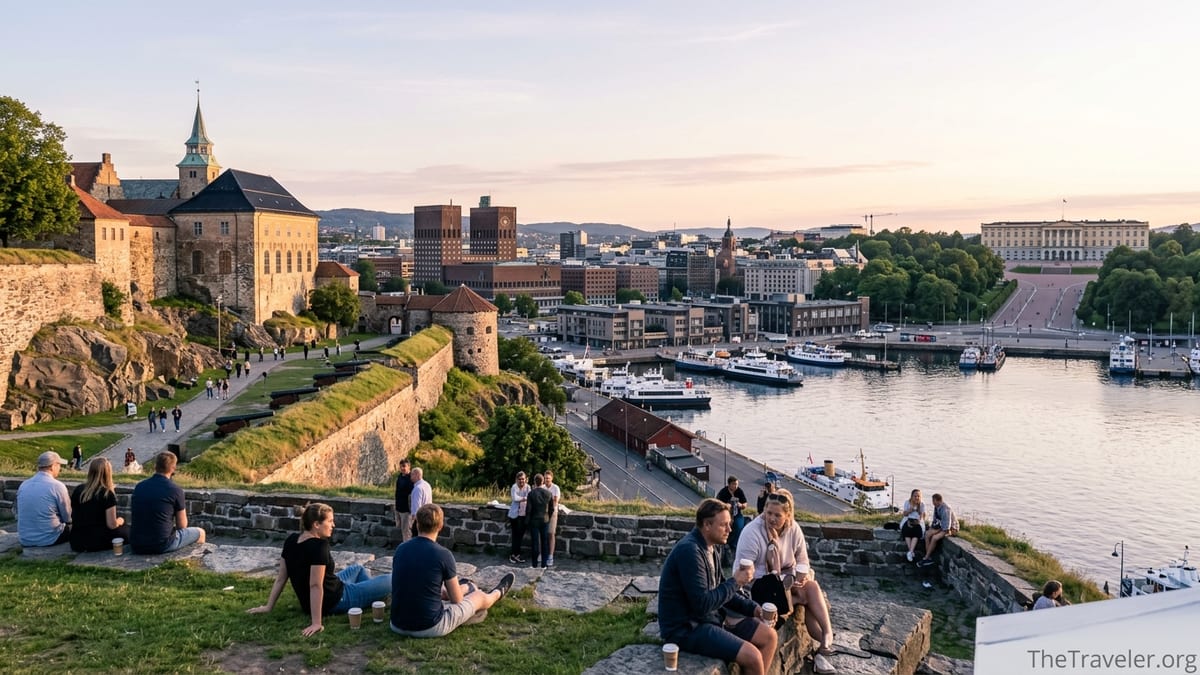
In practice, travelers experience Akershus as a spread-out outdoor historic landscape with ramparts, courtyards, museums and harbor views, while the Royal Palace is more formal: manicured parkland, ceremonial guards, and, in summer, timed interior tours. Both are central, both are icons of Norway’s history, but they deliver very different moods and activities.
Thinking about them this way helps with planning. If you imagine wandering an old fortified town, peering through stone embrasures at the water and dipping into a war museum, you are picturing Akershus. If you imagine a stately building framed by lawns, a changing of the guard, and a glimpse into royal reception rooms, you are thinking of the Royal Palace.
Location, Access and Cost: What Your Day Really Looks Like
Akershus Fortress lies between the City Hall waterfront and the modern Bjørvika district. From Oslo Central Station it is about a 15-minute walk: you pass the Opera House, cross into the historic harbor front and then climb gently up into the fortress. Several city trams and buses stop close by, but in reality most visitors arrive on foot from Aker Brygge, the City Hall, cruise ship piers, or the Opera House. The outer fortress grounds are free to enter and are typically open from early morning until evening, although exact gate hours can vary slightly by season.
The Royal Palace sits on a hill at the western end of Karl Johans gate, Oslo’s main boulevard. From the Central Station it is also about 15 minutes on foot along a mostly flat, pedestrian-friendly route past the Parliament and National Theatre. The surrounding Slottsparken gardens are open year-round and free. The famous daily changing of the guard happens outside the palace at around 13:30, and crowds start forming 10 to 15 minutes before. Interior tours run only in summer, typically from late June to mid-August, and must usually be booked in advance through official ticket outlets or the Oslo Visitor Centre.
Cost is a key difference if you hope to see interiors. Walking the Akershus grounds is free, but entering Akershus Castle or museums like the Norwegian Resistance Museum requires a ticket. As of 2025, adult entry prices are typically in the range of 120 to 150 NOK for the castle or individual museums, with discounts for students and children, and some inclusions with the Oslo Pass. The Royal Palace’s interior tours are guided only and often cost a similar amount per adult, again with reductions for children and possible Oslo Pass benefits, but there are no self-guided options inside.
Atmosphere and Story: Medieval Stronghold vs Living Monarchy
Standing on the ramparts at Akershus, it is easy to imagine watchmen scanning the fjord for enemy ships. The core of the fortress dates back to the late 13th century, when King Håkon V chose the rocky promontory as a defensive site. Over time it became a royal residence, a Renaissance castle, and later a notorious prison. During the Second World War it was occupied by the Germans and used for executions, which is one reason the Norwegian Resistance Museum inside the walls leaves such a strong impression on visitors.
Today, that layered history creates a contemplative mood. You might see children on school outings playing by cannons, locals jogging the paths, and small groups quietly reading memorial plaques. Parts of the complex are still used by the Norwegian armed forces, which adds to the sense that this is not just a relic but a working site. The views across the harbor to Bygdøy and the sailing ships below are among the best in central Oslo, especially around sunset on clear days.
The Royal Palace tells a different story: the development of Norway as a constitutional monarchy in the 19th and 20th centuries. Built for King Charles XIV John, it presides over the city’s main avenue, symbolizing modern statehood more than medieval warfare. The atmosphere in Slottsparken is relaxed and almost surprisingly informal. Locals picnic on the grass, office workers cut through the park on their commute, and joggers circle the lawns, all within a few meters of the royal residence.
The presence of His Majesty the King’s Guard, with their feather-plumed hats and ceremonial drills, injects a sense of pageantry. When you join the crowd for the changing of the guard, you are taking part in a living ritual, not just peering into the past. On summer tours you step through state rooms that are still used for official receptions, which can feel more like visiting a working embassy than an empty palace museum.
What You Actually See and Do at Each Site
At Akershus, most visitors follow a loosely circular route. After entering through the main gate, you climb past thick stone walls to the outer ramparts, where you can look down over ferries and harbor promenades. Many people linger here with takeaway coffee from nearby waterfront cafés. Continuing inward, you reach courtyards lined with brick and stone buildings, some housing offices, others the castle entrance or museums. The Resistance Museum, for example, uses photographs, personal objects and recreated rooms to tell the story of occupation and resistance; travelers often report spending an hour or more inside despite expecting a quick visit.
Inside Akershus Castle itself, guided by simple signage, you move through vaulted halls, the royal chapel, banquet rooms and the crypt where members of Norway’s royal family are entombed. Interpretive panels, usually in Norwegian and English, explain how the building shifted from medieval keep to Renaissance residence. A small café operates seasonally inside the fortress, and in good weather you might end up sitting on the grass with locals between bastions. In summer, some walking tours of Oslo include Akershus as a major stop on World War II or city history routes, which can be a convenient way to gain context.
At the Royal Palace, your core experiences are more structured. Outside, you can freely explore the gardens, approach the front square, and observe the guards. Many visitors time their arrival for the 13:30 changing of the guard, a short ceremony involving marching, music on some days, and precise drills. Around national holidays or royal events, the area can be particularly lively, with flags and occasional parades along Karl Johans gate.
If you visit in summer and book an interior tour, expect a strictly timed, roughly one-hour guided visit in small groups. You pass through reception halls, the banquet dining room, and sometimes the palace chapel, while guides explain royal traditions, artwork and the role of the monarchy today. Photography rules can be strict inside, so be prepared to simply look and listen. Because tours are only offered for a limited window each year and often sell out on popular dates, travelers who strongly value interior access should plan their Oslo itinerary around this if the palace is a priority.
Practicalities: Time of Day, Season and Mobility
Season and daylight drastically shape these experiences. In summer, Akershus becomes a popular evening hangout thanks to the long Nordic light. It can be a beautiful place to unwind after a day of sightseeing, especially if you pick up food from the nearby Aker Brygge restaurants and bring it up to the grass by the walls. In winter, when daylight is short and weather can be icy, the exposed ramparts may feel bleak, though snow on the stonework can be atmospheric. The Royal Palace, by contrast, offers a similar atmosphere year-round outside: Slottsparken’s trees change with the seasons, from spring blossoms to golden autumn leaves, but the basic stroll is the same.
Weather also affects your decision if you have mobility or stamina considerations. Akershus involves more uneven surfaces, cobblestones, and slopes. Some inner courtyards and rampart paths may be challenging for travelers with limited mobility or small children in strollers, especially in wet or icy conditions. The Royal Palace approach from Karl Johans gate is mostly paved and gently sloping, and the surrounding lawns offer plenty of benches. However, interior tours at both sites involve stairs and extended standing, so travelers with accessibility needs should confirm current arrangements with each site before visiting.
Time of day can tip the balance. For example, if your ship docks at Oslo Cruise Terminal in the morning and you have only four or five hours, Akershus is extremely convenient: you can walk up, explore at your own pace, and adjust how long you spend based on your energy. You could then continue along the waterfront or back into the city center without worrying about a specific start time. If your schedule allows you to be at the Royal Palace around early afternoon, combining a relaxed walk up Karl Johans gate with the 13:30 guard change and a loop through Slottsparken makes for a low-stress, photogenic couple of hours.
Which Site Fits Different Types of Travelers?
For history enthusiasts, especially those interested in medieval and wartime history, Akershus Fortress usually ranks higher. Its story spans royal politics, sieges, occupation and resistance. The chance to see thick defensive walls, Renaissance halls and the powerful exhibits of the Resistance Museum in one compact area is hard to match. A traveler who enjoyed sites like the Tower of London or Prague Castle, and who prefers self-paced exploration with occasional museum stops, will feel at home at Akershus.
For visitors most interested in modern Norwegian society, symbolism and everyday city life, the Royal Palace has the edge. Slottsparken is woven into Oslo’s daily routines, and the Palace itself is a living seat of constitutional monarchy. Travelers who enjoy watching guard ceremonies at Buckingham Palace or the changing of the guard in Stockholm often appreciate Oslo’s more relaxed version, where the crowd is smaller and the atmosphere less commercialized. Families with young children frequently find the soldiers and marching band more engaging than museum exhibits.
Short-stay visitors and cruise passengers often ask which single site delivers the most “Oslo” in limited time. If your main image of Oslo is the fjord, the new Opera House, and historic harbor, Akershus frames those views perfectly and can be easily combined with a waterfront walk and a visit to the City Hall. If your mental picture is of a capital boulevard rising to a palace, Scandinavian flags and city parks, the Royal Palace fits better, especially when combined with shopping or dining along Karl Johans gate.
Budget-conscious travelers should factor in how much they value interiors. If you are content with exterior impressions, the Royal Palace and its park are excellent completely free activities. Akershus grounds are also free, but many people find it hard to skip the Resistance Museum once they are on-site. For someone traveling with a family of four, choosing between multiple paid museum entries at Akershus and a single palace tour could make a noticeable difference to the day’s budget.
How to Combine Both in One Efficient Itinerary
With smart planning, you do not have to choose. On a full day in Oslo, an efficient route can comfortably include both Akershus Fortress and the Royal Palace without feeling rushed. One common pattern is to start the day near the water. After breakfast, you walk from the Central Station to the Opera House, continue along the harbor promenade toward Aker Brygge, then detour up into Akershus around mid-morning. You spend one to two hours exploring the ramparts, courtyards and, if you wish, the Resistance Museum or castle interior.
After leaving the fortress, you can have lunch at one of the waterfront restaurants in Aker Brygge or at casual spots around the City Hall, many of which offer reasonably priced lunch specials compared to Norwegian dinner prices. From City Hall Square, you then cut uphill through side streets or follow the echo of trams to Karl Johans gate. A relaxed 10-minute walk brings you to the base of the Palace hill in time to find a spot for the 13:30 changing of the guard. This sequence uses the natural geography of the city, so you are rarely backtracking.
In the afternoon, you can stroll through Slottsparken’s winding paths, loop around to the back of the Palace where the atmosphere is quieter, and then drift back down Karl Johans gate, stopping at the National Theatre, Oslo Cathedral or cafés along the way. If you have secured a timed summer tour inside the Royal Palace, you would simply adjust the schedule so that you are at the palace for your booking and move the guard ceremony or Akershus earlier or later. The key idea is that both sites anchor an easy, mostly flat walking route through Oslo’s greatest hits.
Travelers staying several days in the city might separate the visits. For example, one day could be dedicated to “fjord and fortress,” pairing Akershus with the Opera House and a ferry ride to Bygdøy museums. Another day could focus on “city and monarchy,” linking the Palace with the National Museum, Parliament and shopping along Karl Johans gate. Thinking in themes helps avoid museum fatigue and lets each site’s story stand out clearly in your memory.
The Takeaway
If you can only choose one, let your interests be the guide. Choose Akershus Fortress if you are drawn to medieval walls, wartime stories, panoramic harbor views and the freedom to wander at your own pace. It is especially rewarding for travelers who like to mix significant history with relaxed outdoor time and do not mind a bit of uphill walking over stone and grass.
Choose the Royal Palace if you are curious about modern Norway’s monarchy, enjoy ceremonial guard displays and want to experience a royal residence that is deeply integrated into everyday city life. It suits visitors who prefer gentle strolling through parkland, people-watching along a grand boulevard, and, in summer, a structured glimpse inside working state rooms.
For many travelers, the best answer is not either-or, but both. Akershus and the Royal Palace are close enough in distance yet far enough apart in character that visiting each reveals a different side of Oslo. Whether you arrive by overnight train, budget airline or cruise ship, a well-planned day linking fortress and palace will leave you with a rounded sense of Norway’s journey from medieval stronghold to modern constitutional monarchy.
FAQ
Q1. If I only have half a day in Oslo, should I prioritize Akershus Fortress or the Royal Palace?
If you have just a few hours and arrive near the harbor, Akershus Fortress usually offers more variety in a compact area: historic fortifications, museum options and excellent fjord views, all without needing to book timed tickets. The Royal Palace is better if you specifically want to see the changing of the guard and enjoy a relaxed park setting at the end of Karl Johans gate.
Q2. Can I visit both Akershus Fortress and the Royal Palace in one day without rushing?
Yes. With a full day you can comfortably walk from the Central Station to Akershus in the morning, explore for one to two hours, then continue via City Hall and Karl Johans gate to reach the Royal Palace for the 13:30 changing of the guard. Add time in Slottsparken and optional interiors, and you still have margin for café stops and photos.
Q3. Are the fortress and the palace suitable for young children?
Both can work well for families, but in different ways. Akershus offers open space to run, cannons to look at and walls to explore, though parents need to supervise near drops and uneven paths. The Royal Palace and Slottsparken are gentler for strollers, and the guard change is often a highlight for kids who enjoy uniforms and marching, but interior tours involve a lot of standing and listening.
Q4. How expensive is it to visit these sites?
Walking the grounds at both Akershus Fortress and the Royal Palace park is free. Costs arise if you choose interiors. Entry to Akershus Castle and on-site museums is typically in the low to mid hundreds of Norwegian kroner per adult, while guided summer tours inside the Royal Palace are usually in a similar price band. Exact prices can change, so it is wise to check current rates shortly before your trip.
Q5. Do I need to book tickets in advance?
For the fortress grounds and Royal Palace park you do not. For interior access, advance booking is strongly recommended for the Royal Palace summer tours, which are at set times and often sell out on peak days. Akershus Castle and its museums generally allow same-day ticket purchase at the door, but during busy summer weekends popular time slots can be crowded.
Q6. Which site is better in bad weather?
In heavy rain, strong wind or very cold conditions, the more exposed ramparts at Akershus can feel harsh, and paths may be slippery. On such days, many travelers prefer the Royal Palace area, where the walk from the city center is shorter and more sheltered and where you can combine the visit with nearby indoor attractions such as the National Museum or cafés along Karl Johans gate.
Q7. How accessible are Akershus Fortress and the Royal Palace for visitors with limited mobility?
The Royal Palace approach from Karl Johans gate and the surrounding park paths are generally smoother and less steep than the stone and cobbled surfaces at Akershus. The fortress includes slopes, uneven ground and some stairs, which can be challenging. Both sites’ interior tours may involve staircases and standing. Travelers with mobility concerns should review up-to-date accessibility information and consider focusing more of their time on Slottsparken and the palace surroundings.
Q8. Can I see a guard ceremony at both sites?
The most visible and predictable ceremony is the daily changing of the guard outside the Royal Palace, usually taking place around 13:30. Akershus also has guards and, at times, smaller movements of soldiers, but these are less formalized as visitor spectacles. If a guard ceremony is important to you, you should plan around the palace schedule.
Q9. Is it worth paying to go inside if I am on a tight budget?
If money is tight, you can have a satisfying experience by sticking to free exteriors: walk the Akershus walls and courtyards, then enjoy Slottsparken and palace views from outside. Paying to go inside adds depth. At Akershus, interiors and the Resistance Museum bring the long history into focus. At the Royal Palace, the guided tour lets you see state rooms still used today. Whether that is worth the cost depends on how much you value detailed historical interpretation versus general impressions.
Q10. Which site offers better photo opportunities?
For wide city and fjord landscapes, Akershus Fortress usually wins, with elevated viewpoints over the harbor, islands and modern waterfront architecture. For classic capital-city images of a grand avenue rising toward a royal residence, the Royal Palace excels, especially when framed with trees or crowds gathering for the guard change. Many photographers visit both, using Akershus for dramatic vistas and the palace for people-focused, street-level shots.