


Oslo Airport Gardermoen sits around 45 kilometers north of central Oslo, and getting into the city is straightforward but rarely cheap. Two options dominate most visitors’ choices: the Airport Express Train, Flytoget, and the various airport buses often branded as Flybussen or airport coaches. Both will get you downtown without much hassle, but they differ in speed, price, comfort, and how close they get you to your actual hotel. This guide breaks down the real-world pros and cons of Flytoget versus the airport bus in 2026 so you can pick the option that makes the most sense for your trip and budget.
Get the latest updates straight to your inbox!
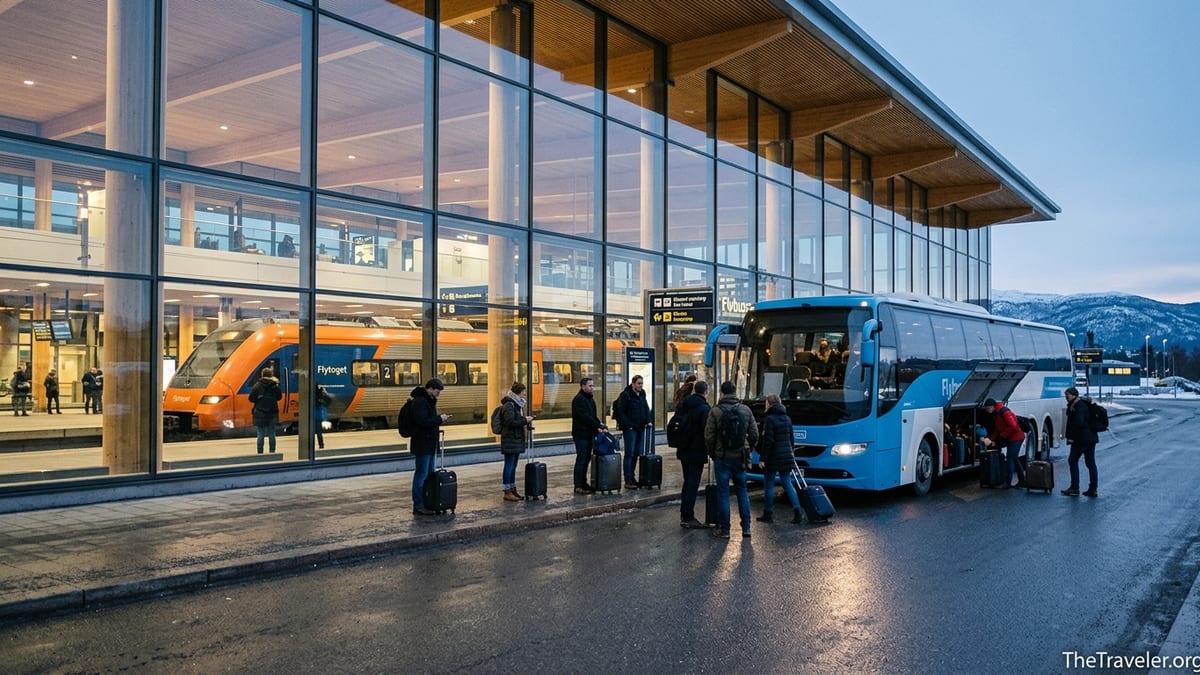
What Flytoget and the Airport Bus Actually Are
Flytoget is Oslo’s dedicated airport express train. It runs on the Gardermoen high-speed rail line directly from the station beneath the terminal at Oslo Airport Gardermoen to Oslo Central Station (Oslo S) and, on many departures, further to Nationaltheatret in the western city center. Travel time to Oslo S is typically around 19 to 22 minutes. Trains run roughly every 10 minutes during the day, tapering to less frequent services early morning and late at night. Tickets can be bought in the Flytoget app, at machines in the arrivals hall, or directly at the platform.
The airport buses are long-distance coaches that connect Gardermoen with different parts of Oslo and nearby suburbs. Several brands operate, but many routes are marketed as Flybussen or Airport Express Coach. Instead of going only to Oslo Central Station, these buses run to Oslo Bus Terminal and then on to neighborhoods like Majorstuen, Storo, and various business districts, often stopping outside or very near major hotels. Typical travel time into central Oslo is around 45 to 60 minutes, depending on route and traffic.
There is also a third player in the background: regular Vy trains on the same railway line that Flytoget uses, as well as local Ruter buses. For this article, however, the focus stays on the classic visitor dilemma: pay more for very fast Flytoget or save a bit and get a seat on the airport bus that drops you closer to your bed for the night.
Both Flytoget and the airport buses are designed with travelers in mind. That means luggage racks, clear signage in English, card payments, and staff or drivers who are used to visitors that may be jet lagged and slightly confused. You do not need to speak Norwegian or know the city to use either option comfortably on your first visit.
Price Check in 2026: What You Actually Pay
By Scandinavian standards, Flytoget is not cheap, but it is priced as a premium express service rather than basic public transport. In early 2026, a standard adult one-way ticket from Oslo Airport to Oslo S on Flytoget is typically in the region of 230 to 250 NOK, with many sources quoting around 243 NOK for a single adult. Children often travel free with a paying adult on Flytoget up to a certain age, which can noticeably change the math for families.
Airport buses are usually slightly cheaper, but not dramatically so. A typical adult one-way fare into central Oslo on a Flybussen or similar coach is commonly around 200 to 230 NOK, depending on the exact route and whether you buy in advance or on board. Some deals or advance-purchase discounts can trim that a bit, but in most realistic scenarios you are saving perhaps 20 to 40 NOK per person compared with Flytoget, not half the price.
To illustrate, imagine two solo travelers landing within minutes of each other. One buys a Flytoget ticket to Oslo S for roughly 240 NOK and arrives in the center in under 25 minutes. The other hops on an airport coach to Oslo Bus Terminal for around 210 NOK, arriving perhaps 45 to 55 minutes later. The bus passenger has saved roughly the price of a coffee and pastry in Oslo, in exchange for doubling journey time.
Where price differences become more meaningful is for groups and families. A family of four with two children who qualify for free travel on Flytoget might pay for just two adult tickets on the train, closing the gap with or even undercutting what they would pay on the bus, where child discounts tend to be smaller and less generous. On the flip side, a group of budget-conscious adults staying near a specific hotel that the bus stops outside may decide the slightly lower price and door-step convenience are worth the extra half hour.
Speed and Frequency: When Time Really Matters
In terms of speed, Flytoget clearly wins. The journey time of about 19 minutes from Gardermoen to Oslo S is one of the main selling points of the service. The train runs on a dedicated high-speed line that avoids traffic and, in normal conditions, keeps time very reliably. During the main part of the day you can expect a departure roughly every 10 minutes, which means that even if you have just missed one, the wait is rarely longer than the time it takes to buy a coffee.
Airport buses take roughly 45 to 60 minutes to reach central Oslo, depending on traffic and the number of intermediate stops. They are especially vulnerable to rush-hour congestion on the E6 motorway and the approach roads into the city. If your flight lands around 16:00 on a weekday, it is common to spend the first part of the bus journey crawling through traffic. Most bus routes advertise departures about every 20 to 30 minutes, though frequencies can vary by time of day and day of the week.
Consider a traveler arriving from New York on a morning flight scheduled to land at 09:30. They clear passport control quickly and reach the arrivals hall at 10:00. If they take Flytoget, they may be sitting at a café by Oslo S around 10:30. If they choose the bus, arrival in the center might be closer to 11:00 or a bit later, especially if there is weekday traffic. For business travelers trying to make a late-morning meeting or tourists hoping to maximize a short city break, that half hour can make a noticeable difference.
Late at night, frequency becomes more important than outright speed. Flytoget generally stops running not long after 01:00, and there have been repeated Norwegian media reports about passengers who land after the last train and find themselves dependent on crowded late-night buses or very expensive taxis. For flights scheduled to land after midnight, it is wise to check the exact last departure for both the train and the relevant bus route on your travel date and to have a backup plan in case of delays.
Where You End Up: City-Center Access and Hotel Convenience
Flytoget’s main city stop is Oslo Central Station, which is attached to the large Jernbanetorget hub. From there, virtually every tram, metro (T-bane), and many city buses fan out across Oslo. For travelers staying in neighborhoods like Grünerløkka, Tøyen, or the Barcode district, a short tram or metro ride from Oslo S is efficient and predictable. If your hotel is just south of the central station in the Barcode or Bjørvika area, you can often walk from the platform to your lobby in 10 minutes or less.
On many departures, Flytoget continues beyond Oslo S to Nationaltheatret station in the western city center. This is handy for hotels around Karl Johans gate, Aker Brygge, and the government district. If you are staying at a large chain hotel near Nationaltheatret or in the business-heavy Vika area, taking Flytoget to that station means you emerge effectively in the middle of the action with only a few minutes’ walk to many properties.
Airport buses, by contrast, tend to deliver what could be called “front-door value.” Several routes swing by major hotel clusters, stopping near places like Radisson Blu Scandinavia at Holbergs plass, hotels in Bislett and Storo, or properties in the Helsfyr business district. For travelers with heavy luggage, families with strollers, or anyone with mobility challenges, a bus that drops you right by your hotel can easily beat the combination of Flytoget plus a tram or metro transfer.
As a practical example, imagine you are staying at a conference hotel in the Helsfyr area, a few kilometers east of the city center. Flytoget would bring you quickly to Oslo S, but you would then need to find the correct metro line, ride a few stops, and navigate from the station to your hotel. An airport bus on a route that includes Helsfyr can be slower overall, yet far simpler: sit down at the airport, store your suitcase, get off when the driver announces your stop, and walk straight into your hotel lobby.
Comfort, Luggage, and Onboard Experience
Flytoget’s trains feel much like modern, well-kept intercity trains. They have wide doors, level boarding from platform to carriage, and generous overhead racks as well as luggage areas near the doors. Seats are comfortably padded, and many travelers comment on the quiet ride and smooth acceleration of the express. The interior layout is straightforward, with a central aisle and two-by-two seating, making it easy to maneuver with a suitcase.
Airport buses are modern coaches with high-backed seats, large windows, and dedicated luggage compartments under the floor. You usually store bigger suitcases in these compartments before boarding and keep smaller bags and backpacks with you inside. The seats are often very comfortable for the 45 to 60-minute journey, but the ride can be bumpier or more stop-start, especially when traffic is heavy or the route includes several hotel stops.
For travelers with large amounts of luggage, both options work, but in slightly different ways. On Flytoget, you roll everything directly onto the platform and into the train, keeping it in sight in the luggage racks. On the bus, you will likely hand your main suitcase to the driver or place it in the underfloor hold. This is generally safe and standard practice, but some travelers prefer the peace of mind of keeping their bags near them on the train, especially when they are carrying expensive equipment such as camera gear or musical instruments.
In terms of ambiance, the train often feels more “business traveler” in character, with a mix of commuters and visitors quietly using laptops or phones. The bus can feel more relaxed and social, with families, tour groups, and locals headed to and from the airport. Both options usually offer Wi‑Fi and power outlets, though the quality of the connection can vary and should not be relied upon for critical work tasks.
Reliability, Disruptions, and Late-Night Risks
Flytoget is generally considered very reliable. The high-speed rail line was built specifically to connect Oslo to Gardermoen, and punctuality is usually strong. However, even this system is not immune to disruptions. In late 2025, for instance, a serious incident near Kløfta station led to a full stoppage on the line north of Oslo, causing Flytoget and other trains to be cancelled for several hours and forcing passengers to switch to buses or taxis. Such events are rare, but they are a reminder that no mode of transport is guaranteed.
Airport buses can be more vulnerable to everyday disruptions such as winter weather, road construction, or routine rush-hour congestion. Snow and ice can slow traffic significantly, and while Norway is well equipped for winter conditions, heavy snowfall or accidents on the E6 can turn a 45-minute run into an hour or more. On the other hand, buses can be more flexible than trains in responding to specific issues on the rail network, as operators can reroute around certain problems or add extra departures when trains are affected.
A particular risk window to keep in mind is late at night and very early morning. Norwegian media and local travelers repeatedly highlight the problem of arriving after the last train and finding that the first buses leaving the airport fill quickly. Once both the last Flytoget and the final scheduled airport bus have departed, options shrink dramatically, sometimes leaving passengers facing taxi fares in the thousands of kroner even for relatively short rides to nearby hotels.
If your flight schedule puts you into Gardermoen after midnight or close to the end of regular services, planning ahead is crucial. Check the timetable for your specific travel date a day or two before departure, and consider booking an airport hotel if you land after 01:00, especially in winter when delays are more common. The cost of a short taxi hop to an airport hotel and a train or bus into the city the next morning can easily be less than an emergency late-night taxi all the way into Oslo.
Who Should Choose Flytoget, and Who Is Better Off on the Bus
For many travelers, Flytoget is the default recommendation. If you value speed, simplicity, and predictable arrival times, and you are staying near Oslo S or Nationaltheatret, the airport express train is usually worth the extra kroner. Business travelers on tight schedules, solo travelers arriving during rush hour, and visitors on short weekend breaks commonly find that the time saved getting into the city is more valuable than the small cash saving a bus might offer.
The bus starts to make more sense when your hotel location, luggage situation, or budget tips the scales. If your accommodation is directly on an airport bus route and the coach stops almost outside the door, it can be more comfortable and less stressful to stay on the bus than to drag large suitcases across platforms and through crowded trams. Budget travelers staying in areas like Helsfyr, Bislett, or Storo sometimes prefer the bus because it combines reasonable price with point-to-point convenience.
Families should run a quick calculation rather than assuming the bus is cheaper. Because Flytoget offers generous child policies on many tickets, a family of four might find that the total cost of the express train is similar to or even lower than the bus, especially once they factor in an extra tram ticket from the bus terminal if their hotel is not immediately nearby. Meanwhile, a solo backpacker with all their belongings in one rucksack might gladly sit an extra 20 or 30 minutes on the bus to save enough for a meal in town.
Finally, if you are nervous about using public transport or traveling with someone who has mobility issues, consider the total journey rather than just the airport-to-city leg. Sometimes the train plus a short taxi from Oslo S to your hotel is the smoothest solution. Other times, the bus dropping you close to the hotel lobby means you avoid both the complexity of transfers and the cost of a city-center taxi.
Practical Booking Tips and Real-World Scenarios
In practice, most travelers decide between Flytoget and the bus when they are already at the airport. You can follow signs from the arrivals hall either down to the train station directly beneath the terminal or out to the coach stands in front of the arrivals area. Ticket machines for Flytoget are located just before the escalators down to the platforms, and they accept major credit and debit cards. Airport bus tickets can be purchased from machines, in apps, or often directly from the driver with card payment.
Booking in advance is not strictly necessary for either option, but it can bring small advantages. Some operators offer modest discounts for tickets purchased ahead of time, and having the ticket ready on your phone means one less thing to worry about when you are tired after a long flight. For example, a traveler landing from London in the early evening might buy their Flytoget ticket in the app while waiting at the baggage carousel, then walk straight onto the first departing train without stopping at a machine.
On the other hand, flexibility can matter more than a small discount. Flight delays are common in winter, and buying a bus departure at a fixed time could lock you into a ticket you cannot realistically use if your plane gets stuck de-icing or in a holding pattern. Many travelers prefer flexible tickets valid on any departure on a given day, whether that is with Flytoget or an airport coach, so they can simply take the first available service once they are through arrivals.
It is also worth combining tools. For example, an early-morning business traveler might ride Flytoget into Oslo S to ensure a fast, reliable arrival, then use a public Ruter ticket on local trams and buses for meetings around the city. A budget-conscious visitor leaving on a midday flight might take a regular Vy train back to the airport from Oslo S and use savings compared with Flytoget to cover lunch at the terminal. The key is not treating the airport transfer as a one-size-fits-all product, but as part of an overall transport strategy during your stay.
The Takeaway
The contest between Flytoget and the airport bus from Oslo Gardermoen is less about which one is objectively “better” and more about which one suits your specific trip. Flytoget is fast, frequent, and very straightforward if you are heading to or from central Oslo or the western downtown area. Prices are on the high side but predictable, and for many visitors the 20 minutes saved compared with the bus are worth the premium, especially on short visits or business trips.
The airport buses, in contrast, trade pure speed for a mix of slightly lower fares and greater geographic reach inside the city. They are especially appealing if they drop you right outside your hotel, if you are carrying bulky luggage, or if you simply enjoy settling into a coach seat and watching the suburbs roll by as you ease into the city. Their main weaknesses are vulnerability to traffic, longer travel times, and potential late-night crowding when services are limited.
To decide, look at three factors together: your arrival time, your hotel’s location, and who you are traveling with. Early-morning or daytime arrival, hotel near Oslo S or Nationaltheatret, traveling solo or as a couple: Flytoget usually makes more sense. Late arrival, hotel on a bus route, traveling with heavy bags or young children: the airport bus can come into its own. And if your flight lands uncomfortably close to the end of scheduled services, consider an airport hotel and a train or bus into the city the next morning to avoid the risk of a very costly taxi.
Oslo’s airport connections are among the better ones in Europe, and whether you choose Flytoget or the bus, you are likely to find a clean, efficient, and relatively stress-free ride. With a little planning around time, cost, and convenience, you can step off your flight and into the Norwegian capital in the way that fits you best.
FAQ
Q1. Is Flytoget really worth the extra money compared with the airport bus?
For many travelers, yes. Flytoget is roughly twice as fast as the bus into central Oslo and runs very frequently, so if you value time and a smooth ride more than saving a few dozen kroner, it is usually worth paying the premium. If your budget is tight or the bus stops directly outside your hotel, the bus can still be the smarter overall choice.
Q2. How much does Flytoget cost from Oslo Airport to the city center in 2026?
As of 2026, a typical adult one-way ticket from Gardermoen to Oslo Central Station on Flytoget is generally in the low to mid-200s NOK, often quoted around 230 to 250 NOK. Exact prices can vary slightly over time, so it is wise to check just before you travel, but you can plan on paying in that approximate range.
Q3. How long does the airport bus take compared with Flytoget?
Under normal conditions, Flytoget takes about 19 to 22 minutes from Oslo Airport to Oslo Central Station. Airport buses usually take around 45 to 60 minutes, depending on route, time of day, and traffic. During rush hour or in winter weather, the bus can be slower, while the train time is usually stable unless there is a specific rail disruption.
Q4. Which option is better if my hotel is not near Oslo Central Station?
If your hotel is not within easy walking distance of Oslo S or Nationaltheatret, compare the total journey, including transfers. Often Flytoget plus a short tram, metro, or even a brief taxi ride still makes sense, especially if you want to minimize time. However, if an airport bus stops very close to your hotel, taking the coach can be more convenient and may save you from handling luggage on local public transport.
Q5. Do I need to book Flytoget or the airport bus in advance?
You generally do not have to book either service ahead of time, as they are designed to handle walk-up passengers. Buying tickets in advance through apps or websites can sometimes bring small discounts and saves time at the airport, but it also slightly reduces flexibility if your flight is delayed. Many travelers are comfortable buying tickets on arrival, especially during the day when services are frequent.
Q6. What is the best option for families with children?
Families should compare total cost and convenience rather than assuming the bus is cheaper. Because Flytoget often lets children travel free with a paying adult up to a certain age, a family of four might pay for only two adult tickets on the train. That can narrow or erase the price difference with the bus, while still giving you a faster and more straightforward trip into the city.
Q7. How late do Flytoget and the airport buses run at night?
Flytoget typically runs from early morning until shortly after 01:00, though exact times vary by day and season. Airport buses also operate late, but frequencies are usually lower overnight, and some routes have limited departures. If your flight is scheduled to land around or after midnight, always check the last departures for both services on your specific travel date and consider an airport hotel if the timing is tight.
Q8. What happens if there is a disruption on the train line?
Serious disruptions on the rail line are uncommon but do happen, for example due to technical failures or incidents on the track. In those cases, Flytoget and the regular Vy trains can be cancelled or heavily delayed, and passengers are often advised to use replacement buses or regular coaches. If you see warnings about problems on the Gardermoen rail line on the day of travel, the airport bus may be the more reliable option that day.
Q9. Is there space for large luggage or sports equipment?
Both Flytoget and the airport buses are set up for travelers with luggage. Flytoget has dedicated racks at carriage ends and overhead storage for smaller bags, while buses have underfloor luggage holds for suitcases and bulky items. If you are carrying very large sports equipment or fragile items, many travelers prefer the train because they can keep their belongings in sight in the carriage rather than in the bus’s external luggage compartment.
Q10. If I am on a tight budget, what is the cheapest way into Oslo?
If you are extremely budget-conscious, neither Flytoget nor the airport bus is the absolute cheapest option. Regular Vy trains on the same rail line can be significantly cheaper than Flytoget while still reasonably fast, and local public transport tickets from Ruter can offer good value if you combine the airport leg with city travel. However, between just Flytoget and the airport bus, the bus usually edges out the train on price by a small margin, at the cost of a longer journey.