


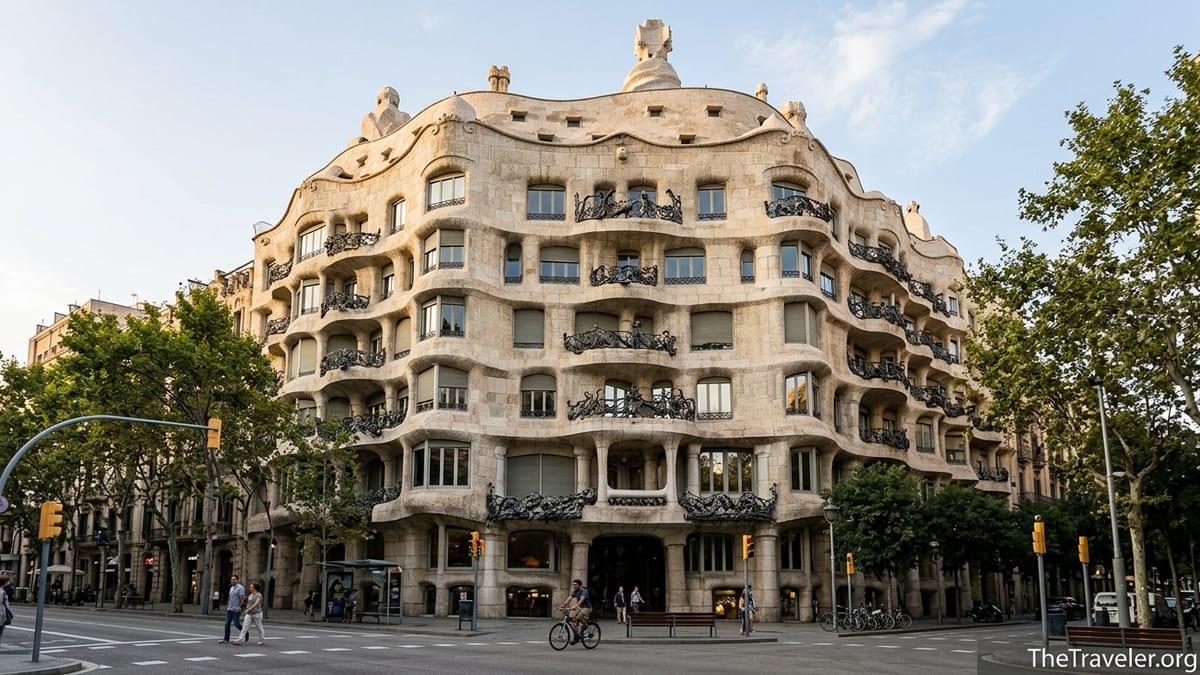
Walk up Barcelona’s Passeig de Gràcia and the city’s elegant grid suddenly ripples and bends. Where you might expect a stately stone mansion, you find instead a building that looks as if it has been carved by wind and waves. This is La Pedrera, or Casa Milà, Antoni Gaudí’s last great residential work and one of the most fascinating buildings in Barcelona for travelers who want to see how radical design can completely reimagine everyday city life.
Get the latest updates straight to your inbox!
From Controversial Quarry to World Heritage Icon
When construction began on Casa Milà in 1906, locals were not impressed. The building’s rough, irregular limestone earned it the nickname “La Pedrera,” meaning “the stone quarry,” and newspapers mocked its strange curves and fortress-like roof. Yet this same daring approach is exactly what makes it a standout today. Instead of a flat façade in line with the Eixample district’s rational grid, Gaudí wrapped the corner plot in undulating stone and flowing wrought iron, breaking with the polite apartment blocks around it.
Gaudí designed La Pedrera as a luxury apartment house for the industrialist Pere Milà and his wife Roser Segimon, with an opulent home for the couple and rental apartments around two vast interior courtyards. Built between 1906 and about 1912 on what was then Barcelona’s most fashionable avenue, it was Gaudí’s final residential project before he devoted himself fully to the Sagrada Família. Today, instead of scandal, it attracts long queues of visitors and is recognized as part of the “Works of Antoni Gaudí” UNESCO World Heritage listing.
Travelers experience this dramatic change in perception as soon as they step inside from Passeig de Gràcia. The same organic forms that once shocked early 20th century neighbors now feel visionary, echoing contemporary architecture that favors curves, light, and flexibility. A century after critics called for parts of it to be demolished, La Pedrera appears in guidebooks alongside icons like the Eiffel Tower and the Guggenheim Museum Bilbao as a must-see work of modern architecture.
For modern visitors, the building’s heritage status has practical benefits. Strict conservation rules keep the limestone façade, rooftop sculptures, and interiors well maintained, while the private foundation that runs the site channels ticket income into restoration and cultural projects. When you pay for a daytime “La Pedrera Essential” ticket or the popular “Night Experience,” you are not only touring a landmark but also helping preserve one of the most unusual apartment buildings ever constructed.
A Living Experiment in Structure and Light
One reason La Pedrera fascinates architects, engineers, and curious travelers alike is that it functions as a full-scale laboratory for structural innovation. Instead of relying on load-bearing exterior walls and thick interior partitions, Gaudí used a framework of stone pillars and metal beams that carry the weight of the building. This allowed for flexible floor plans, large windows, and apartments that could be reshaped over time, a radical concept in the 1910s and a clear precursor of modern open-plan living.
Visitors see these ideas in action in the attic, where a forest of more than 250 parabolic brick arches supports the roof. Walking through this space, now the Gaudí Interpretation Centre, feels like moving along the ribcage of a great stone animal. The arches are not decorative; they are pure structure, distributing loads efficiently while creating a surprisingly airy, almost skeletal space. Contemporary architects still cite this attic as a pioneering example of expressive structural design.
Light and ventilation were another obsession for Gaudí, and La Pedrera turns what could have been a dark urban block into a luminous interior world. Two large courtyards pierce the building, bringing daylight and fresh air to apartments that otherwise would only have façades on the street or interior side. The walls of these courtyards are painted in soft blues, yellows, and greens and decorated with murals that you can still admire from the staircases and gallery-level walkways as you follow the visitor route.
For travelers comparing Gaudí’s works across the city, this focus on light makes La Pedrera feel more livable than the dreamlike, almost theatrical Casa Batlló down the street. While Casa Batlló can feel like stepping into a fairy tale, La Pedrera reveals how Gaudí’s vision could be applied to everyday urban housing: apartments with cross-ventilation, varied room shapes, and windows oriented both to the street and to the inner patios, making them comfortable in Barcelona’s long, bright summers.
Organic Forms, Iron Seaweed, and a Moving Stone Façade
From the pavement of Passeig de Gràcia, the façade is what first stops passersby in their tracks. The stone does not run straight from one corner to the other but swells in and out in long waves that many visitors compare to a frozen sea. Large, irregular window openings cut into this surface, while hand-forged iron balconies twist and curl like seaweed or vines. Gaudí worked closely with ironworkers to develop these pieces, which were made from scrap metal and individually shaped to avoid repetition.
This organic approach was not simply aesthetic. Gaudí often said that straight lines belonged to humans and curved lines to God, and at La Pedrera the geometry recalls eroded cliffs, caves, and rocky coastlines of Catalonia. Travelers used to steel-and-glass skyscrapers are often surprised at how solid yet fluid the building feels. It seems to have grown rather than been assembled, a sensation strengthened when you notice that there is almost no applied ornament on the stone itself. The façade is powerful because of its shape and the interplay of light and shadow, not because of carved decoration.
Details reward close looking. At street level, the two monumental wrought iron and glass entrance gates open to the courtyards, visually linking street and interior. The stone around some openings appears to bulge outward, as if under the pressure of the space inside, emphasizing the building’s sense of volume. Even the windows were carefully engineered: at a time when large glass panes were difficult to produce, Gaudí combined smaller panes into gridded frames that graduate from smaller pieces near the base to larger ones higher up, maximizing light while reducing the risk of breakage.
The result is a façade that changes throughout the day. In the soft light of early morning, the limestone reads pale and chalky; by late afternoon, it warms to honey tones that contrast with the dark iron balconies. Travelers staying nearby often say that they enjoy walking past La Pedrera at different times just to watch how the textures shift with the sun and clouds. Unlike a flat-fronted building you glance at once, this one invites repeated, lingering looks.
Inside an Early 1900s Luxury Apartment
One of the most engaging parts of a visit, especially for travelers interested in social history, is the chance to step into a recreated early 20th century apartment. On one of the standard floors, the foundation has furnished an entire unit with period pieces: polished wooden furniture, curved doors, original mosaic and parquet floors, and custom handles and fixtures designed in Gaudí’s studio. Walking through the dining room, bedrooms, and tiled bathrooms, you get a concrete sense of how well-off Barcelonians might have lived a century ago.
Unlike some historic house museums that feel frozen in time, this apartment is integrated into a working building that still houses offices and private residences. As you look out the windows toward Passeig de Gràcia, you see the city’s modern traffic and boutiques, while behind you stand heavy wooden wardrobes and early appliances. It becomes easier to imagine the original tenants receiving guests in the salon, children playing in curved hallways, or servants moving between small interior rooms and balconies facing the courtyards.
Gaudí’s functional thinking is visible everywhere. Doorways and corridors widen or contract according to how spaces are used. Built-in storage follows the curves of walls, eliminating wasted corners. Even details such as the height of windowsills and the shape of door handles were reconsidered so they would feel comfortable in the hand or offer better views from a seated position. Travelers who have already toured Gaudí’s more religious or symbolic works often find this domestic scale refreshing, because it shows how deeply he cared about the daily experience of occupants.
For those planning a visit, the apartment provides one of the clearest opportunities for photography inside, with abundant natural light and thoughtful staging. Morning tickets often mean fewer people crowding the narrow corridors, which can make it easier to appreciate the craftsmanship of items such as the original radiators or the intricate floor patterns. Unlike the rooftop, which can feel exposed in midsummer, the apartment rooms offer a quieter, cooler perspective on Gaudí’s vision of urban comfort.
The Surreal Rooftop: Chimneys, Guardians, and City Views
La Pedrera’s roof terrace is one of the main reasons travelers describe the building as unforgettable. Instead of a flat, utilitarian surface, Gaudí created a sculptural landscape of chimneys, ventilation towers, and stair exits that twist and rise like helmeted sentries and abstract creatures. Many visitors compare the chimneys’ helmet shapes to medieval warriors, while others see them as masks or figures from a dream. Some are clad in broken ceramic and glass, others in rough stone, catching the light differently throughout the day.
Practically, these elements hide functional infrastructure. Each whimsical form corresponds to something technical: a chimney flue, a ventilation shaft, a rooftop stairwell. But Gaudí refused to separate engineering and art, so he transformed necessities into a walkable sculpture garden. As you climb the undulating stairs and ramps of the terrace, you are constantly rewarded with new angles on the forms and on the city beyond. The design also cleverly supports drainage and insulation, protecting the building below.
For travelers, the rooftop is one of Barcelona’s most memorable viewpoints. From here you look across the orderly grid of the Eixample toward the Sagrada Família cranes in one direction and the sea in the other. Sunset visits are particularly atmospheric: the stone sculptures glow in golden light while the city lights slowly come on. Many of the night tours time their rooftop segment to coincide with this change of light, sometimes adding subtle projections and a glass of cava to create more of an event.
Because the roof is exposed, conditions can affect your experience. In high summer, midday sun can be intense, and visitors often appreciate wearing hats and bringing water, both allowed in small quantities. In cooler months, the wind can be surprisingly strong as it moves around the chimneys. Stair sections can also be narrow, and the surface has some uneven steps, so flat shoes are recommended. These small logistical points matter because the rooftop is the climax of most tour routes; being comfortable makes it easier to linger and absorb the drama of the space.
Experiencing La Pedrera Today: Tickets, Tours, and Timing
La Pedrera functions both as a cultural monument and as the headquarters of a private foundation, so visiting it feels more like entering a living institution than a static museum. The official ticket categories are updated regularly, but typically include a basic daytime visit with audio guide, premium early-access or small-group options, and an evening “Night Experience” that combines a guided visit with audiovisual projections on the roof and a drink. Families often choose the daytime option for its flexibility, while couples may prefer the more atmospheric night format.
Buying tickets in advance through the official sales channels is strongly recommended, especially from April through October and around major holidays, when time slots can sell out. Same-day walk-up purchase is possible at the Passeig de Gràcia entrance, but travelers report queuing on the sidewalk during peak hours. Morning slots around opening time and late evening visits tend to be less crowded than mid-afternoon, when tour groups are most numerous, and they also offer softer, more flattering light for photography.
Ticket prices evolve over time, but as of mid 2026 a standard adult daytime ticket is typically in the range that many travelers would consider comparable to other major Gaudí sites, with reduced prices for children, students, and seniors. The Night Experience costs more but includes a guided tour and rooftop projection show. Combination options sometimes bundle La Pedrera with other cultural activities or temporary exhibitions housed in the building’s interior gallery spaces, which can be a good value if you already plan to spend several hours there.
Accessibility is better than at many historic sites. Elevators connect key levels, and staff are used to assisting visitors with reduced mobility. However, the rooftop remains challenging for some due to uneven surfaces and stairs, and in wet weather portions may be temporarily off-limits for safety. Security screening at the entrance is similar to that at many major European attractions, with bag checks and some limits on large backpacks or tripods. Allow a few extra minutes for this process so it does not cut into your timed entry window.
La Pedrera in the Context of Gaudí’s Barcelona
Part of what makes La Pedrera so fascinating is how it speaks to Gaudí’s broader evolution as an architect. When you place it alongside earlier works such as Casa Vicens and Palau Güell, you see a move away from more traditional ornament and historic references toward increasingly abstract, nature-inspired forms. By the time of La Pedrera, he was confident enough to leave the façade almost bare of decorative motifs, letting pure shape and light do most of the work.
For travelers trying to decide which Gaudí buildings to visit, La Pedrera offers a particularly clear view of his mature ideas about structure and daily life. The design of the apartments, the courtyards, and the circulation systems reveals how he thought about families, servants, and visitors moving through space over the course of a day. By contrast, the Sagrada Família focuses on religious symbolism and vertical awe, while Park Güell explores landscape and public space. Seen together, they form a multi-layered portrait of a city reinventing itself at the start of the 20th century.
La Pedrera’s location amplifies its impact. Standing at the junction of Passeig de Gràcia and Carrer de Provença, it occupies a prime corner of what was then the city’s newest, wealthiest district. Today, travelers often pair a visit here with a walk down Passeig de Gràcia to compare it with Casa Batlló and other Modernisme landmarks by Gaudí’s contemporaries. Moving from the colorful ceramic scales of Casa Batlló to the stone waves of La Pedrera helps you appreciate just how wide the stylistic range of this movement was.
The building’s continued use as a cultural venue also sets it apart. Temporary art exhibitions in the former garage or main floor salons, classical and jazz concerts on the rooftop in summer, and educational programs for local schools all keep La Pedrera connected to Barcelona’s daily life. For a traveler, catching a rooftop concert at dusk or a photography show in the interior galleries can turn a standard sightseeing stop into a more immersive cultural experience, deepening your sense of the building as a living, evolving place.
The Takeaway
La Pedrera is fascinating not only because it is beautiful or strange, but because it pushes so many boundaries at once. Structurally, it anticipates modern engineering with its free-plan floors and expressive attic arches. Aesthetically, it turns a residential block into a stone landscape inspired by sea and rock rather than classical columns or historic styles. Socially, it embodies a moment when Barcelona’s industrial wealth, artistic ambition, and urban growth were all peaking.
For travelers, what this means in practice is that a visit to La Pedrera offers multiple layers of experience. You can walk its rooftop for the views and surreal sculptures, linger in the courtyards to see how light filters down the painted walls, explore a recreated bourgeois apartment to imagine daily life in the 1910s, and study models and drawings in the attic to understand Gaudí’s technical experiments. Whether you spend an hour or half a day, it is difficult to leave without feeling that you have glimpsed both the mind of a singular architect and the spirit of a city that embraced, resisted, and ultimately celebrated his vision.
In a city full of striking architecture, La Pedrera stands out because it asks a simple but radical question that still resonates today: what if even the most ordinary building type, an apartment house on a city block, could become a work of art that changes how people live and see their surroundings. For anyone planning a trip to Barcelona and curious about how architecture can reshape everyday life, La Pedrera deserves a firm place on the itinerary.
FAQ
Q1. Where is La Pedrera located in Barcelona. La Pedrera, also known as Casa Milà, is on Passeig de Gràcia at the corner with Carrer de Provença in the Eixample district, a central and easily accessible area.
Q2. Why is it called La Pedrera. The nickname “La Pedrera,” meaning “the stone quarry,” was originally a joking reference to its rough, irregular stone façade, which many locals found shocking when it was built.
Q3. Do people still live in La Pedrera. Yes, although much of the building is open to visitors, La Pedrera remains a mixed-use property with offices and some private residences alongside museum and exhibition spaces.
Q4. How long should I plan for a visit. Most visitors spend between 90 minutes and two hours exploring the courtyards, the recreated apartment, the attic exhibition, and the rooftop, longer if there is a temporary show.
Q5. Is La Pedrera suitable for children. Many families find La Pedrera engaging for children thanks to the rooftop sculptures and the apartment rooms, though parents should supervise closely on the roof’s uneven steps and ramps.
Q6. What is the best time of day to visit. Early morning offers fewer crowds and gentle light, while late afternoon and evening visits provide warm sunset views from the rooftop and a more atmospheric experience.
Q7. Is the rooftop accessible to everyone. The building has elevators and is generally accessible, but the rooftop includes stairs and uneven surfaces, so it can be challenging for visitors with reduced mobility or balance issues.
Q8. Can I visit La Pedrera without a guided tour. Yes, standard daytime tickets typically include an audio guide, allowing you to explore at your own pace, while optional guided tours and night experiences provide additional commentary.
Q9. Are photos allowed inside La Pedrera. Photography for personal use is generally allowed in most areas, including the rooftop and the recreated apartment, though tripods and professional equipment are usually restricted.
Q10. How does La Pedrera compare to Casa Batlló. La Pedrera emphasizes structure, space, and stone forms, with a more subdued palette, while Casa Batlló is more colorful and fantastical; many travelers enjoy visiting both to see different sides of Gaudí’s work.