


Ask almost anyone in Barcelona where to meet and there is one answer you will hear again and again: “Plaça de Catalunya.” This busy, wedge-shaped square, where the medieval city meets the modern Eixample, functions as Barcelona’s default rendezvous point, a place where airport buses arrive, walking tours begin, protests gather and friends say “see you under the big clock.” Understanding why Plaça de Catalunya holds this role is the key to understanding how Barcelona itself works.
Get the latest updates straight to your inbox!
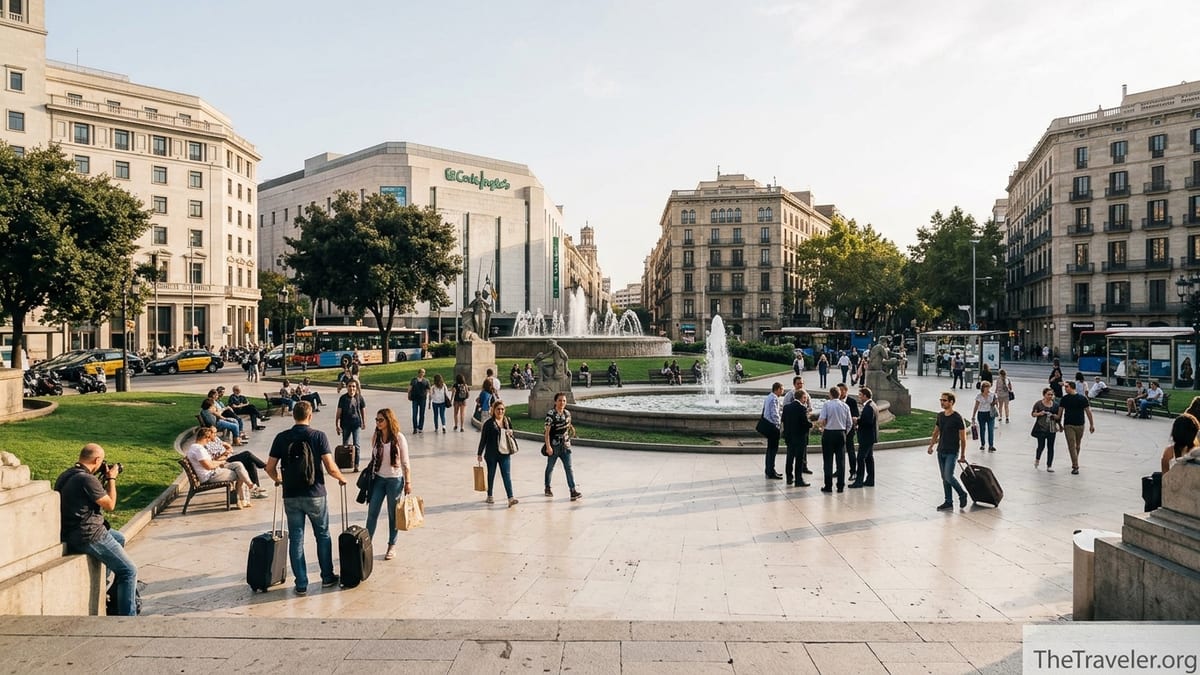
The Geographic Heart Where Old and New Barcelona Meet
Stand in the middle of Plaça de Catalunya and you can see, in a single slow turn, the story of Barcelona’s growth. To the south, streets like Portal de l’Angel and La Rambla pull you toward the Gothic Quarter and the old port, a dense tangle of medieval alleys. To the north, the long, straight lines of Passeig de Gràcia and Rambla de Catalunya lead into the Eixample, the 19th century grid that houses Modernista landmarks like Casa Batlló and La Pedrera. That meeting of eras is exactly why the square became the city’s de facto center.
The square itself, roughly 30,000 square meters in area, was laid out in the late 19th and early 20th centuries as planners stitched together the old walled city with Ildefons Cerdà’s new grid. It was never just another plaza, but a deliberate hinge: a space that would symbolically and physically connect merchants in the Gothic Quarter with the new bourgeois boulevard of Passeig de Gràcia. Today, visitors feel this immediately when they cross from the shade of Barri Gòtic’s narrow lanes into the open, light-filled space of the square.
For practical purposes, this meeting of old and new makes Plaça de Catalunya the most logical starting point for exploring the city. Most guided walking tours, from Gothic Quarter history walks to Gaudí architecture routes, use the square or its immediate surroundings as a collection point. A typical first-morning plan for visitors staying anywhere central is to walk up to Plaça de Catalunya, grab a coffee from a cafe facing the fountains, and then fan out: one friend down La Rambla to the Boqueria Market, another up Passeig de Gràcia toward Gaudí, agreeing to meet back “by the big fountain at six.”
Local life mirrors this pattern. Office workers from the Eixample and students from the University of Barcelona regularly choose the square as a neutral, midpoint rendezvous, especially if half the group lives near the old town and the other half farther north. Because so many of the city’s main streets radiate from here, nobody feels like they have drawn the short straw in terms of distance or convenience.
Barcelona’s Most Connected Transport Hub
If Plaça de Catalunya is the city’s geographic heart, its transport connections supply the lifeblood. Directly beneath the paving stones lies one of Barcelona’s busiest rail complexes, with metro lines, suburban trains and regional services converging in a tangle of tunnels and platforms. At street level, it is the terminus for key airport and interurban buses, as well as urban bus lines that fan out across the metropolitan area.
Arriving passengers quickly learn that the Aerobús airport shuttle, the option many first-time visitors choose, runs direct from both terminals to Plaça de Catalunya, with a typical journey taking around 30 to 40 minutes depending on traffic. Recent 2026 information places a single ticket in the mid-single-digit euro range, making it a relatively affordable express link for solo travelers who want a simple “no thinking” route into town. The buses set down just in front of El Corte Inglés, so it is common to see travelers stepping off with suitcases, orienting themselves under the department store’s facade before walking on to their hotels in the Gothic Quarter or Eixample.
Underground, the Catalunya station gives access to metro lines L1 and L3, along with FGC suburban lines that reach out toward the Vallès region. Commuters stream up from these platforms every rush hour, filling the square with a tide of people heading in all directions. For someone staying near Plaça d’Espanya or Sants station, getting to a concert or dinner near Plaça de Catalunya typically involves one quick metro ride, often without changing lines, which is one more reason locals instinctively suggest the square when organizing group meetups.
Urban bus lines, including those that run along Gran Via, Ronda de la Universitat and Ronda de Sant Pere, stop on the edges of the square and link it to neighborhoods that are less well served by the metro. Visitors may first notice this when catching a daytime bus toward the beaches at Barceloneta or toward Gràcia; residents experience it every day as a dense mesh of options that, in practice, make Plaça de Catalunya feel “one ride away” from almost anywhere in the city. The result is that the square is often the beginning or end of a journey, which reinforces its status as a natural meeting point.
A Crossroads of Shopping, Cafés and Everyday Errands
One of the reasons people keep coming back to Plaça de Catalunya is simple: almost everything a city-dweller or traveler needs can be found within a few minutes’ walk. On one side of the square stands a major El Corte Inglés department store, a familiar landmark for anyone who travels in Spain. Locals might drop in after work to pick up a small appliance, try cosmetics, or buy a last-minute birthday gift. Travelers, meanwhile, use it as a one-stop solution for adapters, extra clothing layers and picnic supplies.
Not far away, international brands cluster along Portal de l’Angel, a pedestrian shopping street descending toward the cathedral, while Passeig de Gràcia hosts luxury boutiques, flagship fashion stores and design-led Spanish brands. In practice, this means that a Barcelonan organizing a Saturday afternoon of errands can say “Let’s meet in Plaça de Catalunya at five” and know that everyone can combine the social gathering with a quick stop at FNAC for a book or at a phone store for a new SIM card.
Cafés and casual dining options deepen this pattern. Around the perimeter of the square and on nearby streets, you will find chains and independent spots serving everything from takeaway espresso to sit-down menus del día. The terrace cafe on one of the upper floors of El Corte Inglés, for example, has become an informal vantage point for both locals and visitors, who line up for a coffee or light lunch partly for the elevated view over the fountains and statues below. Travel writers often recommend it as an easy way to get your bearings on arrival day, and residents use it as an accessible meeting place with grandparents or friends who may not want to navigate steep streets.
For tourists, this combination of services and scenery is especially useful on changeover days. A common real-world example is the traveler who must check out of their hotel by late morning but only flies later in the afternoon. Many will store their luggage at lockers just off the square, have lunch on a nearby terrace, do some last-minute shopping on Portal de l’Angel and then catch the Aerobús back to the airport, all without ever moving far from Plaça de Catalunya.
A Stage for Celebrations, Demonstrations and Shared Emotion
Plaça de Catalunya is not just a place to change buses or browse shop windows. It is also one of Barcelona’s principal stages for public emotion. While political demonstrations often assemble in Plaça Sant Jaume, in front of the Catalan Government and City Hall, large rallies and marches routinely spill toward or through Plaça de Catalunya because of its capacity and its visibility. On weekends, it is common to come across groups with banners or small protests occupying a corner of the square, watched by passersby on their way to meet friends.
Sporting triumphs and national celebrations have also washed through the square. When FC Barcelona win major trophies, crowds gather along nearby streets and overflow toward Plaça de Catalunya, turning it into an impromptu carnival ground of flags, car horns and chants. On New Year’s Eve, while some people head to Avinguda Maria Cristina near Montjuïc for the official fireworks, many groups of friends still choose to meet near Plaça de Catalunya first, using it as a central assembly point before deciding where to continue the night.
Travelers may experience this more quietly in the form of cultural events and seasonal installations. Around Christmas, for example, the streets radiating from the square glow with lights, and temporary markets and performances often set up in the surrounding area. Families might decide to meet “by the central fountain” before walking together to admire window displays or to ride a temporary carousel set up for the holidays. For someone arriving off the metro into this scene, it becomes immediately clear why the square functions as a shared living room for the city.
Even on ordinary days, the sense of the square as a stage is palpable. Street performers stake out regular positions on nearby stretches of La Rambla and Portal de l’Angel, tourists pose near the fountains or statues for photos they will send home, and local teenagers meet in groups at the edges of the lawns, sitting in circles to talk or practice skateboard tricks. For a visitor sitting on a bench, watching these overlapping micro-events can feel like attending a constantly changing performance about contemporary Barcelona.
Orientation Point and Psychological Anchor for Visitors
First-time visitors to Barcelona often describe feeling anchored by Plaça de Catalunya in a city that can otherwise feel like a maze of diagonals and twisting alleys. Many hotel websites and rental listings reference the square in their directions: “ten minutes’ walk from Plaça de Catalunya” or “two metro stops from Catalunya on L1.” Once travelers identify it on a map, they use it as a reference point, tracing walking routes with the thought, “as long as I can get back to the square, I won’t get lost.”
In practical terms, this translates into real-world habits. A couple staying in El Born might spend a morning in the Picasso Museum, then walk back toward Plaça de Catalunya to regroup, grab a drink and decide on afternoon plans. Solo travelers who feel uncertain about exploring at night often take the metro back to Catalunya station first, knowing that from there the routes to La Rambla, the Gothic Quarter and most central hotels are well lit and busy late into the evening.
Many guided services reinforce this psychological role by using the square as the default starting point. Free walking tours commonly meet just off the square, under specific lampposts or in front of prominent hotels, instructing participants to “look for the green umbrella near Plaça de Catalunya.” Airport transfer companies that operate shared shuttles routinely offer drop-off or pick-up points around the square for guests whose accommodation is in pedestrian-only areas, telling them to walk the last few minutes from there.
Because Plaça de Catalunya feels busier and more surveilled than a smaller, darker side street, visitors often perceive it as a safer fallback location if they feel disoriented or uncomfortable somewhere else. A traveler out late in a nearby bar might keep in mind that official black-and-yellow taxis circle the area and that night buses start or pass close by, making “I’ll just get back to Plaça de Catalunya and decide from there” a manageable plan.
Design, Statues and Green Space in the Middle of the Rush
Although it functions as a transit machine and shopping crossroads, Plaça de Catalunya is also an aesthetic environment, with fountains, sculptures and soft landscaping offering brief respite from the surrounding traffic. Several statues by notable artists stand within the square, some representing allegorical figures and others notable Catalan personalities, giving the plaza a sense of cultural depth that rewards slow wandering as well as hurried crossings.
In the warmer months, the fountains provide not only a visual focal point but also a cooling effect, their spray catching the light in the afternoon while children lean against the railings and couples pause for photos. The square’s lawns and tree-lined edges, though not expansive, create patches of shade where people can sit on benches to eat takeaway sandwiches or scroll through messages while waiting for friends. For office workers in nearby buildings, a quick lunchtime walk around the perimeter of the square can feel like a brief escape into a shared urban garden.
From an urban design perspective, the square manages a complex choreography: wide pedestrian areas, crossing points, and slightly raised planting beds organize movement without excessive barriers. This allows thousands of people an hour to traverse the space, meet friends, watch performances or simply sit, without the square breaking into chaotic congestion. Visitors might notice how, even at peak times, there is usually a spot to pause near a statue or under a tree where you can consult a map without feeling in the way.
For photographers and content creators, the visual mix of historic facades, modern storefronts, fountains and constant motion provides almost endless material. Many travel blogs and social media posts about Barcelona include at least one angle on Plaça de Catalunya, often taken at “blue hour” when the sky softens and the square’s lights reflect in the water. That combination of recognizability and lived-in detail underlines why it remains such a potent symbol of the city.
The Takeaway
Plaça de Catalunya’s status as one of Barcelona’s most important meeting points is not an accident. It results from its unique position at the seam between the old city and the Eixample, from a dense concentration of transport links and services, and from its role as a stage for public life. For people who live in Barcelona, it functions as a neutral ground where districts converge, errands are combined with coffees, and events large and small pass through.
For visitors, the square very quickly becomes both a compass and a comfort zone: the place where the airport bus drops you off, where you join a walking tour, where you decide which neighborhood to explore next. As Barcelona continues to evolve, adding new tram lines, redeveloping other squares and experimenting with “superblock” traffic-calming plans, Plaça de Catalunya’s essential role seems unlikely to fade. It will remain the place where you say, almost without thinking, “Let’s meet in the square,” trusting that everyone will know exactly which one you mean.
FAQ
Q1. Why is Plaça de Catalunya considered Barcelona’s main meeting point?
It sits between the Gothic Quarter and the Eixample, concentrates key metro, bus and airport links, and is surrounded by shops and cafés, so it is convenient for almost everyone.
Q2. How do I get from Barcelona airport to Plaça de Catalunya?
The Aerobús shuttle runs from both airport terminals to Plaça de Catalunya in about 30 to 40 minutes, and there are also metro and train options with easy connections nearby.
Q3. Is Plaça de Catalunya a good place to stay nearby for sightseeing?
Yes. Staying within a short walk gives quick access to the Gothic Quarter, Passeig de Gràcia, La Rambla and multiple transport lines, which simplifies most sightseeing plans.
Q4. Is the area around Plaça de Catalunya safe at night?
It is usually busy and well lit, with regular police presence and taxis, though visitors should still use normal big-city precautions and watch their belongings, especially in crowds.
Q5. What are some easy meeting landmarks in Plaça de Catalunya?
People often agree to meet by the main fountains, in front of El Corte Inglés, or near the entrances to major streets like La Rambla and Passeig de Gràcia.
Q6. Are there good views of the square from above?
Yes. Several nearby buildings have upper-floor cafés or terraces that overlook the square, which locals and visitors use as relaxed spots to enjoy the view.
Q7. Does Plaça de Catalunya host events or demonstrations?
It frequently serves as a gathering point or route for marches, celebrations and seasonal activities, so it is common to encounter events there on weekends or holidays.
Q8. Is Plaça de Catalunya family-friendly?
Families often use the square as a meeting and rest point, thanks to its open space, benches, fountains and proximity to shops, though children should be watched near traffic.
Q9. Can I easily reach other neighborhoods from Plaça de Catalunya by public transport?
Yes. Multiple metro lines, suburban trains and numerous bus routes connect the square with most areas of Barcelona and its surroundings.
Q10. What should I watch out for when visiting Plaça de Catalunya?
The main issues are pickpockets in crowded areas and heavy traffic on surrounding roads, so keep valuables secure and use designated crossings when moving around the square.