


Right in front of Florence’s cathedral, the Baptistery of San Giovanni is one of the city’s oldest and most venerated buildings, wrapped in green-and-white marble and crowned with glittering medieval mosaics. Yet many travelers, pressed for time between the Duomo dome climb, the Uffizi and a Tuscan day trip, wonder if going inside the baptistery is really worth a precious hour. In 2026, with restoration work ongoing but access fully possible, the answer depends less on sightseeing checklists and more on what kind of traveler you are and how you plan your day in Piazza del Duomo.
Get the latest updates straight to your inbox!
What Exactly Is the Baptistery of San Giovanni?
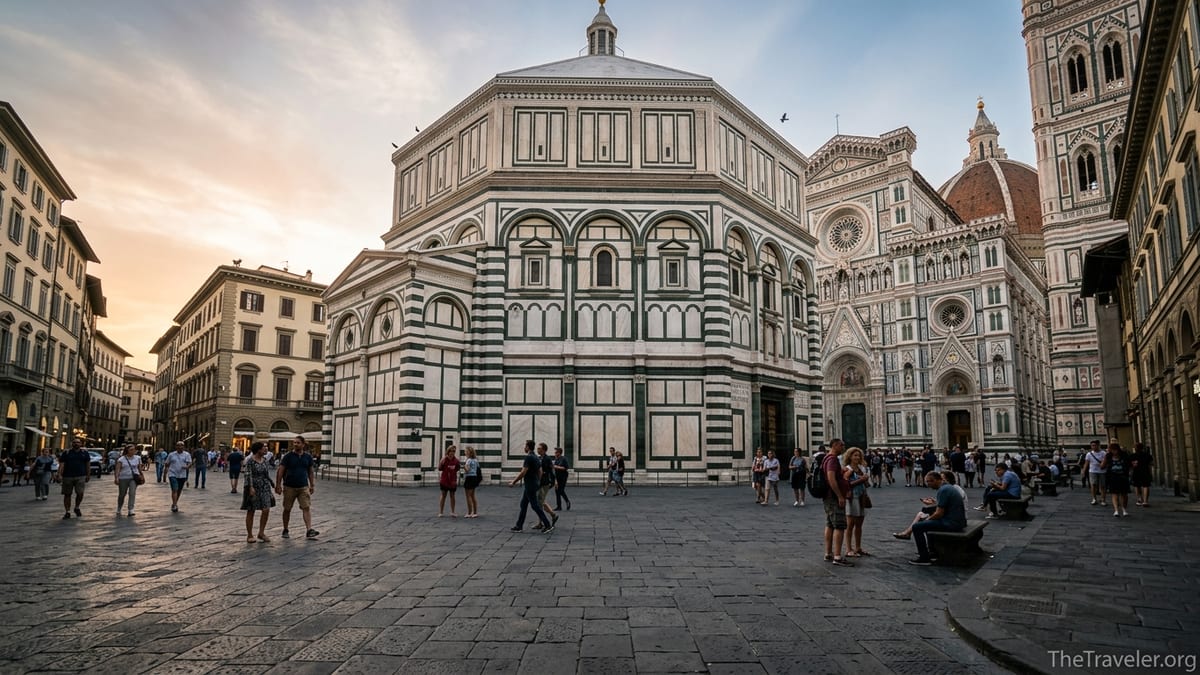
The Baptistery of San Giovanni sits in Piazza del Duomo, directly facing the west front of Florence Cathedral. From the outside, it appears as an elegant, compact, eight-sided structure clad in white Carrara and dark green Prato marble, harmonizing with the cathedral and Giotto’s bell tower. For centuries this building functioned as the city’s civic and spiritual heart, where generations of Florentines, including Dante Alighieri, were baptized. Today it forms part of the official Duomo complex, managed by the Opera di Santa Maria del Fiore, and you enter with a combined ticket that also covers several other monuments.
Step through the doors and you are standing inside a space that feels older and more solemn than the flamboyant Renaissance architecture around it. The interior is a single, high octagonal hall crowned by a mosaic-lined dome and ringed by marble columns and tomb slabs of prominent Florentine families. There are no side chapels, no aisles and no modern lighting gimmicks, just a dim golden glow from the mosaics, creating an atmosphere that many visitors describe as almost Byzantine. The building you see today dates mainly from the 11th to 13th centuries, layered over earlier structures that archaeologists are still piecing together.
Visiting the baptistery is therefore less about ticking off another ornate church and more about encountering a rare surviving medieval ritual space. It predates the cathedral opposite and tells the story of a city transitioning from a Roman and early Christian settlement into a powerful medieval republic. If your image of Florence is dominated by Renaissance names like Michelangelo and Brunelleschi, the baptistery shows you what came before them.
Highlights Inside: Mosaics, Marble and the Famous Doors
The single most compelling reason many travelers decide that the baptistery is worth their time is the interior mosaic decoration. The dome and upper walls are covered in 13th-century mosaics made of colored glass and gold, depicting scenes from the Last Judgment, the life of Christ, stories of John the Baptist and Old Testament narratives. A monumental figure of Christ dominates one section of the dome, surrounded by concentric bands of angels, saints and narrative scenes. Even if you have visited the mosaics in Ravenna or Venice’s San Marco, the sheer vertical drama of this octagonal dome often comes as a surprise.
As of 2026, these mosaics are in the middle of a multi-year conservation campaign. The large restoration scaffolding that had filled the interior a few years ago has been significantly refined, and the work is now concentrated on the vault mosaics themselves. For normal visitors on the floor, this means you will still see portions of scaffolding and technicians’ platforms, but the main bands of mosaics and the walls are visible and lit. The advantage is that the cleaning completed in earlier phases has already made many sections far brighter than they appeared a decade ago, giving a clearer impression of the original colors and gold shimmer.
On the ground level, look down as well as up. The patterned marble floor, made from local serpentinite and other stones, shows intricate geometric designs that have been studied and conserved in recent years. Wear is visible in places, but this patina is part of the building’s character. Around the walls you will also find medieval tomb slabs and dedicatory inscriptions, tangible reminders that the baptistery once stood within a cemetery ringed by sarcophagi. The baptismal font itself, which historically stood at the center, is now more modest than in medieval times but still marks the ritual focus of the space.
Outside, the three sets of bronze doors are another key highlight, though what you see on the baptistery today are high-quality replicas. The originals by Andrea Pisano and Lorenzo Ghiberti, including the celebrated “Gates of Paradise,” are displayed in the nearby Museo dell’Opera del Duomo for conservation reasons. Many travelers choose to view the replicas in situ to understand how the doors interact with the architecture, then visit the museum (usually on the same ticket) to examine the originals up close, with controlled lighting and explanatory displays. If you are interested in sculpture, this pairing of baptistery and museum makes the visit far more rewarding.
Practicalities in 2026: Tickets, Hours and Restoration Impact
In 2026, you cannot buy a standalone ticket only for the baptistery through the official Duomo system. Instead, you choose one of the combined passes, which typically range from around 15 to 30 euros for adults, depending on how many monuments and climbs they include. The passes that do not involve climbing the dome or bell tower tend to cost less and are ideal for travelers who want a lower-key but still in-depth visit focused on the baptistery and the excellent Museo dell’Opera del Duomo. Each pass is valid for three consecutive calendar days, allowing you to spread the included sites over several mornings or evenings.
Opening hours for the baptistery usually run from about 8:30 a.m. until the early evening, though closing times can shift slightly between seasons and on the first Sunday of the month, when an earlier closure is common. Because it is an active religious site, rare liturgical events may also affect access. The prudent approach is to check the Opera di Santa Maria del Fiore’s official visitor information page shortly before your trip and again the day before your planned visit, as the site posts temporary schedule changes and any maintenance-related closures there.
The ongoing restoration of the dome mosaics is the main factor affecting the current experience. When scaffolding filled most of the interior a few years ago, some visitors found the space underwhelming and suggested skipping the interior entirely and simply admiring the exterior and doors. As of 2026, enough of the scaffolding has been reconfigured that you now get a reasonably clear view of the main mosaic zones from the floor. However, scaffolding is still present and the uppermost parts of the dome may be partially obscured.
This situation comes with a silver lining. The Opera offers special guided visits that take small groups up into the restoration platforms themselves on select days, at a premium price point well above the basic ticket. Travelers who have taken these tours report that they are one of the most extraordinary art experiences in Florence, allowing you to stand eye-to-eye with the medieval mosaics and watch conservators at work. If you are an art history enthusiast or making a return trip to Florence, the existence of these limited tours can tilt the balance in favor of prioritizing the baptistery on your itinerary.
Who Will Find the Baptistery Most Worthwhile?
Whether the baptistery is worth visiting depends heavily on your interests. For travelers who love medieval art, religious history or architecture, the building is a cornerstone. If the mosaics in Venice’s San Marco or Rome’s early Christian churches fascinated you, the baptistery offers a Tuscan counterpart that shows how those traditions were adapted in Florence. The combination of glittering mosaics, Romanesque architecture and a relatively small footprint means you can absorb a great deal of visual information without the fatigue that often sets in during long museum visits.
Travelers with a deep interest in Dante and medieval Florence also tend to value the baptistery highly. It appears in his writings as the “bel San Giovanni,” and standing inside gives a concrete sense of the physical and spiritual world he inhabited. If you are reading the Divine Comedy on your trip or following a Dante-themed walk, the baptistery is not just another church interior but a narrative anchor, a place you can mentally connect to passages from the text.
On the other hand, first-time visitors with only one full day in Florence and a broad, general interest might find their time better spent elsewhere. For someone trying to balance the Uffizi, Accademia, a quick walk across the Ponte Vecchio and perhaps a dome or tower climb, adding a dedicated interior visit to the baptistery can feel like one stop too many. In that scenario, appreciating the building’s exterior and doors from Piazza del Duomo and allocating more time to the museum, where the original doors, sculptures and models of Brunelleschi’s dome are displayed, might be a smarter trade-off.
Families with younger children should consider attention spans. The baptistery is compact, and a focused visit can be completed in about 20 to 30 minutes, which works well if you frame it as a “treasure hunt” for specific images in the mosaics. But the solemn atmosphere and limited seating mean it is not a space for kids to run around, and the ongoing restoration may reduce the immediate “wow” factor for those not yet captivated by medieval art. Weigh this against alternatives like climbing Giotto’s bell tower, which provides a more physical and visually varied experience for energetic children and teenagers.
How Long to Allow and How to Combine It With Other Sights
Most independent travelers spend about 20 to 40 minutes inside the baptistery. If you are on a tight schedule or visiting with a combined Duomo pass, a realistic plan is to pair the baptistery with either the cathedral interior or the Museo dell’Opera del Duomo in a single time block. For example, you could enter the baptistery at around 9:00 a.m., when it often feels quietest, then cross the square to the museum for a deeper dive into the original doors and façade sculptures, finishing the whole combination by late morning.
If you have purchased a pass that includes a dome climb, it is worth considering how the baptistery fits into your energy budget for the day. Many travelers underestimate how demanding the dome or Giotto’s campanile can be, especially in summer heat. Doing the baptistery first, when you are still fresh and able to look up at the mosaics attentively, then taking a short break before your timed dome climb slot, often works better than trying to “squeeze in” the baptistery after ascending and descending hundreds of steps.
Some visitors schedule the baptistery for late afternoon, after the major museums have closed or as a quieter pre-dinner activity. The warm, slanting light in Piazza del Duomo at this time can make the exterior particularly photogenic, and the slightly thinner crowds often translate to a calmer interior experience. However, you need to verify closing times, as the baptistery does not stay open into the late evening, and an early closure on certain Sundays can catch people off guard.
If you are staying very close to the Duomo, perhaps in a hotel on Via dei Servi or Via del Proconsolo, you could even treat the baptistery as a short, contemplative break in your day rather than a major outing. In that case, visiting becomes less about maximizing sights and more about enjoying a rare atmospheric interior for a brief, focused interval.
Is It Worth It if You Are on a Budget or Short on Time?
For budget-conscious travelers, the key question is whether the share of your ticket price that you mentally assign to the baptistery justifies the time you will spend there. Because you cannot purchase a simple, low-cost single-entry ticket through the main system, the baptistery ride-alongs on a broader pass that also covers other monuments. If you were already planning to climb the dome or visit the museum, the marginal cost of adding the baptistery to your itinerary is effectively zero in euro terms. In that scenario, popping inside for 20 minutes is usually worth it, even if scaffolding partially obscures the dome.
The equation changes if your schedule is so tight that adding the baptistery will force you to skip another major site. For instance, if a half-hour here means you cannot make your timed entry at the Accademia or you will have to rush through the Uffizi, the trade-off is more debatable. First-time visitors who are not specifically interested in medieval Christian art may value Michelangelo’s “David” or Botticelli’s paintings more than a brief visit inside the baptistery, especially during a once-in-a-lifetime trip.
That said, even time-pressed travelers sometimes find the baptistery a useful “Plan B” when queues or weather disrupt other plans. If a sudden rain shower clears the cathedral square or your intended dome climb is delayed, using that window to step into the baptistery can salvage an otherwise frustrating hour. The compact interior, predictable security check and relatively straightforward entry process mean you are unlikely to lose much time in lines, especially if you arrive outside midday peak.
Remember also that the baptistery exterior and doors can be appreciated for free at any time. If budget is the overriding constraint, you can stand in Piazza del Duomo, examine the replica “Gates of Paradise,” circle the octagonal exterior and read up on the mosaics beforehand, gaining a good understanding of the monument even without going inside. This approach keeps your costs down while still connecting you to the baptistery’s story as you move through the square.
The Takeaway
In 2026, the Baptistery of San Giovanni is absolutely worth visiting for travelers with a strong interest in medieval art, religious history or the deep roots of Florence’s civic identity. The combination of glittering mosaics, solemn octagonal architecture and the knowledge that countless generations of Florentines were baptized here creates an experience that feels distinct from the Renaissance brilliance of the nearby cathedral dome. The ongoing restoration does introduce visual compromises, but it also brings a rare opportunity: small-group visits up into the conservation platforms for those willing to invest extra time and money.
If you are a first-time visitor with only a day or two in Florence and more general interests, the answer is more nuanced. The baptistery is compact and atmospheric, but it competes with some of Europe’s most famous museums and viewpoints. In that situation, treating the interior as a “nice to have” rather than a must-see, and instead making sure you at least appreciate the exterior and doors in passing, is a reasonable strategy. You can always deepen the experience with the Duomo museum, where the original bronze doors and major sculptures are preserved.
Ultimately, the baptistery rewards those who value depth over breadth. Even a short, quiet visit can serve as a counterpoint to the busier, more overtly spectacular sights around Piazza del Duomo, reminding you that Florence is not only the city of the Renaissance, but also of a much older spiritual tradition. If that side of the city speaks to you, then yes, the Baptistery of San Giovanni will almost certainly be worth your precious travel hour.
FAQ
Q1. How long does a typical visit inside the Baptistery of San Giovanni take?
A normal self-guided visit usually takes about 20 to 40 minutes. Art enthusiasts who spend time studying the mosaics in detail may want closer to an hour, especially if they are also photographing the floor patterns and reading any on-site explanatory panels.
Q2. Can I buy a ticket only for the baptistery?
Through the main Duomo ticketing system, access to the baptistery is bundled into combined passes that also include other monuments such as the cathedral museum, dome or bell tower. There is no widely available, official single-entry baptistery ticket, so most visitors enter on a multi-site pass valid over several days.
Q3. Are the famous “Gates of Paradise” doors original?
The gilded reliefs you see on the east side of the baptistery are high-quality replicas. The original 15th-century bronze panels by Lorenzo Ghiberti, along with the earlier doors by Andrea Pisano, are preserved and displayed in the nearby Museo dell’Opera del Duomo, where climate control and security are better suited to their conservation.
Q4. Is the interior badly affected by restoration work right now?
In 2026, restoration of the dome mosaics is ongoing, so some scaffolding and platforms are still present. However, much of the main mosaic decoration and the walls are visible from the floor, and earlier phases of cleaning have already brightened several zones. Expect some visual disruption, but not a completely obstructed interior.
Q5. When is the best time of day to visit the baptistery?
Early morning, shortly after opening, and late afternoon, about an hour before closing, are often the calmest times, with fewer tour groups and a softer light filtering through the windows. Midday can be busier, especially during peak season when large groups move through Piazza del Duomo.
Q6. Is the baptistery suitable for visitors with limited mobility?
The baptistery interior is on a single level, but the historic floor is uneven in places, and practical accessibility can vary. Before your visit it is wise to consult recent accessibility information provided by the Florence cathedral authorities or local tourism offices to confirm the current situation and any available support.
Q7. Can I take photos inside the baptistery?
Non-flash photography for personal use is generally allowed, but tripods, monopods and professional lighting equipment are restricted. Because policies can evolve and special events sometimes impose stricter rules, check posted signs at the entrance and follow staff instructions during your visit.
Q8. Does visiting the baptistery require a dress code?
Like most active religious sites in Italy, the baptistery expects modest attire. Shoulders and knees should be covered, and hats removed inside. While enforcement can vary day to day, dressing respectfully avoids any potential issues and is considered good practice when visiting churches in Florence.
Q9. Is it worth visiting the baptistery if I am already seeing the cathedral interior?
Yes, if your schedule allows. The cathedral interior is vast and largely painted, while the baptistery is smaller, older and dominated by mosaics and marble. Together they give a fuller picture of Florence’s religious art across centuries and show how the city’s spiritual center evolved over time.
Q10. How far in advance should I plan a visit to include the baptistery?
If you simply intend to enter with a standard combined ticket, purchasing a pass a few days in advance is usually enough outside the very busiest periods. If you hope to join a special small-group tour up into the restoration platforms, booking several weeks ahead is prudent, as those limited slots can sell out quickly in high season.