


Stepping into the Baptistery of San Giovanni in Florence is like walking into a jewel box of medieval marble and gold. This octagonal building facing the Duomo is one of the city’s oldest monuments and for centuries was the place where Florentines, including Dante, were baptized. For a first-time visitor, though, the mix of ticket options, rules, and crowds in Piazza del Duomo can be confusing. Understanding how the Baptistery works today will help you spend less time lining up and more time looking up at its famous mosaics.
Get the latest updates straight to your inbox!
Understanding Where the Baptistery Fits in the Duomo Complex
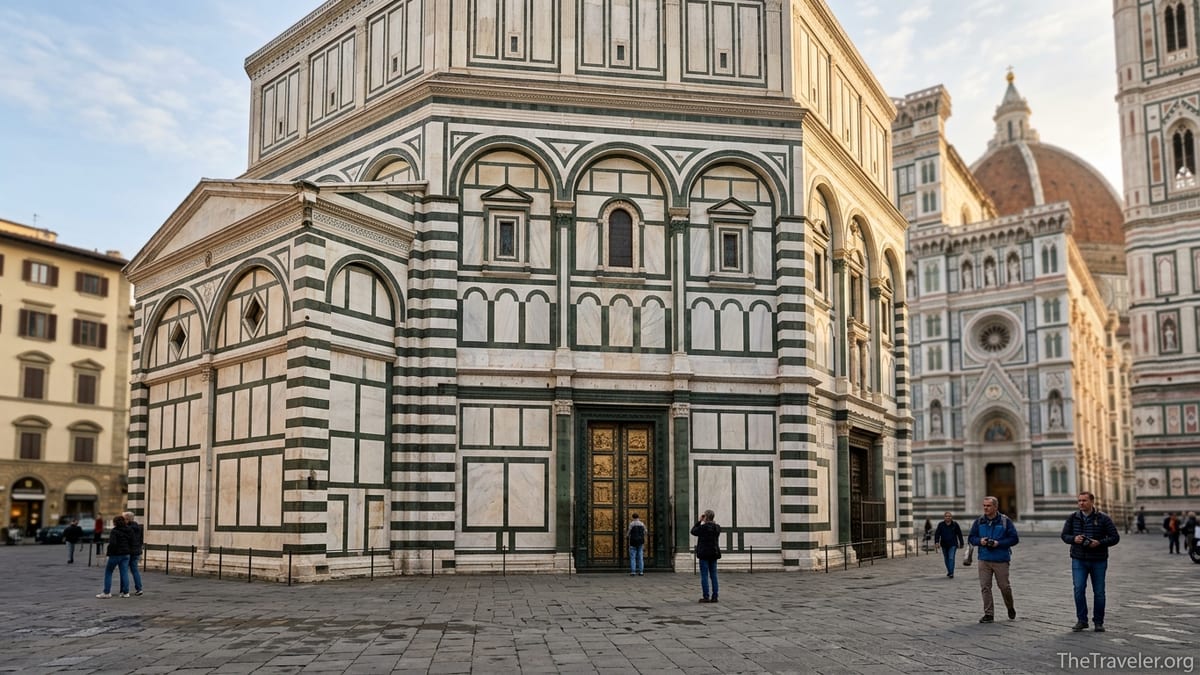
The Baptistery of San Giovanni stands directly opposite the main facade of Florence Cathedral in Piazza del Duomo. It is part of the same monumental complex as the cathedral (Santa Maria del Fiore), Brunelleschi’s Dome, Giotto’s Bell Tower, the crypt of Santa Reparata and the Opera del Duomo Museum, all overseen by the Opera di Santa Maria del Fiore. In practice, this means you do not visit the Baptistery as a stand-alone attraction but as one element in a larger system of timed tickets and shared rules.
Historically, the Baptistery is older than the cathedral. Its core dates back many centuries and it served as the city’s main baptismal site well into the modern era. When you stand in the middle of the octagonal space, you are in the room where generations of Florentines began their lives as Christians, surrounded by the same marble revetments and glittering mosaics they would have seen. This continuity of use explains why the site is run with a mix of museum-like regulations and church-like respect for worship.
For visitors, the most important point is that the Baptistery is managed together with the rest of the Duomo monuments. The same official ticket platform, luggage storage rules and dress code apply to the Baptistery as to the cathedral interior, even though you enter through its own doors on the square. If you are building an itinerary that includes the dome climb, bell tower, museum and Baptistery, treat them as a single ecosystem rather than separate stops scattered across the city.
This integrated management has a practical upside. Once you understand the basic structure of passes and regulations for the Duomo complex, you will know what to expect at every doorway in Piazza del Duomo, from the security checks at the cathedral to the bag rules at the Baptistery.
Tickets, Passes and How to Actually Get Inside
There is no single-entry ticket just for the Baptistery sold at the door. Access is through combined tickets for the Duomo complex that bundle several monuments together. At the time of writing, the most comprehensive option is the Brunelleschi Pass, which includes one entry each to Brunelleschi’s Dome, Giotto’s Bell Tower, the Baptistery, the Opera del Duomo Museum and the archaeological area of Santa Reparata under the cathedral. This pass is valid for several days from first use, which gives you some flexibility in planning.
Prices can change seasonally and are adjusted periodically, but in recent years the main Duomo passes have generally cost in the range of a few dozen euros per adult. Children usually benefit from reduced rates or free entry below a certain age when accompanied by an adult. For a typical family of two adults and two children, expect to budget roughly the cost of a simple restaurant lunch per person for access to the Baptistery plus the other main monuments over two or three days.
Many visitors buy their Duomo complex pass online in advance, especially in high season from late spring through early autumn. Booking ahead is essential for timed experiences like climbing the dome, where slots can sell out days before. While the Baptistery itself usually does not require a specific timeslot, your access is tied to the validity period of your pass, so it is still wise to have your ticket sorted before you arrive in Piazza del Duomo. If you prefer to buy in person, there is an official ticket office near the cathedral, but lines can be long on busy mornings.
Third-party ticket sellers and walking tour companies also offer packages that include Baptistery access. These often fold the official Duomo pass into a guided experience, sometimes at a premium. As an example, a small-group Duomo tour that includes the Baptistery, museum and a dome climb might cost roughly double the face value of the pass itself, but in exchange you get commentary, help navigating security and sometimes an earlier meeting time that helps you beat the worst queues. Whether this is worth it depends on your budget and how confident you feel managing logistics on your own.
Opening Hours, Closures and When to Go
The Baptistery’s schedule is similar but not identical to other Duomo monuments, and it can change for liturgical reasons. Typically it opens in the morning and remains accessible through much of the afternoon and early evening, with reduced hours on Sundays and possible interruptions for religious ceremonies, weddings or special events. Exact times are published by the Opera di Santa Maria del Fiore and are updated seasonally, so you should always check close to your travel dates rather than relying on a guidebook printed years ago.
In practice, visitors who turn up at 9 or 10 in the morning on a weekday usually find the Baptistery open, while those arriving late in the day sometimes run into early closures, especially in winter when the overall complex finishes earlier. As a rule of thumb, aim to visit before lunchtime or in mid-afternoon, leaving a margin in case the building needs to close temporarily. If your time in Florence is short and the Baptistery is a high priority, consider planning it for your first full morning rather than saving it for the end of the day.
Crowd levels in the Baptistery are very different from the open-air square outside. Piazza del Duomo can feel packed from late morning onwards, particularly between April and October, but the number of people allowed inside the Baptistery at one time is limited. Around opening time and during mid-afternoon lulls, you may find yourself with enough space to stand in the center and slowly turn under the dome without jostling, while peak late-morning times can feel more compressed.
Weather also affects your experience less here than at rooftop attractions like Brunelleschi’s Dome or Giotto’s Bell Tower. Even if it is raining or very hot, the Baptistery interior remains a cool, sheltered refuge. For that reason, many travelers sensibly shift tower or dome climbs to clear early mornings and reserve the Baptistery and museum for the hotter or wetter parts of the day.
Dress Code, Security and the Compulsory Luggage Storage
Although many visitors treat the Duomo complex as a cluster of tourist attractions, it is first and foremost a group of religious monuments. The dress code that applies inside the cathedral also applies when entering the Baptistery. Shoulders and knees should be covered for all genders, and very low-cut tops, bare midriffs and short shorts are likely to be considered inappropriate. In practice, a lightweight shirt or scarf over a sleeveless top and knee-length shorts or a skirt will usually be accepted.
Security has become more structured in recent years. All visitors to the Duomo complex are subject to checks before entering, and certain objects are prohibited. Knives, scissors and metal tools are not allowed, and large umbrellas or camera tripods are often refused as well. These rules are not unique to Florence but are part of a wider tightening of security around major monuments across Italy.
One rule that regularly surprises first-time visitors is the compulsory use of the official luggage storage for anyone holding a ticket to the Duomo complex who is carrying medium or large bags. The cloakroom is located at Piazza del Duomo 38/r, near the Opera del Duomo Museum. Visitors with suitcases, hiking backpacks or bulky bags must leave them there before entering any of the monuments, including the Baptistery. Smaller handbags and compact daypacks are usually allowed, but capacity and exact size tolerances can vary, so staff have discretion to ask you to check something in.
In practical terms, this means you should not arrive at the Baptistery straight from the train station dragging wheeled luggage and expect to go straight in. If you are checking out of a hotel and catching an afternoon train, either leave your baggage at the hotel until after your visit or build time into your schedule to use the official storage or a private left-luggage service near the station. The cloakroom itself is typically open from early morning into the evening, but you must retrieve your bags before it closes on the same day you deposited them.
What Not to Miss Inside: Mosaics, Marble and Doors
The great draw of the Baptistery interior is its extraordinary mosaic ceiling. When you first step inside, resist the urge to start taking photos immediately. Instead, move toward the center of the octagon, let your eyes adjust and then look up. You will see concentric bands of gold-ground mosaics rising to the dome, with an enormous figure of Christ in Majesty dominating one side and scenes from the Last Judgment, Genesis and the lives of Christ and John the Baptist unfolding around him.
Even if you are not a specialist in medieval art, certain details are easy to pick out. The row of expressive, almost cartoon-like devils tormenting the damned in the Last Judgment panel often captivates modern visitors, while the narrative scenes from Genesis include recognizable episodes like the creation of Adam and Eve and the building of Noah’s Ark. The glittering effect comes from tesserae of colored glass and gold leaf that catch the light differently as you move around the floor.
At eye level, the walls are covered in bands of green and white marble, a pattern that anticipates the famous striped exterior of the cathedral and bell tower. The floor is an intricate pavement of geometric marble inlays that can be slippery in wet weather, so watch your step, especially near roped-off areas. In the center stands the baptismal font, though the monumental octagonal font used for full-immersion baptisms has been moved to the nearby Opera del Duomo Museum, where you can see it in a quieter setting.
From the outside, the Baptistery is equally famous for its three sets of bronze doors. The most celebrated are the east doors facing the cathedral, known as the Gates of Paradise, with rectangular panels illustrating Old Testament scenes. Today, what you see on the Baptistery itself are high-quality replicas, while the meticulously restored originals are housed a short walk away in the Opera del Duomo Museum. For a complete experience, many travelers plan to visit the museum either right before or right after the Baptistery so they can compare the outdoor copies with the shimmering originals displayed indoors.
Practical Visiting Strategies for First-Timers
The Baptistery does not take long to walk through, but lingering makes a big difference. Most visitors spend between 15 and 30 minutes inside, yet those who stay closer to 45 minutes often describe a much richer experience, especially if they bring a short guide or audio tour. If you are using a Duomo complex app or renting an audio guide for the museum, check whether it includes a section on the Baptistery mosaics and floor. Having someone quietly explain, for example, why Christ’s figure is off-center in the dome can turn what looks like decoration into a story.
Photography is allowed for personal use but without flash. Tripods and large camera rigs are not permitted, in line with the rules across the complex. A practical approach is to take a few wide shots of the ceiling near the beginning of your visit, then put your phone or camera away for several minutes and simply look. Moving slowly around the perimeter, pausing at each bay, will give you a sense of how the iconographic program unfolds, from scenes of the patriarchs and prophets to depictions of Florence’s patron saint, John the Baptist.
If you are traveling with children, the Baptistery can be surprisingly engaging. Many families turn the ceiling into a kind of visual treasure hunt, asking younger visitors to find angels, animals or specific scenes. Because the space is compact and enclosed, it can feel less overwhelming than the vast expanse of the cathedral nave. Just be aware that voices carry easily, so it is important to keep conversation low and movement calm out of respect for the building’s religious character.
For travelers with mobility needs, the Baptistery interior is on a single level, but the historic floor can be uneven and slightly sloped in places. Access arrangements in Piazza del Duomo are updated periodically, and local tourist information services in Florence provide up-to-date notes on ramps, entrances and assistance points around the square. If accessibility is a concern, allowing extra time and checking the latest information before setting out will reduce stress and help you focus on the art rather than the logistics.
Combining the Baptistery with the Museum and the Rest of Piazza del Duomo
Seeing the Baptistery in isolation gives you only part of the story. The Opera del Duomo Museum, located behind the cathedral on the same square, holds the original sculptures and architectural elements that once decorated the Baptistery and the cathedral facade, including the original bronze doors. A smart sequence for many visitors is to start at the museum to understand how the complex was conceived, then step into the Baptistery with that context fresh in mind, and finally visit the cathedral interior or climb the dome or bell tower.
Because the Duomo passes are valid over a set number of hours or days, you do not need to rush between sites. One very workable plan is to schedule the dome climb early one morning, visit the Baptistery late the same morning when queues are manageable, and save the museum for an afternoon when the weather is less predictable or you need a break from the sun. Another option is to visit the Baptistery in the late afternoon when larger tour groups have thinned out and then linger in the square to see the white and green marble facades begin to glow in the evening light.
If you are staying nearby, it can be effective to break the Duomo complex across different days. For example, on your first full day in Florence you might visit the Baptistery and museum after breakfast, then leave the cathedral and bell tower for the next morning and explore other parts of the city, such as Santa Croce or the Oltrarno, in between. This pacing helps avoid “monument fatigue,” where the details of stained glass, sculpture and mosaics start to blur together.
Finally, remember that Piazza del Duomo is one of the most crowded and pickpocket-prone spaces in Florence. While inside the Baptistery you will be protected by ticket checks and security staff, outside you should keep wallets, phones and passports in secure pockets or money belts and avoid leaving bags unattended while photographing the exterior or queuing for entry.
The Takeaway
Visiting the Baptistery of San Giovanni for the first time is not just about ticking off another monument in Florence. It is a chance to stand where generations of Florentines once gathered for one of the most important rites of their lives, under a ceiling that still blazes with medieval gold. With a bit of preparation around tickets, opening hours, the dress code and the mandatory luggage storage, you can move smoothly through the practicalities and give yourself the time and mental space to really take in the mosaics, marble and atmosphere.
Treat the Baptistery as part of the wider Duomo complex rather than a quick stop on the way to the Uffizi, and build it into your days in Florence alongside the Opera del Duomo Museum and, if you have the energy, a climb up Brunelleschi’s Dome or Giotto’s Bell Tower. Plan to arrive earlier in the day, keep your bags light, dress with modesty in mind and allow yourself at least half an hour inside. Do that, and your first encounter with the Baptistery of San Giovanni will likely be one of the moments you remember long after you have left the crowded piazza behind.
FAQ
Q1. Do I need a separate ticket just for the Baptistery of San Giovanni?
There is no standard single-entry ticket sold only for the Baptistery. Access is usually included in combined passes for the Duomo complex, such as the options that also cover Brunelleschi’s Dome, Giotto’s Bell Tower and the Opera del Duomo Museum. Check the official ticket descriptions carefully to confirm that the Baptistery is listed among the included monuments.
Q2. How much time should I plan for a first visit inside the Baptistery?
Most visitors spend between 15 and 30 minutes inside, but allowing around 45 minutes gives you time to study the mosaics, walk the perimeter, take photos without rushing and simply stand in the center to absorb the atmosphere. If the Baptistery is a highlight for you, consider giving it close to an hour, especially at quieter times of day.
Q3. What is the dress code for visiting the Baptistery?
The same modest dress code that applies in the cathedral applies here. Shoulders and knees should be covered, and very revealing clothing is discouraged. In practical terms, a T-shirt or light shirt and knee-length shorts or skirt is usually acceptable. Carrying a light scarf to cover bare shoulders can be helpful if you are visiting in summer.
Q4. Are photos and videos allowed inside the Baptistery?
Non-flash photography for personal use is generally permitted, while flash, tripods and bulky camera equipment are not allowed. Always follow instructions from staff if they ask you to stop filming or to move aside from crowded areas. If you plan to publish professional images, separate permissions may be required from the managing authority.
Q5. Is there a baggage check, and can I bring a backpack inside?
Visitors holding tickets for the Duomo complex who carry medium or large bags or backpacks must use the official luggage storage on Piazza del Duomo before entering any monument, including the Baptistery. Small handbags and compact daypacks are usually permitted, but staff have discretion to decide what needs to be checked, so traveling light is the safest approach.
Q6. When is the best time of day to visit the Baptistery?
Morning visits, especially shortly after opening, typically offer a calmer atmosphere with fewer large tour groups. Mid-afternoon can also be pleasant, particularly outside peak summer months. Late in the day you may encounter early closures or reduced access, so it is wise not to leave your only opportunity to visit until the final hour of opening.
Q7. Are the famous “Gates of Paradise” doors I see outside the originals?
The bronze doors on the exterior of the Baptistery are high-quality replicas. The restored originals, including the famous east doors known as the “Gates of Paradise,” are displayed inside the nearby Opera del Duomo Museum. Visiting both the museum and the Baptistery lets you appreciate the doors in their historical setting and then examine the originals up close.
Q8. Can I visit the Baptistery on a Sunday or during religious services?
The Baptistery usually opens on Sundays but often with shorter hours. It may close temporarily for religious ceremonies, weddings or special liturgies. Schedules are published and updated by the managing authority, but last-minute changes are sometimes necessary, so it is a good idea to confirm opening times shortly before your planned visit.
Q9. Is the Baptistery suitable for children and families?
Yes, the Baptistery can be very engaging for children. The vivid mosaics, dramatic scenes of angels, saints and the Last Judgment and the compact, clearly defined space make it easier to manage than some larger churches. Families often have success turning the visit into a visual scavenger hunt, though it is important to keep voices low and respect the building’s religious character.
Q10. How accessible is the Baptistery for visitors with limited mobility?
The interior is on a single level, but the historic marble floor can be uneven and slightly slippery, especially in wet weather. Access arrangements around Piazza del Duomo, including ramps and designated entrances, are updated from time to time. Visitors with mobility concerns should allow extra time to navigate the square and may find it useful to consult current local accessibility information before visiting.