


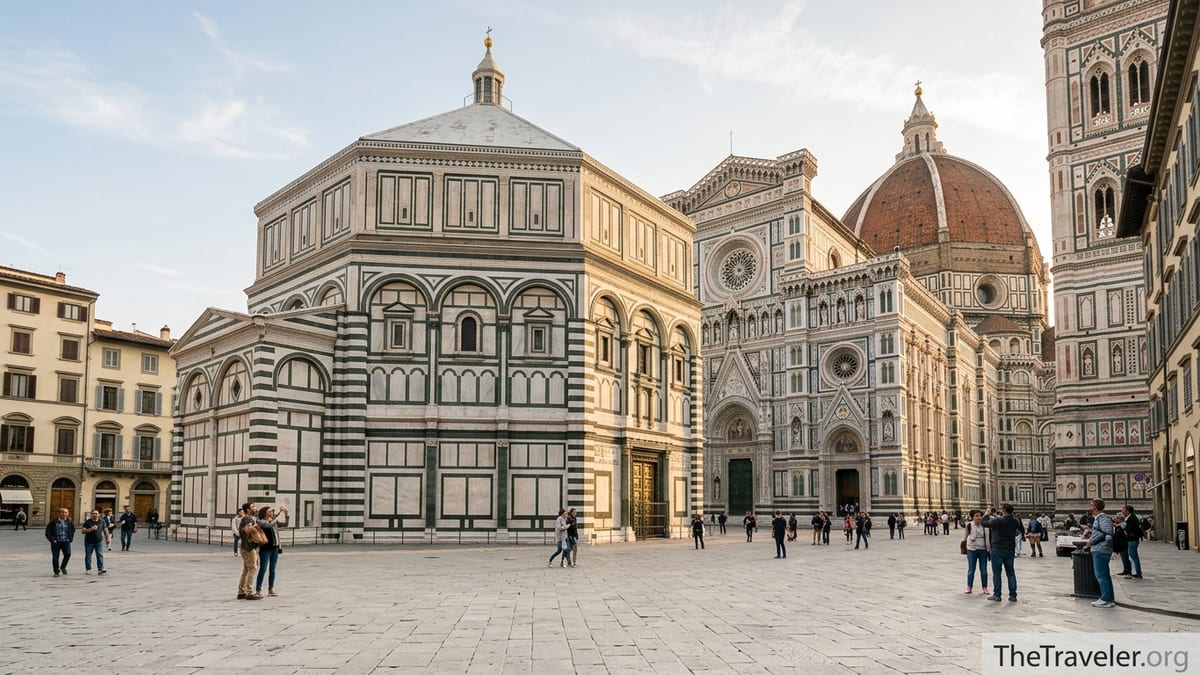
Standing in Florence’s Piazza del Duomo, it can feel impossible to choose between the Baptistery of San Giovanni and the Cathedral of Santa Maria del Fiore, better known as the Duomo. Both are icons, both sit a few steps apart, and both now require some advance planning. With limited time, money or energy, many travelers reasonably ask: which experience is actually better?
Get the latest updates straight to your inbox!
Understanding the Two Experiences
The Baptistery of San Giovanni and the Cathedral of Santa Maria del Fiore belong to the same monumental complex, yet they offer very different visits. The Baptistery is an intimate, octagonal, Romanesque building with glittering medieval mosaics overhead and famous bronze doors. The cathedral is a vast Gothic basilica crowned by Brunelleschi’s dome, with the option to climb inside the dome structure for sweeping views over Florence.
Most visitors today access both through one of the combined passes sold by the Opera di Santa Maria del Fiore. As of mid‑2026, typical official passes cluster around the 20 to 30 euro range, with the more expensive options including the dome climb. These passes usually bundle the Baptistery, cathedral interior, dome or bell tower climb, the Opera del Duomo Museum, and the archaeological area of Santa Reparata beneath the cathedral. In practice, your choice is less “either/or” and more about which site you prioritize if you are short on time, mobility, or patience for crowds.
For a first‑time visitor with a full day in Florence, it is absolutely realistic to experience both. A common pattern is a morning dome or bell tower climb, an afternoon visit to the Baptistery and museum, and a quick walk through the cathedral interior in between. The harder decision comes if you only have a few hours in the city, are traveling with someone who cannot manage hundreds of steps, or simply want to choose one paid highlight and be done.
What It Feels Like Inside: Atmosphere and Aesthetics
The Baptistery is about immersion. You step inside and are instantly wrapped in cool marble and soft light. The space is not large, which enhances the impact of the golden mosaic dome overhead. Scenes of the Last Judgment and Old Testament stories spiral above you, their tesserae catching every shift in light. Even with groups moving through, the acoustics encourage hushed voices, and many travelers report spending longer than expected simply standing in the center and looking up.
The cathedral interior offers almost the opposite mood. After queuing outside the Duomo’s striped marble walls, you enter a vast, relatively sober Gothic space. The architecture is impressive in scale, but much of the color and decoration that dazzles from the exterior gives way to gray stone and wide, mostly empty nave inside. For some visitors, this understatement is powerful, especially when sunlight slices through stained glass or when the building is in use for mass. For others, it feels surprisingly plain compared with the ornate churches elsewhere in Italy.
Where the cathedral’s interior truly comes alive is at the crossing, where you can crane your neck upward and see the interior of Brunelleschi’s dome painted with a dramatic Last Judgment. However, you view it from a distance at ground level. Those who book the dome climb get to see the frescoes far closer from the internal galleries, but if you only walk into the free nave, you will experience them more as a distant canopy than intimate artwork.
Height vs Detail: Dome Climb Compared With Baptistery Mosaics
When travelers ask which experience is “better,” they are usually comparing the dome climb to a contemplative visit inside the Baptistery. The dome climb is a 463‑step ascent through narrow stone corridors that weave between the inner and outer shells of the dome. It is physical, sometimes crowded, and not ideal for anyone with claustrophobia or bad knees. The payoff is twofold: you pass within arm’s length of the dome frescoes on internal walkways, and you emerge onto an outdoor terrace with one of the most famous panoramas in Europe.
On a clear afternoon, the dome terrace reveals terracotta roofs rolling toward the Arno, the green‑white tower of Palazzo Vecchio, and the olive‑smudged hills beyond. Travelers who make the climb often describe it as a highlight of their entire Italy trip. However, slots for the dome are limited and must be reserved for a specific time, and in peak months like May through September, the later morning and mid‑afternoon climbs can be extremely hot inside.
The Baptistery offers no height and no view, but instead focuses everything on storytelling and detail. You enter at ground level and spend your time reading the mosaics and the patterns of the marble floor. If you have seen images of the ceiling of Ravenna or Venice’s San Marco, the Baptistery’s shimmering gold interior will feel like a close cousin, though on a more intimate scale. Unlike the timed, linear flow of the dome climb, you can linger as long as you like within the opening hours, stepping back to take in the full dome or moving close to study the expressions on the faces of angels and demons.
In practical terms, the dome climb is an “event” felt in your legs and lungs, punctuated by the view at the top, while the Baptistery is a quieter art and faith encounter. Your personality and priorities will heavily influence which one you remember more strongly a year after the trip.
Time, Tickets, and Crowds: How Each Fits Into a Short Stay
For many travelers, the decisive factor is not art history but logistics. The cathedral nave itself is free, which naturally creates long security lines stretching across the square, especially from late morning through mid‑afternoon. In busy seasons, you might wait 45 to 90 minutes to step inside, and the experience once there can feel rushed if staff are trying to manage the flow. The dome climb, by contrast, operates on timed tickets that cap the number of people on the stairways and terrace. Within your roughly 45 to 60 minute slot, the experience feels more structured, though popular time slots still mean sharing narrow passages with many others.
The Baptistery also requires a ticket, but its visitor numbers at any given time tend to be more manageable than the free cathedral interior. In practice, many people use one of the combined passes and schedule the dome or bell tower climb precisely, then slot the Baptistery and museum flexibly around that time. With a typical 3‑day validity window on passes, you could even visit the Baptistery early one morning and climb the dome the next day to avoid crowd fatigue.
If you have only half a day in Florence, a realistic, low‑stress plan might be to book a morning dome or bell tower climb, walk through the free cathedral line if it looks short, and then choose either the Baptistery or the museum as your single paid “deep dive.” In this scenario, travelers who love views and don’t mind stairs often feel more satisfied with the dome, while those who prefer shorter queues and intense decoration find the Baptistery more rewarding for the time invested.
Mobility, Comfort, and Accessibility Considerations
Mobility is where the two experiences differ sharply. The dome climb involves hundreds of narrow steps, sometimes in one‑way corridors with no option to turn back. Handrails are present, but staircases can be steep and occasionally uneven. In warm weather, the enclosed space can feel hot and stuffy. For anyone with heart issues, serious knee problems, claustrophobia, or vertigo, this can shift quickly from exhilarating to miserable.
The Baptistery, by contrast, is far more accessible and comfortable. Entry is at ground level from the square, and once inside you walk on a largely flat marble floor. There are benches and ledges where people often sit quietly to gaze at the dome. The relatively compact footprint means you can see everything thoroughly in 20 to 30 minutes, or linger longer without worrying about physical strain. For older travelers, families with very young children, or anyone with limited mobility, the Baptistery almost always offers the more enjoyable experience.
If you are visiting with a mixed‑ability group, one practical strategy is to split: some members tackle the dome or Giotto’s bell tower, while others spend that time in the Baptistery and cathedral nave, then everyone reconvenes at the Opera del Duomo Museum. The museum is modern, climate‑controlled, and designed with lifts and clear signage, making it easier to share afterwards what each person saw in the square itself.
Cost and Value for Different Types of Traveler
From a budgeting perspective, the incremental cost difference between “Baptistery only” and “Baptistery plus dome climb” within the official pass system is not enormous relative to other Florence expenses, but it still matters if you are a family of five or traveling long‑term. Roughly speaking, you can expect an official pass that includes the Baptistery, museum, underground Santa Reparata and possibly Giotto’s bell tower to sit in the lower end of the pricing range, while adding the dome climb with a timed slot nudges you toward the upper end.
Value, though, is about what you personally care about. If you plan a once‑in‑a‑lifetime visit and enjoy challenging hikes or city viewpoints, the dome climb likely delivers the better emotional return on your investment. The combination of engineering story, frescoes seen almost at arm’s length, and the terrace view is hard to replicate elsewhere. Many travelers walk away saying they would have paid more for it.
If you are on a tighter budget, dislike crowds, or have already climbed towers in Pisa, Siena, or another part of Italy, then you may perceive more value in the Baptistery. Its visit is intensive rather than extensive: you get world‑class medieval mosaics, a deep sense of Florence’s early Christian history, and a focused half‑hour indoors for a lower overall effort. Pairing the Baptistery with a relaxed stroll around the exterior of the Duomo, rather than fighting indoor lines, can give you a rich sense of the complex without exhausting your patience or wallet.
Photography, Mood, and Memory
Photography is another way to think about “better.” The dome climb gifts you the archetypal Florence skyline shot: the maze of terracotta roofs under the Tuscan sun, with the Arno and hills beyond. These images feel expansive and triumphant, and smartphones love the light on a clear day. You will also capture close‑up details of the dome structure, lantern, and surrounding marble that tell a story of how audacious the engineering was in the 15th century.
The Baptistery, on the other hand, shines in low‑light interior photography. The gold mosaics play well with modern phone cameras, especially if you stabilize the device and let it adjust exposure. Close‑ups of individual angels, prophets, or the expressive figures in the Last Judgment panel make for striking, almost timeless images. Because the building is smaller, it is easier to frame compositions without crowds, particularly if you arrive early in the day.
In terms of mood, many travelers find the dome climb energizing and social. You share tight corridors with other visitors, exchange smiles about the steep steps, and collectively gasp when the view finally opens. The Baptistery tends to imprint as a quieter, more contemplative memory. If you are the kind of traveler who keeps a journal, you may find more introspective reflections after the Baptistery, and more exclamation marks after the dome climb.
The Takeaway
So which experience is “better,” the Baptistery of San Giovanni or the Cathedral of Santa Maria del Fiore with its famous dome? There is no universal answer, but there is likely a right answer for you. If you crave views, big engineering stories, and do not mind heat, tight spaces, and a timed slot, then prioritizing the dome climb within a cathedral pass will probably feel unforgettable. You will emerge with photos and memories that define Florence in your mind for years.
If you are drawn to medieval art, quieter spaces, and a more reflective encounter with Florence’s spiritual history, the Baptistery may resonate more deeply. Its scale invites contemplation rather than conquest, and its mosaics compress centuries of theology and artistry into a single golden vault. For travelers with mobility limits, small children, or a low tolerance for queues, the Baptistery is also simply the more comfortable choice.
In an ideal world you would do both, weaving them together with a visit to the Opera del Duomo Museum to contextualize what you have seen. If time or energy forces you to choose, think in pairs of words: if your priority pair is “height and view,” choose the dome; if it is “art and calm,” choose the Baptistery. Either way, standing in Piazza del Duomo and looking from one to the other, you will understand that both belong to the same extraordinary story of Florence, told in stone, marble, and light.
FAQ
Q1. If I can only choose one, should I visit the Baptistery or climb the Duomo dome?
The dome climb usually wins for travelers who love views and do not mind stairs or confined spaces, while the Baptistery is better for those who prefer rich decoration, calmer crowds, and an easier visit.
Q2. Is the cathedral interior worth it if I do not climb the dome?
Yes, but expectations matter. The nave is vast and relatively plain compared with the exterior. Many travelers enjoy a short walk through, but feel that the real wow moments are the dome climb, Baptistery, and museum.
Q3. How physically demanding is the dome climb compared with visiting the Baptistery?
The dome climb involves about 463 narrow, winding steps with no elevator and limited opportunities to stop. The Baptistery visit is on one main level with benches and requires only modest walking.
Q4. Can I visit the Baptistery and the Duomo on the same ticket?
Most official passes sold by the cathedral complex include both the Baptistery and access to the cathedral, often along with the museum and other elements. The exact inclusions depend on which pass you choose.
Q5. Which is better for travelers with limited mobility?
The Baptistery is generally better for those with limited mobility, as it has level access and no mandatory long staircases. The dome climb and bell tower are not suitable for wheelchairs and can be challenging for anyone with knee or heart issues.
Q6. When is the best time of day to climb the dome?
Early morning slots tend to be cooler and slightly less crowded inside, while late afternoon can offer warmer light over the city but may feel stuffier on hot days.
Q7. Does the Baptistery ever feel too crowded?
Yes, it can be busy during peak hours, especially when large tour groups enter at once, but the crowds are usually more manageable than the free‑entry cathedral line, and you can often find a quiet corner to look up at the mosaics.
Q8. Which experience is better for children?
Active older children often love the sense of adventure on the dome or bell tower climbs, while younger children or those sensitive to dark, tight spaces may be happier with the shorter, visually rich Baptistery visit.
Q9. If I am on a tight budget, what should I prioritize?
You can see the cathedral exterior for free and the nave without a ticket, though you will need to queue. If you pay for just one special experience, many budget travelers favor the dome climb for its views, while art lovers might choose the Baptistery instead.
Q10. How far in advance should I book tickets for the dome or Baptistery?
Dome climb slots in high season can sell out several days or more in advance, especially popular times. Baptistery entries are generally easier to secure, but it is still wise to buy a combined pass online ahead of arrival when possible.