


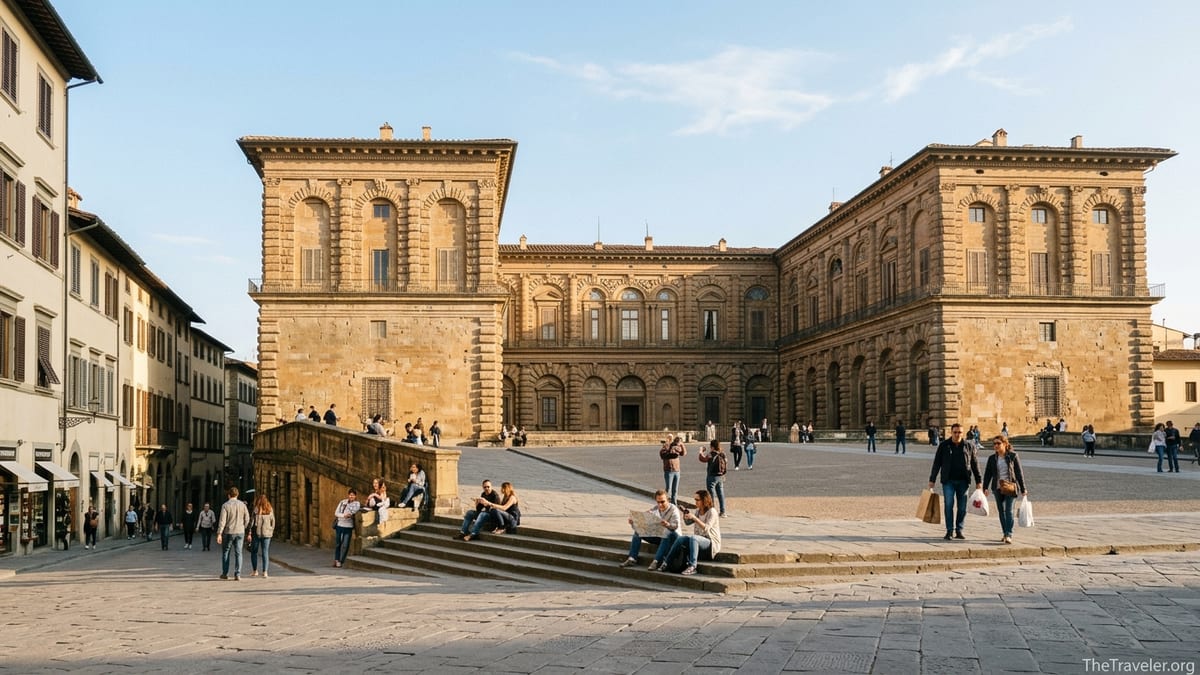
Walk across Florence’s Arno River and the city changes character. The crowds thin, workshop doors stand open, and the huge rusticated facade of Pitti Palace rises at the edge of a sloping piazza. For many travelers, this former Medici residence is a question mark on the itinerary: is Pitti Palace actually worth visiting, especially if you are already planning to see the Uffizi or the Duomo? The answer depends a lot on what you enjoy most when you travel. Here is a detailed, up to date look at what Pitti Palace offers, how much time and money it requires, and who will get the most value from including it in a Florence trip.
Get the latest updates straight to your inbox!
What Exactly Is Pitti Palace Today?
Pitti Palace, or Palazzo Pitti, is a vast Renaissance palace in the Oltrarno district, just a short walk over Ponte Vecchio from Florence’s historic center. Built in the 15th century for the Pitti banking family and later purchased by the Medici, it eventually became the main residence of the grand dukes of Tuscany and later the royal palace of the unified Italian kingdom. Today it is part of the Uffizi Galleries complex and houses several distinct museums under one roof, plus direct access to the Boboli Gardens behind it.
When you buy a ticket for Pitti Palace, you are not just seeing one museum. The building contains the Palatine Gallery with opulent Baroque rooms and paintings, the Royal and Imperial Apartments that show how the Medici and Savoy families actually lived, the Gallery of Modern Art focusing on 18th to early 20th century Italian works, the Treasury of the Grand Dukes with jewelry, hardstone vases, and tableware, and rotating temporary exhibitions. Travelers often underestimate how large and layered the complex is. Even a focused visit can easily fill half a day if you include time in the Boboli Gardens.
In practical terms, Pitti Palace is one of Florence’s major cultural anchors on the south bank of the Arno. If the Uffizi is about masterpieces in a gallery setting, Pitti is about art in context: ceilings still painted for powerful families, rooms furnished for royal ceremonies, and gardens laid out as a 16th century showpiece. That difference in feel is a key reason some visitors fall in love with it and others prefer to prioritize different sights.
Tickets, Costs, and How Pitti Fits Into Your Budget
For many travelers the first question is cost. As of mid 2026, a combined official ticket from the Uffizi Galleries that covers the Uffizi, Pitti Palace, and Boboli Gardens is advertised at around 40 euros per adult in high season. This combined ticket is valid for five consecutive days and gives you one priority admission to each site during that period. There are also seasonal variations, reduced prices for EU youth, and separate options if you only want the gardens or just one museum, but for a typical short city break the 40 euro combined ticket is the benchmark price point.
To understand whether Pitti is worth it, compare that figure to other Florence expenses. A basic plate of pasta with a glass of house wine in a casual Oltrarno trattoria might run 15 to 18 euros per person. A midrange dinner with antipasti, main course, dessert, and wine can easily reach 35 to 45 euros. A cappuccino and pastry at a sit-down cafe near the Duomo often cost around 4 to 6 euros. In that context, adding Pitti Palace via the combined ticket is roughly equivalent to a single nicer sit-down dinner in Florence. If you are already buying the pass for the Uffizi, the incremental cost of taking full advantage of it by also visiting Pitti and Boboli is relatively low.
Where costs can creep up is through third-party resellers that bundle “priority access” or “guided tours” at a significant markup. It is common to see private operators advertising Pitti Palace and Boboli Gardens packages for 70 euros or more per person. Those can make sense if you specifically want a small-group guide, but in terms of entry alone, the official Uffizi channels remain notably cheaper. Planning ahead for which ticket option you will choose helps you judge the true value of Pitti in your overall Florence budget.
What It Feels Like Inside: Highlights and Atmosphere
The strongest argument in favor of visiting Pitti Palace is the experience of walking through rooms that are still visually overwhelming in the way they were meant to be. The Palatine Gallery on the piano nobile is the star attraction for many visitors. Instead of the white walls and clean sightlines of a modern museum, you get densely hung paintings from floor to ceiling, framed in heavy gilded wood. Works by Raphael, Titian, Rubens, and Van Dyck compete for attention with stucco, chandeliers, and ceiling frescoes. It can feel chaotic compared to the carefully curated Uffizi, but that chaos is part of the charm.
Concrete details give a sense of scale: travelers often report spending about two hours just in the Palatine Gallery and Royal Apartments, even when moving at a steady pace. If you pause to really look at individual works like Raphael’s portraits or the allegorical ceilings, you can easily double that. Unlike some large museums where you might feel pressure to “do it all,” Pitti rewards picking a few rooms or themes to focus on and allowing the rest to be background splendor.
Another recurring highlight is the Royal and Imperial Apartments, which preserve 19th and early 20th century furnishings from the Savoy dynasty. Here you see bedchambers with canopied beds, reception rooms with silk-covered walls, and smaller private spaces that give human scale to the otherwise monumental palace. Travelers who enjoy peeking into historic homes, from London’s Kensington Palace to Vienna’s Schönbrunn, tend to find this part of Pitti particularly engaging.
Boboli Gardens and the Oltrarno: Beyond the Palace Walls
Many visitors end up valuing Pitti Palace not only for the art inside, but as a gateway to the Boboli Gardens and the wider Oltrarno neighborhood. Once you pass through the palace and out into Boboli, you are in one of Europe’s classic formal gardens: long tree-lined avenues, clipped hedges, grottoes, fountains, and sweeping terraces. In summer, opening hours typically start at 8:15 in the morning, with closing times gradually extending up to about 7 pm by June through August. That makes early morning or late afternoon particularly attractive for cooler temperatures and softer light over Florence’s rooftops.
Travelers often use Pitti and Boboli as a way to build breathing space into a dense sightseeing schedule. After a few days of churches and galleries, wandering the gravel paths of the gardens with views of the Duomo can feel like a reset without ever leaving the city. Families appreciate the open space where children can move more freely, though there are slopes and gravel paths that can be challenging for strollers with small wheels. Realistically, combining Pitti Palace and a leisurely circuit of Boboli can take four to five hours, especially if you stop at one of the benches or grassy areas for a simple picnic picked up from a bakery or supermarket in Oltrarno.
Stepping outside Pitti into the surrounding streets is also part of the appeal. The Oltrarno remains Florence’s artisan quarter, with workshops producing leather goods, marbled paper, jewelry, and furniture within a few blocks of the palace. Streets like Sdrucciolo de’ Pitti, Via dello Sprone, and Via Maggio are known for their concentration of small studios and galleries. A typical afternoon might see you leaving the palace, grabbing a gelato on Piazza Pitti, then wandering into a family-run bookbinding shop to watch marbled paper being made or chatting with a leatherworker about custom belts.
Crowds, Logistics, and How Much Time You Need
Compared with the Uffizi or the climb to Brunelleschi’s dome, Pitti Palace tends to feel less crushed by tour groups, but it is no longer a secret. Summer weekends, especially when a big cruise ship is in Livorno or La Spezia, can still see lines at the security check in Piazza Pitti by late morning. To keep the visit pleasant, it is worth approaching Pitti with a rough time plan. Many travelers who report the best experiences enter the palace when it opens at 8:15 or 8:30, spend two to three hours indoors, take a late-morning coffee break nearby, then continue into the Boboli Gardens once the day has warmed up slightly.
If your Florence stay is short, think in terms of blocks of time. For a quick “taster,” you can see the Palatine Gallery and peek into a few Royal Apartment rooms in about 90 minutes, then move on. A more complete visit to palace plus gardens is realistically a half-day commitment. Trying to squeeze Uffizi, Pitti, and Boboli into a single day often leaves visitors exhausted and less able to appreciate any of them. Spreading those visits over two or three days, using the five-day combined ticket validity, generally makes for a better experience.
Logistically, reaching Pitti is straightforward: most visitors cross over on Ponte Vecchio or Ponte Santa Trinita from the historic center, then walk a few minutes up to Piazza Pitti. The square is a pedestrian area, so you approach on foot, often passing shop windows filled with leather bags or antique furniture. There is a security check at the entrance, and bag sizes may be limited; very large backpacks are better left at your accommodation. There is air conditioning in key interior galleries, but the palace can still feel warm on hot days, so a refillable water bottle and comfortable walking shoes are important.
Who Will Love Pitti Palace, and Who Might Skip It
Pitti Palace is most rewarding for travelers who enjoy layered experiences rather than a single headline masterpiece. If the idea of seeing how powerful families displayed their wealth, walking directly from frescoed halls into landscaped gardens, and then disappearing into side streets full of crafts appeals to you, Pitti is easy to recommend. Fans of Baroque art and decorative arts often prefer the Palatine Gallery to the more didactic layout of the Uffizi. Visitors who liked places such as the Doge’s Palace in Venice or the Hofburg in Vienna generally find a similar mix of spectacle and domestic detail at Pitti.
It is also a strong choice for repeat visitors to Florence who have already spent time in the Uffizi and Accademia on earlier trips. For them, Pitti offers a deeper dive into Medici history and the chance to anchor a day in the Oltrarno, away from the heaviest foot traffic north of the river. Couples on longer stays sometimes build a “slow day” around Pitti: palace in the morning, a long lunch on Piazza Santo Spirito, and an evening drink near San Frediano.
On the other hand, travelers who are indifferent to art and historic interiors, or who only have a single day in Florence, may reasonably prioritize other sights. If your top priorities are seeing Michelangelo’s David at the Accademia, the Uffizi’s highlights, and climbing the Duomo’s dome, those can easily fill the available time. Likewise, families with very young children or travelers with limited mobility might decide that the size of the complex and the slopes of Boboli make other activities more appealing. Pitti is less essential for a rushed first-time visit, and more valuable for those with at least two or three full days in the city.
Practical Tips: When to Go, Accessibility, and Comfort
Timing your Pitti visit can make a significant difference to how enjoyable it feels. Weekday mornings outside peak summer months are generally the quietest, with a lull between about 8:30 and 10:30 before the bulk of group tours arrive. Late afternoon can also be pleasant, especially if you focus on the gardens when the light is softer and the city heat starts to ease. On the first Sunday of many months, Italian state museums sometimes offer free entry; on those days Pitti may be more crowded and advance booking options limited, so plan to arrive early if that is when you go.
For accessibility, the palace has elevators that make the main gallery levels reachable for visitors using wheelchairs, though some routes are longer than the standard staircases and a few small rooms can be tight. The Boboli Gardens, by contrast, include steep paths and uneven surfaces that can be challenging. A realistic strategy for travelers with mobility concerns is to focus on the palace interiors and only explore the flattest garden areas near the entrances, rather than attempting the full circuit. Staff at the ticket office are accustomed to questions about accessibility and can point out recommended routes on the spot.
Comfort-wise, it is worth remembering that Pitti is large and visually dense. Bringing a lightweight scarf or layer is helpful because some rooms are cooler than others, and shoulders should be covered if you plan to visit nearby churches on the same day. Photography is generally allowed without flash in many areas, but rules can change and temporary exhibitions sometimes have stricter policies, so check signage in each room. Simple amenities such as restrooms and small refreshment points are present but not as plentiful as in some newer museums; it is wise to take advantage of facilities when you see them.
The Takeaway
So, is Pitti Palace worth visiting during your trip to Florence? For most travelers who have at least two full days in the city and a genuine interest in art, history, or grand architecture, the answer is yes. It offers something different from the Uffizi or the Duomo complex: a lived-in sense of Medici and royal power, an almost overwhelming density of paintings in their original palace setting, and the chance to walk directly from frescoed ceilings into a hillside garden and an artisan neighborhood that still feels distinctly Florentine.
If your time is extremely limited, or if historic interiors and gardens are not priorities for you, it can be reasonable to concentrate instead on the absolute icons: Michelangelo’s David, the Uffizi’s star works, and the views from Brunelleschi’s dome or Giotto’s bell tower. But for travelers who enjoy slower, more atmospheric experiences, Pitti often becomes a favorite memory. Structuring it as part of a half day in Oltrarno, pairing the palace visit with a simple lunch nearby and a walk through artisan streets, turns an optional museum stop into a highlight that helps you experience Florence as more than just a checklist.
FAQ
Q1. How long do I need to visit Pitti Palace and the Boboli Gardens?
Most visitors should plan on at least three to four hours for a satisfying visit that includes the main palace museums and a walk through part of the Boboli Gardens. If you move quickly, you can see the Palatine Gallery and peek into the Royal Apartments in about 90 minutes, but adding the gardens and time for breaks makes a half day more realistic.
Q2. Is it better to buy a combined ticket with the Uffizi?
If you are already planning to visit both the Uffizi and Pitti Palace, the official combined ticket that also includes Boboli Gardens is usually good value, especially for stays of several days. It costs around 40 euros per adult in high season and is valid for five consecutive days, which lets you spread your visits out rather than rushing everything into one day.
Q3. Are the Boboli Gardens included in the Pitti Palace ticket?
With the main combined ticket issued by the Uffizi Galleries, entry to the Boboli Gardens is included alongside Pitti Palace and the Uffizi. There are also separate garden-only tickets at a lower price if you are not interested in the palace interiors, but most travelers who want to see both the art and the green space opt for the combined option.
Q4. Is Pitti Palace suitable for children?
Pitti Palace can work well for families, especially when combined with time in the Boboli Gardens where children have more room to move around. Younger kids may not be interested in dense picture galleries, so it can help to focus on the most decorative rooms, look for details like animals in the paintings, and keep the palace part shorter before heading outdoors.
Q5. How does Pitti Palace compare to the Uffizi Gallery?
The Uffizi presents masterpieces in a more traditional museum layout, with clear labeling and chronological organization, and is often busier. Pitti Palace feels more like stepping into a lived-in residence, with paintings hung salon-style amid frescoes, furniture, and decorative arts. Many visitors consider the Uffizi essential for a first visit, while Pitti is a richer, more atmospheric second step if you have the time.
Q6. When is the best time of day to visit Pitti Palace?
Weekday mornings shortly after opening are generally the quietest, making it easier to move through the main galleries before group tours arrive. Late afternoons can also be pleasant, especially if you plan to end your visit in the Boboli Gardens with softer light and cooler temperatures. Midday in summer tends to be the busiest and warmest period.
Q7. Is Pitti Palace accessible for visitors with limited mobility?
The main palace museums have elevators and accessible routes, though some paths are longer and a few rooms can be tight. The Boboli Gardens, however, include steep slopes and uneven gravel paths that may be challenging for wheelchairs or those with mobility difficulties. It is often best to focus on the palace interiors and only explore the flattest garden areas near the entrances.
Q8. Do I need a guided tour to enjoy Pitti Palace?
A guided tour is not essential, but it can add context to the Medici history and highlight key works that are easy to miss in such a dense collection. Independent travelers can still have a rewarding visit by picking up a basic map at the entrance, reading room panels, and perhaps doing a little reading on Medici Florence beforehand. Audio guides or app-based guides are a middle ground if you want extra information without joining a group.
Q9. Can I visit Pitti Palace and Boboli Gardens on the same day?
Yes, and many visitors do exactly that, often starting with the palace in the morning and moving into the gardens afterward. Just be aware of energy levels: together they can easily fill a half day or more. It is wise to plan a relaxed lunch or coffee break in between and avoid scheduling another major museum immediately afterward.
Q10. Is Pitti Palace worth it if I only have one day in Florence?
If you have just a single day in Florence and have never been before, you may want to prioritize the Duomo complex, the Uffizi highlights, and simply walking the historic center. In that scenario, Pitti Palace is a worthwhile extra but not essential. If you have at least two full days, or if you particularly enjoy palaces, gardens, and decorative arts, then Pitti becomes a strong candidate to include.