


Pitti Palace looms over Florence’s Oltrarno district, a massive block of rusticated stone that most travelers treat as just another museum stop. They hurry through the Palatine Gallery, snap a few photos of the Boboli Gardens and move on, often without realizing how many quiet, intricate stories are woven into this former Medici residence. Look closer, and the palace reveals a different side of Florence: not the postcard city of domes and crowds, but a layered, lived-in court where power, taste and everyday life played out in subtle details that are easy to overlook.
Get the latest updates straight to your inbox!
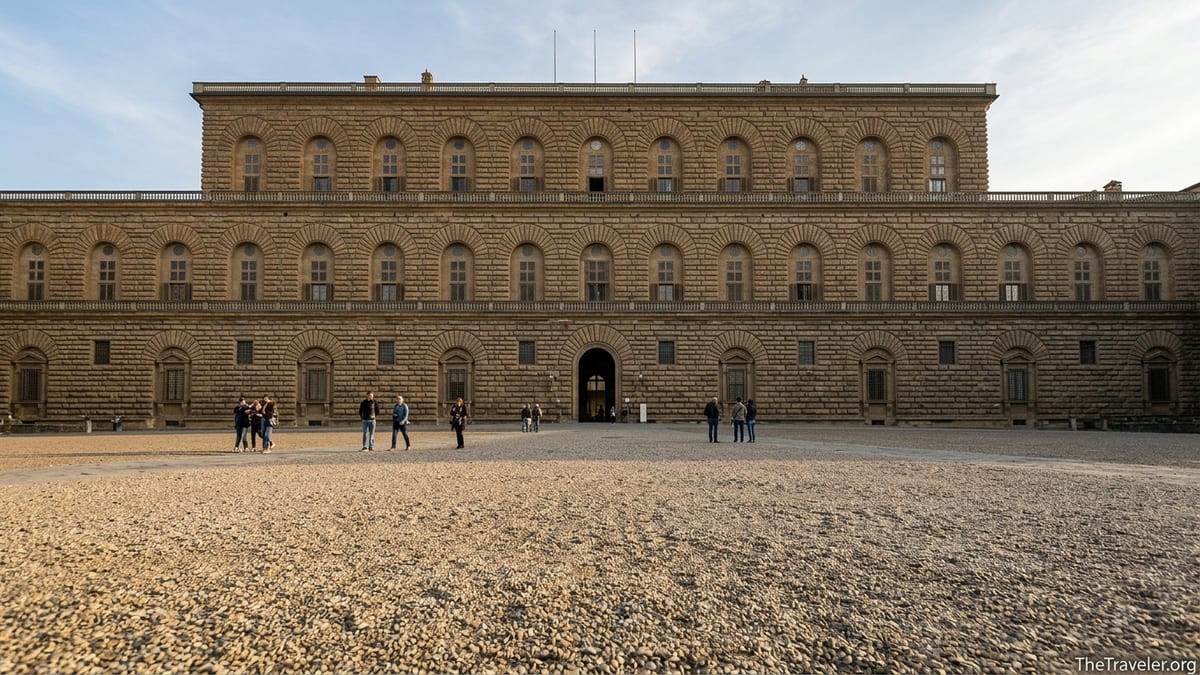
The Palace That Still Feels Like a Private Home
Most visitors enter Pitti Palace expecting a conventional museum. In reality, large parts of the building still feel like someone’s house, frozen at the height of Medici and later Savoy power. The Palatine Gallery on the first floor is arranged not like a modern gallery, but like a 17th century private collection, with paintings stacked salon style from skirting board to ceiling. There is no neat chronological sequence of schools and movements. Instead, the hang reflects the personal taste of the grand dukes who lived here, which is why a Raphael can sit unassumingly above a doorway with no spotlight or crowd in front of it.
One detail almost everyone misses is how the circulation and room sequence echo court etiquette. When you move from the more public audience rooms into smaller, more intimate chambers, the ceilings often drop slightly and the decoration becomes quieter. In practical terms, that means you might step out of the vast Throne Room into a chamber where the doorframes are lower and the floorboards creak faintly underfoot. These are the spaces where the grand dukes and their families actually lived, negotiated marriages and handled private affairs. If you pay attention to that shift, it suddenly feels less like a museum and more like you have been allowed into somebody’s back rooms.
Even modern logistics reinforce that domestic feeling. Unlike heavily industrial tourist complexes, Pitti can still surprise you with a guard manually unlocking a side door or a custodian wheeling a cleaning cart down a polished corridor. Travelers who arrive early on a winter morning often find that parts of the palace are still waking up: shutters being opened, diffused light slowly revealing the frescoes and parquet floors. It is worth pausing in those in-between moments rather than rushing straight to the most famous canvases.
The Medici Taste Hiding in the Palatine Gallery
Guidebooks rightly mention that the Palatine Gallery contains masterpieces by Raphael, Titian and Rubens, but few visitors stop to notice what makes this collection different from almost any other major museum in Europe. Here, the labels are discreet, the famous names are not always at eye level and there is no didactic timeline on the wall. The point is not to teach you art history. It is to immerse you in the way the Medici wanted to live with art, surrounded on all sides by mythological scenes, portraits and allegories that constantly reinforced their own image.
Take a typical visitor path as an example. Many people walk straight into the Sala di Marte, raise their phones toward the lavish Pietro da Cortona ceiling, and then move on. If you stay a little longer, you notice how the martial subject of the ceiling, celebrating Medici military virtues, is echoed in smaller details: armour pieces worked into the stucco frames, painted standards, and male portraits positioned at a slightly dominant angle over the door. This is not random decoration. It is a private propaganda program that once shaped how every courtier interpreted the duke’s power.
Another subtlety is how certain artists are clustered. Rooms with a concentration of Raphael paintings feel calmer and more harmonious, while spaces heavy with Baroque canvases by Rubens and his contemporaries feel almost crowded and theatrical, especially in the original, relatively low-lit environment. If you time your visit to late afternoon on a sunny day, the window light can pick out a single face or piece of drapery in a way that completely changes the reading of a picture. Locals sometimes take advantage of the discounted afternoon tickets in winter to enjoy exactly this shifting light with far fewer people around than in summer.
If you are used to large museums with big interpretive panels, you might initially feel disoriented. A useful trick is to focus on one corner of a room rather than trying to scan every wall. Pick a single Raphael, a pair of smaller devotional paintings and the stucco work around them, and try to imagine why a 17th century grand duchess wanted this exact group to hang above a writing desk or near a bed where she might see it first thing in the morning.
Clues to Royal Daily Life in the Royal Apartments
Many travelers do not realize that their Pitti ticket can include the Royal Apartments, or they treat them as a quick add-on on the way out. Yet these rooms preserve some of the most vivid traces of how the building changed from Medici residence to Savoy royal palace and then to a modern national symbol. While much of the original Renaissance decoration was replaced, the later furnishings now tell their own story about evolving tastes and political ambitions.
In the Royal Apartments, look beyond the obvious chandeliers and velvet upholstery. Small functional details are where daily life hides. You might notice a bell pull beside a door, a barely visible hinge in a panel that suggests a hidden service door, or areas of floor where the parquet has clearly been patched after decades of wear from servants’ footsteps. These are subtle reminders that behind the ceremonial rooms lay a dense network of service spaces, kitchens and circulation routes that allowed the household to function discreetly.
Recent curatorial work has made those layers more legible. A room may display a Savoy era writing desk alongside explanatory notes about how much furniture was moved to the Quirinal Palace in Rome when the monarchy relocated. That small fact changes how you read the interior. Instead of seeing a perfectly preserved royal suite, you start to understand Pitti as a place that was continually rearranged in response to changing dynasties. When you see an especially fine inlaid table or a suite of chairs, it is worth remembering that some of the “very best” pieces once chosen for Pitti later traveled to another capital, leaving gaps that curators have filled carefully over the last century.
For a modern visitor, these rooms offer something rare in Florence: a sense of 19th and early 20th century Italy layered over a Renaissance shell. If you have already spent hours surrounded by 15th century altarpieces at the Uffizi, it can be oddly refreshing to stand in a Pitti bedroom with patterned wallpaper, framed photographs and furniture that belonged to a king who still read newspapers and rode in trains.
Boboli Gardens: The Hidden Structure Behind the Greenery
Walk out the back of Pitti Palace and you emerge into the Boboli Gardens, which many visitors treat as a pleasant place for a stroll after too many paintings. What most people never notice is that Boboli is one of the prototype Italianate gardens that shaped formal landscaping all over Europe. Its amphitheater, axial paths and scattering of statues are not random. They form a carefully choreographed outdoor extension of the palace’s power and taste.
Stand with your back to the palace and look up toward the main axis that climbs the hill. The amphitheater embedded in that slope once hosted court spectacles and elaborate performances for the Medici and their guests. From below, the stone seating blends into the landscape, and many travelers simply see it as a grassy hollow with a central Egyptian obelisk. In fact, this was a theater built into the earth, an outdoor equivalent of the indoor music and drama rooms, where the garden itself acted as a stage set.
The higher you climb, the more the hidden structure reveals itself. Long straight gravel avenues intersect with intimate side paths that suddenly open onto unexpected views of Florence’s skyline or small garden buildings. Behind a cluster of hedges you might find a quiet basin with weathered statues, a place where Florentines bring a sandwich from a nearby bar and sit in the shade on hot days. These semi-private corners are part of what makes Boboli a living park rather than a static monument. Local residents, who enjoy certain free access privileges in defined areas, often use these shaded spots in the late afternoon while most tourists cluster near the palace facade.
Ticketing details also shape the experience. As of mid 2026, a combined ticket for Pitti Palace and Boboli Gardens typically costs a little over 20 euros at standard rates, with seasonal variations between peak and low season and a small booking fee for advance reservations. Many visitors focus on squeezing value out of that cost by seeing everything quickly. A more rewarding approach is to consciously “waste” an hour sitting on a bench halfway up the hill, watching how light shifts over the palace stone and how the terraces line up with Florence’s churches in the distance.
Buontalenti’s Grotto: An Artificial Cave That Fools the Eye
Just inside the Boboli Gardens, tucked near the old entrance to the Vasari Corridor, sits one of the most surprising structures on the estate: the Buontalenti Grotto. At first glance its crusted stalactites, rough rock surfaces and enigmatic figures look like a natural cave that has somehow grown out of the garden wall. In reality, the entire structure is an exercise in Renaissance stage design, carefully engineered to look ancient and organic.
Many visitors walk past the grotto’s facade, take a quick photograph of the Michelangelo-inspired figures at the entrance and continue uphill. They rarely step inside long enough to see how the interior plays tricks with perspective. The walls are coated with stucco made to resemble dripping limestone, studded with small shells and stones. Figures emerge half-real, half-dissolved from the surfaces, as if the garden itself were turning to flesh. Originally, water features and mechanical elements would have added movement and sound, creating a fully theatrical environment commissioned by Francesco I de Medici.
Today, you will usually encounter the grotto either as part of a self-guided visit included in your Boboli ticket or on a specialized guided tour that explains its history. What nearly everyone misses is how the grotto connects ideologically to the collections in Pitti. Inside the palace, mythological paintings and allegories celebrate Medici control over nature, art and science. Outside, in the grotto, that same message takes sculptural form. The garden appears wild but is in fact completely constructed. If you stand near the entrance and look back toward the palace, you can feel how this single grotto acts as a hinge between the formal stone facade and the seemingly natural hillside beyond.
For photographers, the grotto is also one of the best places to capture the texture of Boboli without crowds. Early in the morning, before the sun climbs high, side light grazes the rough surfaces and casts delicate shadows inside the cave. A standard phone camera can do justice to these textures if you take a moment to lock focus and slightly lower exposure to avoid blowing out the highlights on the pale stucco.
The Invisible Line of the Vasari Corridor
One of the most remarkable elements of Pitti Palace is one that many visitors never consciously register: the Vasari Corridor that connects the palace to the Uffizi and Palazzo Vecchio on the other side of the Arno. From ground level in the palace courtyard or in the street outside, it simply looks like an extra row of small windows or a slightly odd covered walk crossing the Ponte Vecchio. Without knowing its story, you might assume it is part of the surrounding houses.
In fact, this elevated enclosed passageway gave the Medici a private, secure route between their official government seat and their home. It slips through existing buildings, over shop roofs and across the river, disappearing into walls and re-emerging blocks away. Modern visitors mostly experience the corridor indirectly. On a walk through the Oltrarno, you might pass under a modest arch near Pitti without realizing that courtiers once hurried overhead, invisible to the common crowd.
For those who book a dedicated corridor visit through the Uffizi ticketing system, the experience is quite different from a standard gallery tour. After moving through stretches of the Uffizi, you find yourself in a long, elevated space punctuated by carefully placed windows that frame specific views of the Arno and the city. The architecture is intentionally plain. The drama lies in the idea of moving above the city, tracing a line that only a tiny elite once used daily. The route now typically ends near Pitti, dropping you back into the world of the palace with a heightened sense of how interconnected Florence’s power buildings really are.
Even if you never step inside the corridor, you can play a kind of urban treasure hunt by tracing its path from outside. Start near the Uffizi, follow the enclosed structure across the Ponte Vecchio, look for the small round windows overlooking the river and watch how it threads through the houses on the Oltrarno bank before reaching the Pitti side. Once you see it, you cannot unsee it, and your mental map of Florence changes permanently.
Tickets, Timing and the Art of Dodging the Crowds
Because Pitti Palace is part of the wider Uffizi complex, practical details like ticket types and timing can significantly shape what you notice once you are inside. As of summer 2026, a standalone Pitti ticket bought on the day of entry typically costs in the mid-teens in euros, while advance purchases cost a few euros more but secure a specific time slot. Combined options that include Pitti, Boboli and sometimes the Royal Apartments or special routes vary through the year, with peak season prices higher than those in the quieter winter months.
Many travelers instinctively pair the Uffizi and Pitti in a single day, connected either by a standard walk across the Ponte Vecchio or, for those who reserve it, the Vasari Corridor. While this has logistical appeal, it can also lead to art fatigue. After several hours in the Uffizi, your eyes may glaze over inside the Palatine Gallery, and you will be more likely to miss the subtle domestic details that make Pitti unique. If your schedule allows, consider dedicating a fresh morning to Pitti and Boboli instead, using the cooler hours to explore the gardens and the softer afternoon light for the palace interiors.
Specific timing makes a huge difference. On high season weekends, groups often flood the Palatine Gallery around late morning. If you enter right at opening time on a weekday, you may find yourself briefly alone in some of the state rooms, able to stand in the center and turn slowly under the ceilings without bumping into tour groups. Conversely, in winter, discounted afternoon tickets can make a late-day visit both more affordable and more atmospheric. Light fades early, creating a golden glow in the frescoed rooms and a rare sense of quiet in the gardens.
One practical tip that many visitors never think about is to build in a deliberate pause between the palace and the gardens. Instead of walking straight from the last gallery into the formal parterres, exit to the courtyard, sit for ten minutes on a low wall and let your eyes adjust from gilded interiors to open sky. That reset can make you far more attentive to the alignment of paths, the sightlines and even the soundscape of Boboli when you step outside.
The Takeaway
Pitti Palace rewards the kind of travel that values close looking over box ticking. Its most memorable qualities are not the famous names on the walls, but the way art, architecture and landscape quietly reveal how power and daily life were staged in Renaissance and later royal Florence. The stacked hang of the Palatine Gallery, the worn thresholds of the Royal Apartments, the theatrical hillside of Boboli, the deceptive Buontalenti Grotto and the almost invisible ribbon of the Vasari Corridor all become richer when you slow down enough to notice them.
If you approach Pitti as a living complex rather than a single “museum,” small details start to add up: a service door left ajar, a glimpse of a custodian unlocking a faded cabinet, a local walking a dog along a little-used garden path. These are signs that, despite its grandeur and tourist traffic, Pitti remains embedded in the daily rhythms of Florence. Plan your visit with time to wander, look up, sit down and double back on yourself, and you will leave not just with photos of lavish interiors, but with a deeper sense of how this stone giant has quietly shaped the city around it for centuries.
FAQ
Q1. How much time should I plan for a visit to Pitti Palace and Boboli Gardens?
Most travelers should allow at least three to four hours if visiting both the palace and the gardens. Two hours lets you skim the Palatine Gallery and Royal Apartments, but adding another one to two hours gives you time for a relaxed walk up through Boboli and a few quiet pauses on the terraces.
Q2. Is it better to visit Pitti Palace before or after the Uffizi Gallery?
If you can, visit Pitti on a different day from the Uffizi. Seeing both collections back to back often leads to overload. When that is not possible, start at Pitti in the morning while your attention is fresh, then cross the river for an afternoon visit to the Uffizi, or schedule a longer lunch break between the two.
Q3. Are the Royal Apartments worth adding to my ticket?
Yes, especially if you are interested in how people actually lived in these grand buildings. The Royal Apartments contain later furnishings, wallpapers and everyday objects that show how Pitti evolved from a Medici residence to a Savoy royal palace. They offer a different atmosphere from the more formal Palatine Gallery.
Q4. Can I access the Vasari Corridor directly from Pitti Palace?
Access to the Vasari Corridor is only possible on specific routes managed through the Uffizi ticketing system, and you cannot simply walk into it from the palace courtyard. When open for visits, the corridor is experienced as part of a guided or structured route that starts on the Uffizi side and finishes near Pitti.
Q5. What is the best time of day to visit Boboli Gardens?
Early morning and late afternoon are the most pleasant times. In the morning, the light is softer and temperatures are cooler, especially in summer. Late afternoon offers long shadows, quieter paths and beautiful views over Florence as the sun begins to drop behind the hills.
Q6. Are there places to sit and rest inside Pitti Palace?
Seating is limited in some galleries, but you will find benches in certain larger rooms and near stair landings. Between the palace and the gardens, the courtyard provides low walls and steps where visitors often sit for a short break before continuing. The Boboli Gardens themselves have more benches and informal seating spots along the paths.
Q7. Do I need a separate ticket for Boboli Gardens?
Ticket options change seasonally, but you can usually choose between a palace-only ticket and combined tickets that include Boboli Gardens and sometimes other spaces. Combined tickets cost more than a palace-only ticket but are still good value if you plan to spend time outdoors. Always check current options when you book, as combined offers can vary across the year.
Q8. Is photography allowed inside Pitti Palace?
In most areas of Pitti Palace, non-flash photography for personal use is allowed, but tripods and bulky equipment are usually prohibited. Temporary exhibitions or specific rooms may have stricter rules, so always look for posted signs and follow staff instructions.
Q9. Can I bring food or have a picnic in Boboli Gardens?
Small snacks and water are generally fine, and you will see people sitting on benches with a panino from a nearby cafe. Formal picnics with blankets, large spreads or alcohol are not encouraged, and you are expected to respect the garden as a historic site by keeping noise down and taking all litter away with you.
Q10. Is Pitti Palace accessible for visitors with limited mobility?
Pitti Palace and Boboli Gardens occupy a historic site built on a slope, but there are elevators and alternative routes to reach many of the main rooms. The gardens include steep and uneven paths that can be challenging. It is a good idea to check the latest accessibility information when booking and to ask staff at the entrance for the best routes based on your needs.