


Two monumental palaces tell the story of Florence: the stern, medieval Palazzo Vecchio on Piazza della Signoria and the vast, aristocratic Pitti Palace rising above the Oltrarno. Both were Medici residences, both are headline attractions in 2026, and both can swallow half a day of your itinerary. Yet they offer very different experiences. If you only have time for one, the choice between them will shape how you remember Florence. This guide compares Pitti Palace and Palazzo Vecchio on atmosphere, art, views, gardens, logistics and cost so you can decide which one is right for your trip.
Get the latest updates straight to your inbox!
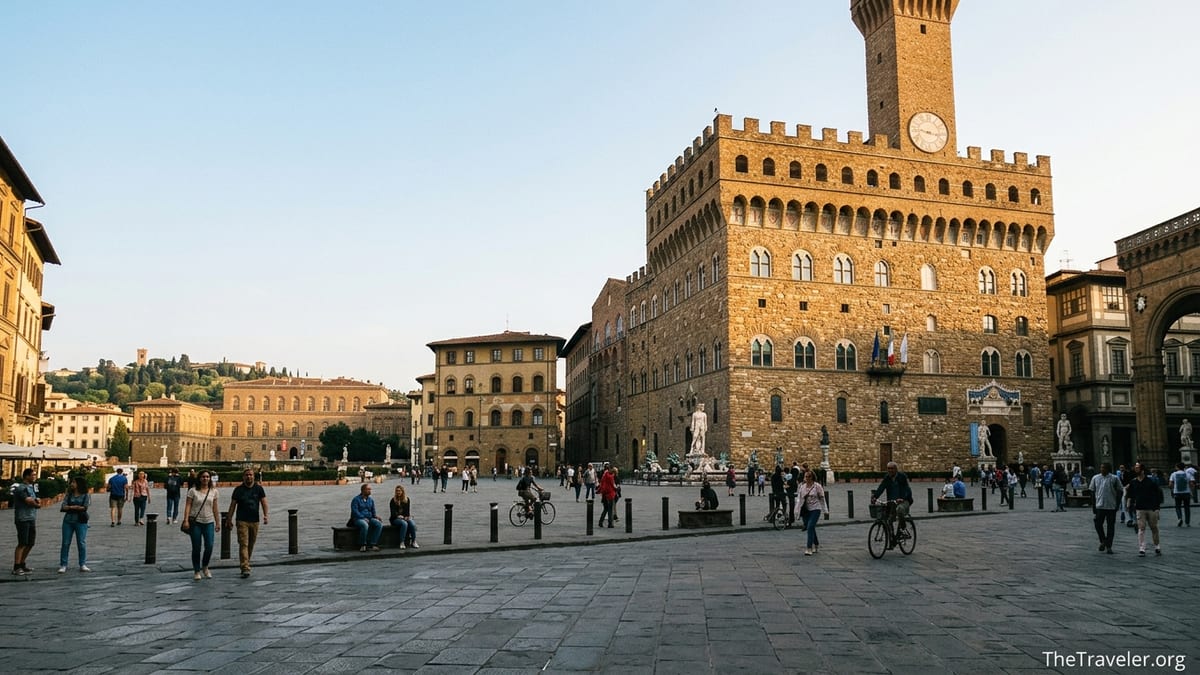
At a Glance: Two Very Different Medici Worlds
Palazzo Vecchio is Florence’s fortified town hall, begun in 1299 and later turned into a Medici ducal residence. Today it is still the seat of the city government while also functioning as a museum. When you walk into its stone courtyard, you immediately feel the building’s dual identity: civic power and Renaissance pageantry layered together. The heart of the visit is the immense Salone dei Cinquecento with battle frescoes and ceiling panels celebrating Medici victories, alongside the more intimate private apartments painted for Cosimo I and Eleonora of Toledo.
Pitti Palace, on the opposite side of the Arno near the Ponte Vecchio, is something else entirely. Originally a banker’s mansion, it became the main Medici residence in the 16th century and later housed the Lorraine grand dukes and the king of Italy. Its rusticated façade looks almost austere, but inside it unfolds into a series of lavish galleries, royal apartments and, behind it, the sweeping Boboli Gardens. The tone here is courtly and residential rather than governmental: more Versailles than city hall.
For a traveler, that contrast translates into two different moods. Palazzo Vecchio delivers the drama of power: soaring council chambers, a tower over the city, and direct contact with the political heart of Renaissance Florence. Pitti Palace feels like stepping into the private life of the ruling family: bedchambers, throne rooms, costume collections and long walks through sculpted gardens. Knowing which mood you prefer is the first step toward your decision.
Location also plays a role. Palazzo Vecchio anchors Piazza della Signoria in the historic center, a few minutes’ walk from the Duomo and the Uffizi. Pitti Palace is across the river in the Oltrarno, surrounded by artisan workshops, wine bars and quieter streets. If you want to combine the palace with a day of neighborhood wandering, cafes and sunset on a hillside, the Pitti side of town has the edge.
Art & Interiors: Masterpieces vs Overload
If your priority is paintings and historic interiors, Pitti Palace generally offers more depth, while Palazzo Vecchio offers more drama in smaller doses. The Palatine Gallery at Pitti is one of Florence’s great art collections, especially for late Renaissance and Baroque painting. In 2026, visitors can still expect to see major works by Raphael, Titian, Rubens and Pietro da Cortona displayed salon-style on walls covered in silk and stucco. The royal apartments, including the rooms used by the Savoy kings when Florence was briefly Italy’s capital in the 19th century, add layers of furniture, textiles and everyday objects.
That richness has a downside: it can feel overwhelming. Many travelers report “art fatigue” after an hour or two in the Palatine Gallery because there is so much on display and labels are minimal. A practical approach is to focus on a few highlight rooms and then move on to the Costume and Fashion Museum or the Gallery of Modern Art, which have more breathing space. Allow at least two to three hours if you want to see the main gallery plus a taste of the other sections without racing.
Palazzo Vecchio’s collection is smaller but highly curated, and the building itself is the primary artwork. The Salone dei Cinquecento, with its monumental Vasari frescoes and sculptural program, is often enough to satisfy visitors who have already seen the Uffizi and Accademia. The private rooms, such as the Studiolo of Francesco I with its mysterious allegorical paintings and hidden cupboards, are a reminder that this was once a lived-in court. Decorative ceilings, carved doors and inlaid furniture punctuate the visit without the sense of endless galleries.
In practical terms, Palazzo Vecchio can feel more digestible if you are already dedicating serious time to art elsewhere. Many visitors comfortably cover the main museum in 90 minutes to two hours, including pauses to photograph the frescoes and read panels about the Medici. If you value architectural atmosphere and narrative over sheer volume of paintings, Palazzo Vecchio may feel more satisfying than the denser collections at Pitti.
Views, Towers and Gardens: Where the Outdoors Wins
For views, Palazzo Vecchio holds the trump card. Its Arnolfo Tower is one of the highest accessible points in the city center, offering a near 360 degree panorama of the Duomo, Santa Croce, the Arno and the tiled roofs of Florence. Climbing the roughly 230 steps is a workout, and the tower closes in rain or high winds for safety, but on a clear day the experience is memorable. Timed entries spread people out, so even in busy months you typically get a few moments to yourself at the top platform for photos.
Those who prefer strolling to climbing are drawn instead to Boboli Gardens behind Pitti Palace. The Boboli hillside spreads out in a series of terraces, statues, grottoes and long gravel avenues lined with cypresses. In summer, locals and visitors alike sit on the lawns near the Amphitheatre or climb up to the Kaffeehaus pavilion for views over the city. Because the garden covers a large area, it absorbs crowds better than confined indoor spaces. Even in June and July, you can usually find a quiet corner away from tour groups, particularly in the late afternoon.
Season matters for Boboli. In high summer, the gravel paths reflect heat and there is little shade on some of the main axes, so early morning or after 4 pm is ideal. In winter months, the garden is greener than many European parks thanks to evergreen hedges and trees, but fountains may be dry and some statues under conservation covers. The official schedule currently opens the gates from 8:15 am, with closing times varying by season, and last admission typically one hour before closing, so it pairs well with a late-morning Pitti visit followed by a shaded lunch in the Oltrarno.
If your perfect Florence moment involves wind in your hair and a city panorama, the Arnolfo Tower is hard to beat. If it looks like rain on your chosen day or someone in your group is uncomfortable with steep, narrow staircases, then Boboli offers a gentler outdoor alternative. Both experiences reward planning around weather: tower tickets can be wasted if storms roll in, while Boboli is far more pleasant in mild temperatures.
Practicalities: Tickets, Prices and Time Investment
As of mid 2026, both Palazzo Vecchio and Pitti Palace are firmly in the “major attraction” category in terms of ticketing and crowds. Standard full-price tickets for Palazzo Vecchio start from around the low 20 euro range for the museum only, rising if you add the Arnolfo Tower or special exhibitions. Official guidance notes that the ticket office closes one hour before museum closing, and the tower has slightly earlier last entry. Many visitors now reserve timed-entry tickets in advance, especially for busy weekends in spring and early autumn, to avoid queuing for 60 minutes or more at the courtyard ticket desk.
Pitti Palace uses a different structure, often combining access to the palace museums and Boboli Gardens under a single ticket when purchased through the official channels. Prices vary slightly between low and high season and depending on which temporary exhibitions are running, but travelers can expect a basic combined palace and gardens ticket to sit in the mid teens to low 20 euro range per adult, with reduced rates for EU youth and occasional free-entry days mandated by Italian cultural policy. Third-party sellers may add booking fees, so checking the official museum circuit is advisable when comparing prices.
One important 2026 development is the reintroduction of the Firenze Card at 85 euros for 72 hours, covering more than 60 museums including Pitti Palace, Boboli Gardens and Palazzo Vecchio, as well as other major sites like the Uffizi and Accademia. The card is generally good value if you plan to visit at least five or six paid museums in three days. Reservation rules vary: for example, Palazzo Vecchio and some other city museums may require or strongly recommend advance time slots even with the card, so it is wise to secure those online as soon as you know your dates.
Time investment is another deciding factor. A focused Palazzo Vecchio visit, including a quick look at Piazza della Signoria before or after, can be done in about two hours without feeling rushed, three if you add the tower climb and linger over details. Pitti Palace plus Boboli is essentially a half-day commitment: two hours inside and at least an hour in the gardens, more if you picnic, stop for coffee or photograph the views. If your Florence stay is only one full day, Palazzo Vecchio may fit more neatly between other marquee stops, while a longer visit of three days or more makes the Pitti and Boboli combination easier to justify.
Crowds, Atmosphere and Seasonality
Both palaces are popular, but the way you feel the crowds is different. Palazzo Vecchio, especially in high season and during mid-morning, fills up quickly in the Salone dei Cinquecento and on the main staircase, where school groups and guided tours cluster around key paintings. Queue reports in 2026 suggest that walk up visitors around late morning can easily wait 45 to 90 minutes at the ticket office during busy weeks in May and September. However, because the museum route is fairly linear and compact, once you are inside you can often dodge the slowest clusters by circling ahead or ducking into smaller side rooms.
Pitti Palace’s interior galleries can also feel crowded in central rooms of the Palatine Gallery, particularly under the grand ceiling frescoes, but the flow is more dispersed because there are multiple routes through the complex. The key advantage is that once you step into Boboli Gardens, the sense of intensity drops sharply. Even on national holidays when timed tickets have sold out online, the garden’s size allows visitors to spread out, and families with children appreciate the chance for kids to run on the lawns after time in formal galleries.
Season affects which palace is more enjoyable. In midwinter, when daylight is short and drizzle is common, Palazzo Vecchio has the edge because almost the entire visit is indoors and the heavy stone walls feel atmospheric rather than oppressive. In late spring and autumn, Pitti Palace plus Boboli often becomes the highlight of a trip, especially for travelers who build in a long coffee stop or bring a simple picnic to enjoy on one of the upper terraces where city views open up.
Evening options also differ. Palazzo Vecchio operates extended evening hours on many days between roughly April and September, staying open until late in the evening on selected nights except Thursdays, which keep an early closure for city council business. Visiting after 8 pm can transform the experience: tour groups thin out, the frescoes glow in softer light and you spill directly out into a twilight Piazza della Signoria for gelato. Pitti Palace and Boboli typically close earlier, so they are best planned for mid-morning or afternoon slots.
Who Should Choose Which Palace?
For first-time visitors with very limited time, Palazzo Vecchio is often the better fit. Its central location, manageable scale and combination of art and political history deliver a powerful sense of Florence in a short window. You can easily pair it with a visit to the Duomo, a stroll through the Uffizi corridors or a walk along the Arno, all without crossing the river. Travelers who enjoy stories of intrigue and power, from Machiavelli to Savonarola, will appreciate being in the very rooms where those dramas unfolded.
Pitti Palace is ideal for travelers who either have more time in Florence or are particularly drawn to royal residences and decorative arts. If you loved palaces such as Versailles, Schönbrunn or Madrid’s Royal Palace, Pitti will likely resonate. It also works well for families and couples who want a slower-paced day: museum in the late morning, lunch in a nearby trattoria, and a long lazy walk through Boboli as the afternoon light softens over the city. Many repeat visitors to Florence list Pitti and Boboli among their favorite experiences precisely because they allow more wandering and less queueing than some other major sights when planned well.
Budget and energy levels matter too. If climbing towers is a priority and you do not want to pay separately for multiple viewpoints, choosing Palazzo Vecchio’s tower over other climbs like Giotto’s bell tower may be a smart consolidation. Conversely, if you are traveling with someone who cannot manage many stairs, prioritizing Pitti Palace and Boboli offers grandeur with fewer physical constraints, as elevators serve some interior routes and the main garden paths, while sloped, are generally manageable with pauses.
Finally, consider your broader itinerary. If you are already dedicating a half day to the Uffizi, which shares much of its core collection period with the Palatine Gallery, you might find Palazzo Vecchio gives you a more varied experience than another dense painting collection. If, on the other hand, you are skipping some of the larger museums or you are a devoted fan of Baroque art and historic interiors, Pitti Palace can serve as your primary deep dive into Medici-era luxury.
The Takeaway
So which palace offers the better experience, Pitti Palace or Palazzo Vecchio? The honest answer is that there is no single winner, only a better fit for different types of trips. Palazzo Vecchio excels if you want a concentrated, narrative-rich introduction to Florence’s political and artistic history, dramatic interiors and one of the city’s finest viewpoints. It is easier to slot into a tight schedule and more weatherproof in winter or during summer storms.
Pitti Palace, especially when paired with Boboli Gardens, delivers a slower, more immersive encounter with Medici life and landscape. It suits travelers with time to wander, sit on a bench above the city and let Florence unfold gradually rather than racing between checklists. On a blue-sky day in late spring or early autumn, many visitors come away feeling that Pitti and Boboli were the most memorable part of their stay.
If you can, visit both palaces on different days and enjoy the arc that connects them, from the fortified seat of republican power to the garden palace of Europe’s grand dukes. If you must choose, let your own travel style decide: towers and frescoed council halls in the heart of the city, or royal apartments and hillside gardens across the river. Either way, you will be walking through the very spaces where Florence’s extraordinary story was written.
FAQ
Q1. If I only have one full day in Florence, should I choose Pitti Palace or Palazzo Vecchio?
For a single day, Palazzo Vecchio usually fits better. Its central location, shorter recommended visit time and optional tower climb give you a strong sense of Florence while leaving room for the Duomo area or the Uffizi. Pitti Palace plus Boboli Gardens tends to require at least a half day, which can feel tight in a one-day itinerary.
Q2. How much time should I plan for each palace?
Most travelers are satisfied with 1.5 to 3 hours at Palazzo Vecchio, depending on whether they climb the tower and how much they read the interpretive panels. For Pitti Palace and Boboli Gardens together, plan a minimum of three hours and ideally four, especially if you want to see the Palatine Gallery, peek into the royal apartments and then walk up through the gardens for city views.
Q3. Are tickets more expensive for Pitti Palace or Palazzo Vecchio?
Base prices are broadly comparable in 2026, usually somewhere in the teens to low 20 euros for adults, but structures differ. Palazzo Vecchio charges separately for the museum and the Arnolfo Tower, while Pitti Palace often sells a combined ticket covering palace museums and Boboli Gardens. Exact amounts change with season and special exhibitions, so it is best to check official pricing close to your travel dates.
Q4. Which is better for families with children?
Pitti Palace paired with Boboli Gardens often works better for families. While very young children may not engage deeply with the paintings, they usually enjoy the grand rooms briefly and then have space to run and explore in the gardens. Palazzo Vecchio can still be rewarding, especially with older kids interested in castles, towers and stories of intrigue, but indoor spaces can feel more constrained during peak hours.
Q5. Is one of the palaces easier to visit for people with limited mobility?
Pitti Palace and its main indoor routes have more elevator access, and Boboli Gardens offer wide paths, though some are steep. Palazzo Vecchio, by contrast, includes many staircases and uneven stone floors, and the Arnolfo Tower is accessible only via a narrow stair with no lift. For visitors who use a wheelchair or who prefer to minimize stairs, Pitti Palace is generally the more comfortable choice.
Q6. Do I need to book tickets in advance?
Advance booking is highly recommended for both sites in spring, summer and early autumn. Same-day lines at Palazzo Vecchio can exceed an hour in busy weeks, and timed entries at Pitti Palace and Boboli sometimes sell out on popular dates. Booking online lets you choose a specific arrival window and reduces time spent queuing, which is particularly valuable in hot weather.
Q7. Can I visit both palaces on the same day?
It is technically possible but not ideal. Doing Palazzo Vecchio in the morning and Pitti Palace plus a brief Boboli visit in the afternoon can leave you museumed-out and rushing through highlights. Most travelers enjoy each site more when they are split across different days, paired with lighter activities such as neighborhood walks, gelato stops or a sunset in the Oltrarno.
Q8. Which palace has better views of Florence?
For a classic skyline panorama with the Duomo front and center, Palazzo Vecchio’s Arnolfo Tower wins. The views are high, close and dramatic. Boboli Gardens at Pitti Palace offer more distant, layered views from various terraces, with olive trees and rooftops framing the city rather than a single lookout point. If you like wide, scenic vistas, you may prefer Boboli, while photographers chasing iconic skyline shots will favor the tower.
Q9. Is there a best time of year to visit each palace?
Palazzo Vecchio is a strong choice year round, but it is particularly appealing in winter and on rainy days when indoor attractions shine. Pitti Palace and Boboli Gardens are at their best from late March through early June and again from September into October, when temperatures are mild and the gardens are pleasant for long walks. In peak summer, early morning or late afternoon entries help avoid excessive heat in Boboli.
Q10. Does the Firenze Card include Pitti Palace and Palazzo Vecchio?
Yes, the current version of the Firenze Card, valid for 72 hours, includes both Pitti Palace with Boboli Gardens and Palazzo Vecchio among its covered museums, along with many other major sites. You still need to check whether advance reservations are required for specific time slots, but if you plan multiple paid visits within three days, the card can simplify logistics and may save money compared with buying individual tickets.