


More news on this day
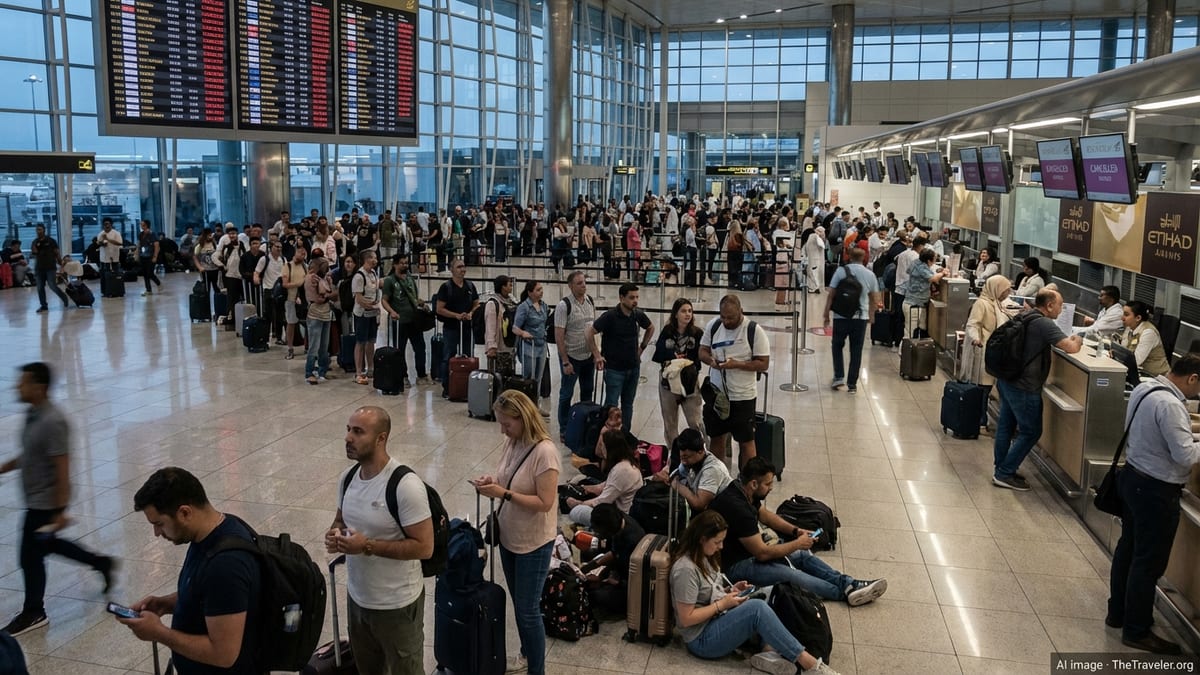
Recent missile and drone activity around the Gulf has unsettled travelers heading to or transiting through the United Arab Emirates, yet industry data and new airspace measures suggest commercial flying in and out of the country remains highly safe, albeit with more operational complexity and occasional disruption.
Get the latest news straight to your inbox!
Regional Tensions Collide With a Busy Gulf Sky
The Gulf’s role as a global aviation crossroads has made the United Arab Emirates particularly exposed to geopolitical turbulence. In early 2026, regional conflict involving Iran led to short, sharp interruptions to flights, including brief suspensions of operations at Dubai International Airport and temporary closures of sections of regional airspace as a precaution.
Publicly available information from the UAE’s General Civil Aviation Authority in May 2026 indicated that air traffic operations in the country’s airspace had fully resumed after a phase of precautionary limitations, following assessments of security and operational conditions. In parallel, aviation industry coverage highlighted how missile and drone incidents across the wider region prompted airlines to divert or reroute services on short notice, adding complexity rather than fundamentally undermining safety.
International analysis underscores how central the region has become to global connectivity. An economic report from the International Air Transport Association (IATA) released in 2026 noted that Middle Eastern airlines carried around 10 percent of global passenger traffic in 2025, with Gulf hubs acting as key bridges between Europe, Asia and Africa. At the same time, that report described the Iran conflict in early 2026 as one of the most severe operational shocks since the pandemic, with up to 85 percent of flights at some Gulf airports canceled at the height of the disruption. The result for travelers has been less about airborne danger and more about schedule volatility.
Against this backdrop, safety oversight frameworks in the Middle East have been tightened. Regional initiatives led by the International Civil Aviation Organization’s Middle East office describe increased emphasis on risk-based oversight and contingency planning, reflecting the new reality of managing high-traffic skies close to conflict zones.
What the Numbers Say About Safety in UAE and Gulf Skies
Despite the headline-grabbing nature of missile and drone activity, global safety statistics continue to show that commercial aviation remains one of the safest forms of travel, including in the Middle East and North Africa. IATA’s 2025 Annual Safety Report, published in March 2026, recorded a further improvement in the region’s overall accident rate compared with 2024 and better performance than the five-year average for 2021 to 2025.
The data for the Middle East and North Africa showed an all-accident rate of around 0.53 accidents per million sectors in 2025, down from just over 1.0 in 2024 and below the five-year regional average. That level is broadly in line with, or better than, many other world regions when adjusted for traffic volumes, reinforcing the point that operational safety standards remain high even amid geopolitical strain.
Industry security assessments also highlight that most conflict-related aviation incidents in recent years have involved state or military aircraft, unmanned systems, or operations inside or immediately adjacent to active war zones, rather than scheduled passenger jets flying established international routes. IATA’s 2025 Annual Security Report characterized 2025 as the most geopolitically volatile year for civil aviation since 2014, but still recorded vanishingly few events directly affecting commercial passenger flights.
In practice, the primary risks for travelers have been non-lethal: missed connections, re-routed journeys and longer flying times. Coverage in regional media during March 2026 described how flights from the UAE to North America and parts of Asia were operating with extended flight times as airlines shortened exposure to certain airspace segments, sometimes adding close to an hour to long-haul routes. These measures are evidence of risk management in action, prioritizing safety margins over punctuality.
How Airlines and Regulators Are Adjusting Routes and Airspace
One of the most visible impacts for passengers has been the way airlines have redrawn flight paths around sensitive areas. Following escalations around Iran and subsequent airspace constraints, several UAE-based carriers publicly advised customers of reduced schedules and re-routing on selected routes. Information shared via airline advisories and airport updates in early 2026 referenced reduced operations and longer journeys as a precaution while regional airspace gradually reopened.
According to industry analyses of flight-tracking data, carriers have increasingly sent aircraft on more northerly or southerly routings to avoid conflict-adjacent airspace when missile launches or drone activity are reported. Flights between the Gulf and Europe or North America have in some cases been shifted westward to avoid overlapping with traffic already displaced from other conflict zones, contributing to congestion and additional fuel burn.
Air navigation authorities in the UAE have also updated technical documentation to reflect a more dynamic risk environment. The country’s Aeronautical Information Publication, used by pilots and flight planners, records security-related circulars, including procedures for emergency security control of traffic and the establishment of a national airspace coordination and contingency cell. Supplementary notices indicate that sections of individual routes may be closed or modified at relatively short notice, codifying how the system reacts when threats arise.
At a global level, airlines rely on structured risk assessments produced under International Civil Aviation Organization guidance and supplemented by IATA’s airspace risk management bulletins. These frameworks emphasize continuous monitoring, assessment of intent and capability of potential attackers, and the option to reroute or suspend services altogether when risks are judged unacceptable. The result for travelers is a network that may feel less predictable, but is being actively managed to maintain safety.
Managing Emerging Threats From Drones and GPS Interference
While traditional missile threats dominate headlines, the Gulf’s aviation system is also contending with newer, more diffuse challenges. One of the most prominent is the rapid rise in reports of interference with satellite navigation signals used by aircraft. In June 2025, IATA and the European Union Aviation Safety Agency published a joint plan addressing the growing problem of global navigation satellite system interference, noting that reported incidents had more than doubled worldwide between 2021 and 2024, with hotspots including parts of the Middle East.
This kind of interference can cause temporary loss or degradation of GPS signals on which modern cockpit systems heavily rely, especially during en route navigation. Mitigation strategies laid out in the IATA and EASA plan include enhanced pilot training, procedural back-ups using conventional radio navigation, better reporting channels and technical workarounds by aircraft manufacturers. These measures are designed to ensure that navigation integrity is maintained even when satellite signals are disrupted by jamming or spoofing.
Drone activity is another focus of regional risk planning. Open-source reporting on the 2026 conflict involving Iran describes thousands of drones launched across the wider Gulf region as part of missile and drone campaigns. While these operations are directed at strategic targets, the sheer volume of unmanned systems raises the stakes for airspace management, particularly near major hubs like Dubai and Abu Dhabi.
Regulators and airport operators have responded by strengthening coordination with military authorities and enhancing surveillance of approaches and departure paths. International safety plans for the Middle East region emphasize the importance of harmonized procedures, incident reporting and capacity building in areas such as landside security and the protection of airport public spaces. For passengers, the most tangible effects may be visible in the form of heightened security presence, occasional ground holds and more conservative spacing between flights when alerts are active.
What Travelers Should Expect When Flying Through the UAE
For visitors and transit passengers, the key message emerging from safety data and recent operational experience is that flying to, from and through the UAE remains statistically very safe, but less immune to geopolitical disruptions than in the past. When tensions spike, airlines operating out of Dubai, Abu Dhabi and Sharjah have shown a willingness to cancel, delay or reroute flights quickly, sometimes with limited advance notice, in order to maintain safety buffers.
Travelers can expect ongoing schedule adjustments on some long-haul routes as airlines factor in alternative routings and potential holding patterns around constrained airspace. Longer block times on tickets, extended connections and occasional last-minute gate or timing changes are likely to remain features of Gulf travel while regional tensions persist.
Passengers concerned about risk are increasingly advised, in publicly accessible travel and aviation guidance, to pay attention to airline travel alerts, reconfirm itineraries before departure and allow extra time for connections, especially when transiting through the Gulf on complex multi-leg journeys. Comprehensive travel insurance that covers delays and cancellations related to security events can also help offset the financial impact of unexpected changes.
Ultimately, aviation in the UAE operates within a global system that has spent the past decade building more sophisticated tools to navigate conflict-adjacent airspace. The combination of strong safety performance, evolving risk management practices and the economic importance of Gulf hubs suggests that, while journeys may be longer and less predictable at times, commercial flying in the region remains a highly controlled and closely monitored way to travel.