


Hol Chan Marine Reserve is one of Belize’s signature snorkel trips, but its deeper channel, currents and boat traffic can surprise first-time visitors. If you are a beginner, traveling with children or simply not a confident swimmer, understanding the difference between Hol Chan, Shark Ray Alley and Mexico Rocks will help you choose the right site and prepare for a relaxed, memorable day on the water.
Get the latest updates straight to your inbox!
Hol Chan in Context: What Beginner Snorkelers Can Expect
Hol Chan Marine Reserve lies just off Ambergris Caye and Caye Caulker, where most visitors base themselves. A typical half-day tour from San Pedro or Caye Caulker includes two main stops: the Hol Chan channel itself and the nearby Shark Ray Alley. Boats usually leave between 8 and 9 in the morning, spend about 45 minutes in the water at Hol Chan and another 30 to 45 minutes at Shark Ray Alley before heading back to town.
The Hol Chan channel is a natural cut through the barrier reef. In the core snorkel zone, the floor drops to roughly 6 to 9 meters, with coral heads rising toward the surface. You float on top, looking down at turtles, schools of fish and sometimes nurse sharks and rays cruising along the channel. You are not expected to dive down, but you will almost always be in water that is deeper than you can stand in, which matters for nervous swimmers.
Shark Ray Alley, in contrast, is a much shallower sand flat within the same marine reserve. Here, nurse sharks and southern stingrays gather around the boat when the crew tosses fish scraps into the water. Even when you cannot stand everywhere, the visual effect is of pale sand, clear turquoise water and marine life moving in slow circles near the surface. Many guides describe this as the gentler, more forgiving stop on the standard tour and often put first-timers or children in the water here first.
North of San Pedro, Mexico Rocks is a separate patch reef inside the barrier. The water here is generally 2.5 to 3.5 meters deep and protected from most ocean swell by both the outer reef and the shape of the lagoon. Several Ambergris Caye resorts describe Mexico Rocks as the “calmest snorkel on the island,” and in practice many operators steer families with small kids or anxious swimmers there when Hol Chan’s current is running or seas are choppy.
Currents, Depth and Conditions: Hol Chan vs Shark Ray Alley vs Mexico Rocks
The biggest practical difference for beginners is the way water moves at each site. Hol Chan is a cut that connects the open sea to the inner lagoon, so water naturally funnels through the channel. On a mild day the flow is gentle and simply nudges you along behind the guide. On days with stronger tide or wind, snorkelers feel that movement more clearly and need to fin steadily to stay with the group. Travelers occasionally report being surprised by the strength of the current here and having to work harder than expected, particularly if they are watching fish and not looking up to check their position.
Shark Ray Alley sits in shallower, more protected water. The area is inside the barrier reef and away from the main channel, so the current tends to be lighter and the surface flatter. You still need basic swimming skills, but the combination of sand bottom, warm water and the visual focus on nurse sharks and rays close to the boat makes it psychologically easier for many first-time snorkelers. Parents often note that their children relax more quickly here, especially if they can see the boat ladder just a few fin kicks away.
Mexico Rocks, further north, takes the calm concept even further. It is a patch reef in waist to chest deep water for many adults, with coral heads surrounded by sand and very little noticeable current in normal conditions. Resorts that send guests here routinely advertise it as ideal for first-timers and for those who want to spend more time floating quietly over coral rather than managing a drift in a channel. On breezy days when Hol Chan can be choppy, Mexico Rocks is often still swimmable for cautious snorkelers.
Conditions change from day to day. After a cold front or during strong trade winds, any of these sites can feel rougher, with whitecaps and more side-to-side movement at the surface. Morning trips are generally calmer and clearer than afternoon tours, because wind tends to increase through the day and the sites are less crowded earlier on. If you know you or your child are sensitive to movement, asking specifically for a morning departure and for a guide’s honest view of that day’s conditions is a smart step.
Rules, Group Size and the Role of the Guide
Hol Chan Marine Reserve has clear rules for tour operators. One that matters directly to beginners is the group size limit: a snorkel or dive tour may include no more than eight people per guide or divemaster. Reputable operators on both Ambergris Caye and Caye Caulker follow this requirement and often split larger parties into multiple groups, each with its own leader in the water. If you see twenty people following one guide, you are not looking at a compliant tour and you should think twice before booking.
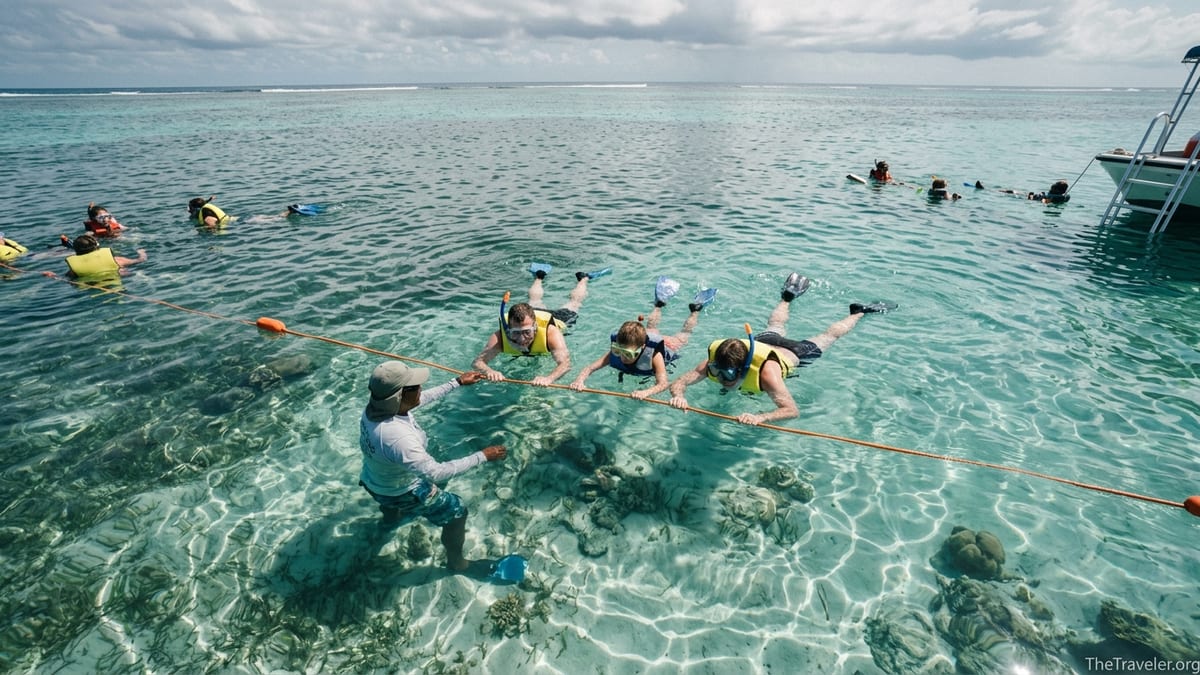
In practice, that eight-person limit is what keeps Hol Chan manageable even for hesitant swimmers. A good guide will stay in the water with you, demonstrate mask clearing at the surface, check that everyone’s fins and vests fit, and keep the group together across the channel. They will usually lead in single file, stopping every few minutes to point out a turtle, moray eel or big school of fish and to count heads. If you identify yourself as a weak swimmer when you book, many operators arrange to have you near the guide at all times or even hold onto a float rope that the guide tows.
The rules also cover behavior: no touching or chasing wildlife, no gloves, and no standing on coral. For beginners, staying relaxed and horizontal in the water naturally supports these rules. When you are anxious and constantly trying to push your feet down to stand, you are more likely to brush coral or kick someone else’s mask. Practicing in a pool or shallow hotel beach beforehand, just to get used to breathing through a snorkel while lying flat, can make the Hol Chan experience feel less overwhelming and more like a gentle sightseeing float.
Because Hol Chan is in a managed reserve, rangers patrol the area and tour operators pay conservation fees on your behalf. This means there is usually some level of on-site oversight, which offers an extra comfort layer for cautious guests. Still, your primary support is your guide and the crew of your specific boat, so choosing an operator that prominently mentions working with families, beginners or non-swimmers is worth the extra few minutes of research.
Boat Logistics: Getting In, Getting Out and Managing Seasickness
For first-time snorkelers, the moment of stepping off the boat can be as stressful as the swim itself. Most Hol Chan and Shark Ray Alley boats use a back ladder or side gate. Crew members typically sit guests down on the gunwale, fit masks and fins while they are still seated, then help them slide or step into the water one by one. If you are nervous about deep water, tell the crew before they start the entry process. They can arrange for you to be first or last in the water, and for the guide to wait right beside the ladder to greet and reassure you.
Climbing back on board is usually done on a metal or wooden ladder. You will be asked to take your fins off at the bottom rung and hand them to the crew, then climb up. This can feel awkward if you are tired, but the key is to move slowly and keep three points of contact on the ladder. Do not hesitate to ask for help; crew members are used to steadying guests by the elbow or arm as they step up. If knee or mobility issues make ladders difficult, raise this when you book. Some operators with larger catamarans can lower a wide, easier-to-climb swim platform, while small skiffs are more limited.
Seasickness is another real concern. The ride from San Pedro or Caye Caulker out to Hol Chan is short, but you can still encounter chop and side-to-side movement, especially on windy days. People who are fine on cruise ships sometimes feel queasy on smaller boats hovering at anchor while guests are in the water. If you know you are prone to motion sickness, consider taking a medication such as meclizine or dimenhydrinate about an hour before departure, after checking with a medical professional at home. Sit near the middle or stern of the boat, keep your eyes on the horizon and avoid heavy, greasy food beforehand.
If you start to feel unwell while snorkeling, signal the guide with a raised arm and return to the ladder early. Many travelers report that the combination of focusing down into the water and the gentle rocking at the surface triggered their queasiness at Hol Chan more than during the ride itself. Getting back on the boat, sipping water and sitting in the breeze can prevent a mild wave of nausea from becoming a trip-ruining experience.
Flotation, Swim Vests and Support for Nervous Swimmers
Hol Chan tours expect guests to have basic water comfort, but you do not need to be a strong lap swimmer. Nearly all operators carry snorkel vests or lifejackets, and many also provide noodle floats or tow floats. At check-in, you can ask specifically for a fully buoyant lifejacket instead of a thin inflatable snorkel vest if you want to float without effort. Some guides inflate beginners’ vests more fully and leave experienced swimmers’ vests partially deflated so they can duck dive.
A helpful approach for nervous swimmers is to float near the guide’s side or hold onto a float line attached to a lifebuoy. In a typical eight-person group, you might see one or two guests using such support at Hol Chan. That is not unusual and you should not hesitate to request the same. On Shark Ray Alley or Mexico Rocks trips, some operators assign an extra in-water assistant on busy days specifically to keep an eye on less confident swimmers and children.
If you have never used a snorkel before, practicing in a hotel pool or calm beach lagoon the afternoon before your tour can be a game changer. Put on your mask, practice breathing slowly through the snorkel with your face in the water and clear the snorkel by blowing out. Even twenty minutes of practice can mean that your brain is not processing everything as new when you enter the deeper water at Hol Chan. That familiarity is especially valuable when there is any current or when you are sharing the channel with multiple groups.
Some guests choose to skip the Hol Chan channel entirely and stay on board until the group reaches Shark Ray Alley, where the shallower, more protected feel is psychologically easier. Reputable guides accept this without pressure. A compromise many families use is to have a hesitant adult or child sit out the first five to ten minutes while the guide assesses the conditions and then decide together whether to enter. This staged approach can prevent panic and still give them a chance to experience the reserve.
Traveling with Children: What Parents Should Know
Families visit Hol Chan every day, and children regularly snorkel both the channel and Shark Ray Alley. Whether it is a good idea for your child depends more on their prior water experience than on their age alone. A confident eight-year-old who has practiced snorkeling in a pool and is comfortable in lifejackets may handle the channel better than a taller teenager who rarely swims. Before you book, honestly assess whether your child can float calmly on their stomach for several minutes and follow simple instructions in a group.
Discuss specific child-friendly options with your operator. Some companies running small-group tours from Ambergris Caye or Caye Caulker are happy to put families with children into a dedicated group, with the guide staying closer, swimming a shorter route in the channel and giving extra time at Shark Ray Alley. Others emphasize Mexico Rocks as their family focus, marketing it as suitable even for younger kids because of the shallow depths and gentle water. If you see this kind of language in an operator’s brochure or description, it usually reflects real experience supporting nervous or young swimmers.
On the day itself, bring child-size masks if possible. While most operators carry a range of gear, a mask that a child has already tried at a hotel pool or at home dramatically lowers the odds of leaks and frustration. Consider a shorty wetsuit or rash guard for warmth and sun protection; kids tend to get cold more quickly when floating still. Agree on a simple signal for “I want to go back to the boat” and make sure the guide knows that your child has permission to use it without embarrassment.
Be realistic about fatigue. A full morning that includes the Hol Chan channel, Shark Ray Alley and a third shallow stop, such as Coral Gardens, can be a lot for a ten-year-old. Many families find that a two-stop tour, or a Mexico Rocks-only trip of two to three hours, hits the sweet spot between adventure and overload. Boats often provide fresh fruit and water, but it is wise to pack a light snack that your child already likes and can stomach after time in the sea.
When Mexico Rocks Is the Better Choice
Mexico Rocks shines as the calmer alternative when your main goal is easy snorkeling rather than ticking off a bucket-list name. It is especially appealing in three situations: when you or your child are anxious in deep water, when you are traveling with mixed-ability groups including older relatives or non-swimmers, and when the wind forecast suggests choppy conditions on the reef. Because the reef here is a patch system inside the barrier, you can enjoy bright coral structures and schools of fish in a setting that feels more like a giant, sheltered pool.
Several Ambergris Caye resorts and independent tour operators describe Mexico Rocks in their materials as having waist to chest deep water with very little current, and as suitable for all skill levels. Prices are usually in the same range as Hol Chan tours, with a typical half-day group excursion costing roughly the equivalent of several dozen US dollars per adult, plus the marine reserve fee collected on board. You might not see the same concentration of nurse sharks and rays as at Shark Ray Alley, but you will likely spend more uninterrupted time floating over coral without worrying about drift or crowding.
If you decide that Hol Chan is too demanding, you do not have to miss out on swimming with sharks and rays entirely. Operators sometimes combine Mexico Rocks with other nearby shallow spots where stingrays regularly feed in the sand, or they may offer a separate Shark Ray Alley and Mexico Rocks itinerary that avoids the main channel. Ask specifically about these options when you book. This way, you can still enjoy the famous Hol Chan marine life mix without committing to the deeper, current-affected section of the reserve.
Do keep in mind the logistics. Mexico Rocks is typically reached from San Pedro rather than Caye Caulker, and the boat ride can be slightly longer, though still short by day-trip standards. For some travelers based in Caye Caulker, it makes sense to do Hol Chan and Shark Ray Alley from Caulker, then a separate Mexico Rocks tour if they spend a night on Ambergris Caye. Considering your base and transfer time will help you choose the option that feels relaxed rather than rushed.
What to Tell Your Operator Before You Book
Many of the most important safety decisions are made before you ever step on the boat. When you first contact a snorkel operator, be explicit about your swimming ability and expectations. Instead of simply saying “we are beginners,” offer detail such as “two adults who can dog paddle but get anxious in deep water, plus one child who is comfortable in a pool but has never snorkeled.” This level of information allows the operator to advise whether Hol Chan plus Shark Ray Alley, Mexico Rocks, or a private charter with tailored pacing is best.
Mention any relevant health conditions. If someone in your party has a history of panic in the water, asthma that flares with exertion, recent surgery, mobility limitations or strong susceptibility to seasickness, the operator needs to know. This is particularly important for Hol Chan’s channel, where getting a struggling snorkeler back to the boat may require guiding them against a mild current or through a cluster of other groups. Being upfront helps the staff assign an experienced guide, choose a calmer day, or recommend a gentler site.
Ask specific questions about safety measures. You might inquire whether they provide full lifejackets as well as snorkel vests, whether a second guide will be in the water on days with full boats, and how they handle guests who want to stay on board at one of the stops. Clarify group size and confirm that they follow the eight-snorkeler-per-guide rule inside the reserve. This both signals that you are informed and helps you avoid companies that prioritize volume over supervision.
Finally, discuss the day’s conditions. One day before your trip, call or message the operator and ask about the forecast, sea state and whether they expect stronger-than-usual current in the channel. Guides who are on the water daily are often frank about when Hol Chan is glassy and ideal for first-timers and when it might feel more like a workout. If they say “today the wind is up and the current is running hard in the cut,” taking their suggestion to postpone or switch to Mexico Rocks is almost always the wiser choice.
The Takeaway
Hol Chan is not an extreme snorkel site, but it is more demanding than many visitors expect, particularly in the channel where depth, current and crowding can challenge beginners and children. Shark Ray Alley, with its shallower, calmer water and focus on close-up encounters with nurse sharks and rays, usually offers a gentler introduction. Mexico Rocks, with its protected patch reef and easy depths, stands out as a strong alternative for families, older travelers and anyone uneasy in deep or moving water.
If you have basic water comfort, use a flotation vest, communicate openly with your operator and choose a calm morning, Hol Chan can be both safe and unforgettable, even for first-time snorkelers. The key is matching the site to your group’s real abilities rather than to a brochure image. By understanding the differences between the channel, Shark Ray Alley and Mexico Rocks, and by asking the right questions before you book, you can design a Belize snorkel experience that showcases the reef’s beauty without overwhelming the people in your party.
FAQ
Q1. Is Hol Chan suitable for someone who can swim but has never snorkeled before?
For many first-timers, Hol Chan is manageable if conditions are calm, they use a flotation vest and they stay close to the guide, but it can feel challenging on days with stronger current or chop. If you are anxious, pairing Hol Chan with Shark Ray Alley or choosing Mexico Rocks for your first outing is often a better way to build confidence.
Q2. Can non-swimmers snorkel at Hol Chan or Shark Ray Alley?
Non-swimmers can sometimes participate using lifejackets and holding onto a float line, but they rely entirely on the guide and conditions being gentle. At Hol Chan’s deeper channel this is more stressful, so many operators prefer to put true non-swimmers in at Shark Ray Alley or Mexico Rocks first, or suggest that they stay on the boat and simply watch the action.
Q3. How strong are the currents at Hol Chan, and will I have to fight them?
Current strength varies with tide and wind. On a light day you may barely feel movement and simply drift behind the guide, while on a stronger day you will need to kick steadily to stay with the group. It is important to ask your operator about that specific day’s conditions and not be shy about skipping the channel if they describe it as “running hard.”
Q4. Is Shark Ray Alley really easier than Hol Chan for kids and beginners?
Yes, in most conditions Shark Ray Alley is shallower and more sheltered, with less noticeable current and a clear view of the boat ladder at all times. Children and nervous adults often find it less intimidating, especially when using flotation jackets and staying very close to the boat and the guide.
Q5. When is Mexico Rocks a better choice than Hol Chan?
Mexico Rocks is usually better when you prioritize calm water over dramatic scenery, such as for nervous swimmers, families with younger children, older travelers or anyone who dislikes being in water deeper than they can stand. The patch reef there offers plenty of fish and coral in generally gentle, waist to chest deep water.
Q6. What should I tell a snorkel operator before I book a Hol Chan tour?
Explain your group’s swimming ability, any health or mobility issues, whether anyone is prone to seasickness or panic in water, and what kind of experience you want. Ask about group size, flotation options, the eight-snorkeler-per-guide limit and how they support beginners in the channel.
Q7. Are there age limits for children snorkeling at Hol Chan and Shark Ray Alley?
Most operators do not set a strict age limit but instead focus on whether a child can wear a mask, listen to instructions and stay calm in the water. Many families bring children eight and up into the channel and younger kids to Shark Ray Alley or Mexico Rocks, but final decisions rest on conditions and the child’s comfort level.
Q8. How can I reduce the risk of seasickness on a Hol Chan trip?
Choose a morning tour, avoid heavy food and alcohol beforehand, sit near the middle or stern of the boat and keep your eyes on the horizon. If you are prone to motion sickness, consider approved medication in advance and tell the crew, so they can seat you where the ride is smoothest and keep an eye on you.
Q9. Do I need my own snorkel gear or can I rent everything locally?
You can rent all essential gear from local operators, including mask, snorkel, fins and flotation. However, bringing your own well-fitting mask, especially for children or people with smaller faces, greatly reduces the chance of leaks and makes the experience more comfortable.
Q10. What happens if I panic or get tired while snorkeling at Hol Chan?
If you feel overwhelmed, signal the guide immediately by raising your arm. They can help you rest on a float, calm your breathing or escort you back to the boat. It is always acceptable to end your snorkel early and sit out the rest of the stop rather than pushing through discomfort or fear.