


Mexico attracts many international families with its proximity to North America, established expatriate communities, and relatively affordable urban centers. At the same time, the country is associated worldwide with organized crime, high-profile violence, and concerns about public security. For families evaluating a long-term relocation rather than a short visit, the central question is not whether Mexico is “safe” in absolute terms but whether identifiable regions, routines, and risk‑management practices can deliver an acceptable level of safety for daily family life.
National Safety Profile: Overall Crime and Violence Context
Mexico’s national security landscape is shaped by a combination of organized crime, drug trafficking, common theft, and localized political and social conflicts. By international standards, Mexico remains a high‑violence country, even though recent years have seen a modest downward trend in homicides. Government figures and aggregated international data indicate that Mexico’s intentional homicide rate has fallen from around the high‑20s per 100,000 inhabitants in the late 2010s to the low‑20s per 100,000 in recent years. Preliminary government announcements for 2025 suggest an additional decline to under 20 homicides per 100,000 people, the lowest level in roughly a decade, although analysts recommend interpreting these figures cautiously due to underreporting and classification issues.
For comparison, typical homicide rates in Western Europe are around 1 per 100,000 and in Canada around 2 per 100,000. Mexico’s rate is therefore several times higher than most advanced economies, though lower than the most violent countries in Latin America. In addition to lethal violence, victimization surveys report that a high proportion of residents feel unsafe in their city and routinely modify behavior, such as avoiding public transport at night or not wearing visible valuables. Families considering relocation must therefore understand that the baseline risk environment is structurally higher than in many traditional expat destinations.
Importantly, official crime data captures only part of the security picture. Mexico has several hundred thousand people internally displaced by criminal violence, and localized surges in homicides, disappearances, and extortion can occur when rival criminal groups clash. These dynamics rarely target foreign families specifically, but they shape the wider environment in which day‑to‑day life unfolds.
Regional and City-Level Risk Differences Relevant to Families
Risk in Mexico is highly uneven, and national averages can be misleading for relocation decisions. Some states report homicide rates comparable to or below those of major U.S. cities, while others have levels more typical of active conflict zones. For example, states such as Colima and certain municipalities in Michoacán and Zacatecas have recorded extreme homicide rates above 100 per 100,000 residents in recent years, driven largely by cartel competition over ports, trafficking routes, and local markets. These areas are widely regarded as unsuitable for family relocation and are frequently subject to travel restrictions for foreign government personnel.
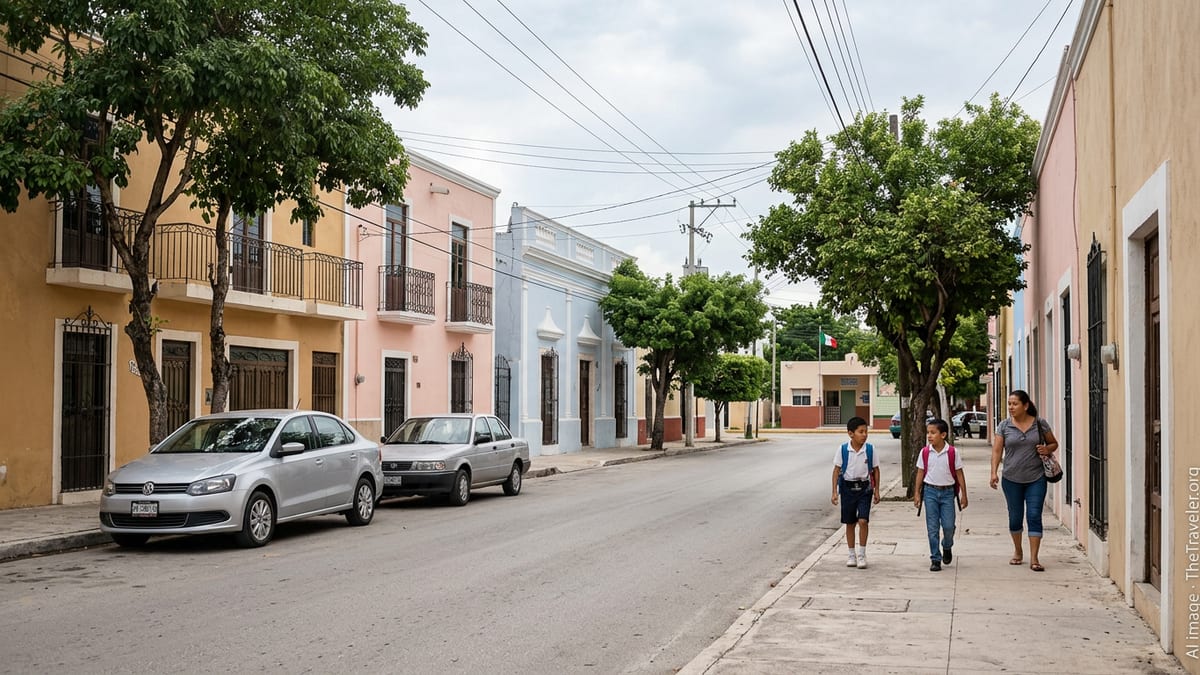
In contrast, a group of states and mid‑sized cities demonstrate markedly lower levels of lethal violence and more stable public security. Yucatán state, including the city of Mérida, has repeatedly reported homicide rates in the low single digits per 100,000 residents. Similarly, some central and Bajío‑region cities such as Querétaro and parts of Aguascalientes typically report rates nearer to or even below national averages for the United States. These locations also tend to have fewer reports of high‑impact crimes like kidnappings and cartel battles affecting civilian areas, which contributes to their reputation as more suitable for families.
Large metropolitan areas such as Mexico City, Guadalajara, and Monterrey present mixed profiles. Mexico City’s homicide rate in recent years has been estimated at roughly 10 per 100,000 inhabitants, which, while high by European standards, is lower than several major U.S. cities. Within these metros, safety can vary sharply between neighborhoods, with some districts experiencing relatively routine urban crime like pickpocketing and vehicle theft while others see more pronounced gang activity. For families, practical safety evaluations must therefore be made at city and sub‑city level rather than only by state.
Types of Crime That Most Commonly Affect Families
While headlines often focus on cartel‑related massacres and high‑profile attacks, families are more likely to encounter lower‑level but more frequent crimes. These include theft from vehicles, street robbery, burglary, and fraud. Victimization surveys in Mexico indicate that property crimes such as robbery, mugging, and vehicle‑related thefts are among the most commonly experienced offenses. Many residents respond by using secure parking, avoiding carrying large amounts of cash, and adopting routine situational awareness in public spaces.
Violent crimes with direct impact on civilians, including express kidnappings, carjackings, and assaults, do occur and are more prevalent in certain regions and along specific transport corridors. Foreigners are not the principal targets but may be affected, especially if they display visible signs of wealth or travel through higher‑risk areas at night. Families that depend on regular road travel between states or through rural zones near trafficking routes face elevated exposure to such risks compared with those living in well‑policed urban neighborhoods with limited need for long‑distance driving.
Cybercrime and fraud are also non‑trivial. Common patterns include card cloning at ATMs, online marketplace scams, and fraudulent rental or property listings. While these offenses are less physically threatening, they can disrupt relocation and erode confidence. Using reputable banks, secure payment channels, and verified housing intermediaries is a key part of a family’s broader safety strategy, even though these measures concern financial rather than physical security.
Public Security Institutions and Reliability of Protection
The reliability of law enforcement and justice institutions is central to family safety assessments. Mexico has invested in federal and state‑level security reforms, including the deployment of the National Guard and various professionalization efforts for police forces. However, structural weaknesses remain. Impunity rates for many serious crimes are high, meaning that a large proportion of offenses do not result in investigation or conviction. This weakens deterrence and undermines public trust in authorities, particularly in states with entrenched organized crime.
Police capability and integrity vary widely by jurisdiction. Some city and state forces are better trained, have more robust internal controls, and are perceived by residents as relatively professional. Others continue to struggle with corruption, infiltration by criminal groups, and limited investigative capacity. Families relocating to Mexico need to understand that calling the police may not always produce the rapid or thorough response expected in countries with stronger rule‑of‑law traditions, especially outside major urban centers.
At the same time, there are positive pockets. Certain states with lower homicide rates also exhibit more effective coordination between municipal police, state prosecutors, and community organizations. In these places, local governments often maintain preventive programs, neighborhood watch schemes, and better street lighting and surveillance systems. For foreign families, selecting jurisdictions with such institutional characteristics can significantly improve the practical level of safety, even if national data portrays a challenging overall picture.
Daily Life Risk Management for Expatriate Families
For families that do decide to relocate, day‑to‑day risk management practices are a decisive factor in real‑world safety outcomes. Long‑term expatriates in Mexico commonly adopt a set of behavioral norms that reduce exposure without severely constraining normal life. These include avoiding driving at night between cities, using toll highways instead of free roads where possible, keeping doors and windows secured, and varying routes and routines in areas known for higher crime.
In urban neighborhoods with established middle‑class and expatriate populations, residential buildings frequently offer controlled access, security guards, and perimeter fencing. This built environment mitigates certain threats such as opportunistic burglary and car theft. Families with children typically place strong emphasis on school transport arrangements, ensuring that daily routes are predictable, well‑lit, and do not pass through known trouble spots. Many schools and housing complexes maintain their own security staff and procedures, providing an additional layer of monitoring.
Social integration also plays a role. Building relationships with local neighbors, school communities, and other parents can improve situational awareness by providing informal information networks about emerging risks, demonstrations, or crime trends in specific streets or parks. Conversely, living in highly isolated enclaves with little local engagement can leave families more dependent on generic national news that may not reflect immediate neighborhood realities.
Differentiating Tourist Risk from Long-Term Residential Risk
Families often encounter conflicting narratives about Mexico’s safety: tourism promotion that emphasizes modern infrastructure and hospitality, and international headlines that highlight kidnappings, mass shootings, or cartel blockades. For relocation decisions, it is essential to distinguish between the risk profile of short‑term visitors who remain mostly in resort areas and that of residents who engage in routine activities such as commuting, grocery shopping, and school runs.
Major tourist zones with controlled access, like some coastal resort developments, tend to maintain relatively high security perimeters, frequent patrols, and strict access control. Violence that does occur in these areas often involves targeted incidents between criminal groups rather than random attacks on families staying in established complexes. However, long‑term residents typically spend less time inside such insulated spaces and more time navigating ordinary urban or semi‑urban environments where police visibility and informal social controls vary.
For families, the relevant question is therefore not whether a destination is marketed as “safe for tourists,” but whether everyday residential neighborhoods, commute routes, and nearby public spaces sustain acceptable levels of safety year‑round. Locations with strong tourist sectors can indeed be viable for families, but only if the underlying municipal security context and social cohesion support consistent low to moderate risk beyond hotel zones.
The Takeaway
Mexico presents a complex safety landscape for families considering relocation. At the national level, homicide and violent crime rates remain significantly higher than in many traditional expatriate destinations, and organized crime continues to drive episodes of extreme violence and forced displacement in several regions. Public security institutions are uneven, and impunity for serious offenses is common. These structural factors mean that Mexico cannot be classified as a uniformly safe destination for foreign families.
At the same time, risk is far from homogeneous. Some states and cities, particularly in the southeast and parts of the central highlands, record homicide rates close to or even below those of major North American cities and maintain relatively stable security conditions. Within large metropolitan areas, specific districts with stronger policing, community organization, and secure housing infrastructure can offer conditions that many international families consider acceptable, provided that careful neighborhood selection and prudent daily routines are observed.
For families, a practical assessment should combine macro indicators such as state‑level homicide rates and travel advisories with micro‑level due diligence on specific cities and neighborhoods. When relocation is focused on higher‑risk states or involves frequent inter‑city road travel through contested areas, the overall safety outlook becomes considerably less favorable. When concentrated in lower‑risk states with stronger institutions and supported by conservative personal security practices, long‑term residence in Mexico can be managed, but it is unlikely to match the safety levels of low‑crime countries. Ultimately, the decision depends on each family’s risk tolerance, the ability to choose a safer locality, and the discipline to maintain appropriate safeguards over time.
FAQ
Q1. Is Mexico generally safe for foreign families to live in?
Mexico as a whole has significantly higher violent crime and homicide rates than most developed countries, so it cannot be considered generally low risk. However, certain states and cities with lower crime levels and stronger local institutions can offer conditions many families find acceptable when combined with prudent daily security practices.
Q2. Which parts of Mexico are considered safer for families?
States such as Yucatán and some central and Bajío‑region cities, along with selected neighborhoods in large metropolitan areas like Mexico City, tend to report lower homicide rates and fewer high‑impact violent incidents. Even within these areas, safety should be evaluated at neighborhood level, considering factors like local policing, community cohesion, and housing security.
Q3. Are cartels a direct threat to expatriate families?
Cartels primarily target rival groups, local authorities, and specific economic sectors rather than foreign families. Nonetheless, their presence raises overall violence and can lead to blockades, shootouts, or extortion that indirectly affects residents. Families are at higher risk when living or traveling through areas where rival groups contest territory or where state presence is weak.
Q4. How does Mexico’s homicide rate compare to other countries?
Recent data indicates Mexico’s homicide rate is in the low‑ to mid‑20s per 100,000 inhabitants, several times higher than in Western Europe or Canada and multiple times higher than the global average. A small number of Mexican states, however, record much lower rates closer to those seen in safer countries.
Q5. Are children specifically targeted in crimes in Mexico?
Children are not typically targeted in an organized way, but they can be victims of collateral damage during violent incidents or affected by property crimes and robberies that involve their families. The main concern for parents is exposure to violence in public spaces, on school routes, or during transport rather than systematic targeting of minors.
Q6. How important is neighborhood choice for safety?
Neighborhood selection is critical. Within the same city, some districts may have relatively low crime, visible policing, secure housing, and active community networks, while others experience frequent robberies, gang activity, or weak infrastructure. Families should base decisions on granular local security information, not only on city or state reputation.
Q7. Is it safe to drive with a family across Mexico?
Risk on highways and rural roads is uneven. Some toll roads and corridors are widely used with relatively few incidents, while others see carjackings, armed robberies, or blockades linked to criminal groups. Families often reduce risk by limiting night driving, favoring busy toll roads, and avoiding known high‑risk regions for non‑essential travel.
Q8. Do foreign families need special security measures like guards?
Most foreign families in comparatively safer areas rely on standard precautions, such as secure housing, controlled access buildings, and careful route planning, rather than private guards. In higher‑risk states or for high‑profile individuals, some households employ additional measures, but these are not universal and should be evaluated based on specific risk exposure.
Q9. How reliable are police and emergency services in Mexico?
Response times and effectiveness vary considerably by location. In some cities, emergency services are reasonably reliable and professional, while in others capacity constraints and corruption issues reduce effectiveness. Families should understand local norms, including average response times, and may wish to identify reputable private medical and security providers as a supplementary resource.
Q10. Can Mexico ever be as safe as my home country?
For families coming from low‑crime countries, overall risk in Mexico will usually remain higher, even in safer states or neighborhoods. However, with careful location selection and disciplined safety habits, many families manage to maintain an acceptable risk level for their circumstances. The key question is not absolute parity with the home country but whether the mitigated risk aligns with the family’s tolerance and priorities.