


For decades, Nagorno-Karabakh was known more to diplomats and conflict reporters than to leisure travelers. A mountainous enclave internationally recognized as part of Azerbaijan but long controlled by ethnic Armenian authorities, it briefly attracted a trickle of adventurous visitors interested in offbeat wine routes, Soviet-era cable cars, and monastery-studded valleys. Since late 2020, and especially after the lightning Azerbaijani offensive in September 2023 and the subsequent exodus of almost all ethnic Armenians, the region has changed beyond recognition. Anyone wondering whether Nagorno-Karabakh is safe to visit now needs to understand that they would be entering a heavily militarized, politically sensitive area that is still absorbing the aftermath of war and mass displacement.
Get the latest updates straight to your inbox!
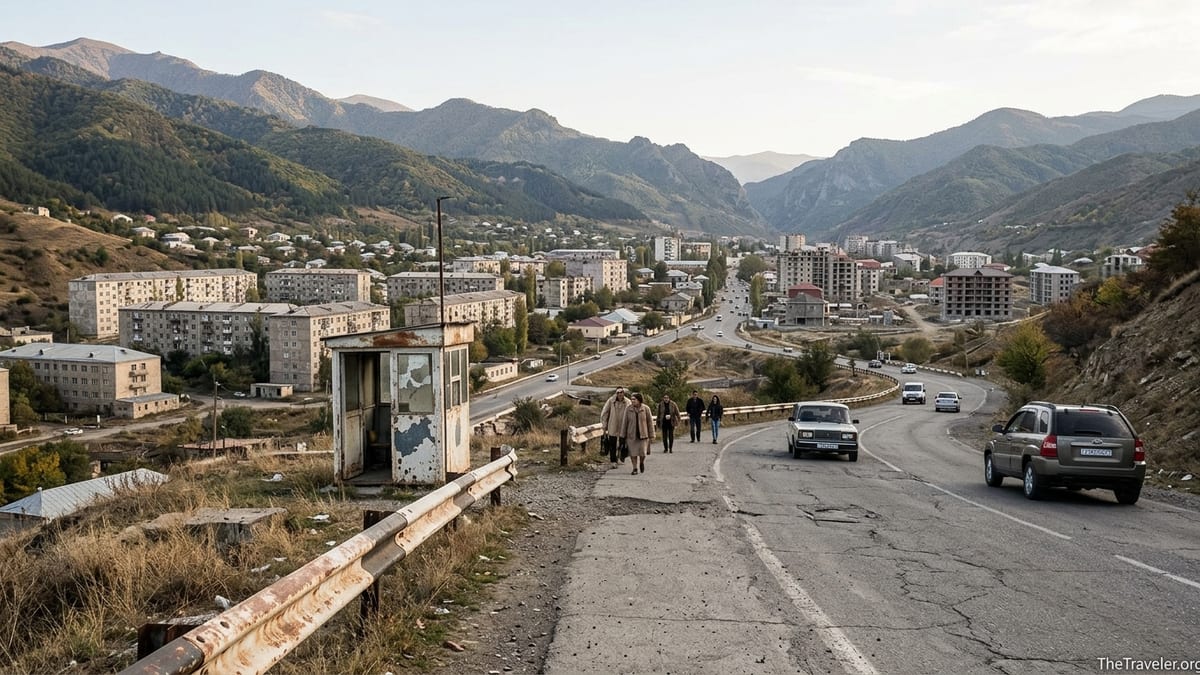
The New Reality in Nagorno-Karabakh After 2023
Until 2020, most foreign visitors who made it to Nagorno-Karabakh did so from Armenia, driving from Yerevan through the resort town of Dilijan and the border city of Goris before crossing into what was then the self-proclaimed Republic of Artsakh. Guesthouses in the de facto capital Stepanakert, such as small family-run bed-and-breakfasts around Renaissance Square, catered to a niche mix of diaspora Armenians, hikers, and conflict-curious travelers. That infrastructure effectively disappeared after Azerbaijan retook most of the territory in the 2020 war and completed its military takeover in September 2023.
The decisive moment came when Azerbaijani forces launched a rapid offensive on September 19, 2023, leading to the capitulation of local Armenian authorities within about 24 hours. Within days, almost the entire Armenian population of Nagorno-Karabakh, estimated at around 100,000 to 120,000 people, fled along the mountain road toward Armenia. International media described traffic jams stretching for many kilometers as families queued for fuel in Stepanakert and then crawled past the Azerbaijani checkpoint on the Lachin road en route to the Armenian town of Goris. The exodus left formerly Armenian-inhabited cities and villages nearly empty.
Since then, Azerbaijan has asserted full political and security control over the area, and the Armenian-backed de facto government has formally announced its dissolution. What this means in practice is that any present-day travel to Nagorno-Karabakh is, as far as Baku is concerned, travel inside the sovereign territory of Azerbaijan, subject to Azerbaijani law, border rules, and security restrictions. At the same time, most Western governments still advise against any travel to the region because of unresolved tensions, the risk of landmines, and the absence of consular access. The combination makes Nagorno-Karabakh fundamentally different from destinations where a ceasefire has produced something like normality.
How Access Works Now: Borders, Checkpoints, and Permissions
Before 2020, the practical way in was via Armenia’s Syunik province, on a highway that snaked from Goris into Nagorno-Karabakh. That road, once known to backpackers as a slightly hair-raising but beautiful mountain drive, is now controlled by Azerbaijani forces. A fortified checkpoint on what used to be the Lachin corridor regulates all movement, and the link that functioned as Nagorno-Karabakh’s lifeline to Armenia is no longer an open transit route for ordinary passengers.
Any legal visit today would have to be coordinated with Azerbaijani authorities. In practice, this typically means arranging travel through Baku, applying for any required special permits, and traveling with either an approved local fixer, a tour operator, or under the umbrella of some institutional visit such as a press tour or humanitarian mission. Travelers cannot simply “show up” at the old crossing near Goris and expect to be admitted. If you were to try to drive from Armenia to the former Karabakh capital (known as Stepanakert in Armenian and Khankendi in Azerbaijani), you would encounter a closed frontier rather than a functioning international checkpoint.
Even entering Azerbaijan itself may be complicated if you have past Armenian visas or Nagorno-Karabakh entry stamps in your passport. In previous years, Azerbaijani border guards sometimes refused entry to foreigners whose passports showed visits to the region made without Baku’s authorization. Travelers who visited Nagorno-Karabakh from Armenia in, say, 2018 and still carry the same passport should be prepared for additional questioning on arrival in Baku, and in some cases may be denied entry altogether. While individual experiences vary, it is important to treat immigration rules here as much stricter than in places where political sensitivities are low.
Security on the Ground: Military Presence, Tensions, and Landmines
The biggest question for any potential visitor is whether the region is physically safe. The answer depends on what one means by “safe.” The full-scale battles of 2020 and the 2023 offensive have stopped, and by mid-2024 there were no open front-line clashes at a large scale in the region itself. But the area remains heavily militarized, layered with multiple security forces, and shaped by a recent history of shelling, drone strikes, and sniper fire. That environment is fundamentally different from, for example, visiting a post-conflict city like Sarajevo decades after the Bosnian war, where scars remain but active military deployments are minimal.
For civilians, the most concrete, daily risk is unexploded ordnance. Both sides used artillery, rockets, and drones across the region, and large swaths of countryside and former trench lines remain contaminated by landmines and cluster munition remnants. International demining organizations have documented extensive minefields in former front-line areas such as the districts around Fizuli and Jabrayil, south of the traditional Nagorno-Karabakh heartland, and similar risks exist around old defensive positions elsewhere. Unlike established trekking destinations, there are no systematically marked hiking trails with reliable signage to indicate cleared versus uncleared areas.
Another layer of risk involves unpredictable local incidents. The ceasefire lines between Armenia and Azerbaijan and along the broader border area have seen sporadic shootings and detentions. While these usually involve soldiers rather than tourists, the possibility of sudden flare-ups is one reason Western foreign ministries classify the entire area as high-risk. An independent traveler who drives into a rural area to photograph abandoned farmhouses or monastery ruins could, in theory, find themselves stopped by soldiers or police and questioned about their purpose, especially if they are near sensitive infrastructure such as military bases or newly built roads.
Legal, Political, and Ethical Considerations for Travelers
Beyond physical security, there are legal and ethical aspects that any traveler should consider. From the standpoint of international law and most Western governments, Nagorno-Karabakh is part of Azerbaijan. Entering the region from Armenia without Azerbaijani permission was previously considered an illegal border crossing by Baku. Although the Armenians who administered the region issued their own visas and entry stamps in Stepanakert, those documents were never recognized internationally. Travelers who once treated a Karabakh visa as an offbeat souvenir found that it could later complicate attempts to visit Azerbaijan.
Now that Azerbaijan controls the territory directly, any travel to the region will effectively be travel under Azerbaijani jurisdiction. That means your rights will be defined by Azerbaijani law, including laws on public assembly, speech, and contact with local communities. Journalists planning to report on sensitive topics such as the treatment of former Armenian homes, the status of churches and cemeteries, or the prospects for any Armenian return should expect scrutiny. In the past, foreign reporters who were perceived as critical have faced restrictions inside Azerbaijan, and a similar pattern could apply here.
There is also the ethical question of traveling to a place that has just experienced the mass displacement of its population. In late 2023 and early 2024, human rights organizations and legal experts argued that the exodus of Armenians from Nagorno-Karabakh amounted to forcible transfer or worse. Walking through empty streets of once Armenian-majority towns that are now in transition could mean photographing people’s former homes or religious sites while questions about their protection and ownership remain unresolved. For many would-be visitors, this alone is a reason to postpone any nonessential travel until the political and humanitarian picture is clearer.
On-the-Ground Realities: Infrastructure, Services, and Daily Life
Even if a traveler secures the necessary permissions and accepts the security and ethical trade-offs, they must grapple with the region’s limited tourism infrastructure. Before the 2020 war, Stepanakert had a handful of mid-range hotels with nightly rates roughly comparable to a three-star property in Yerevan, as well as cafes serving local wine and traditional dishes like khorovats grilled meats. Many of those establishments either closed during the wars and blockade or were left behind when their owners fled. Today, whatever guesthouses or hotels function in the main towns are likely to be catering more to construction crews, state employees, or military personnel than to leisure tourists.
Roads, electricity, and telecommunications are also in a process of rapid change. Azerbaijan has invested heavily in new highways and airports in previously contested areas, particularly to connect them more directly with Baku and other Azerbaijani cities. Travelers arriving a few years from now may find freshly paved multi-lane roads where old Soviet-era two-lane highways once ran. At the same time, they should not expect the kind of predictable services associated with more established destinations. Power supply and mobile coverage can be patchy in rural stretches, and sudden road closures for security reasons are not uncommon in recently reintegrated territories.
Medical and emergency services are another practical concern. In a typical European mountain destination, a traveler who sprains an ankle on a hike might call a well-established rescue service and reach a reasonably well-equipped regional hospital. In Nagorno-Karabakh, access to modern medical facilities could be limited, and language barriers may complicate communication about insurance or consent forms. Evacuation to Baku or Yerevan in a true medical emergency would be logistically and politically sensitive, given the still-tense relations across the region.
Alternative Ways to Experience the Caucasus Responsibly
Given the current realities in Nagorno-Karabakh, most independent travelers are likely to conclude that it is not an appropriate destination for leisure travel in the near term. That does not mean, however, that the broader South Caucasus is off limits. Many of the experiences that once drew visitors to the enclave can be found, sometimes in more developed form, in safer parts of Armenia, Azerbaijan, and Georgia.
Travelers interested in mountain scenery and monasteries similar to those on the old Karabakh tourist circuit can explore Armenia’s Tatev Monastery via the Wings of Tatev cable car in Syunik province or hike through the Debed Canyon near the UNESCO-listed monasteries of Sanahin and Haghpat. Accommodation options in these regions range from simple family guesthouses, where a night’s stay including homemade breakfast might cost roughly the price of a mid-range restaurant meal in Western Europe, to modern boutique hotels with polished wine lists.
On the Azerbaijani side, those curious about culture and history might focus on accessible regions like Sheki, with its restored Khan’s Palace and traditional caravanserai hotel, or the mountain villages around Quba and Lahij that showcase local crafts. Visits here can be arranged through reputable Baku-based tour companies that offer clear itineraries, English-speaking guides, and transparent pricing. Georgia, meanwhile, provides a more established tourism scene, with Tbilisi’s cafe culture, the vineyards of Kakheti, and the high mountain villages of Svaneti offering a rich Caucasus experience without crossing into active or recently active conflict zones.
The Takeaway
For the foreseeable future, Nagorno-Karabakh remains a region defined more by unresolved political questions and humanitarian aftermath than by any form of normal tourism. The combination of heavy militarization, extensive landmine contamination, limited civilian services, and deep sensitivities around displacement means that independent travel is both difficult and, in many cases, inappropriate. Most Western governments advise against visiting, and even seasoned conflict travelers would need to weigh carefully whether their presence could complicate local dynamics or their own legal and personal safety.
Prospective visitors to the South Caucasus who are simply looking for mountain landscapes, ancient monasteries, and rich hospitality will find safer, more welcoming alternatives in other parts of Armenia, Azerbaijan, and Georgia. Those whose interest is specifically in Nagorno-Karabakh’s recent history may be better served, at least for now, by engaging through research, journalism, or support for reputable humanitarian and cultural heritage organizations rather than by trying to go in person. Until the political settlement is clearer, rights of return are addressed, and demining and reconstruction have progressed significantly, Nagorno-Karabakh is best regarded not as a travel destination but as a region in recovery where caution and respect must come first.
FAQ
Q1. Is Nagorno-Karabakh currently open to foreign tourists?
Foreigners cannot freely visit Nagorno-Karabakh as casual tourists. Any visit would need to be coordinated with Azerbaijani authorities and is typically limited to tightly controlled or official trips.
Q2. Can I enter Nagorno-Karabakh from Armenia like travelers used to do?
No. The former route from the Armenian town of Goris through the Lachin corridor is now controlled by Azerbaijan and is not open as a normal crossing for tourists.
Q3. Is it safe to travel to Nagorno-Karabakh if I go with a local guide?
Travel with a vetted local guide reduces certain risks but does not remove core problems like landmines, military restrictions, and political sensitivities. Most travelers are still advised not to go.
Q4. What are the main physical dangers in Nagorno-Karabakh right now?
The primary dangers include unexploded landmines and ordnance, potential military incidents, restricted access to emergency medical care, and sudden changes in security conditions.
Q5. Will having an Armenian stamp or an old Nagorno-Karabakh visa in my passport cause problems?
It can. Azerbaijan has previously denied entry or questioned travelers whose passports showed unapproved visits to Nagorno-Karabakh. Renewing your passport before visiting Azerbaijan may be prudent.
Q6. Are there any organized tours to Nagorno-Karabakh?
Some operators in the region monitor possibilities for tightly controlled trips under Azerbaijani oversight, but regular leisure tours are not widely available and may be cancelled on short notice.
Q7. What do Western governments advise about traveling to Nagorno-Karabakh?
Most Western foreign ministries currently advise against all travel or all but essential travel to Nagorno-Karabakh and nearby border areas due to security and landmine risks.
Q8. Could travel to Nagorno-Karabakh be seen as taking a political side?
Yes. Given the recent mass displacement and ongoing disputes, visiting can easily be interpreted as a political statement, regardless of your personal intentions.
Q9. If I want to experience the culture and landscapes once associated with Nagorno-Karabakh, where else can I go?
You can explore mountainous regions and historic sites in safer parts of Armenia, Azerbaijan, and Georgia, such as Syunik, Sheki, or Svaneti, which offer similar scenery and traditions.
Q10. When might Nagorno-Karabakh become a normal travel destination again?
There is no clear timeline. It would require lasting political agreements, extensive demining, reconstruction, and a stable security environment before mainstream tourism could be considered.