


For decades, Nagorno Karabakh and Armenia were spoken of in one breath, especially by travelers interested in the South Caucasus and Armenian history. Today the picture is very different. After the lightning offensive by Azerbaijan in September 2023 and the dissolution of the self-proclaimed Republic of Artsakh in January 2024, almost the entire ethnic Armenian population of Nagorno Karabakh has fled to Armenia. What was once a living Armenian cultural landscape inside Azerbaijan has become extremely difficult to access, heavily militarized, and politically sensitive. For travelers seeking a meaningful cultural experience with strong historical context, this raises a complex question: is it Nagorno Karabakh’s scarred landscape or Armenia itself that now offers the deeper insight into Armenian history and identity?
Get the latest updates straight to your inbox!
Understanding the New Reality in Nagorno Karabakh
Any cultural comparison between Nagorno Karabakh and Armenia needs to start with the basic fact that Nagorno Karabakh no longer functions as an Armenian-run destination. After Azerbaijan’s September 2023 offensive, the de facto authorities agreed to disarm and dissolve their institutions, and on 1 January 2024 the self-proclaimed Republic of Artsakh was formally dissolved. In the following days and weeks, more than 100,000 ethnic Armenians fled along the Lachin corridor toward Armenia, effectively emptying the region of its Armenian civilian population.
On the ground this means that places that once shaped backpacker narratives about Nagorno Karabakh, such as the former capital Stepanakert, the mountain town of Shushi, and monasteries like Gandzasar and Dadivank, are now under Azerbaijani control. Access for foreign visitors is tightly controlled by Baku, security conditions can change quickly, and independent cultural tourism is not encouraged in the same way Armenia promotes its own heritage. Many governments advise against all but essential travel to parts of the region, and insurance coverage can be limited or excluded entirely.
For a culturally focused traveler, this has two key implications. First, you should not think of Nagorno Karabakh today as an extension of Armenian cultural space you can simply “add on” to an Armenian itinerary; politically and practically it is part of Azerbaijan. Second, any visit, if it proves possible, is less about immersive Armenian community life and more about witnessing a post-conflict landscape where Armenian heritage sites, cemeteries, and churches exist in a new and uncertain custodial reality.
Because of these constraints, most travelers looking to understand the history and culture associated with Nagorno Karabakh now do so from Armenia, meeting displaced families in Yerevan or provincial towns, visiting museums and memorials, and tracing the story through Armenian historical sites rather than by entering the territory itself.
Armenia as a Living Museum of Armenian History
Unlike Nagorno Karabakh, Armenia is a compact, accessible country where historical context is woven into everyday life. Yerevan, the capital, makes this immediately apparent. Stand in Republic Square at dusk and you are surrounded by rose-tinted Soviet-era architecture, dancing fountains, and a skyline of construction cranes that speak to Armenia’s rapid change. A short walk away, the History Museum of Armenia and the National Gallery frame thousands of years of material culture, from Urartian bronze shields to medieval khachkars, in a setting that most travelers can explore in half a day.
Beyond the capital, Armenia’s cultural depth is concentrated in its monasteries and churches. UNESCO-listed complexes such as Haghpat and Sanahin in the Debed Valley, or Geghard Monastery carved into a cliff in the Azat River gorge, are not simply picturesque stops; they are milestones in Armenian theological and intellectual history. Many visitors join day trips from Yerevan that combine Geghard with the nearby Greco-Roman Garni Temple, letting them see how pre-Christian and Christian traditions sit back-to-back in the landscape.
The spiritual center of Armenia lies in Etchmiadzin, about 20 kilometers from Yerevan, often visited on a half-day excursion by taxi or organized tour. The Etchmiadzin Cathedral complex, another UNESCO site, is considered one of the earliest Christian cathedrals in the world and is the seat of the Catholicos, head of the Armenian Apostolic Church. Attending a Sunday liturgy, even for a brief period at the back of the church, offers a vivid sense of continuity; the incense, chanted liturgy in Classical Armenian, and the presence of families with small children all speak to a living tradition rather than a museumified past.
Practically, Armenia is easy to navigate for this kind of cultural tourism. A traveler might base themselves in Yerevan for several days, joining reasonably priced small-group trips to sites like Khor Virap under the shadow of Mount Ararat, or taking intercity minibuses to regional hubs like Gyumri or Dilijan. Accommodation runs from family guesthouses to international hotels, and it is perfectly realistic to construct an itinerary where every day involves direct engagement with pre-Christian ruins, medieval monasteries, or Soviet modernist landmarks.
Nagorno Karabakh: Memory, Absence, and Heritage at Risk
Even if most travelers will not set foot in Nagorno Karabakh today, the region remains central to how Armenians think about their history. For decades it was home to some of the most treasured Armenian monasteries and khachkar fields outside the borders of the Republic of Armenia. Churches such as Dadivank, Gandzasar, and the cathedral in Shushi were integral to Armenian pilgrimage routes from Armenia and the diaspora, and their images still appear in Armenian homes and cafes.
Since Azerbaijan’s takeover, the fate of Armenian heritage in the region has become a subject of intense international concern. Satellite-based monitoring by academic projects and reports by human rights and heritage organizations point to previous destruction of Armenian cemeteries and churches in adjoining regions that came under Azerbaijani control after the 2020 war, and they warn of similar risks for monuments in Nagorno Karabakh. For travelers whose interest lies in cultural preservation, this shifts Nagorno Karabakh from being a place to visit into a case study: it is something to research, to follow in the news, and to discuss with locals and experts in Armenia, rather than a straightforward destination.
The human dimension of this story is now largely visible in Armenia itself. Many of Nagorno Karabakh’s former residents live in and around Yerevan, as well as in provincial towns and villages where the government and aid groups have worked to provide housing and services. A traveler might encounter a Karabakh Armenian taxi driver in Yerevan who speaks a slightly different dialect of Armenian, or stay in a guesthouse run by a family who arrived in late 2023. Conversations over coffee or homemade apricot jam can quickly move from small talk into deeply personal narratives of displacement and loss.
In this sense, the “cultural experience” of Nagorno Karabakh for travelers has become more abstract but no less powerful. It is encountered through oral history, photographs, and contested narratives about heritage and identity. It is carried in songs performed in Yerevan’s small music clubs, in exhibitions on the recent wars hosted at local galleries, and in the way many Armenians describe their national story as one of repeated uprooting and survival.
Depth of Historical Context: Armenia’s Monasteries, Museums, and Urban Fabric
When measuring which destination offers more historical context in practice, Armenia holds a clear advantage because its heritage is accessible, layered, and officially curated for visitors. In the capital alone, a traveler can move from the Matenadaran manuscript institute, with its collection of illuminated Gospels and scientific treatises, to the Tsitsernakaberd Armenian Genocide Memorial and Museum, which situates 20th-century trauma in a longer narrative of survival. Both institutions provide English-language displays and often guided tours, allowing non-specialists to connect historical episodes to the present.
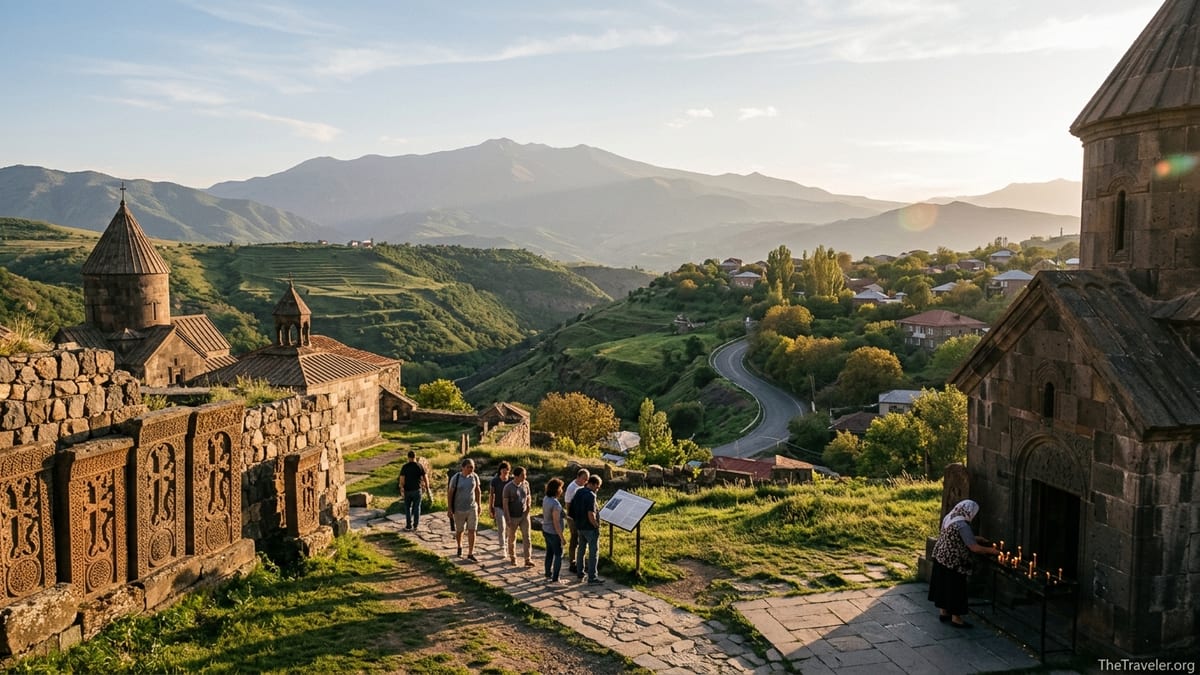
Outside Yerevan, the built landscape functions as a continuous timeline. In the wine village of Areni, travelers visit a working winery and nearby cave complex where archaeologists uncovered some of the world’s oldest known winemaking installations and leather shoes. Further south, near the Iranian border, the Tatev Monastery stands on a plateau reached by a long cable car line from the Vorotan Gorge; here, ninth-century monastic life, Soviet-era engineering, and modern tourism intersect in a single panorama.
Even Armenia’s smaller cities tell complex stories. Gyumri, badly damaged in the 1988 earthquake, combines 19th-century Russian imperial architecture with black tufa stone houses and pockets of Soviet modernism. Walking tours often include stops at traditional artisan workshops where blacksmiths and woodcarvers discuss how their crafts survived both economic collapse and natural disaster. In Dilijan, a forested town in the north, eco-lodges and artist residencies coexist with medieval monasteries like Haghartsin and Goshavank, which have been restored with international support.
All of this makes Armenia unusually effective at providing historical context to visitors. Monasteries and archaeological sites are typically interpreted through signage and, increasingly, through local guides who can connect a 10th-century inscription to present-day religious practice, or explain how Soviet policies reshaped village life. In contrast, whatever survives in Nagorno Karabakh is now embedded in a closed and contested environment where outside interpretation is restricted and the Armenian community that once gave those sites meaning has departed.
Cultural Immersion: Daily Life, Food, and Living Traditions in Armenia
Beyond monuments and museums, Armenia offers something that Nagorno Karabakh can no longer provide on any meaningful scale: immersion in Armenian daily life. In Yerevan’s Vernissage market, visitors browse hand-carved chess sets, traditional carpets, and Soviet memorabilia while chatting with vendors who will often explain the symbolism in carpet motifs or the stories behind certain khachkar designs. Evening strolls along Northern Avenue lead to wine bars pouring glasses of Areni and Voskehat varietals, sometimes accompanied by live folk or jazz performances.
Food is another entry point into Armenia’s historical story. In many restaurants and village homes, dishes like tolma, khorovats grilled meats, and lavash flatbread are presented as part of a long culinary lineage. Lavash baking in particular has been recognized by UNESCO as intangible cultural heritage, and travelers can join experiences in villages around Yerevan where they help slap thin sheets of dough onto the hot wall of a tonir clay oven, then share the bread with fresh herbs and cheese. These hands-on encounters turn abstract ideas about “heritage” into sensory memories of smell, taste, and touch.
Village guesthouses deepen this sense of continuity. Staying with a family in a village near Lake Sevan or in the Lori region, visitors might help harvest apricots, taste homemade mulberry vodka called tuti oghi, or watch grandparents teaching children traditional circle dances during a family celebration. Many of these families include relatives from Nagorno Karabakh or other historically Armenian regions now outside the republic’s borders, and conversations naturally weave personal and national histories together.
Urban culture also plays a role. Yerevan’s small theaters and music venues regularly host performances that reflect on war, migration, and identity. A traveler might attend a contemporary play about the post-Soviet transition, followed the next night by a concert of traditional duduk music in a converted factory space. The range of experiences, and the ease with which a visitor can move between them, mean that Armenia provides not just historical information but a living, evolving cultural context.
Ethical and Practical Considerations for Visiting Nagorno Karabakh
If you are considering whether to attempt a visit to Nagorno Karabakh today, ethical and practical questions should be central. First is safety. The region has experienced multiple wars since the early 1990s, and although there may be periods of calm, the militarized environment and unresolved political tensions create a level of unpredictability that most cultural travelers will find difficult to justify, especially when rich alternatives exist within Armenia itself.
Second is the issue of access and control. Any visit would now be arranged under Azerbaijani jurisdiction, potentially as part of tightly managed group itineraries that emphasize certain narratives over others. Independent movement, in-depth documentation of Armenian heritage sites, or unsupervised conversations with local residents could be limited or discouraged. For travelers interested in balanced understanding and responsible tourism, this lack of autonomy can undercut the very purpose of the trip.
Third are the ethics of presence in a place where a recently displaced population has barely begun to rebuild their lives elsewhere. Many of the Armenians who left Nagorno Karabakh now live in temporary housing or are still adapting to new communities in Armenia. Some may feel that leisure tourism to their former hometowns, conducted without their participation or consent, trivializes their recent trauma. Listening to and supporting these communities in Armenia, whether by staying in their guesthouses, buying their crafts, or simply hearing their stories, may be a more constructive way to engage with Nagorno Karabakh’s legacy.
Given these factors, most culturally focused travelers will find that the more responsible and rewarding choice is to explore Nagorno Karabakh as a subject of study and conversation while physically traveling in Armenia, rather than attempting to reach the region itself.
The Takeaway
When comparing Nagorno Karabakh and Armenia as cultural destinations, the key distinction is between a largely inaccessible, post-conflict landscape and a small but dense country that actively curates and celebrates its heritage. Nagorno Karabakh once offered visitors direct access to Armenian communities and monuments outside Armenia’s borders, but after 2023 it has become a space of absence, risk, and politically charged narratives. Armenia, by contrast, concentrates millennia of history into a territory that travelers can navigate in a matter of days or weeks, moving from prehistoric sites to medieval monasteries, from Soviet-era memorials to contemporary art spaces.
For travelers seeking historical context, Armenia clearly offers more: UNESCO-listed monasteries where liturgy is still sung, museums that frame regional history in multiple languages, markets and village homes where traditions are practiced rather than displayed, and a society that is openly processing recent events in Nagorno Karabakh. The stories of that contested region are very much alive in Armenia’s streets, galleries, and homes, even if the physical territory is out of reach.
Ultimately, the most meaningful way to engage with both Armenia and Nagorno Karabakh today is to travel in Armenia with curiosity and sensitivity, to listen more than you speak, and to recognize that every church, wine cellar, and family kitchen may hold layers of memory that stretch well beyond current borders. In doing so, you will find that Armenia itself, rather than the physically distant and politically fraught landscapes of Nagorno Karabakh, offers the deeper, more responsible cultural experience.
FAQ
Q1. Is it currently possible for foreign tourists to visit Nagorno Karabakh?
Access is controlled by Azerbaijan and conditions can change quickly, so most governments advise extreme caution. Independent cultural tourism is very difficult and often not realistic for ordinary travelers.
Q2. Can I still experience Nagorno Karabakh’s Armenian culture without going there?
Yes. Many former residents now live in Armenia, where their stories, dialect, food, and traditions are part of daily life in Yerevan and regional towns.
Q3. Which Armenian sites provide the best historical overview for first-time visitors?
Etchmiadzin Cathedral, the Matenadaran in Yerevan, Geghard Monastery and Garni Temple, and the genocide memorial at Tsitsernakaberd together offer a strong introduction.
Q4. How many days should I spend in Armenia for a culture-focused trip?
A week allows you to explore Yerevan plus key sites like Etchmiadzin, Geghard, Garni, Khor Virap, and at least one regional hub such as Dilijan or Gyumri.
Q5. Is it ethical to visit areas of Nagorno Karabakh under Azerbaijani control?
Opinions differ, but many travelers and Armenians question the ethics of leisure tourism in a recently depopulated conflict zone, especially while displaced people are still resettling.
Q6. Are Armenia’s main cultural sites easy to reach without renting a car?
Yes. Many monasteries and landmarks can be visited on organized day tours from Yerevan or by using intercity minibuses combined with local taxis.
Q7. What is the best time of year to visit Armenia for cultural travel?
Late spring and early autumn usually offer mild weather, clear views of the mountains, and comfortable conditions for exploring monasteries and walking city streets.
Q8. Can I learn about the recent conflicts in museums or exhibitions in Armenia?
Several museums and smaller galleries in Yerevan include exhibits on the wars over Nagorno Karabakh and on more recent displacement, often with English explanations.
Q9. How should I talk about Nagorno Karabakh with locals in Armenia?
Approach the topic gently, be prepared for strong emotions, and let people decide how much they want to share. Listening respectfully is usually appreciated.
Q10. If I am mainly interested in history, should I focus my trip on Armenia rather than trying to reach Nagorno Karabakh?
Yes. Armenia offers abundant, accessible historical sites and living traditions, while Nagorno Karabakh is hard to access, heavily politicized, and not suited to casual cultural tourism.