


Nice Côte d’Azur Airport is the main gateway to the French Riviera, handling millions of passengers a year and serving everyone from summer holidaymakers to Monaco regulars. For a first-time visitor, any unfamiliar airport can feel intimidating. The good news is that Nice is compact by international standards and, with a bit of advance knowledge, surprisingly straightforward to navigate. This guide walks you through what it is like to arrive, depart, and connect at Nice Airport for the very first time, using up-to-date local details and real examples to help you feel confident before you land.
Get the latest updates straight to your inbox!
How Nice Airport Is Laid Out
Nice Côte d’Azur Airport sits just west of the city, squeezed between the Mediterranean and the Promenade des Anglais. It is France’s third-busiest airport, but its footprint is closer to a large regional hub than a mega-airport. That scale works in your favor as a newcomer. Instead of sprawling piers and multiple satellite terminals, you will find two main passenger terminals and clear separation between arrivals, departures, and ground transport.
Terminal 1 is the older and smaller of the two. It mostly handles low-cost and European carriers such as easyJet, Transavia, and Vueling, along with some seasonal services. It has a compact ground-floor arrivals hall and a central security checkpoint feeding two main gate zones. Terminal 2 is newer and larger, handling many full-service airlines including Air France, British Airways, Emirates, and major SkyTeam partners. If you are arriving on a long-haul flight from North America or the Middle East, you will almost certainly use Terminal 2.
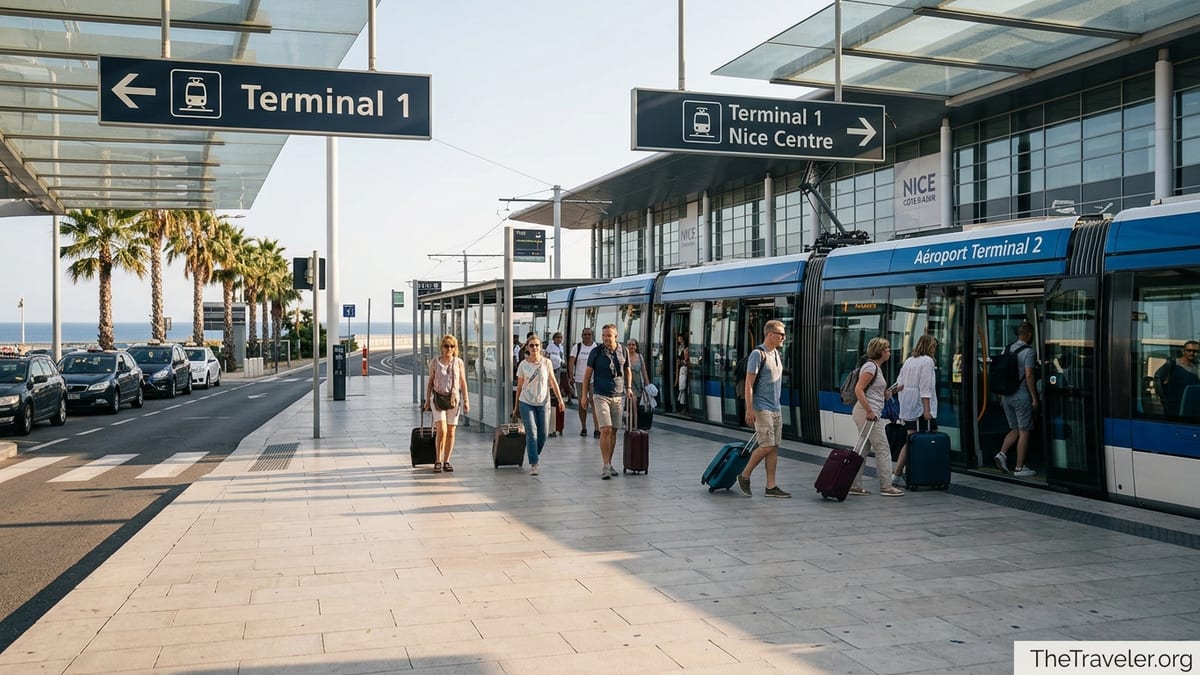
The distance between the terminals is short enough that they function as one campus rather than two separate airports. A free tram shuttle links Terminal 1 and Terminal 2, and there are clear roadside signs if you prefer to walk outside along the curb. For first-time travelers who worry about getting lost, the key comfort is that there are not hidden satellite buildings or offsite terminals to discover later. Once you know whether you are using T1 or T2, you have essentially mapped your entire day.
What occasionally confuses visitors is not the overall layout, but that different services cluster by terminal. Car-rental desks, for example, are concentrated near Terminal 2 in the dedicated Car Rental Center, while many budget airlines operate only from Terminal 1. If you realize after landing that your car is reserved from the wrong terminal, you will need to follow signs to the tram or shuttle between T1 and T2, but the actual transfer usually takes less than 10 minutes from curb to curb.
Signage, Language, and Wayfinding Inside the Terminals
Inside Nice Airport, the wayfinding design is modern and fairly intuitive. Overhead signs use the standard European color codes: yellow and black for essential airport information like arrivals, departures, baggage claim, and security; blue or white for secondary services such as car rental, toilets, and tourist information. Every major sign includes French and English, with icons for services like taxis, trams, and rentals that match those used across Europe.
For a first-time traveler landing in Terminal 2, the experience after disembarking typically looks like this: you follow multilingual “Arrivées / Arrivals” signs along a single corridor, descend by escalator or ramp to passport control if you are coming from outside the Schengen Area, then move directly into the baggage hall. Customs, if staffed, is usually a short walk beyond the luggage carousels. Within 5 minutes of collecting your bag, you will see large “Sortie / Exit” signs leading to doors that open directly onto the arrivals forecourt, where the tram, taxis, ride-hailing pickup point, and hotel shuttles are signposted.
In both terminals, ground-transport signage has improved notably in recent years. For example, the tram icon is used consistently from baggage claim all the way to the platform. At Terminal 1, signs will point you to “Tram Aéroport Terminal 1” near Gate A0 outside the arrivals hall. At Terminal 2, look for “Tram Aéroport Terminal 2” near Gates A2 and A3 on the arrivals level. First-time arrivals often comment that the tram signs are easier to follow than in many larger European airports, where rail icons sometimes compete with bus and metro symbols in a single crowded signboard.
That said, some first-time visitors do report moments of hesitation where airport signage and city transport rules intersect. One common example is at the tram ticket area: boards might mention a special airport fare in large print, while the information about the free shuttle zone between the terminals and the Grand Arénas interchange is less prominent. If you know in advance that this one-stop section can be free, you will be less likely to stand in front of the ticket machines wondering which product you actually need.
Arrivals: From Plane Door to Nice City Center
For most first-time travelers, the biggest question is how easily they can get from the arrivals hall to their hotel in central Nice. Here, the airport’s compact layout and tram connection work together to make the experience relatively straightforward, especially during the day and early evening. Tram Line 2 runs from the airport via the western business district and Nice city center to the port, with stops at popular downtown points such as Jean Médecin and Durandy.
A typical first-day scenario might look like this: a couple from New York lands around 14:00 in Terminal 2 on an Air France flight. After passport control and baggage claim, they follow signs to the tram at Gate A2. Outside, they see the Line 2 platform with electronic displays showing the next tram to “Port Lympia.” If they are staying near Place Masséna, they can ride the tram for around 25 to 30 minutes to Jean Médecin station, then walk or take a short taxi ride to their hotel. As of mid-2026, a standard city tram ticket costs under 2 euros when bought as a regular local fare at non-airport stops, making this one of the most economical airport-to-city transfers on the Riviera.
Where things become slightly less intuitive is with Nice’s ticketing rules around the airport, which changed in recent years. The tram ride between the terminals and the Grand Arénas transport hub is advertised as free, while special “airport” tickets from the city to the terminal can be more expensive if purchased incorrectly. A common real-world workaround, recommended by many regular visitors, is to ride the tram for free between the terminal and Grand Arénas, then purchase or validate a standard city ticket there using the normal vending machines or mobile app. For a first-time visitor, this means that even if the machines at the airport platform seem confusing, you can still board the tram in the free zone and sort out your ticket one stop later.
If you prefer a more straightforward experience and are willing to pay more, taxis and ride-hailing services like Uber and Bolt are available outside both terminals. Official airport taxis line up at signed ranks; fares into central Nice are usually a flat or semi-regulated rate, so you can ask the driver for an approximate total before leaving. Ride-hailing pickup points are slightly less obvious, often located a short walk from the main exit doors to keep private cars from blocking the taxi area. As a first-timer, it is worth reading the confirmation screen in your app carefully, which will usually specify a lettered gate or parking bay, such as “Terminal 2, Gate A3,” to avoid standing in the wrong pickup zone.
Departures: Check-in, Security, and Time Management
On departure, Nice Airport is generally regarded as efficient by European standards, but reliability depends on time of day and whether you are flying within or outside the Schengen Area. During morning peaks and late afternoon waves, lines for security and passport control can appear suddenly, while mid-morning and mid-afternoon often feel very quiet. Recent monitoring tools and passenger reports suggest that many travelers are through security in under 15 minutes outside peak periods, but waits can stretch to 30 minutes or more when several large flights depart close together.
The airport itself and independent tracking services recommend arriving around 2 hours before a domestic or Schengen flight and 3 hours before a non-Schengen or long-haul departure. For a first-time traveler, especially in summer, this is sensible. As an example, a British family flying home to London from Terminal 2 on a Saturday afternoon in July might find a long but steadily moving queue at security, followed by a second line at passport control. If they arrive 2.5 to 3 hours ahead, they generally still have time for a quick meal or duty-free stop before boarding begins.
Wayfinding on departure is straightforward once you know your airline and terminal. Electronic departure boards in the landside halls show flights by time and destination, with gate information added closer to boarding. The risk of confusion is more about underestimating how long it takes to move from security to the gate when the airport is busy. In Terminal 2, some non-Schengen gates are accessed via an additional passport-control point after security, which can create bottlenecks. If you are flying to the United States, United Kingdom, or another non-Schengen country, it is wise to go straight through this checkpoint once your gate number appears, rather than lingering in the main duty-free area and joining a last-minute rush.
Within the secure area, signage for gates, lounges, and basic services is clear enough that you are unlikely to get lost. However, like many Mediterranean airports, space at the gates can feel cramped in high season. This can be disorienting for first-timers who expect large seating areas and multiple food outlets at each gate. A practical tip is to eat or shop in the central post-security zone before walking to your gate, rather than assuming you will find large facilities at the end of the pier.
Inter-terminal Transfers and Short Connections
For most travelers, Nice is a point-to-point airport rather than a major connection hub. Connecting flights exist, particularly on Air France and other European carriers, but itineraries are less complex than at big hubs like Paris Charles de Gaulle or Frankfurt. That is good news if you are worried about rushing through an unfamiliar airport on a tight layover. The two passenger terminals are close together, and both use a largely centralized security model that simplifies transfer flows.
If you arrive into Terminal 1 and depart from Terminal 2, or the reverse, you can move between them using the free tram shuttle. The platforms are located within a few minutes’ walk of each arrivals hall. From a practical standpoint, you should allow around 15 to 20 minutes to cover the entire transfer: walking to the platform, waiting for the next tram, traveling one or two stops, and walking back into the second terminal. In many real-world experiences, the actual tram ride takes only a couple of minutes and the limiting factor is how quickly you can exit one terminal and re-enter the other.
The easiest connections are those fully within the Schengen Area. In such cases, you may bypass passport control on arrival and proceed directly to security if your airline offers airside transfers, or exit to landside and re-clear security. Non-Schengen connections, such as a traveler arriving from London and flying onward to Rome, add the complexity of both Schengen immigration and security within a relatively short time. While operational details vary by airline and booking, a safe rule for first-timers is to avoid self-planned connections of less than 2.5 to 3 hours at Nice unless you are very comfortable with European airport procedures.
One hidden advantage, however, is that the airport is small enough that even a novice can backtrack quickly. If you realize you have followed the wrong signs, for example toward baggage claim instead of transit, it rarely takes more than a few minutes to correct course. Staff at general information desks and airline service counters usually speak English and are used to explaining transfer routes to confused passengers, particularly during busy summer seasons when many are transiting the Riviera for the first time.
Accessibility, Families, and Nervous Travelers
First-time travelers who are anxious, mobility-impaired, or traveling with young children often experience airports differently from seasoned solo flyers. Nice Airport has made visible efforts to support these groups with a mix of physical infrastructure and service options. Both terminals have elevators, escalators, and step-free routes signposted between check-in, security, and gates. Dedicated assistance counters allow passengers with reduced mobility to arrange escort services from curb to gate, which is particularly helpful if you are worried about navigating unfamiliar signage or standing in long queues.
Families will find baby-changing facilities in both pre- and post-security areas, along with a reasonable selection of casual dining options that appeal to children: sandwich chains, pizzerias, and cafés offering simple pastries and fruit. The airport’s Wi-Fi is free and time-unlimited, which is relevant if you rely on streaming or games to keep kids entertained while waiting. A real-world example: a family arriving on a delayed evening flight can connect children’s tablets to the Wi-Fi while one adult heads to the tram vending machines, reducing the perceived chaos while sorting out transit tickets or taxi arrangements.
For nervous or infrequent flyers, the main sources of stress at Nice are usually crowding at peak times and confusion about the post-security layout rather than any inherent complexity. Security staff have a reputation for working quickly but can appear brisk during busy periods, which some travelers perceive as unfriendly. To ease anxiety, it helps to pack your liquids and electronics so they are easy to remove, and to arrive early enough that a longer queue does not threaten your boarding time. Once past security, finding your gate is rarely complicated, and large windows overlooking the runways and sea offer a calming sense of orientation.
Travelers arriving late at night face a slightly different challenge. Tram frequency reduces toward midnight, and some first-time visitors, especially solo travelers, report feeling uneasy about using public transport in the early hours. In these cases, pre-booking a taxi or hotel shuttle can buy peace of mind. While this option costs more than the tram, it removes the need to interpret ticketing rules or navigate a dimly lit platform after a long travel day.
Common Pain Points and How to Avoid Them
No airport is universally easy, and Nice is no exception. The same features that make it quick and convenient on a quiet weekday morning can become pressure points when thousands of holidaymakers pour through in August. Reviews and anecdotal reports highlight a few recurring frustrations that first-timers can largely avoid with preparation.
The first is confusion around tram tickets. Some travelers report paying an unnecessarily high airport fare when a standard city ticket would have sufficed, or buying the wrong ticket because they tried to navigate the machines in a hurry. To avoid this, decide in advance whether you plan to stay in Nice proper or connect onward by train from Grand Arénas or Nice-Saint-Augustin. If your goal is simply to reach the city center, consider riding the free section to Grand Arénas and using the more intuitive ticket machines there, or installing the local transport app before you fly so you can purchase and validate digital tickets without queues.
A second pain point is underestimating the time needed for security and passport control during very busy periods. Travelers who arrive only 60 to 75 minutes before departure, especially for flights to the United Kingdom or other non-Schengen destinations, risk a stressful dash. The layout itself is not difficult, but once a line backs up, there are few shortcuts. Planning to be at the airport 2 to 3 hours early in summer and over holidays dramatically reduces the chance that your first impression of Nice is a frantic sprint to the gate.
Finally, some passengers perceive the indoor layout as slightly dated or cramped compared to newer European hubs, especially in Terminal 1. Seating can be limited at some gates, and it is not always clear which side corridors lead to additional restrooms or quiet corners. A good strategy is to take a moment after security to scan the overhead signs and digital map screens if available, then choose a place to wait in the central area rather than at the gate itself until boarding time nears. This small adjustment can make the airport feel far less chaotic, even when flight volumes are high.
The Takeaway
For a first-time traveler, Nice Côte d’Azur Airport sits in a comfortable middle ground between tiny regional fields and sprawling, multi-terminal giants. Its two-terminal layout is compact, the tram connectivity to the city center is a genuine strength, and bilingual signage makes basic navigation relatively straightforward. Real-world trouble spots tend to revolve around crowding at peak times and nuances of the local tram ticketing system rather than any deep structural complexity.
If you arrive with realistic expectations, allow sensible buffer time for security and passport checks, and familiarize yourself briefly with the tram options before you land, Nice is unlikely to be the airport that derails your trip. In practice, most first-time visitors find that they can step off the plane, follow the signs to baggage claim and ground transport without difficulty, and be on the Promenade des Anglais within an hour or so of landing. With a bit of preparation, the airport becomes a manageable starting point for enjoying the Riviera rather than a stress test before your holiday has even begun.
FAQ
Q1. Is Nice Airport easy to navigate for someone who has never flown through it before?
Yes, for most first-time travelers Nice Airport is reasonably easy to navigate. It has only two main terminals, clear bilingual signage, and a single tram line serving both terminals and the city, which keeps wayfinding much simpler than at larger European hubs.
Q2. How much time should I allow at Nice Airport before my flight?
A good guideline is to arrive about 2 hours before a domestic or Schengen flight and 3 hours before a non-Schengen or long-haul flight, especially in summer or on weekends. This gives you enough time to check in, clear security and any passport control, and still reach your gate without rushing.
Q3. Is the tram from Nice Airport to the city center straightforward to use?
Overall, yes. Tram Line 2 runs directly from both terminals to central stops like Jean Médecin and the port. The platforms are well signposted from arrivals. The main complication is ticketing rules around the airport zone, so it helps to know in advance that the short section between the terminals and Grand Arénas may be free and that standard city tickets are cheaper when bought in the regular network.
Q4. What is the easiest way to get from the airport to a hotel near Place Masséna?
For most travelers, the simplest option is Tram Line 2 from Terminal 1 or 2 to Jean Médecin station, then a short walk or quick taxi ride to Place Masséna. If you have heavy luggage or arrive late at night, booking an official taxi directly from the terminal to your hotel can be more comfortable, though more expensive.
Q5. Are the signs inside Nice Airport available in English?
Yes. Almost all essential signage uses both French and English, along with standard international icons for baggage claim, security, customs, toilets, taxis, and trams. Staff at information desks and most airline counters typically speak at least some English as well.
Q6. How long does it take to transfer between Terminal 1 and Terminal 2?
The terminals are very close. Plan on around 15 to 20 minutes door to door, including walking to the tram platform, waiting for the next free shuttle ride, and walking back into the other terminal. The actual tram journey takes only a few minutes.
Q7. Is Nice Airport suitable for travelers with limited mobility or families with small children?
Yes. Both terminals offer elevators, ramps, and step-free routes, as well as dedicated assistance services that can escort passengers from curb to gate. Families will find baby-changing rooms, casual dining, and free Wi-Fi to keep children occupied while waiting.
Q8. Are there common mistakes first-time travelers make at Nice Airport?
Typical issues include underestimating security and passport-control queues during busy periods, buying more expensive airport tram tickets than necessary, and waiting until the last minute to pass through passport control for non-Schengen flights. Arriving early and familiarizing yourself with tram options significantly reduces these risks.
Q9. Is it safe to use public transport from the airport late at night?
The tram is generally considered safe, but service becomes less frequent late in the evening. Some solo travelers, especially those unfamiliar with the city, prefer to take a taxi or pre-booked car service after midnight for added comfort and convenience.
Q10. If I feel lost inside the airport, where can I get help?
You can approach airport information desks located in the arrival and departure halls of both terminals, or ask staff at airline check-in counters. They are used to helping first-time visitors and can direct you toward the correct terminal, check-in area, tram platform, or taxi rank.