


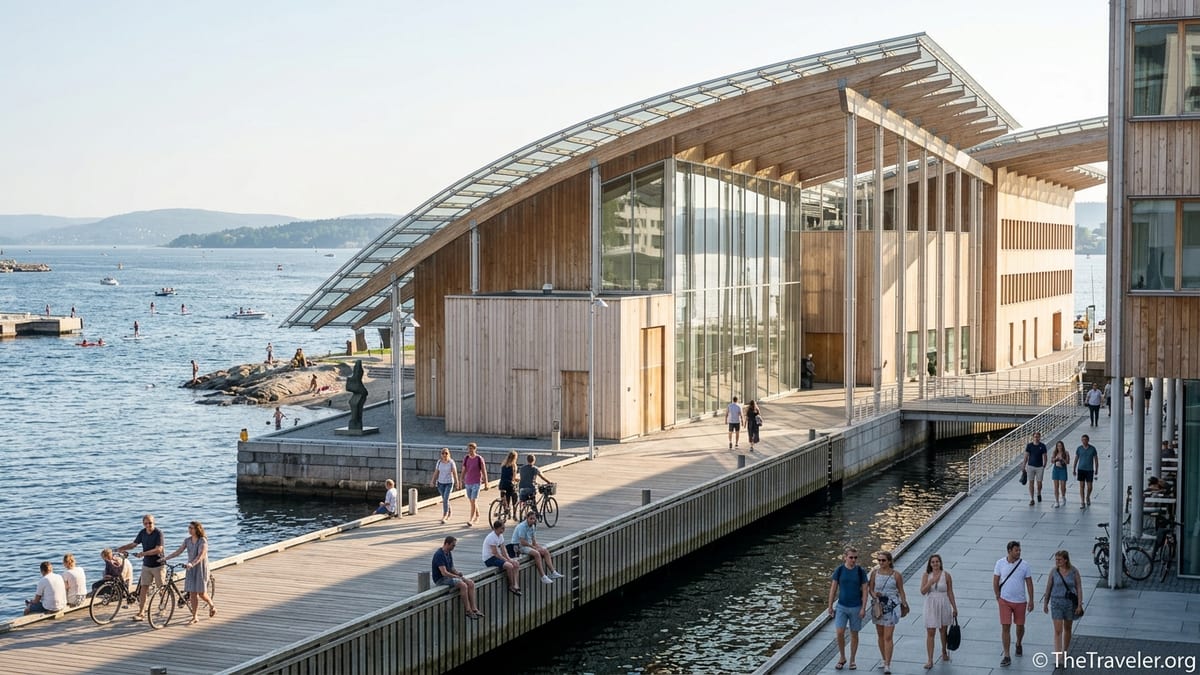
On a sunny afternoon along Oslo’s harbor promenade, it is hard to miss the sweeping sail-like roof of the Astrup Fearnley Museum of Modern Art. Framed by the Oslofjord, with bathers on the tiny city beach and locals lingering over coffee on the pier, this contemporary art museum has become one of the capital’s most photogenic landmarks. But is it actually worth carving out time and money to visit, especially when Oslo is packed with competing cultural heavyweights like the Munch Museum and the National Museum? What recent visitors and art lovers say reveals a surprisingly nuanced answer.
Get the latest updates straight to your inbox!
What Exactly Is the Astrup Fearnley Museum?
The Astrup Fearnley Museum of Modern Art is a privately run contemporary art museum on the Tjuvholmen peninsula at the western end of Oslo’s waterfront. Founded in 1993 by Norwegian shipping magnate and collector Hans Rasmus Astrup, it is built around one of Norway’s most important private collections of contemporary art, mixed with large rotating exhibitions that bring in new international and Norwegian work.
Since 2012, the museum has occupied a purpose-built complex designed by Italian architect Renzo Piano, whose other high-profile projects include the Centre Pompidou in Paris and the Whitney Museum in New York. The building itself is part of the attraction: three low glass-and-wood structures tucked under an arched, sail-like roof, with a narrow canal of seawater flowing between them and wooden bridges linking the galleries. For many travelers, simply walking around the complex and the surrounding quays is their first encounter with the museum.
Astrup Fearnley is relatively small compared with major European institutions. Most visitors report spending between one and two hours inside, longer if they read wall texts carefully or carry a sketchbook. This compact size appeals to travelers who want a concentrated dose of contemporary art without the fatigue that can set in at bigger museums where you feel obliged to cover multiple floors in a single visit.
Being private also shapes the museum’s character. The core Astrup Fearnley collection reflects the tastes and bold purchases of a single collector more than a national canon. This gives the museum a distinct personality that some travelers find refreshing and others see as a limitation compared with the breadth of a state museum.
Location, Tickets, and Practical Details That Matter
For many travelers, the first argument in favor of visiting Astrup Fearnley is how easy it is to combine with a day on Oslo’s waterfront. The museum sits at Strandpromenaden 2, right at the tip of Tjuvholmen, a short walk from Aker Brygge’s restaurants and about 15 to 20 minutes on foot from Oslo City Hall. Many visitors simply follow the harbor promenade past outdoor cafes and moored boats until the museum’s curved roof appears ahead.
As of spring 2026, adult admission is typically around 180 Norwegian kroner, with discounted tickets for students and seniors closer to 100 kroner, and free entry for children and teens under 20. During periods when staff are changing exhibitions, the museum reduces its price, with adult tickets closer to 130 kroner, which can be good value for spontaneous travelers who happen to be in Oslo between major shows. Oslo Pass holders get in free, making the museum particularly appealing for visitors already investing in that city card for public transport and other attractions.
The museum is closed on Mondays for most of the year but opens on Mondays during the busiest summer months of July and August. Standard opening hours tend to be from midday to 5 p.m. on weekdays, with extended hours until 7 p.m. on Thursdays and earlier 11 a.m. openings on weekends. Many reviewers recommend timing a visit for late afternoon, then stepping straight out into the golden evening light on the pier, when the fjord and the building’s glass surfaces reflect soft colors.
Facilities are modern and traveler friendly. There is a staffed cloakroom, lockers for bags, a museum shop that emphasizes Scandinavian design and art books, and an on-site Italian restaurant where locals linger over aperitivo plates and glasses of wine facing the water. Travelers often mention combining the museum with a swim at the adjacent tiny beach on warm days, or with a relaxed coffee at one of the other waterfront cafes if the restaurant is fully booked.
What the Art Is Like: Highlights and Common Reactions
Stepping inside, visitors encounter a mix of permanent collection works and temporary exhibitions that shift several times a year. The collection is firmly contemporary, with a strong international focus: large-scale works by artists such as Jeff Koons, Damien Hirst, Cindy Sherman, and Anselm Kiefer feature alongside pieces by leading Nordic artists. Travelers who are used to more historic collections can be surprised to find entire rooms dominated by installations, video works, and conceptual pieces rather than traditional painting and sculpture.
Reactions to the art are divided in a way that is typical for contemporary museums. Some visitors call Astrup Fearnley one of the best modern art spaces they have seen in Scandinavia, praising the boldness of the collection and the quality of curation. They highlight immersive installations, thought-provoking photography, and the way the architecture interacts with the art through natural light and views of the water. For this group, the museum is a must-visit and often a favorite stop in Oslo.
Others feel underwhelmed, especially if they arrive expecting a large, encyclopedic modern art museum on the scale of New York’s MoMA or London’s Tate Modern. A recurring comment in traveler reviews is that the museum can be “hit or miss” depending on the current temporary exhibition, with some seasons offering dense, intellectually challenging shows that delight art world insiders but leave casual visitors puzzled. A few reviewers mention that they finished the galleries in under an hour and felt the ticket price was steep for the amount of art on show that day.
This variability makes it worth checking, shortly before your visit, what exhibition is on view and whether it aligns with your interests. For example, some recent years have brought major thematic shows about global contemporary art and technology, or solo presentations by Nordic artists with strong visual impact. At other times, the programming leans more conceptual, with subtle installations that reward slow looking but may not resonate with travelers seeking bold, Instagram-friendly works.
Architecture, Setting, and the Sculpture Park Experience
Even travelers who are lukewarm about the art tend to agree on one thing: the setting is spectacular. The museum anchors one end of the Tjuvholmen Sculpture Park, a landscaped waterfront area dotted with works by international artists set among lawns, promenades, and rocky edges that meet the fjord. On a warm evening, it is common to see people sitting with their feet dangling over the water, kids playing near outdoor sculptures, and swimmers using the small public beach next to the museum.
Renzo Piano’s architecture plays a major role in the museum’s appeal. The roof’s timber structure filters daylight into the galleries and extends beyond the building over the canal, creating sheltered walkways outside. Inside, tall ceilings and generous windows give many exhibition spaces a calm, airy feel. Travelers often describe the pleasure of glimpsing boats, water, and sky between artworks, which softens the intensity of some contemporary pieces.
From a visitor’s perspective, this means that even if you decide not to buy a ticket, the area around Astrup Fearnley is worth a stroll. Many budget-conscious travelers walk out along the pier, explore the free sculpture park, sit at the edge of the water for a break from sightseeing, and take photographs of the building from different angles. If you are traveling with someone who is not especially interested in art, this setting can be a compromise: one person enjoys the museum interior while the other relaxes outdoors with a book and the fjord view.
Compared with more centrally clustered institutions like the National Museum and the City Hall, Astrup Fearnley feels like a small art district of its own at the end of the promenade. This sense of escaping the city center for a more open, maritime environment is a key part of the experience, especially for visitors who arrive in Oslo expecting dramatic fjord landscapes but find themselves in a relatively compact urban core.
How It Compares With Other Oslo Museums
For travelers with limited time in Oslo, deciding whether Astrup Fearnley is “worth it” often comes down to how it fits in with other major museums. Many visitors choose between it and the Munch Museum, the National Museum, or the Nobel Peace Center when planning a one or two day stay. Each offers a very different experience.
The Munch Museum in Bjørvika is the obvious choice for those who want to see “The Scream” and dive into a single artist’s world across many floors. It is larger, more crowded, and more focused on early 20th century expressionism and Munch’s life. The National Museum, close to City Hall, covers centuries of Norwegian art, craft, and design, from medieval altarpieces and folk art to modern works, and can easily absorb half a day. In contrast, Astrup Fearnley is more compact, more international in its collection, and more purely contemporary.
Travelers who prioritize architecture sometimes choose to visit all three. The Munch Museum’s sharply vertical glass tower, the National Museum’s monumental stone block, and Astrup Fearnley’s curved, wood and glass form together show the spectrum of Oslo’s recent cultural building boom. However, if you only have the budget or time for one paid art museum and you are not deeply invested in contemporary art, many visitors suggest prioritizing the National Museum or Munch and treating Astrup Fearnley as an optional extra, perhaps focusing on the free sculpture park outside instead.
On the other hand, if you already know you enjoy contemporary art spaces like Tate Modern, the Museum of Contemporary Art in Chicago, or the Louisiana Museum north of Copenhagen, then Astrup Fearnley will likely sit high on your list. In that case, travelers often recommend pairing it with a short visit to the Nobel Peace Center or a walk along the Aker Brygge promenade, making a full afternoon of culture, fjord views, and cafes in a single compact area.
What Travelers and Art Lovers Actually Say
Recent traveler reviews paint a picture of Astrup Fearnley as a museum that inspires strong but varied reactions. On platforms where visitors leave detailed feedback, many five-star reviews praise the museum’s “perfect size,” calling it a highlight of their Oslo trip. These visitors often mention specific experiences: viewing striking large-scale installations against the backdrop of the fjord, attending guided tours that opened up challenging works, or discovering new Nordic artists they had never encountered before.
Several travelers say they ended up at Astrup Fearnley almost by accident, after walking the harbor promenade, and were pleasantly surprised. They talk about spending an hour in the galleries, then sitting outside with an ice cream from a nearby kiosk or a coffee from the museum cafe, watching boats and paddleboarders pass close by. For them, the museum blends seamlessly into a relaxed waterfront afternoon rather than standing apart as a formal cultural obligation.
At the same time, there are consistent notes of criticism. Some reviewers describe the ticket price as high for what they perceived as a small collection, especially when a major exhibition had recently closed and galleries were in transition. Others express frustration when labels are heavily theoretical, making it harder to connect with the work if you are not already familiar with contemporary art discourse. A few travelers say they preferred the nearby National Museum or Munch Museum and would skip Astrup Fearnley if returning to Oslo with limited time.
Art lovers who follow the international contemporary scene tend to be more enthusiastic, often mentioning the museum in the same breath as notable private institutions elsewhere in Europe. They appreciate the willingness to take risks on challenging exhibitions rather than sticking to crowd-pleasing retrospectives. For this group, even a “difficult” show can be a reason to visit, because it signals that the museum is actively participating in global art conversations rather than simply displaying a static collection.
Tips for Making the Most of Your Visit
If you decide Astrup Fearnley belongs on your Oslo itinerary, a few simple strategies can make the experience more rewarding. First, check the current exhibition program on the museum’s official channels just before you travel. This will give you a sense of whether the focus is on a single artist, a themed group show, or a rehang of the core collection, and you can adjust your expectations accordingly.
Second, consider using the museum’s in-person resources. On many days, staff offer short guided tours or introductions to the exhibitions in English and Norwegian. Travelers who take these often comment afterward that the works made more sense and felt more engaging once they understood the artist’s intentions and the broader context. If no tours are scheduled, simply asking a gallery attendant for a recommended route or a favorite piece can yield useful informal tips.
Third, allow time before or after your visit to explore the immediate surroundings. You might start with a coffee on Aker Brygge, then walk the promenade to reach the museum right as it opens, enjoying relatively quiet galleries before the afternoon crowd. Afterward, you could take a swim at the small Tjuvholmen beach if the weather allows, or spend half an hour strolling through the sculpture park, where you are free to linger by artworks at your own pace without feeling you have to move on for other visitors.
Finally, think about pairing Astrup Fearnley with other nearby attractions in a single outing. One popular pattern is a late morning visit to the City Hall and the harbor area, lunch along Aker Brygge, then Astrup Fearnley in mid-afternoon and sunset drinks facing the fjord. This way, even if the exhibition does not fully resonate with you, the day as a whole still feels rich and varied.
The Takeaway
So, is the Astrup Fearnley Museum of Modern Art worth visiting? The honest answer depends on who you are as a traveler. If you are drawn to contemporary art, enjoy thoughtful architecture, and like the idea of combining culture with time by the water, then the museum is very likely worth your time and ticket price. Its compact scale, strong international collection, and striking setting make it one of Oslo’s most distinctive cultural stops.
If, on the other hand, you are indifferent to contemporary art or traveling on a tight budget and schedule, you may find better value in the city’s larger public museums. In that case, you can still enjoy much of what makes Astrup Fearnley special by walking out along the pier, exploring the free sculpture park, and photographing the building from outside. That way you capture the best of its harborfront atmosphere without committing to a full museum visit.
In the end, what travelers and art lovers consistently agree on is that Astrup Fearnley embodies a particular side of Oslo: open to the world, oriented toward the fjord, and willing to experiment with new ideas. Whether you step inside the galleries or not, making your way to the museum’s wooden decks at the edge of the water offers a vivid snapshot of how Norway’s capital sees itself today.
FAQ
Q1. Where is the Astrup Fearnley Museum located in Oslo?
The museum sits at the tip of the Tjuvholmen peninsula on Oslo’s harbor promenade, a short walk past Aker Brygge from City Hall toward the fjord.
Q2. How much time should I plan for a visit?
Most visitors spend between one and two hours inside the museum, plus extra time for the sculpture park and waterfront if the weather is good.
Q3. Is the Astrup Fearnley Museum suitable for children?
Yes, especially older children and teens, who enter for free. Some works are challenging, but the building, views, and sculpture park help keep younger visitors engaged.
Q4. Do I need to be a contemporary art expert to enjoy it?
No. While background knowledge helps, many travelers with only casual interest in art still enjoy the combination of striking architecture, standout pieces, and fjord views.
Q5. How does it compare with the Munch Museum and the National Museum?
Astrup Fearnley is smaller and more focused on international contemporary art, while the Munch and National museums are larger, cover more history, and feel more like national institutions.
Q6. Is the museum included in the Oslo Pass?
Yes, at present the Astrup Fearnley Museum offers free admission with the Oslo Pass, which can make it an easy and economical addition to your itinerary.
Q7. Are there good places to eat or drink nearby?
There is an Italian restaurant inside the museum building and many cafes and restaurants along Aker Brygge and Tjuvholmen within a few minutes’ walk.
Q8. What days is the museum closed?
The museum is usually closed on Mondays outside the high summer months. From Tuesday to Sunday it keeps daytime hours, with extended evening opening one weekday.
Q9. Is it worth going if I only want to see the building and the fjord?
Yes. You can walk the pier, explore the free sculpture park, and enjoy the waterfront setting even without buying a ticket to the indoor exhibitions.
Q10. Can I combine a visit with a swim or outdoor activities?
In warm weather many visitors do exactly that, taking a dip at the small Tjuvholmen city beach next to the museum or relaxing on the rocks and lawns after seeing the art.