


Set at the very tip of the Tjuvholmen peninsula, where Oslo’s waterfront meets the fjord, the Astrup Fearnley Museum of Modern Art combines bold contemporary architecture with one of Scandinavia’s most interesting private art collections. Planning how to book your tickets and structure your visit makes a big difference here. From Oslo Pass inclusions to skip the line vouchers and combined city tours, knowing the options in advance will help you spend less time queuing and more time with the art and the water views.
Get the latest updates straight to your inbox!
Why Astrup Fearnley Belongs on Your Oslo Itinerary
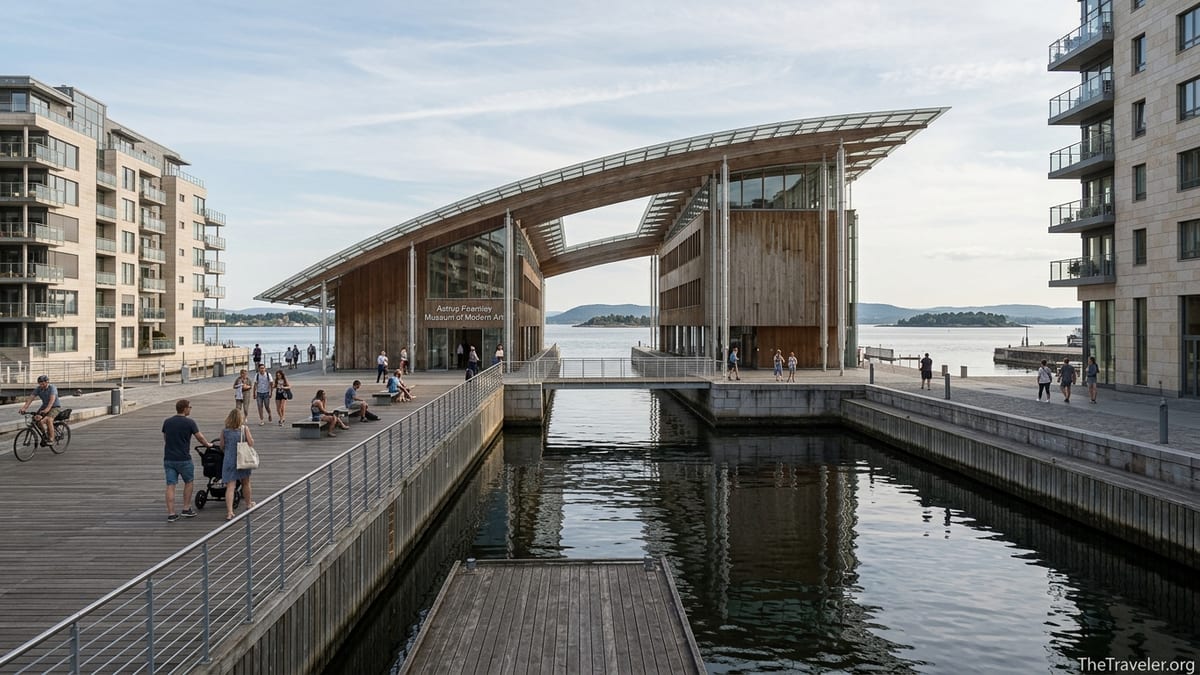
The Astrup Fearnley Museum is a privately run contemporary art museum, housed in a striking Renzo Piano building on Oslo’s Tjuvholmen waterfront. The structure is split into two glass and wood volumes draped under a curved sail‑like roof, with water channels and bridges threading between them. Inside you will find a rotating program of temporary exhibitions alongside highlights from the Astrup Fearnley Collection, which focuses heavily on international contemporary art from the late 20th century onward.
For many visitors, the museum is as much about its setting as the art. It sits at the end of a car‑free promenade that runs from Aker Brygge past restaurants, bars and moored boats to a small city beach and the Tjuvholmen Sculpture Park. On a clear day you can alternate between installations indoors and views across the Oslofjord outdoors, with plenty of places to sit on the wooden piers.
Because of this combination of architecture, collection and waterfront location, peak summer afternoons and late Friday evenings can be busy, especially when a high‑profile temporary exhibition is on. Booking your tickets or passes ahead of time helps you avoid lining up at the on‑site ticket desk and lets you choose the best time window, whether it is a quiet weekday morning in February or a golden‑hour visit in July.
Unlike Norway’s national museums, Astrup Fearnley is not run by the state, so it is not always free. It operates its own pricing and promotions. Travelers who assume every Oslo museum is free are sometimes surprised at the entrance fee here, which makes it worth understanding how best to buy tickets and what is included.
Buying Tickets Directly from the Museum
The most straightforward way to visit Astrup Fearnley is to buy a standard admission ticket directly from the museum, either online in advance or at the ticket desk when you arrive. The museum’s official channels list current prices, which in recent seasons have typically been in the range of what you would expect for a major Oslo art institution. Children, students and seniors usually receive reduced rates, and there is often free entry for very young children.
Booking online before you travel has two clear advantages. First, you can pick your preferred date and, when the museum uses time‑slot entry during popular exhibitions, lock in a starting time that suits your itinerary. Second, you receive a digital ticket that can be shown on your phone, which speeds up entry and helps you bypass the line of visitors still buying paper tickets at the counter. This is particularly helpful if you are arriving from a cruise ship at Aker Brygge or as part of a packed one‑day Oslo schedule.
If you prefer spontaneity, same‑day purchases at the museum are still possible. Outside of peak school holiday weeks, weekday mornings and late afternoons often have shorter queues. Many travelers staying nearby at Aker Brygge or in the city center simply walk down to Tjuvholmen and buy admission on the spot after checking how crowded the entrance lobby looks.
It is also worth watching for occasional evening or special promotions, such as extended opening hours on select nights or discounted admission tied to specific events in Oslo. These are usually announced by the museum itself and can change from year to year, so do not rely on outdated information from old guidebooks.
Using the Oslo Pass and Other City Cards
For visitors planning to see several museums in 24 to 72 hours, the Oslo Pass can be a smart way to manage both transport and entrance fees. The pass typically bundles unlimited travel on local public transport in the main city zones with free or discounted entry to a long list of attractions. In recent seasons, Astrup Fearnley has often been included as a free‑entry or reduced‑price partner, though terms can be updated between summer seasons.
In practice, this means that if you buy a 24‑hour Oslo Pass on a Friday afternoon, you could visit the National Museum, the Munch Museum and Astrup Fearnley the next day, while using the same card to ride trams and buses between them. At Astrup Fearnley, you present the physical or digital pass at the ticket desk to receive a zero‑cost or discounted entry ticket, depending on the current agreement. It does not usually serve as a timed reservation, so on particularly busy days you may still need to queue briefly at the desk for validation.
Travelers often decide between the Oslo Pass and individual tickets by adding up a realistic itinerary. For example, if you plan to visit just Astrup Fearnley and one other paid museum, plus make only a couple of tram rides, separate tickets could end up cheaper than a full pass. On the other hand, if your plan includes multiple museums, ferries within the city transport system and rides to Vigeland Park or Holmenkollen, the pass quickly becomes cost effective, with Astrup Fearnley as one of several stops.
Other bundled products, such as combination deals sold with hop‑on hop‑off sightseeing buses, sometimes include admission to Astrup Fearnley or at least a discount. These are convenient if you like structured transport and commentary, but they can be more expensive than using regular public transport with an Oslo Pass or standard ticket. For independent travelers comfortable with Oslo’s easy tram and bus network, a city pass or single museum ticket paired with transit tickets is usually a better value.
Skip the Line Tickets and Third‑Party Platforms
Several international ticketing platforms and tour resellers list Astrup Fearnley admission, often labeled as skip the line or fast track entry. These products usually include a prebooked entrance voucher that you either print or display on your phone, sometimes with a specific date and a broad time window for arrival. They can be handy if you like to organize everything in a single app alongside other activities such as fjord cruises or walking tours.
Prices on third‑party platforms are often slightly higher than booking directly with the museum, because they include service fees or commissions. In exchange, you gain the security of having everything in your usual booking ecosystem and, in some cases, more flexible cancellation terms. For example, you might find a ticket that allows free cancellation up to 24 hours before your visit, which can be valuable if your plans depend on weather or cruise docking times.
Fine print matters here. Some skip the line tickets still require you to check in at a dedicated counter or exchange the voucher for a museum‑issued ticket before entry. In practice, this may not save time compared with buying directly at the museum on a quiet day. These products make the most sense during high season or when the museum is hosting a blockbuster exhibition and you want to secure entry before traveling.
Be cautious about buying from small resellers that are not transparent about what is included. If a listing does not clearly state that it covers actual entrance to the museum building, it could be a walking tour that only visits the building exterior and nearby sculpture park. Always read product descriptions carefully so you do not show up expecting gallery access with a voucher that only covers a guided stroll along the pier.
Guided Tours, Private Visits and Group Bookings
Astrup Fearnley offers guided tours of its exhibitions and collection, usually led by the museum’s own educators. On many weekends, there are public tours in Norwegian or English scheduled in the early afternoon, which you can join by purchasing a combination ticket that includes both museum admission and the tour. These typically focus first on the temporary exhibition and then on key works from the permanent collection.
If you are particularly interested in contemporary art or traveling with friends, you can request a private guided tour. These must be booked in advance and are priced separately from standard entry. They are popular with corporate groups, university classes and art clubs, as they allow for a deeper discussion of curatorial choices and specific works. Timing is flexible, so you might arrange an early morning tour before regular opening hours or an evening slot as part of a wider event in Tjuvholmen.
Incoming tour operators sometimes combine Astrup Fearnley with other Oslo highlights in half‑day itineraries. A typical example includes a morning coach tour passing by the Royal Palace and Vigeland Park, followed by a drop‑off at Aker Brygge for lunch and a prebooked ticket to Astrup Fearnley in the afternoon. These packages are convenient for first‑time visitors who want a curated overview of the city and do not mind sticking to a schedule.
Families may also appreciate the museum’s occasional kids’ tours and workshops, which introduce younger visitors to contemporary art through hands‑on activities. Availability depends on the season and current exhibitions, so if you are traveling with children it is worth checking whether there are family‑focused events or art labs on the dates you plan to visit.
Planning Your Visit: Opening Hours, Timing and Access
The museum generally operates with daytime opening hours throughout the week, with a closure day that has traditionally been Monday. Exact times can vary by season, with extended hours on certain evenings, particularly during summer or special events. Before committing to a time‑slotted ticket or planning a tight transfer from the airport, verify the current schedule, as weekend and holiday hours around Easter, Christmas and national holidays can be different.
In terms of duration, most visitors spend between one and two hours in the galleries, and another half hour exploring the sculpture park and waterfront around the building. Art enthusiasts may linger much longer, especially when a major temporary exhibition is on. If you have a packed Oslo itinerary, allocating at least 90 minutes on site is a good baseline, plus travel time to and from the museum.
Arriving in the early part of the day often provides the calmest atmosphere inside the galleries, especially on weekdays. In summer, another pleasant option is to visit in the late afternoon or early evening, then step outside for soft light over the fjord. On wet winter days, the museum becomes a welcome indoor refuge, and you may find that the glass roof and reflections off the fjord make the space feel atmospheric even in low light.
Accessibility is generally good. The building has step‑free access, lifts between levels and toilets and facilities for visitors with reduced mobility. If you are traveling with a stroller, you can navigate between the galleries, café and outdoor areas without serious obstacles. Visitors with specific needs, such as assistance dogs or companions, should check current policies when booking, as museums in Oslo often allow a companion to enter free of charge when accompanying someone with a disability card.
Getting to the Museum and Combining It with Nearby Sights
Astrup Fearnley is located at Strandpromenaden 2 on Tjuvholmen, a short distance from the central district of Oslo. From the city center, many visitors simply walk. It takes about 15 to 20 minutes on foot from Oslo Central Station if you follow Karl Johans gate down to the waterfront and continue past the City Hall and Aker Brygge. The route is flat, well lit and full of cafés and shops, so the walk itself feels like part of the experience.
For those using public transport, several tram and bus lines stop near Aker Brygge and the Nationaltheatret station. From there it is a 10‑minute walk along the waterfront boardwalk to the museum. Regular Ruter tickets and passes cover these journeys, and if you are using an Oslo Pass your museum visit and transport can be bundled on the same day. In summer, city ferries that operate as part of the local transport system connect nearby piers with islands in the Oslofjord, making it easy to combine a museum visit with a short boat ride.
The museum’s location makes it easy to pair with other major sights. A common combination is to start the day at the Nobel Peace Center near the City Hall, stroll along Aker Brygge for lunch, visit Astrup Fearnley in mid‑afternoon, then continue along the fjord path toward Akershus Fortress for city views. Alternatively, you can spend a morning in the National Museum, ride the tram to Aker Brygge, and then walk to Astrup Fearnley as a contemporary counterpoint.
Travelers arriving by cruise ship will find that shuttle buses and local trams often drop passengers near Aker Brygge, leaving only a short walk to Tjuvholmen. If you arrive in Oslo by train and have a few spare hours before an evening departure, you can store luggage at the station and head straight down to the waterfront, visiting Astrup Fearnley as part of a compact, walkable loop of central Oslo.
Making the Most of the Collection, Architecture and Waterfront
Once your ticket is sorted and you are inside, it pays to approach Astrup Fearnley as more than just a series of white rooms. Start with the temporary exhibition if there is one on, since this is often the reason locals and regular visitors return. The museum tends to mount large‑scale shows by influential contemporary artists or thematic exhibitions that draw heavily from its own collection and international loans.
Then move into the permanent collection galleries, where you can see works by internationally known names alongside Nordic and Norwegian artists. Depending on the current hanging, these may be arranged thematically or chronologically. Read the bilingual wall texts or pick up any available exhibition guides to understand how the museum frames its collection. If you booked a guided tour, your guide will usually highlight several key works and explain their significance within contemporary art history.
Do not rush past the building itself. The glass roof that stretches over the two pavilions creates ever‑shifting light patterns, while the wooden cladding and steel beams echo boats and shipyards. From the upper levels, look out toward the fjord and back toward the city skyline. Outdoors, the Tjuvholmen Sculpture Park displays works by international artists against the backdrop of the water and islands, and a small sandy beach at the tip of the peninsula is popular with locals on warm days.
To round out your visit, stop by the museum shop, which stocks art books, design objects and prints inspired by current and past exhibitions. The onsite café and nearby waterfront restaurants are convenient places to sit with a coffee or light meal while you look over what you have seen. If you have a full Oslo museum day planned, this is an ideal pause point before heading onward to your next stop.
The Takeaway
Booking Astrup Fearnley Museum tickets and planning your visit does not have to be complicated, but a bit of forethought pays off. Decide first whether a direct museum ticket, an Oslo Pass or a third‑party voucher fits your style and budget, keeping in mind how many other attractions and how much public transport you will use in Oslo.
Next, pick a time that matches your preferences, whether that is a quiet weekday morning to savor the galleries or a summer evening when you can step outside to watch the light change over the fjord. If you enjoy context and conversation, consider adding a guided tour, either a regularly scheduled public one or a private visit tailored to your interests.
Finally, remember that the museum is part of a larger waterfront experience. Combine your gallery access with a walk through Aker Brygge, a pause in the sculpture park, or a ferry trip on the Oslofjord, and you will come away with a richer sense of how contemporary art and everyday city life meet at the end of the Tjuvholmen pier.
FAQ
Q1. Do I need to book Astrup Fearnley Museum tickets in advance?
Booking in advance is not strictly required, but it is recommended in busy summer months and during major exhibitions, as it secures your entry time and reduces waiting at the ticket desk.
Q2. Is the Astrup Fearnley Museum included in the Oslo Pass?
The museum has often been included as a free or discounted attraction in the Oslo Pass, but details can change, so check the latest pass information before relying on it.
Q3. Are skip the line tickets worth it for Astrup Fearnley?
They can be useful on peak days when lines are longest, or if you want flexible cancellation through a familiar booking platform, but on quiet weekdays standard tickets are usually sufficient.
Q4. How long should I plan to spend at the museum?
Most visitors are satisfied with 1 to 2 hours inside the galleries and another 30 minutes outside exploring the sculpture park and waterfront, though art enthusiasts may stay longer.
Q5. What is the best time of day to visit?
Weekday mornings are typically quieter inside, while late afternoons and early evenings in summer offer beautiful light on the fjord if you want to enjoy both the art and the setting.
Q6. Can I visit the Tjuvholmen Sculpture Park without a ticket?
Yes. The sculpture park and surrounding waterfront areas are public outdoor spaces that you can explore freely, but you need a valid ticket to enter the museum galleries themselves.
Q7. Are guided tours available in English?
Yes. The museum regularly offers guided tours in English, especially on weekends, and you can also inquire about booking a private English‑language tour for your own group.
Q8. Is the museum suitable for children?
Many families visit with children, and the building is stroller‑friendly. Some exhibitions are more adult in theme, but there are often family activities or child‑friendly explanations available.
Q9. How do I get to Astrup Fearnley from central Oslo?
You can walk about 15 to 20 minutes from the central station via the waterfront, or take a tram or bus to Aker Brygge or Nationaltheatret and continue on foot along the pier to Tjuvholmen.
Q10. Does the museum have a café and shop?
Yes. There is an onsite café serving drinks and light meals, and a museum shop offering art books, design items and exhibition‑related merchandise that you can visit during opening hours.