


Plage du Ponteil is one of Antibes’ classic town beaches, a long ribbon of pale sand curving between the old ramparts and the elegant Cap d’Antibes. Locals flock here for quick after-work swims and Sunday picnics, while visiting families eye it as an easier alternative to the deep-pebble shores of nearby Nice. If you are wondering whether Plage du Ponteil is truly worth a day of swimming and beach time with kids, the answer depends on what kind of seaside experience you want and when you plan to visit.
Get the latest updates straight to your inbox!
Setting the Scene: What Plage du Ponteil Is Really Like
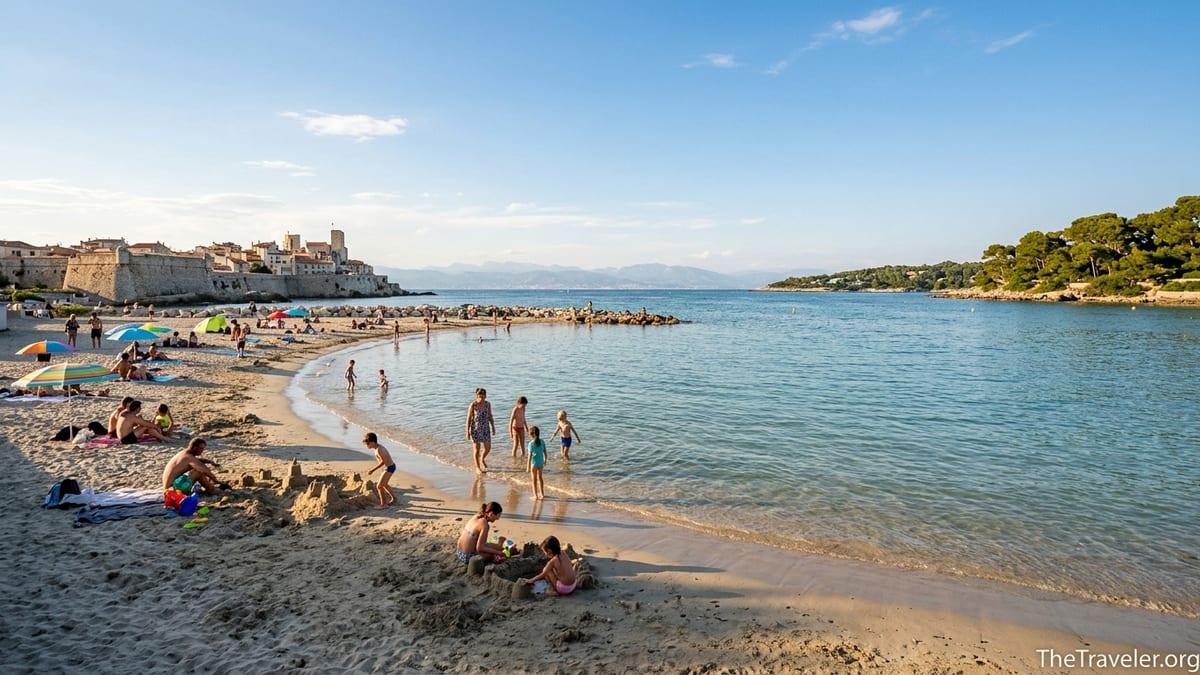
Plage du Ponteil stretches along the southern edge of Antibes, a mostly public, gently curving beach with views that run from the stone ramparts of the old town to the wooded hills of Cap d’Antibes and, on clear days, the Alps in the distance. The beach is sandy by Côte d’Azur standards, though you may still find a mix of fine sand and small gravel, especially closer to the waterline. Compared with the polished pebbles of Nice, many visitors find it notably softer underfoot and far more comfortable for children to play on without water shoes.
The bay is sheltered, so the water is usually calm, with only small waves unless there is a strong wind. The shoreline shelves gradually, allowing many adults to walk 20 to 30 metres out while still standing, which is reassuring if you are supervising young swimmers. In summer, you will see plenty of families setting up just behind the waterline, with toddlers paddling in the shallows and older kids snorkeling or tossing beach balls a little farther out.
Behind the sand runs a promenade lined with benches and shady trees. On a typical July evening, local residents stroll past with ice creams, teenagers gather for beach volleyball, and couples linger on the benches to watch the sunset over the Baie des Anges. This everyday local use gives Ponteil a relaxed, lived-in feel rather than the polished, high-glamour atmosphere of some private beach clubs farther along the Riviera.
To one side of the beach you will find the Royal Beach club, a small private area with sunbeds, umbrellas, and table service during the main season. It is convenient if you want restaurant-quality food at your lounger and clean private restrooms, but the vast majority of Ponteil remains free public sand where you simply lay down your towel wherever you can find space.
Swimming Conditions and Water Quality
For straightforward, recreational swimming, Plage du Ponteil is generally a solid choice. The bay is semi-enclosed and protected from the strongest swells, so the sea surface is often glassy or lightly rippled in the morning. Many locals take advantage of this by swimming laps parallel to shore before work, while visitors often find that children feel more secure entering calm water compared with more exposed beaches.
The depth increases gradually, which is ideal for cautious swimmers and for adults who prefer to wade in slowly. If you walk straight out in front of the central lifeguard station in mid-summer, you may find waist-deep water after only a few metres and chest-deep water after perhaps 20 to 30 metres, depending on the tide and sand shifts. That means less sudden drop-off than at some rocky coves nearby, and it is easier to stay close to non-confident swimmers.
Water clarity is usually good to excellent on clear days, particularly early in the morning before the sand is stirred up by heavy use. You will often see small fish darting around and children using basic masks and snorkels close to shore. On the other hand, because Ponteil is a popular urban beach, you should expect the occasional floating seaweed, the odd plastic wrapper on very busy days, and slightly cloudier water in the late afternoon after constant churn.
Recent municipal reports and independent beach guides consistently describe bathing water at Antibes’ main beaches, including Ponteil, as high quality in recent seasons, with routine monitoring throughout the summer months. While exact readings vary by day and weather conditions, there have been no widely reported, recurring pollution problems on the scale that sometimes affect more industrial or river-adjacent stretches of the Mediterranean. Even so, it is wise to glance at any flags or notice boards at the entrance on arrival, particularly after heavy rain when runoff can affect short-term water quality anywhere along the coast.
Is It Good for Families with Children?
Families are among the main reasons Plage du Ponteil gets busy from late June through August. The sandy surface is comfortable for playing, the shallow entry helps anxious swimmers, and there is an official lifeguard station in season. If you are traveling with under-tens who want to build sandcastles and splash around, you will likely find Ponteil more forgiving and less intimidating than the stony beaches of Nice or the rock platforms of some Cap d’Antibes coves.
Just above the sand, the promenade includes a small playground that gives younger kids somewhere to burn off energy when they tire of the water. Parents commonly switch between sitting on the beach and moving up to a bench in the shade while children swing or climb. Across the road you will find a small supermarket, newsagent, and takeaway-style food options where you can buy picnic supplies, beach toys, sunscreen, and ice creams without needing a car.
Concrete example: a family of four arriving in July without gear can easily pick up a basic folding beach umbrella for around 20 to 30 euros at nearby shops, plus a couple of inflatable rings or a beach ball for under 10 euros each. That means you are not forced to rent chairs at the private club to enjoy some comfort. Many families simply buy a lightweight umbrella at the start of the trip, use it for a week of mixed beach visits at Ponteil and Salis, then leave it behind for the next guest at their rental.
The main downside for families is crowding. On a peak August afternoon, it can be difficult to find a patch of sand large enough for a stroller, toys, and towels all together. If you arrive after 11 a.m. you may end up squeezed between other groups with limited personal space, and children may have less room to run around freely near the waterline. Families with very young toddlers or those who prefer a more spacious environment might be happier coming in late June, early July, or September, when the sea remains warm but the crowd density drops noticeably.
Facilities, Safety, and Practical Details
For a largely public beach, Plage du Ponteil is reasonably well equipped. In summer there are staffed lifeguard posts during the main daylight hours, although exact times can vary from one season to the next. Always check the flag system near the station: a green flag typically signals safe conditions, yellow indicates increased caution due to swell or wind, and red means no swimming. As a family, treat a change from green to yellow as a cue to bring less confident swimmers closer to shore, even if many locals choose to stay out.
The beach offers public showers and basic restrooms, although these can become heavily used and less pristine as the day goes on. Many regular visitors plan one or two longer bathroom breaks, often coinciding with a snack run to the shops just across the road, rather than popping back and forth constantly. If having spotless, hotel-style facilities is a priority, you may want to book a daybed at Royal Beach, which offers its own private restrooms and changing areas as part of the higher per-person fee.
There are usually one or two simple snack kiosks or small cafes at either end of the beach that serve sandwiches, fries, cold drinks, and ice creams at fairly standard Riviera prices. Expect to pay roughly 4 to 6 euros for a panini, around 3 euros for a soft drink, and 3 to 4 euros for a single-scoop ice cream. For a more substantial lunch, many families walk a few minutes back toward the old town for a sit-down meal, then return to the sand for the afternoon session.
Shade is limited on the public section of Ponteil. There are a few trees along the promenade, but the sand itself is exposed, so bringing your own umbrella or pop-up sun tent is strongly recommended, especially if children will be napping. The combination of intense summer sun and reflected glare from pale sand and water can be surprisingly strong even on slightly hazy days, and sunburn can happen quickly between about 11 a.m. and 3 p.m.
Access, Parking, and Getting There
One of the biggest advantages of Plage du Ponteil compared with some more remote coves is how easy it is to reach without a car. From Antibes’ old town, it is roughly a 10 to 15 minute walk along or behind the seafront ramparts, mostly flat and stroller-friendly. Families staying in the pedestrian lanes around the Marché Provençal can simply roll a stroller along the pavement and be on the sand in under 20 minutes, even allowing for a few picture stops.
Public bus routes, including local Envibus services, have stops near the dedicated parking area just behind the beach. This makes Ponteil accessible from other parts of Antibes Juan-les-Pins for only a couple of euros per journey, which can be significantly cheaper and less stressful than feeding a parking meter all day. If you are staying in nearby neighborhoods like La Salis or La Fontonne, checking local bus timetables before your trip can help you plan low-cost beach runs without relying on taxis.
If you do drive, there is a pay-and-display car park close to the beach, but it fills quickly on July and August mornings. As a real-world example, visitors arriving around 9 a.m. on a weekday in early August typically still find spaces, sometimes paying in the region of 1.50 to 2 euros per hour depending on the exact tariff that season. By 11 a.m., you may circle repeatedly or be forced to park farther inland and walk 10 to 20 minutes in the heat. To avoid frustration, aim for early arrival or consider coming for the late-afternoon and evening slot, when locals often leave and some spaces open up again.
For those using regional trains, Antibes station is serviced by frequent services between Nice and Cannes. From the station, it is roughly a 20 to 25 minute walk through town to Plage du Ponteil. Some travelers choose to stop in Antibes for a beach break en route between cities: for instance, leaving luggage in a station locker, enjoying three or four hours at Ponteil with a light picnic, then continuing the journey along the coast later in the day.
How Plage du Ponteil Compares to Nearby Beaches
When deciding whether Ponteil is worth your beach day, it helps to compare it with alternatives in and around Antibes. Just to the east, Plage de la Salis begins where Ponteil ends. Salis is slightly longer, a touch wider in places, and has a similarly sandy surface and shallow, family-friendly water. Many locals alternate between the two, choosing Ponteil when they want to be closer to the old town and Salis when they prefer a slightly more open feeling and an easier connection to the coastal path around Cap d’Antibes.
In the opposite direction, closer to the old port, Plage de la Gravette is a small, sheltered crescent of sand enclosed by breakwaters. It is even more protected than Ponteil and often extremely shallow close to shore, which some parents of very young children love. However, because it is compact and famously photogenic, it can feel more congested than Ponteil in peak season, with towels almost edge to edge by late morning.
Juan-les-Pins, on the other side of the Antibes peninsula, offers broader sandy beaches with a mix of public and private sections, plus several beach clubs with restaurants and water sports. If your ideal day includes renting pedal boats, trying tubing behind a motorboat, and enjoying a more resort-like vibe, you may prefer to spend at least one day there. By contrast, Plage du Ponteil is quieter in terms of motorized water sports, which can be a plus if you want your children swimming in a calmer, less trafficked area.
For stronger swimmers and snorkelers, the rocky inlets and coves around Cap d’Antibes, such as those near Plage de la Garoupe or along the coastal path, offer clearer water and more underwater life. However, access can involve stairs, uneven rocks, and immediate depth, making them less suitable for nervous swimmers or toddlers. Many visitors adopt a mixed strategy: one or two relaxed, family-focused days on Ponteil and Salis, and a separate adults’ or older kids’ excursion to rockier spots for snorkeling and cliffside views.
Best Times to Visit and How to Avoid Crowds
Timing can make the difference between a dreamy, relaxing day at Plage du Ponteil and a slightly cramped, noisy one. From mid-July to late August, especially around the French national holiday on 14 July and into early August, the beach is at its busiest. On weekends during this period, it is common for families to claim favored spots by 9 a.m., while by midday nearly every free patch of sand near the waterline is taken.
If your schedule is flexible, consider late June, early July, or the first half of September. The Mediterranean is usually warm enough for comfortable swimming, yet the mood is more relaxed, with more local families than day-trippers. In September, many French children are back at school, so weekdays, in particular, can feel spacious even when the weather is still summery.
Within a given day, mornings are the quietest. Arriving between 8 and 9:30 a.m. allows you to enjoy cooler temperatures, calmer water, and easier parking or bus seats. Families with early-rising toddlers often prefer this slot, leaving around lunchtime for naps and avoiding the harshest sun. Late afternoon and early evening are the second sweet spot. From about 5 p.m., some sunbeds free up, the heat softens, and the sky over the bay takes on soft golden colors. It is a favorite time for local families to come down for a couple of hours of swimming and a picnic dinner on the sand.
To reduce hassle, plan logistics around these quieter windows. For example, if you are based in Nice and day-tripping by train, catch a mid-morning service, enjoy lunch in Antibes’ old town, then spend 3 to 4 p.m. wandering the ramparts before descending to Ponteil for a sunset swim. That way, you avoid the densest midday crowds and still experience the beach at its most atmospheric time of day.
The Takeaway
So is Plage du Ponteil worth visiting for swimming and family beach time? For many travelers, the answer is yes, especially if you value calm water, easy access, and a local, unpretentious atmosphere over flashy beach clubs and high-intensity water sports. The gently shelving sand, generally good water quality, and presence of lifeguards in season make it particularly appealing for families with school-age children and beginner swimmers.
It is not perfect. In high summer, space on the sand can feel tight, facilities are basic rather than luxurious, and shade must be created rather than found. Strong swimmers and snorkel enthusiasts may prefer to branch out to rockier coves on Cap d’Antibes for more dramatic underwater scenery. Yet as a base for a simple day of sandcastles, swimming, and panoramic views of the old town and Alps, it offers a very satisfying balance of convenience and charm.
If your Riviera itinerary already includes Nice and perhaps a more glamorous beach club day in Juan-les-Pins or Cannes, dedicating at least half a day to Plage du Ponteil provides a complementary experience. You will see how locals actually use their town beach, let children play in forgiving shallows, and enjoy that classic Antibes view that painters and photographers have loved for over a century. For many visitors, that combination makes Ponteil a worthwhile and memorable stop.
FAQ
Q1. Is Plage du Ponteil suitable for young children who cannot swim well?
Yes, the beach has gently sloping sand and typically calm, shallow water near the shore, which is reassuring for non-swimmers. In season, lifeguards are on duty, but close parental supervision remains essential.
Q2. How crowded does Plage du Ponteil get in summer?
From mid-July through August, especially on weekends, it can become very crowded, with towels set up close together. Arriving before 10 a.m. or after 5 p.m. helps you find more space.
Q3. Are there lifeguards at Plage du Ponteil?
Yes, during the main summer season there is usually a staffed lifeguard station with a flag system indicating swimming conditions. Exact operating dates and hours can vary each year.
Q4. Can I rent sunbeds and umbrellas at Plage du Ponteil?
Yes, a private area known as Royal Beach rents loungers and umbrellas for a daily fee. The rest of the beach is public, where most visitors bring or buy their own umbrellas.
Q5. Is the sand soft or pebbly at Plage du Ponteil?
The beach is largely sandy, with a mix of fine sand and small gravel closer to the water. It is generally comfortable enough to walk on barefoot, especially compared with the pebble beaches in nearby Nice.
Q6. How is the water quality for swimming?
Recent seasons have seen consistently good bathing water quality, with regular monitoring by local authorities. As with any urban beach, conditions can vary after heavy rain, so check flags and local notices on arrival.
Q7. Is there shade on the beach?
Natural shade on the sand is limited. There are some trees along the promenade, but most beachgoers bring umbrellas or small sun tents, particularly for children.
Q8. What facilities are available nearby?
The beach has basic public showers and toilets, as well as seasonal snack kiosks. Across the road you will find a small supermarket, newsagent, and simple eateries for picnic supplies and quick meals.
Q9. How do I get to Plage du Ponteil without a car?
From Antibes’ old town, it is about a 10 to 15 minute walk along mostly flat streets. Local buses also stop near the beach, and the main train station is roughly a 20 to 25 minute walk away.
Q10. When is the best time of day to visit for a family beach session?
Mornings between 8 and 10 a.m. and late afternoons after about 5 p.m. are generally best, with cooler temperatures, calmer water, and fewer crowds than midday.