


Visiting Russia in 2026 is not a simple yes-or-no decision. The country still offers world-class art, grand imperial cities and epic train journeys, yet it also comes with serious geopolitical risks, complex logistics and ethical questions. Whether Russia is “worth it” depends heavily on your passport, risk tolerance and what you hope to get out of the trip. This article looks at what travelers love most about Russia today, what often surprises them and the practical realities of planning a visit right now.
Get the latest updates straight to your inbox!
First Things First: Is It Actually Safe or Legal to Go?
The most important starting point is that several Western governments, including the United States, maintain a "Do Not Travel" advisory for Russia due to security concerns and the ongoing war in Ukraine. These advisories typically cite risks like arbitrary enforcement of local laws, limited consular support and the broader unpredictability of the political situation. They do not make it illegal for private citizens to visit, but they do mean you are traveling very much at your own risk and likely without strong help from your home embassy if something goes wrong.
At the same time, Russia itself is open to foreign visitors and actively courting tourists from many regions. The country has rolled out a unified electronic visa system for nationals of around sixty countries, and several large source markets such as China have either visa waivers or streamlined entry rules. Inbound tourism has started to recover from its 2022 collapse, especially from Asian and Middle Eastern countries, even as visitor numbers from Europe and North America remain far below pre-2020 levels.
On the ground, recent travelers from Europe, Asia and a smaller number from North America report that everyday life in cities such as Moscow, Saint Petersburg and Kazan can feel surprisingly normal, with restaurants full, theaters operating and metros running on time. The main safety issues for most careful visitors tend to be the same as in any large city: petty theft, the occasional bar scam and traffic. The larger risks are structural and political rather than what you feel walking down the street, and that contrast is one of the first big surprises for many visitors who arrive expecting an atmosphere of visible crisis.
Ultimately, whether it is worth going comes down to your personal risk threshold and your home country’s guidance. A traveler from a country with a milder advisory and more consular presence might do the calculus very differently from an American or British traveler whose governments explicitly recommend staying away. Before deciding, it is essential to read your foreign ministry’s latest advice line by line, consider how comfortable you are being in a country under heavy sanctions and factor in things like travel insurance that may exclude Russia altogether.
The Practicalities: Visas, Flights and Money in 2026
Travelers who do decide to go often find that the practical side of reaching Russia is more complicated and expensive than it used to be but still manageable with planning. Direct flights from many Western capitals have disappeared, so routes typically go through Istanbul, Dubai, Belgrade or cities in Central Asia. For example, a traveler from Paris or Frankfurt might fly Paris–Istanbul–Moscow on a major Turkish carrier, while a visitor from Southeast Asia could route through Dubai or Doha. These extra legs can easily add several hours of travel time and hundreds of dollars compared with pre-2022 direct flights.
On the bureaucracy side, the unified Russian e-visa has changed the game for many nationalities. Citizens of a broad list of countries in Europe, Asia and the Middle East can now apply online a couple of weeks before departure, pay a modest fee in the range of a few dozen US dollars, and receive an electronic visa that is valid for short trips for tourism, business or private visits. For others, including Americans and Canadians, the old-style tourist visa still applies, which usually means securing an official tourist voucher from a licensed agency and sending your passport to a Russian consulate or visa center in a third country where Russian consular services still operate.
Money is another practical surprise. International cards from major Western banks generally do not work inside Russia due to sanctions, so visitors need to arrive with a plan. The most common approach is to bring foreign cash, such as euros or dollars, and exchange into rubles at banks or official exchange offices once in the country. Some travelers also rely on cards issued by banks in countries that still connect to Russian payment systems, like certain institutions in Turkey or Central Asia, but for a first-time tourist the simplest approach is usually a mix of cash plus prepaid solutions arranged in advance. Day-to-day costs can be pleasantly low by Western standards: a metro ride in Moscow or Saint Petersburg is typically well under one US dollar, a decent fixed-price lunch in a central café might run the equivalent of 5 to 8 dollars, and tickets to major theaters have a wide range from budget gallery seats to premium orchestra prices.
Mobile connectivity also differs slightly from what many travelers expect. Buying a local SIM or eSIM on arrival is straightforward and quite cheap, but new numbers in Russia usually have a short activation delay before full data and calling services work. Recent visitors describe a lag of roughly 24 hours before a newly purchased eSIM becomes fully active, which can catch people out if they are relying on ride-hailing apps or online maps as soon as they land. Downloading offline maps and having accommodation details printed or saved in screenshots remains a very good idea.
What Travelers Love: Culture, Cities and Everyday Life
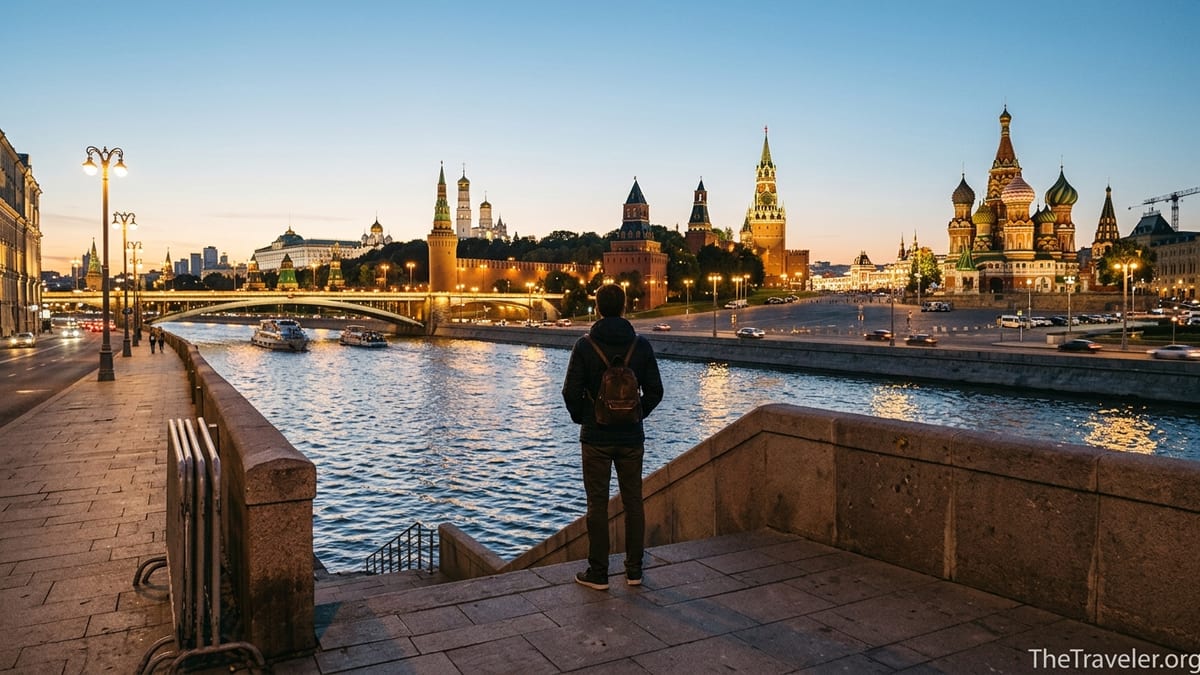
For those who make the trip, the enduring appeal of Russia is rarely abstract. It sits in very concrete experiences: emerging from the Moscow Metro into the expanse of Red Square at night when Saint Basil’s Cathedral is lit up; standing in front of Rembrandt’s "Return of the Prodigal Son" or a roomful of Matisse paintings in the State Hermitage Museum in Saint Petersburg; or walking along the icy Neva River embankments in January when the air is sharp and cafes glow with warm light.
Moscow impresses many visitors with its scale and ambition. The metro system is a highlight in itself, with station halls like Komsomolskaya and Mayakovskaya decorated in marble, mosaics and chandeliers. Central pedestrian streets such as Arbat and Nikolskaya are lined with cafes and street musicians, while the business district offers a more futuristic skyline of glass towers. Even short-stay visitors often manage a mix of classic sights such as the Kremlin, the Armory Chamber and the Tretyakov Gallery with everyday experiences like grabbing an inexpensive lunch in a stolovaya, the old-style self-service canteen where office workers share tables with students.
Saint Petersburg tends to charm in a different way. Travelers frequently describe it as feeling more European and romantic, with pastel palaces, wide avenues and a dense web of canals. In summer, the city’s White Nights season keeps the sky luminous until late, and you may see locals strolling by the Fontanka River or gathering on Palace Square well past midnight. The Hermitage alone can fill days, but visitors also talk fondly about smaller gems such as the Fabergé Museum, where jewel-encrusted Easter eggs sit behind glass, or the less formal atmosphere of neighborhood bars in districts like Petrogradsky and Vasileostrovsky.
Outside the two capitals, the highlights are more varied but no less compelling. Some visitors are drawn to the so-called Golden Ring towns northeast of Moscow, where onion-domed churches and kremlins in places like Suzdal and Sergiev Posad give a sense of medieval Russia. Others prioritize the Trans-Siberian Railway and long-distance trains, where days spent watching birch forests through the window and sharing tea in the corridor with fellow passengers become the core memory of the trip. In winter, travelers to regions like Karelia or Kamchatka may combine northern lights, husky sledding and steaming banya sessions with the kind of vast snowy landscapes that photographs struggle to capture.
Costs on the Ground: Is Russia Expensive in 2026?
One surprise that emerges again and again in recent trip reports is how affordable Russia can feel once you arrive, provided you are paying in local currency and not locked into high-end international hotels or packaged tours. After the ruble’s fluctuations and the retreat of some foreign brands, many everyday services are priced primarily for the domestic market, and that often benefits foreign visitors whose incomes are in euros, dollars or other strong currencies.
In Moscow, for example, a basic single metro ride is usually priced in the tens of rubles, which converts to well under one US dollar. A simple lunch menu in a mid-range café might cost the equivalent of 5 to 10 dollars, especially outside the most touristy streets around Red Square. Budget travelers can find dorm beds in hostels in the rough range of 10 to 20 dollars per night and simple hotel rooms a bit higher, while standard four-star hotel rooms in central districts often fall somewhere around 80 to 150 dollars per night depending on season and demand. Similar or slightly lower prices are common in Saint Petersburg.
Major cultural experiences also span a wide budget spectrum. Entry tickets to flagship museums typically run the equivalent of 10 dollars or less, and many state museums have discounted days or free evenings. Theater remains a relative bargain, at least compared with Western Europe: it is still possible to find upper-gallery ballet or opera tickets at famous venues for around 20 to 30 dollars if you book less popular performances or weekday shows. On the other end of the scale, prime seats for premieres or star casts can be as expensive as in Paris or New York.
Where costs can spike unexpectedly is in international travel to and from Russia, high-end imported goods and certain specialized tours. Because there are fewer airlines operating and more indirect routes, a round-trip ticket from a major Western European city to Moscow or Saint Petersburg can easily be several hundred dollars more than it once was, especially in peak summer or holiday periods. Some outdoor expeditions, such as multi-day trips in the Russian Far East or carefully curated Trans-Siberian packages, also command premium prices, reflecting both the logistics involved and the smaller number of foreign tour companies still active in the country.
The Big Surprises: Modernity, Sanctions and Digital Quirks
Many first-time visitors arrive in Russia expecting either a gray, Soviet-seeming environment or a state of visible emergency, and are genuinely surprised by how modern and digitally integrated major cities feel. In Moscow, contactless payments using local cards, facial-recognition metro turnstiles and app-based taxi services have been part of daily life for years. Large shopping centers, contemporary art spaces and fashionable restaurants continue to operate, even if the brand names on the doors have changed since some Western companies withdrew.
Sanctions show up less in day-to-day street scenes and more in the details that foreign visitors notice when they need to cross a border, pay for something or book a flight. Instead of booking one direct flight on a familiar European airline, travelers may find themselves comparing multi-leg itineraries on carriers based in Türkiye, the Gulf or Asia. Instead of tapping a Visa or Mastercard issued in their home country at a café, they might be counting ruble banknotes or using a workaround card opened through a partner bank abroad. The overall experience of the trip can feel surprisingly smooth, but it is held together by these improvised workarounds that did not exist a few years ago.
Another surprise is the gap between news headlines and everyday conversations. Travelers who speak some Russian or engage with locals in English often report that many people are primarily concerned with ordinary things: jobs, rent, children’s schooling, the price of groceries. Some are keen to talk politics, others avoid the topic entirely, and there can be sharp differences of opinion. For visitors who arrive with a very binary narrative of the country, this complexity can be startling and sometimes uncomfortable, but for others it becomes one of the most thought-provoking aspects of the journey.
Digital life has its own quirks. Some Western social media platforms are limited or blocked and are accessed via VPNs; some foreign news sites load slowly or not at all; and app stores may not offer the same selection travelers are used to at home. At the same time, local platforms and services are sophisticated. Many visitors end up using Russian-made ride-hailing apps, restaurant-delivery services and mapping tools during their stay, getting an impromptu crash course in a parallel digital ecosystem.
Ethical Questions and Personal Calculus
For many travelers, the question "Is Russia worth visiting?" in 2026 is not only about personal safety or sightseeing value, but also about ethics. Some people choose not to visit as a matter of principle, arguing that tourism brings foreign currency and symbolic legitimacy to a government whose actions they strongly oppose. Others feel that engaging with ordinary people, artists and small businesses in Russia is valuable precisely when political relations are at their worst, and that boycotting cultural exchange does little to influence state policy.
There is no single correct answer, but it is worth reflecting on where your money is likely to go. Spending in small guesthouses, independent restaurants, family-run tour operations and local cultural institutions tends to support individuals and communities more directly than business with large state-linked enterprises. Opting for modest, locally owned accommodation instead of the most prominent chain hotels, booking city walks with freelance guides and buying from neighborhood shops are practical ways to tilt your spending toward everyday Russians rather than big structures.
Communication with friends and family at home is also part of this ethical calculus. Some visitors choose to be very open about their reasons for going and what they see, sharing nuanced impressions rather than either romanticizing the trip or ignoring the political context. Others prefer to keep a lower profile, worried about how the trip might be perceived or about cross-border data scrutiny. Before committing, it is helpful to think through not only what you personally believe is right, but also how you will explain your choice to others and how comfortable you are with possible criticism.
Finally, remember that ethical considerations can intersect with legal ones. Certain types of public expression, donations, or statements that might be protected speech at home can carry legal risk in Russia. Travelers who do go generally find it easiest to stay out of any demonstrations, avoid public political discussions with strangers and treat online posting while in the country with extra caution.
Who Might Find Russia “Worth It” Right Now?
Given all these factors, it can be helpful to think about the types of travelers for whom Russia in 2026 might make sense, and those for whom it probably does not. Visitors from countries with relatively neutral or balanced relations with Russia, whose governments do not strongly discourage travel, often find it easier both practically and emotionally to justify a trip. This includes many people from parts of Asia, the Middle East and Latin America, where direct flight options still exist and visa processes are relatively straightforward.
Seasoned independent travelers with a high tolerance for logistical complexity and uncertainty may also feel comfortable taking on the trip. These are the people who enjoy figuring out how to exchange money in a new system, who already travel with offline maps and backup plans, and who are willing to accept that they may need to reroute flights or adjust their itineraries on short notice. For them, the reward can be the feeling of exploring a major country at a time when relatively few of their peers are doing the same.
By contrast, Russia may not be the best choice for someone’s very first international trip, or for travelers who already feel anxious about border crossings, visas or language barriers. Families with young children, people who rely heavily on easy access to their home embassy, and travelers from countries with the strongest travel warnings may reasonably decide that this is not the right time, especially when there are alternatives that offer rich culture and history with fewer layers of complication and risk.
For anyone undecided, a useful approach is to compare Russia honestly with other destinations on your wish list. If your main draw is grand European-style architecture and art museums, there are closer and simpler options. If what you crave is the particular mix of Slavic culture, post-Soviet history and Eurasian geography that only Russia offers, and you are prepared for the realities outlined above, then the country may still be "worth it" to you in a very personal sense.
The Takeaway
Russia in 2026 is not the effortless city-break destination it once was for many Western travelers, nor is it an off-limits war zone where everyday life has ground to a halt. It is something in between: a vast, complex country where world-class cultural experiences coexist with serious geopolitical tensions and practical complications that visitors cannot afford to ignore.
Travelers who do go tend to fall in love with concrete things: the glow of Saint Petersburg’s palaces at midnight in June, the sound of a Siberian train clacking through the night, the unexpected kindness of strangers who help decipher a menu or navigate a suburban rail line. They are also often surprised by how normal life can look despite everything, and by how much of their trip is spent dealing with mundane details like metro tickets, museum queues and figuring out which local card will pay for a taxi.
Whether Russia is "worth visiting" for you depends on your passport, your principles and your appetite for risk. If you decide to go, going in with open eyes, a realistic understanding of the risks and a respect for the country’s complexities will make for a safer and more meaningful experience. If you decide that now is not the right time, that is also a valid choice, and the sights and stories of Russia are unlikely to disappear any time soon.
FAQ
Q1. Is it legal for me to visit Russia in 2026?
It is generally legal for private citizens of most countries to visit Russia, but some governments strongly advise against travel. You should check your own country’s latest travel advisories and any sanctions-related rules before planning a trip.
Q2. Can Americans visit Russia as tourists right now?
Yes, Americans can in principle obtain Russian tourist visas, usually by applying through Russian consulates or visa centers in third countries, but the US government currently recommends that its citizens do not travel to Russia. Many US-based travel insurers also exclude coverage for trips there, which adds another layer of risk.
Q3. How hard is it to get a Russian visa in 2026?
The difficulty depends heavily on your nationality. Citizens of many countries in Europe, Asia and the Middle East can use the unified Russian e-visa system with an online form and a relatively small fee, while others must follow a more traditional consular process that involves official invitations and mailing passports.
Q4. Are flights to Moscow and Saint Petersburg still available?
Yes, but often indirectly. Many travelers now fly via hubs such as Istanbul, Dubai, Belgrade or Central Asian cities rather than using direct flights from Western Europe or North America. This can increase both travel time and cost compared with pre-2022 routes.
Q5. Will my foreign credit or debit card work in Russia?
Cards issued by many Western banks do not work in Russia due to sanctions, so you should not rely on them. Most visitors bring cash in major currencies to exchange into rubles, and some arrange access to alternative cards or accounts issued in countries whose banks still connect to Russian payment systems.
Q6. Is Russia affordable compared with Western Europe?
Day-to-day expenses in Russia are often lower than in Western Europe. Public transport in major cities is usually under a dollar per ride, museum tickets are moderately priced and mid-range restaurants and hotels tend to be relatively good value, though international flights to get there can be expensive.
Q7. Do people in Russia speak English in tourist areas?
In central districts of Moscow and Saint Petersburg, you will often find English signage in the metro, museums and some restaurants, and younger people working in hospitality are more likely to speak at least basic English. Outside major cities and tourist zones, English is less common, so translation apps and a few Russian phrases are very helpful.
Q8. How safe is it to talk about politics while I am in Russia?
It is safest to avoid public political discussions, protests or making statements that could be seen as critical of the state while you are in Russia. Laws on speech and public assembly are stricter than in many Western countries, and travelers generally keep such conversations private and low-key if they have them at all.
Q9. What is the best time of year to visit Russia now?
Late spring and early autumn are popular for milder weather and fewer crowds, while summer offers long days and festivals, especially in Saint Petersburg during the White Nights period. Winter trips can be magical for snow and cultural events but require proper cold-weather gear and a higher tolerance for short daylight hours.
Q10. Should I feel guilty about visiting Russia during the war?
Opinions differ. Some people boycott travel to Russia on principle, while others believe that visiting and supporting ordinary people and cultural institutions is still valuable. It is a personal decision, and it helps to think about where your money will go and how comfortable you are with the symbolism of your trip.