


In a park famous for short, photogenic walks like Navajo Loop and Queen’s Garden, Bryce Canyon’s Fairyland Loop feels almost like a secret. It is longer, quieter, and more strenuous than the classic strolls along the rim, yet many hikers come away saying it was the highlight of their Utah trip. If you are wondering whether this 8 mile circuit belongs on your Bryce Canyon itinerary, it helps to know what the route is really like, who enjoys it most, and how to tackle it safely.
Get the latest updates straight to your inbox!
Where the Fairyland Loop Trail Fits in the Bryce Canyon Experience
Fairyland Loop sits at the northern end of Bryce Canyon National Park in southern Utah, forming a roughly 7.8 to 8 mile circuit around Boat Mesa and dipping deep below the rim. The National Park Service describes it as a strenuous day hike with about 1,900 feet of total ascent, most of it at high elevation around 7,700 to 8,000 feet above sea level. In practical terms, that usually means 4 to 5 hours of hiking for fit walkers, a bit more if you like to stop frequently for photos.
Unlike Bryce’s best known trails that start at Sunset or Sunrise Point, Fairyland Loop begins either at Fairyland Point, reached by a short side road off the main park road, or from the Rim Trail just north of Sunrise Point near the signed Tower Bridge junction. The two access points let you shape your day: many travelers staying at Bryce Canyon Lodge or using the park shuttle start and end near Sunrise, while those with their own car and an early start often choose the quieter Fairyland Point lot.
What sets Fairyland apart is how it combines classic Bryce elements into one continuous journey. You get sweeping amphitheater views from the rim, intimate close-ups of hoodoos and eroded fins on the canyon floor, and a sense of solitude that is increasingly rare in busy national parks. Where the Navajo Loop can feel like a conga line by mid-morning in peak season, Fairyland often has long stretches where you will only pass another party every few minutes or even less, especially outside summer weekends.
For many visitors driving the popular Utah “Mighty Five” circuit, that quieter feel is a strong selling point. When you have already queued for shuttles in Zion and jockeyed for parking at Arches, a half day on a scenic but uncrowded Bryce trail can feel like a luxury, provided you are ready for the distance and climbs.
What Hikers Love About the Fairyland Scenery
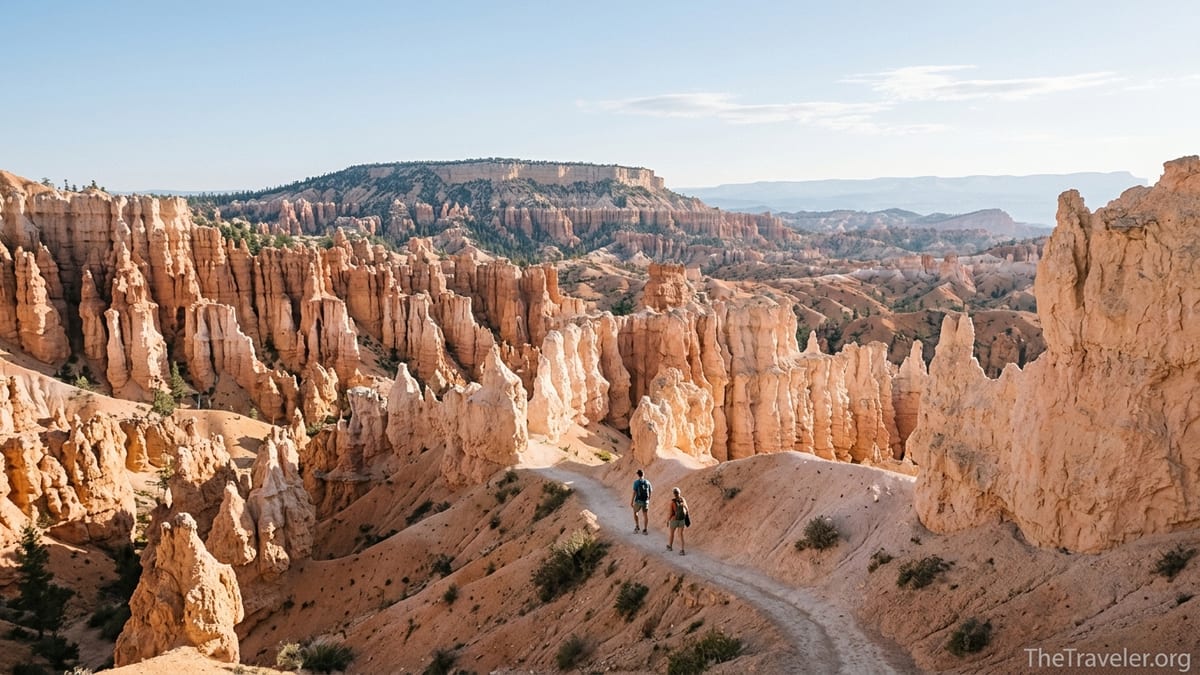
Visually, Fairyland Loop earns its whimsical name. Much of the trail winds among slender cream, pink, and orange hoodoos in the Claron Formation, with occasional bands of pale gray rock that give the landscape a layered, pastel look. Hikers frequently comment that the colors here feel even more varied than along the main amphitheater viewpoints, especially in soft early or late light when shadows exaggerate the texture of every spire and fin.
One highlight is the section near Tower Bridge, a natural rock span framed by tall hoodoos that has become a favorite photo stop. Even travelers who do not commit to the full loop often hike the shorter out and back route to Tower Bridge from Sunrise Point, but on the loop you experience it as part of a larger narrative: first seeing the feature from a distance, then dropping down to walk beneath its massive stone “towers” before continuing deeper into the canyon.
Another draw is the way the loop constantly changes perspective. From below the rim, the hoodoos loom at shoulder height or above, close enough that you can see the fragile layers of sediment and the tiny stones embedded in the rock. Later, as the trail climbs back toward the rim, the same formations shrink into intricate clusters that look almost like a model city laid out below you. The path wraps around Boat Mesa, so your views steadily rotate too, taking in not just Bryce’s amphitheater but distant plateaus and, on clear days, long views across southern Utah’s canyon country.
Because Fairyland Point is a little removed from the main amphitheater cluster of Sunrise, Sunset, Inspiration, and Bryce Points, the scenery around the trailhead also feels slightly wilder. You will still see fencing and a defined path at the start, but within minutes the developed facilities are behind you and the only sounds tend to be wind and the occasional raven. For hikers who equate “worth it” with a sense of immersion in the landscape, that quieter, more backcountry atmosphere is a major advantage.
How Challenging Is the Fairyland Loop Really?
The park labels Fairyland Loop as strenuous, and most regular hikers who have done it would agree that the description is fair, especially for visitors not used to elevation. The route gains and loses close to 1,900 feet overall, but that gain is distributed across a series of rolling climbs rather than one continuous slog. The steepest grades are on the spur to and from Tower Bridge and on the final climb back to the rim, where the trail can feel noticeably steeper than the gentle sidewalk sections along the upper Rim Trail.
In terms of distance, 7.8 to 8 miles on packed native sediment is manageable for anyone comfortable with several hours of walking, but the altitude makes everything feel a little harder. People who routinely walk 8 to 10 miles at sea level sometimes find themselves taking more breaks on this loop than expected. It is wise to factor that in when planning your schedule and water needs, especially if Fairyland is your first hike in Bryce after arriving from a low elevation city like Las Vegas or Los Angeles.
Trail conditions are typical for a backcountry route in a desert park. The surface is mostly firm dirt with loose gravel in places, narrowed in a few spots where erosion has eaten into the bench. The National Park Service notes that the path can be as narrow as about 16 inches in short stretches, which can feel exposed for anyone uncomfortable with heights, though most of the loop does not cling to a dramatic drop. In dry weather most hikers manage it fine in standard hiking shoes or trail runners with decent tread. After rain or spring snowmelt, the dirt can turn sticky and rutted, which slows progress and increases fatigue.
Timing also matters. Starting the loop in the cool of the morning makes the climbs far more pleasant than beginning at midday when the south-facing slopes can feel intense, especially from June through early September. Many visitors who begin around 7 or 8 a.m. in summer finish before early afternoon thunderstorms become more likely, while those starting after lunch sometimes end up hiking the last miles under darker skies or scattered showers. Planning around that pattern can make the difference between a comfortable and a draining experience.
Planning Your Route, Direction, and Logistics
You can hike Fairyland Loop in either direction, but both the National Park Service and many guide writers recommend a counterclockwise circuit. In practice, that usually means starting at Fairyland Point or the nearby junction and first descending into the canyon, then meandering past Tower Bridge, and finally returning along or up toward the rim near Sunrise Point. Many hikers find that getting the longer descent done early, while legs are fresh, makes the later rolling climbs and final ascent psychologically easier.
If you are using the seasonal Bryce Canyon shuttle, a common approach is to ride to Sunrise Point, walk the Rim Trail north to the signed Tower Bridge junction, then follow the loop around and eventually finish back on the rim near Fairyland Point. From there, you continue along the rim section of the Rim Trail to return to Sunrise Point, rejoining the shuttle network. Because there is currently no regular shuttle pickup at Fairyland Point itself, the loop essentially begins and ends under your own power when using public transport. That is worth considering if someone in your group is counting on a half day hike rather than a full morning or afternoon.
For drivers, Fairyland Point has a small parking area at the end of a roughly 1 mile access road that leaves the main park road just south of the northern entrance. The point is not reachable by large RVs during peak season according to recent park planning documents, which designate the road as off limits to most oversized vehicles during the busiest months. Smaller cars and typical rental SUVs generally fit fine, but in high season the lot can still fill after mid-morning, similar to other major viewpoints in the park. Many experienced visitors aim to park here around sunrise, both for the easiest parking and to hike in cooler temperatures.
Because the route is a full loop, you do not need to arrange a car shuttle or pickup. However, you should plan your food and water as if you are committing to a remote backcountry day: at least two liters of water per person in cool shoulder seasons, and closer to three liters in summer heat for most adults, along with salty snacks or a simple packed lunch. There is no reliable water source along the trail itself. Restrooms and water refills are available at the visitor center, Sunrise Point area, and the main amphitheater complex before and after your hike, but not down in Fairyland Canyon.
When the Fairyland Loop Is (and Is Not) Worth It
Whether Fairyland Loop is worth your limited vacation time depends on your fitness, priorities, and how long you plan to spend in Bryce Canyon. For hikers who enjoy long day walks in places like the Grand Canyon’s South Kaibab or Zion’s East Rim, Fairyland feels like a natural choice: a half day of varied terrain, consistent views, and enough solitude to feel like you have truly stepped away from the crowds. If you have two full days in Bryce, many visitors happily devote one to shorter classic routes such as Queen’s Garden plus Navajo Loop and the other to Fairyland.
If your schedule is tighter, the calculus changes. Travelers passing through Bryce in a single afternoon may find that a short descent into the amphitheater and several rim viewpoints give them a stronger overview of the park than committing three to five hours to one longer hike. In that scenario, doing only the Tower Bridge segment of the Fairyland area as a shorter out and back can be a pleasant compromise, giving you a taste of the quieter landscape without the full loop commitment.
Families with young children or adults who rarely hike more than a mile or two at home may find the loop more exhausting than enjoyable. The combination of sun exposure, elevation, and multiple climbs can sap enthusiasm, especially if you are also adjusting to a busy itinerary across Utah’s other national parks. In those cases, easier options like the paved rim section between Sunrise and Sunset Points or the relatively short Queen’s Garden trail often deliver more smiles for less effort.
That said, many people who are on the fence about their fitness still end up counting Fairyland among their favorite Utah hikes, provided they approach it conservatively. A common real-world example is a moderately active couple in their 40s or 50s who walk a few miles a week at home and decide to start the loop early, carry enough water, and allow a generous five to six hours with breaks. By keeping a relaxed pace and being willing to turn around at Tower Bridge if they feel overtaxed, they can usually complete the circuit comfortably, or at least enjoy a substantial taste of it without pushing too hard.
Seasonal Conditions, Weather, and Safety Considerations
Fairyland Loop is typically most enjoyable from late spring through fall, though conditions vary year to year. In late April and May, snow and ice can linger on shaded sections near the rim, especially early in the morning, while canyon sections warm quickly under the sun. By June, most of the route is dry, but daytime highs often climb into the 70s or higher, and the lack of shade makes sun protection critical. Summer monsoon patterns usually bring a higher chance of afternoon thunderstorms in July and August, which is another reason to start early and aim to be off exposed high points by mid-afternoon.
In autumn, generally from late September into October, cooler temperatures and often clearer skies make the loop particularly pleasant, though shorter daylight hours mean starting earlier if you want to finish before dusk. Some years see early snowfalls that dust the hoodoos and make the trail’s colors even more striking, but snow-packed sections can be slick without traction devices. Winter hiking on Fairyland Loop is possible for experienced, well-equipped visitors, yet it is firmly in the realm of backcountry travel, with the need for microspikes, warm layers, and close attention to weather forecasts.
No matter the season, the combination of high altitude and dry air means dehydration can sneak up on you. Many travelers arrive straight from lower elevation cities, spend the previous day in nearby Zion or on long drives, and step onto Fairyland Loop slightly under-hydrated without realizing it. Sipping steadily from a hydration bladder or bottles from the beginning of the hike, rather than only when you feel thirsty, is an easy habit that helps minimize headaches and fatigue later in the day.
Wildlife encounters along Fairyland are typically limited to birds, chipmunks, and the occasional mule deer grazing in the early morning or evening. As with all national parks, you should keep your distance from any animals you see and store food securely. Dogs are not allowed on this unpaved backcountry trail under current park rules, so pet owners will need to make other arrangements such as boarding or taking turns on shorter dog-friendly paved routes near the visitor center.
Gear and Practical Tips From the Trail
For most visitors, standard day hiking gear is sufficient for Fairyland Loop, but a few specific choices can markedly improve your experience. Lightweight, breathable hiking shoes or trail runners with good grip are usually more comfortable than heavy boots, especially on warm days. The packed dirt surface does not require aggressive mountaineering tread, yet the short steeper segments near Tower Bridge feel much more secure with modern rubber soles than with worn street shoes or sandals.
A brimmed sun hat, sunglasses, and high-SPF sunscreen are important because much of the loop is fully exposed. Many hikers carry a small daypack with at least two liters of water, a snack such as nuts or energy bars, and a light insulating layer or wind shell, even in summer. Temperatures at Bryce’s elevation can drop quickly if clouds move in or if you are finishing your hike in the late afternoon. Simple trekking poles are another optional but popular addition, especially on the descents where they help reduce strain on knees and provide extra balance on loose gravel.
Navigation is straightforward: junctions are signed, and the path is usually easy to follow. Still, carrying a basic park map or a downloaded offline map on a smartphone hiking app gives many travelers extra confidence, particularly when they are visiting multiple parks on a longer road trip and trying to keep routes straight in their minds. Because cell coverage is patchy around Bryce, downloading maps in advance at your lodging or the visitor center’s Wi-Fi is a practical habit.
On the financial side, Fairyland Loop does not carry any extra fee beyond Bryce Canyon’s standard entrance pass. Many American and international travelers purchase the annual “America the Beautiful” parks pass if they plan to visit several national parks on a single trip, which can work out cheaper than individual entrance fees. Once inside the park, the shuttle and trail access are included, so spending a day on Fairyland is largely a matter of your energy and time rather than additional ticket costs.
The Takeaway
So is the Fairyland Loop Trail worth it? For hikers who enjoy committing half a day to a varied, moderately strenuous route with fewer crowds and expansive views, the answer is usually yes. Fairyland offers a blend of classic Bryce scenery, from close-up hoodoos to sweeping amphitheater vistas, in a single continuous experience that feels more like a true journey than a quick photo stop.
However, the loop demands respect. Its 8 mile length, cumulative climbs, and high elevation can be surprisingly taxing for anyone unused to full day hikes, particularly in summer heat. Travelers on tight schedules or those visiting with very young kids or mobility limitations may gain more overall satisfaction from a collection of shorter, easier trails near the main amphitheater.
If you have at least one full day in Bryce, are comfortable walking several hours at a steady pace, and value quieter paths over crowds, Fairyland Loop can easily become the centerpiece of your visit. Arrive early, bring sufficient water and sun protection, and set realistic expectations, and you are likely to finish the circuit with tired legs, a full camera, and the feeling that you have seen a more personal side of Bryce Canyon National Park.
FAQ
Q1. How long does it take to hike the Fairyland Loop Trail?
Most hikers take about 4 to 5 hours to complete the roughly 8 mile Fairyland Loop, depending on fitness, pace, photo stops, and weather conditions.
Q2. Is Fairyland Loop harder than the Navajo or Queen’s Garden trails?
Yes. Fairyland Loop is significantly longer with more total elevation change and is considered a strenuous hike, while Navajo and Queen’s Garden are shorter, moderate outings.
Q3. Which direction is best to hike Fairyland Loop?
Many hikers prefer going counterclockwise, starting with a descent from Fairyland Point or the Sunrise area, then finishing with rolling climbs and a final ascent to the rim.
Q4. Can I access the Fairyland Loop Trail using the park shuttle?
You can reach the loop via the shuttle to Sunrise Point and then the Rim Trail, but there is no regular shuttle pickup at Fairyland Point itself, so you must hike back.
Q5. Is the Fairyland Loop suitable for beginners?
It is better suited to hikers with some experience walking several miles. Strong beginners can attempt it with an early start, ample water, and flexibility to turn back at Tower Bridge.
Q6. What is the best time of year to hike Fairyland Loop?
Late spring through fall is generally best. Summer offers long days but more heat, while early autumn often combines cooler temperatures with stable weather and good visibility.
Q7. Do I need any special gear for the Fairyland Loop Trail?
Sturdy hiking shoes, sun protection, and plenty of water are essential. Trekking poles and a light insulating layer are helpful but not mandatory for most visitors.
Q8. Are dogs allowed on the Fairyland Loop Trail?
No. Current park rules limit pets to certain paved areas, and dogs are not permitted on unpaved backcountry trails like Fairyland Loop.
Q9. Is there shade on the Fairyland Loop Trail?
Very little. The route is mostly exposed, so expect full sun for much of the hike and plan accordingly with hats, sunscreen, and adequate water.
Q10. Is the Fairyland Loop worth it if I only have one day in Bryce Canyon?
If you enjoy longer hikes and prioritize a quieter, immersive experience, it can be worth dedicating half a day. Otherwise, shorter classic trails may give you a broader overview.