


School choice is one of the most consequential decisions expat families face when relocating to Italy. The country offers a predominantly public system alongside a varied private sector that includes faith-based schools, Montessori and other pedagogical models, and a growing network of international schools. Each option carries distinct implications for language acquisition, curriculum continuity, social integration, and budget. Understanding how Italian public and private schools differ in practice is essential to selecting the best fit for an expatriate child’s educational path and long-term mobility.
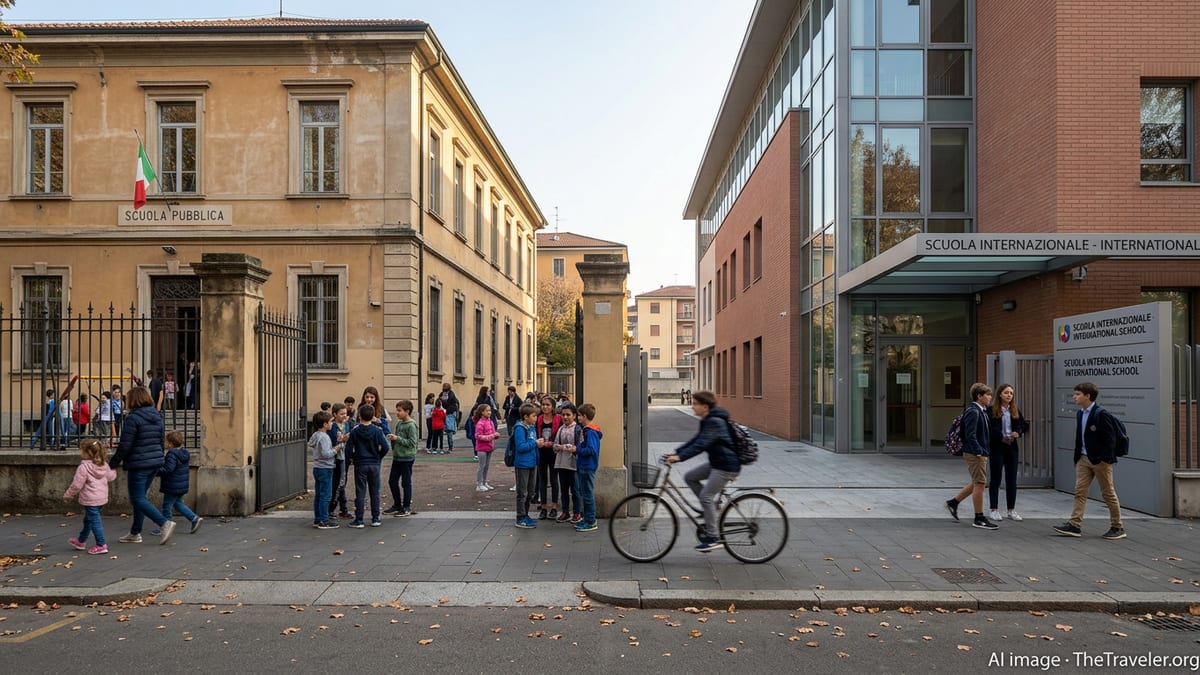
Overview of the Italian School Landscape for Expats
Compulsory education in Italy runs roughly from age 6 to 16, embedded in a unified national system where most children attend state-funded public schools. Public institutions educate the substantial majority of pupils; private schools represent a minority share of total enrolments, with around 12,500 recognized private “paritarie” schools and roughly 800,000 students nationwide, indicating a parallel but smaller network alongside the state system.
Private schooling in Italy falls into three broad categories that are relevant for expats: officially recognized “paritaria” schools that follow the national curriculum; non-recognized “non paritaria” schools, whose diplomas require external validation; and international schools delivering foreign or international curricula such as the International Baccalaureate, British or American programs. Many private schools, particularly at preschool and primary level, are Catholic or faith-based, while international schools concentrate in major cities such as Rome, Milan, Florence and Bologna.
Both sectors are regulated within a national framework, but they differ significantly in governance and financing. Public schools are fully state-funded and tuition-free, while private schools depend on tuition and fees, with limited public subsidies in the case of paritaria institutions. For expat families, the choice is less about absolute quality, which is generally comparable at core academic levels, and more about alignment with language needs, curriculum continuity across borders, and the family’s relocation time horizon.
Decision-making for expats typically centers on three pathways: full immersion in a local public school; a hybrid experience in an Italian private or bilingual school; or continuity-oriented enrolment in an international school using the child’s home-country or IB curriculum. Each route involves trade-offs in integration, academic trajectory and cost that must be assessed against the specific relocation plan.
Curriculum, Academic Standards and School Structure
Italian public schools are bound by a national curriculum set by the Ministry of Education, which applies to core subjects such as Italian, mathematics, sciences, history and foreign languages. Schooling is organized into preschool, primary (grades 1 to 5), lower secondary (grades 6 to 8) and upper secondary (five years, typically ages 14 to 19). Public schools must comply with national standards for teaching hours, subject coverage and examinations, culminating in the state upper secondary exam that grants access to Italian universities.
Paritaria private schools adopt the same national curriculum and their diplomas are legally equivalent to those of public schools. They may, however, supplement the core program with additional hours in foreign languages, arts, technology or religious education, and can organize the school day with greater flexibility. Non paritaria schools have more autonomy but their students often sit external or state exams privately to validate their learning for formal recognition, which can add a layer of complexity for expat families requiring clear academic portability.
International schools in Italy diverge most visibly in curriculum. Many deliver the International Baccalaureate continuum, British curricula leading to IGCSE and A-levels, or American-style programs culminating in a high school diploma and Advanced Placement or similar college-preparatory courses. These schools prioritize English or another foreign language as the main medium of instruction, often combining it with Italian language and social studies to allow re-entry into the local system if needed. For globally mobile expat children, such curricula support smoother transitions between countries and alignment with university admission requirements abroad.
In terms of academic rigor, independent assessments such as OECD and national testing suggest that Italian public schools perform broadly in line with other developed systems, although regional disparities exist, with northern regions typically achieving higher average scores than some southern areas. Private schools’ academic performance is mixed; some paritaria and international schools are highly selective and achieve strong exam outcomes, while others target smaller class sizes or specific educational approaches rather than elite results. For expats, due diligence at the individual school level is more informative than assumptions based solely on public versus private status.
Language of Instruction and Integration Outcomes
Language is often the single most decisive factor for expat families choosing between Italian public and private schools. Public schools teach almost entirely in Italian, with English as a mandatory foreign language and a second foreign language commonly introduced in lower secondary grades. For children with no or limited Italian, full immersion in a public school can initially be challenging but can lead to strong Italian proficiency and deeper integration with local peers over time.
Italian private schools vary in language profile. Many paritaria institutions, particularly Catholic schools, also teach predominantly in Italian but may allocate more hours to English or offer content subjects partially in English. Bilingual schools, often structured as private institutions, provide a significant share of instruction in both Italian and English or another major language, targeting families who want both local integration and international mobility.
International schools typically deliver most instruction in English, French, German or another major world language depending on the school’s alignment. Italian is offered as a host country language, and some schools prepare students to sit Italian state exams or integrate Italian language arts sufficiently to keep open the option of transferring into the national system. For children arriving at later ages, particularly in lower or upper secondary, international schools and bilingual private schools can reduce learning disruption by avoiding sudden full immersion in academic Italian.
In integration terms, public schools tend to facilitate stronger contact with Italian peers, local social networks and community life. International schools, by contrast, can create a more global but somewhat insulated environment, where classmates are often other expat and internationally oriented local families. Private Catholic or paritaria schools may provide a middle path, with predominantly Italian classmates but a somewhat more structured or values-based environment than the average public school. Expat families must weigh the relative importance of deep local integration versus continuity in the child’s schooling language and curriculum.
Costs, Funding and Financial Planning Considerations
Italian public schools are free of tuition at compulsory levels for all residents, including foreign children legally residing in the country. Families must, however, budget for ancillary expenses such as textbooks, notebooks, transport, school canteen fees, compulsory insurance and contributions to field trips. Depending on municipality and age group, these additional costs can amount to several hundred euros per year per child, but remain modest compared with private tuition.
Private and international schools, in contrast, require significant financial commitments. Reported annual tuition ranges for Italian private or paritaria day schools commonly fall between approximately 4,000 and 8,000 euros per year, depending on city, level and facilities. International schools in major centers such as Rome and Milan typically charge substantially more, often in the range of 10,000 to 25,000 euros per year or higher, especially at upper secondary level, with additional charges for registration, transport, meals, extracurricular activities and exams.
These fee levels result from the limited direct state funding available to private institutions compared with the full funding received by public schools. Some tax relief exists; education-related expenses, including certain private school costs, are partially tax deductible up to specified caps per child, but these deductions offset only a minor fraction of total fees. For many expat families, private or international schooling quickly becomes one of the largest recurring relocation costs, comparable to or exceeding housing in some locations.
From a planning perspective, families considering private or international schools should model multi-year costs, including potential fee increases, and understand employer support policies where relocation packages are involved. Those choosing public schools should also factor in potential supplementary Italian language support, private tutoring or after-school programs, particularly in the first years of integration, although these costs generally remain much lower than private tuition.
Class Size, Teaching Environment and Pastoral Care
Available comparative data indicate that average class sizes in Italian lower secondary schools are in the low 20s, with typical public class sizes often around 22 to 25 students. Class sizes in public primary schools are similar or slightly smaller, though conditions vary by region and urban versus rural location. Teachers in public schools are civil servants, and staffing levels are centrally regulated, which can limit flexibility but also ensures a basic standard of teacher qualification and subject coverage.
Private schools, particularly high-fee and international institutions, emphasize smaller class sizes as a differentiating factor. Many international schools advertise average class sizes in the high teens or around 20 students, with some early years classes even lower. These schools often provide additional specialist staff for languages, learning support, counseling and college guidance, funded through tuition fees rather than state budgets. The result is typically greater individual attention and more structured pastoral care, at considerable cost.
Facilities also tend to differ. Public schools in Italy range from well-maintained modern buildings to older facilities with constraints on sports infrastructure, laboratories and technology, reflecting uneven investment across municipalities. Private and international schools are more likely to offer modern campuses, specialized labs, dedicated arts and sports facilities and extensive extracurricular programs. However, this is not universal; some paritaria schools operate in historic buildings with limited physical amenities but strong academic or community reputations.
For expat families, assessing the teaching environment requires school-level visits rather than assumptions based purely on sector. A well-resourced public school in a prosperous northern municipality can offer a learning environment comparable to lower-fee private schools, while a highly regarded international school may deliver premium facilities and support unmatched in the public system. The optimal choice will depend on the child’s specific learning profile, need for support and sensitivity to class size.
Continuity, Mobility and Long-Term Educational Trajectory
Relocation decisions often look beyond the host country and consider the child’s likely educational path over the next five to ten years. Italian public and paritaria schools are well suited for families planning long-term residence in Italy, particularly where children enroll in primary or early lower secondary and have time to develop strong Italian proficiency. Completing an Italian upper secondary program and state exam opens direct access to Italian universities and, with appropriate certification, many European institutions.
For highly mobile expats or those expecting to return to a different system for upper secondary or university, international schools and some bilingual private schools offer clearer academic portability. An IB Diploma, British A-levels or an American high school diploma with recognized college-entrance tests is widely understood by admissions offices worldwide. These qualifications can simplify applications to universities in the United States, United Kingdom and other English-speaking destinations without requiring translation or extensive credential evaluation.
At the same time, public schools can be compatible with later international moves if families plan for language support and engage with credential recognition requirements. Younger children who develop native-like Italian and maintain literacy in their home language can adapt flexibly to other systems, but transitions during critical exam years can be more disruptive. For expats arriving with older children, especially from age 13 onward, the balance often tips toward private bilingual or international schools that reduce curriculum discontinuity and minimize exam-related risk.
An additional strategic factor is the child’s mother tongue and prior schooling. Children who are already proficient readers and writers in a language other than Italian may experience a temporary academic setback when moving into an Italian-only environment, whereas younger children may adapt more quickly. Private and international schools can bridge this gap by maintaining continuity in the primary language of instruction while steadily building Italian competence, preserving long-term academic progression with fewer interruptions.
The Takeaway
Italian public education offers expat families a tuition-free, academically solid pathway with strong potential for linguistic and social integration, particularly for younger children and families intending to remain in Italy for many years. Private and international schools, while carrying substantial tuition costs, provide smaller class sizes on average, more individualized support, broader extracurricular offerings and, in the case of international curricula, clearer academic portability across borders.
Deciding which option is “better” for an expat child in Italy is ultimately context dependent. Key variables include the child’s age and language background, the family’s time horizon in Italy, budget, and long-term university plans. A young child in a family committed to settling in Italy may benefit most from early immersion in a good public school, possibly supplemented with language support. An adolescent arriving mid-way through secondary education with plans to attend an English-speaking university may be better served by a high-quality international or bilingual private school, even at a significantly higher cost.
For relocation planning, families should approach the public versus private decision as an exercise in aligning educational environments with mobility needs and financial capacity, rather than as a simple quality hierarchy. On-the-ground school visits, conversations with other expat parents, and careful review of each institution’s language profile, curriculum, class size and support structures will provide the most reliable basis for a decision that safeguards both immediate adjustment and long-term educational outcomes.
FAQ
Q1. Are Italian public schools good enough for expat children who do not speak Italian yet?
Italian public schools generally offer solid academic standards, but non-Italian-speaking children face an initial language barrier. Younger pupils often adapt within one to two years, while older students may need additional language support or may be better placed in bilingual or international private schools to avoid academic disruption.
Q2. How much do private and international schools in Italy typically cost per year?
Italian private or paritaria schools commonly charge tuition in the approximate range of 4,000 to 8,000 euros per year, while international schools in major cities often range from about 10,000 up to 25,000 euros or more annually, excluding extra costs such as transport, meals and activities.
Q3. What is the main advantage of choosing a public school over a private school in Italy for expats?
The principal advantage is cost, as public schools charge no tuition at compulsory levels, combined with stronger immersion in Italian language and local society. This can be particularly beneficial for younger children and families planning long-term residence in Italy.
Q4. What are the key benefits of international schools in Italy for expat families?
International schools provide instruction mainly in English or another global language, offer internationally recognized curricula such as the IB or British A-levels, generally maintain smaller class sizes and extensive support services, and facilitate smoother transitions between countries and into foreign universities.
Q5. Do private schools in Italy always have smaller class sizes than public schools?
Many private and international schools highlight smaller class sizes, often in the high teens or around 20 students, compared with public averages in the low 20s. However, class size varies by institution, and some public schools also maintain relatively small classes, so it is important to confirm numbers locally.
Q6. Will a diploma from an Italian private school be recognized like a public school diploma?
Diplomas from paritaria private schools are legally equivalent to those from public schools because they follow the national curriculum and meet state requirements. Diplomas from non paritaria schools may require external exams or additional validation, so expat families should verify the school’s legal status before enrolling.
Q7. How does school choice affect a child’s ability to enter Italian universities later on?
Students graduating from public or paritaria upper secondary schools with the Italian state exam can access Italian universities directly. International and foreign-curriculum schools can also lead to Italian higher education, but procedures may involve equivalence checks or additional documentation, depending on qualifications.
Q8. Is religious education mandatory in Italian public or private schools?
Public schools offer Catholic religious instruction as an optional subject, and families can opt out. Many private schools, especially Catholic institutions, integrate religious education and values more fully into school life, so expat parents should ask how religion is handled and what alternatives exist for non-participating students.
Q9. Are there significant regional differences in school quality within Italy?
Data indicate that schools in northern regions often show higher average academic results and may have better facilities than those in some southern areas, reflecting broader regional disparities. However, strong and weak schools exist in all regions, so individual school evaluation remains essential.
Q10. How early should expat families start the application process for private or international schools?
For popular private and international schools, applications typically need to be submitted several months to a year in advance, especially for entry points such as kindergarten, grade 1 or the start of secondary cycles. Early contact improves the chance of securing a place and arranging assessments or placement tests if required.