


More news on this day
An unprecedented summer heatwave is gripping Europe, pushing temperatures above 40 degrees Celsius, draining key rivers such as the Danube and the Po, and forcing governments including Italy and Hungary to coordinate more closely on energy security, transport resilience and emergency response as disruption spreads across the continent.
Get the latest news straight to your inbox!
Record Temperatures Put Italy and Hungary Under Pressure
Publicly available data show that the current European heatwave has pushed temperatures to new highs across central and southern Europe, with Italy placing all of its major cities under the highest heat alert in early August. Reports indicate that tourist hubs from Rome and Florence to Venice have experienced prolonged daytime temperatures above 40 degrees Celsius, prompting warnings about outdoor activity and crowding at popular landmarks.
In Hungary and neighboring states, coverage from regional outlets describes a similar pattern, with heat records broken in multiple locations and nighttime temperatures remaining unusually high. These conditions are intensifying air conditioning demand and straining power grids at precisely the moment when water-dependent power plants face constraints due to low river levels.
Experts quoted in recent climate assessments note that the 2026 heatwave follows a series of hotter, drier summers that have already weakened soils and reduced snowpack in Alpine catchments. That backdrop has amplified the impact of this season’s heat, accelerating evaporation and pushing rivers to record lows much earlier in the summer than in past drought years.
For Italy and Hungary, which both rely on river systems for cooling power plants and supporting freight corridors, the compound effect of high temperatures and shrinking waterways has turned a meteorological event into a broader stress test for infrastructure, tourism and cross-border coordination.
Danube and Po Rivers Hit Historic Lows, Choking Transport
According to recent reporting, water levels on the Danube in Hungary and downstream in Serbia and Romania have fallen to historic lows, in some locations dropping well below previous records set during the 2018 and 2022 droughts. Photos circulated by international agencies show exposed riverbanks, grounded barges and, in some stretches, long-submerged wartime wrecks emerging from the water.
The Danube is a critical artery for energy and grain movements across central and eastern Europe. Low water has forced shipping companies to operate barges at sharply reduced loads or suspend services on the shallowest stretches, cutting capacity and driving up freight costs. For Hungary, a landlocked country that relies heavily on the river, the disruption has immediate implications for fuel deliveries, raw materials and agricultural exports.
Italy faces parallel challenges on the Po, its longest river and a lifeline for the industrial north. Italian media report that flows on the Po have dwindled to a fraction of seasonal norms, with sandbanks appearing in normally navigable channels and irrigation intakes struggling to draw sufficient water. Where river transport remains possible, shipowners are reducing draft and accepting longer transit times, which adds cost and complicates just-in-time logistics for factories.
These constraints echo earlier drought episodes on the Rhine, when low water severely curtailed barge traffic and led to measurable impacts on industrial output. Analysts now warn that simultaneous stress on the Danube, Po and Rhine points to a systemic vulnerability in Europe’s reliance on inland waterways for bulk transport, particularly during increasingly frequent heat-driven droughts.
Energy Security: Joint Responses to Cooling Water and Grid Strains
The heatwave’s most acute effects for policymakers are unfolding in the energy sector, where record demand for cooling coincides with reduced generating capacity. Public information from Hungary and Romania indicates that low Danube levels have already forced one nuclear reactor offline and prompted emergency engineering measures, such as sinking rock-filled barges to redirect water toward critical plant intakes.
In Hungary, discussions on energy resilience have been underway for months as the country adjusts to European Union deadlines to phase out Russian fossil fuel imports. Policy papers and commentary emphasize that river-cooled power plants are central to Hungary’s supply during heat events. With Danube temperatures rising and depths falling, grid operators are being pushed to balance safety limits on reactor cooling and thermal discharges against the need to keep electricity flowing for homes, businesses and rail networks.
Italy brings its own set of vulnerabilities and assets to this regional picture. Hydropower output has been hit in dry Alpine catchments, while soaring air conditioning use in major cities has pushed peak loads higher. At the same time, Rome has spent the past two years broadening its gas supply options, intensifying partnerships with producers such as Azerbaijan and North African countries to reinforce its role as a Mediterranean energy hub for southern and central Europe.
According to published coverage of recent European energy meetings, Italy and Hungary are among the states working within broader European Union and International Energy Agency frameworks to coordinate emergency planning, grid interconnections and demand-reduction campaigns. The aim is to cushion the impact of heat-driven shocks on power systems, share spare capacity when possible and accelerate investment in more resilient generation and storage.
Travel and Tourism Disruption Across a Sweltering Continent
For travelers, the most visible impact of the heatwave is not in power plants but on the ground in Europe’s cities, resorts and river cruise corridors. Airlines and rail companies have warned of delays and localized cancellations as high temperatures affect aircraft performance, overhead power lines and track conditions, particularly on older infrastructure segments.
Reports from Italy describe early-morning scheduling shifts for some outdoor attractions, with museums, archaeological sites and guided tours adapting hours to avoid the hottest part of the day. In cities such as Rome and Florence, visitors are being advised to plan indoor activities during peak heat and expect occasional capacity controls at popular monuments where shaded waiting areas are limited.
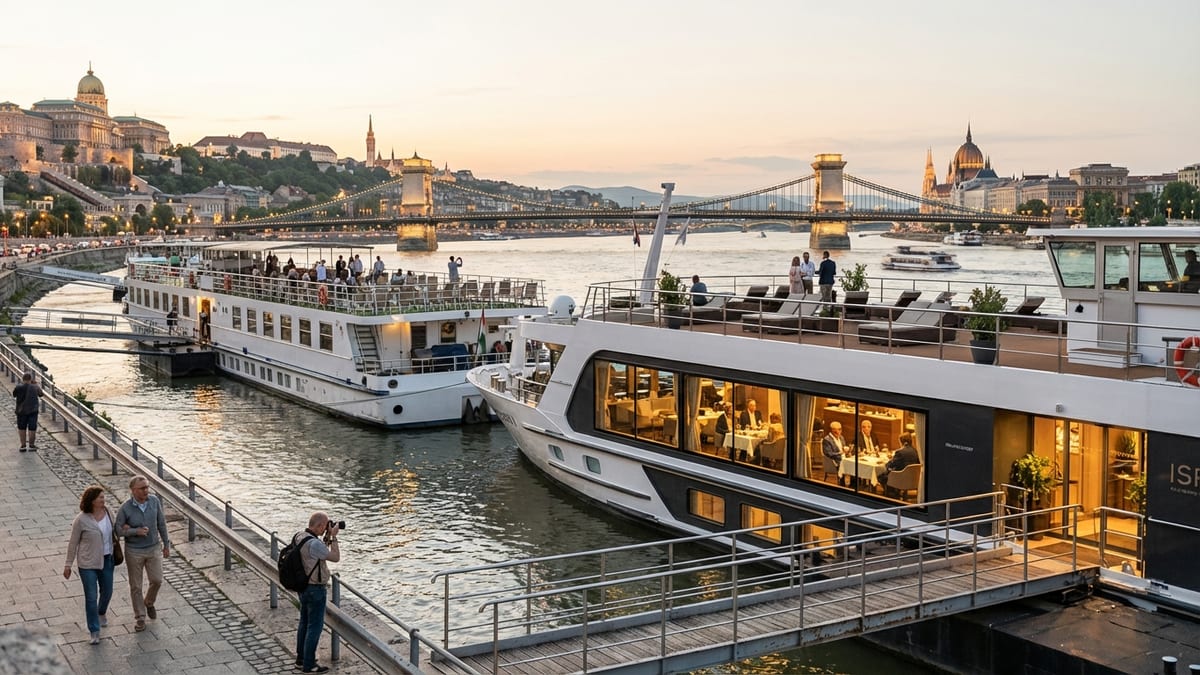
On the Danube, the combination of low water and heat has led several cruise operators to adjust itineraries, replace river segments with coach transfers or reroute ships to deeper stretches. Travel trade publications note that some departures remain oversubscribed despite the disruption, reflecting continued demand for European river cruising, but operators are having to manage expectations around scenic sections that may now be traversed by bus rather than boat.
Tourism boards in Hungary and Italy are emphasizing lesser-known destinations at higher elevations or near coasts, promoting lakes, mountain towns and shaded historic districts where temperatures are marginally more comfortable. However, they are also highlighting the importance of travel insurance, flexible booking policies and close monitoring of local advisories, as wildfire smoke, heat alerts or sudden thunderstorms can alter conditions on short notice.
Rising Calls for Long-Term Climate Resilience and Coordination
While emergency measures dominate the headlines, a parallel debate is unfolding about how to adapt Europe’s infrastructure and travel economy to a climate where summers like 2026 are expected to become more frequent. Scientific assessments released this year underline the role of human-driven climate change in increasing the likelihood and intensity of compound heat and drought events across the continent.
Policy briefings shared at recent European energy and transport forums point to a range of adaptation priorities. These include reinforcing rail tracks and overhead lines to perform reliably at higher temperatures, expanding grid-scale energy storage, diversifying cooling technologies that do not depend on large volumes of river water, and redesigning river navigation channels and ports for a wider range of water levels.
For Italy and Hungary, cooperation is increasingly framed not just in terms of short-term crisis response but also in aligning investment plans so that new gas corridors, electricity interconnectors and renewable energy projects support resilience across borders. Hungarian strategy documents highlight the need for more regional coordination on grid upgrades and flexible generation, while Italy’s outreach to partner countries in the Mediterranean and Caucasus is described as part of a broader push to stabilize supplies for multiple European neighbors.
For travelers, the rapid succession of heatwaves, wildfires and river disruptions is a reminder that climate risk is now a central factor in trip planning. Industry analysts suggest that flexible itineraries, off-peak travel seasons and greater awareness of local emergency protocols will become standard considerations, particularly for river cruising and rail-based journeys that depend directly on Europe’s stressed waterways and power systems.