


Registering residency in Italy is a mandatory administrative step for anyone planning to live in the country beyond a short stay. The process, handled through the municipal civil registry known as the Anagrafe, determines where an individual is officially resident for access to local services and many legal procedures. Understanding how this works, what documentation is required, and what timelines to expect is essential for evaluating the practicalities of relocating to Italy.
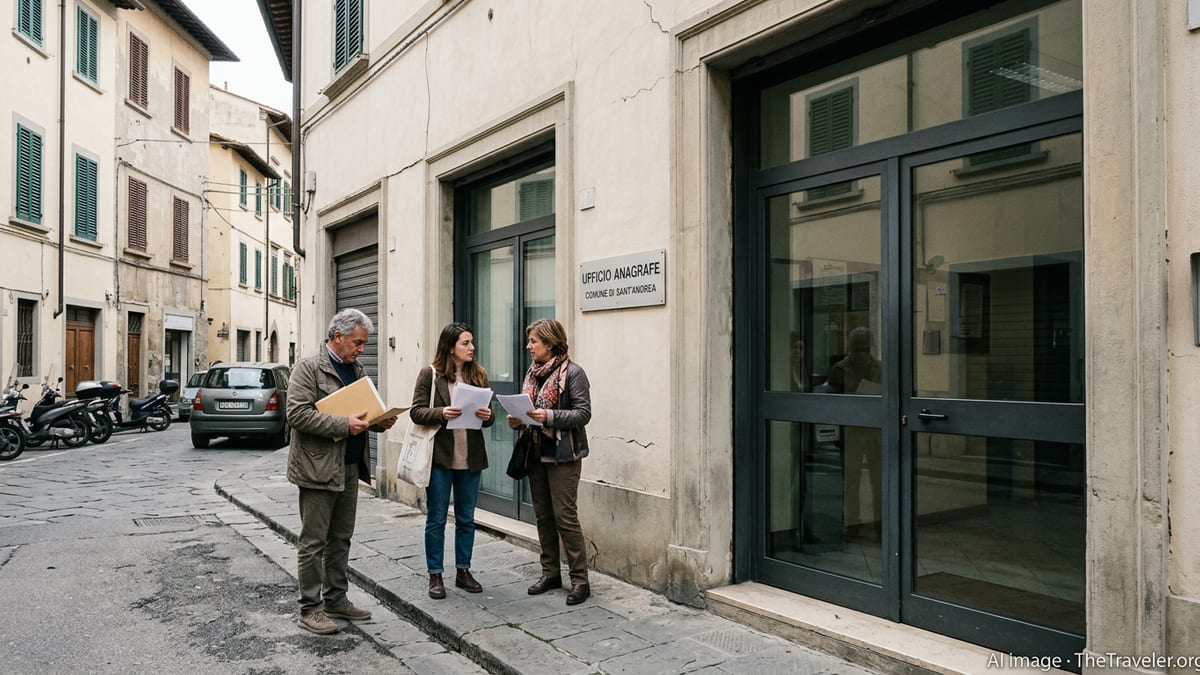
Overview of Residency Registration in Italy
Residency registration in Italy is carried out at the municipal registry office, the Ufficio Anagrafe, in the comune where the individual actually lives. Registration records are held locally and, increasingly, pooled in the national population register (ANPR), which centralizes data previously maintained separately by each municipality. The registration is called iscrizione anagrafica and results in an entry in the register of resident population.
Italian law requires that individuals who establish their habitual residence in a municipality declare it to the Anagrafe. For many comuni, public guidance states that the declaration of new residence must be made within approximately 20 days of settling at a new address. This applies both to new arrivals from abroad and to people moving between Italian municipalities, although practical enforcement and awareness of deadlines can vary by locality.
Residency registration is distinct from immigration status but closely interacts with it. EU and EEA citizens exercise free movement rights and register on the basis of those rights. Non EU nationals must generally hold a valid residence permit or equivalent authorization before a municipality will enter them in the Anagrafe. In both cases, the registration is not purely a formality: it is tied to how authorities assess where a person’s main life interests and habitual abode are located.
From a relocation planning perspective, understanding the Anagrafe process is important because many subsequent administrative steps depend on it. Access to an Italian identity card, enrollment in the regional health service, local schooling procedures and certain tax interactions often require or are simplified by an established registered residence in a specific comune.
Legal Basis and Key Concepts
The operative concept behind residency registration is the civil law definition of residenza as the place where a person has their habitual abode and the center of their personal and, in many cases, economic interests. Municipal authorities are tasked with verifying that the declared address corresponds to an actual, ongoing living situation and not merely a nominal registration. Guidance from various comuni emphasizes that a declaration alone is not sufficient if it is not matched by factual circumstances.
The national demographic regulation and the civil code govern the functioning of the Anagrafe. Under this framework, every municipality keeps or contributes to a register of resident population and must record changes such as new registrations, moves between municipalities, births, deaths and emigration abroad. In recent years, the Anagrafe Nazionale della Popolazione Residente has been progressively implemented to integrate local registries at national level, allowing certain intra Italian moves to be initiated online where technically enabled.
For EU nationals, residence registration implements the free movement rules which allow stays of longer than three months subject to certain conditions. Local and regional materials typically state that EU citizens who stay in Italy for more than three months should enroll with the Anagrafe in the municipality where they live. For non EU nationals, registration reflects lawful stay under national immigration rules and often requires presentation of a residence permit or proof that an application for one has been filed.
A practical implication of the legal framework is that the Anagrafe has investigative powers. After accepting a declaration of residence, the office transmits details to the local municipal police or other officers to verify that the person actually lives at the stated address. Only after a positive verification will the registration become fully confirmed, which can affect how quickly residents can obtain documents based on residency.
Step by Step: Preparing for Residency Registration
Before approaching the Anagrafe, would be residents must typically secure a qualifying address and assemble the required documentary evidence. Municipal guidance across Italy consistently requires proof of housing, identification and, depending on category, proof of lawful stay and economic self sufficiency. Because requirements can vary by comune, relocation planners often recommend reviewing the specific municipal checklist in advance and allowing additional time for obtaining translated or legalized documents where needed.
Proof of address is central. In practice, comuni accept an Italian rental contract, property deed, or a formal declaration by a host combined with proof of their ownership or lease. Short term or informal arrangements may be viewed critically, particularly where the local office suspects that the declared residence is not the applicant’s actual habitual home. In shared housing, it is common for the office to request identification details for other occupants and occasionally their written consent.
Identification requirements are usually clear. All applicants must present a valid identity document such as a passport or national identity card. Where family members register together, documentation proving the family relationship, such as marriage or birth certificates, may be requested. Some municipalities indicate that, for foreign issued civil status documents, translations and in certain cases apostille or other legalization may be needed, depending on the country of origin and applicable international conventions.
For non EU nationals, proof of lawful presence or stay is an additional prerequisite. Local guidance and institutional handbooks directed at researchers and employees generally state that non EU citizens must have applied for or obtained a residence permit before they can finalize registration. Some offices will accept a postal receipt or appointment confirmation showing that the residence permit application has been filed, while others expect at least a receipt confirming submission. This is a critical sequencing issue for relocation planning, since it means residency registration often cannot be completed immediately on arrival for non EU nationals.
Filing the Residency Declaration at the Anagrafe
Once documentation is assembled, the applicant files a declaration of residence, known as dichiarazione di residenza, with the Ufficio Anagrafe of the municipality. Italian regulations and municipal practices allow several submission channels: in person at the counter, by email or certified electronic mail where available, and, in some cases, through online portals. Local instructions typically provide a standardized form which must be completed, signed and accompanied by scans or copies of supporting documents.
The declaration collects key data used to update the resident population register. Typical data points include personal identification details, tax code if available, citizenship, marital status, previous place of residence, and the full address and housing details of the new Italian residence. For households, one member often acts as the primary declarant, but each adult is usually required to sign or provide explicit consent, and information about children or other dependants is recorded in the same application.
Upon receiving the application, the Anagrafe will usually issue a protocol receipt showing the date of submission. Under commonly cited administrative rules, the office has a period of about 45 days to verify the factual basis of the declaration and either confirm or reject the registration. During this interval, some rights linked to residency may be accessible on the basis of the pending application, but others will only be fully activated once verification is completed and the registration is definitively entered.
Municipal procedures highlight that incorrect or incomplete submissions can delay processing. If documents are missing, unclear or inconsistent, the Anagrafe may request integration, effectively pausing the verification timeline until the applicant responds. In busier metropolitan comuni, anecdotal evidence and official guidance both suggest that processing can extend beyond the indicative 45 day period, making realistic time allowances important in relocation planning.
Verification, Confirmation and Potential Outcomes
After a declaration has been filed, the municipality initiates verification to ensure that the applicant actually resides at the declared address. This task is typically assigned to the local municipal police or another authorized officer who may carry out an inspection, ring doorbells or otherwise confirm that the applicant is effectively living there. Verification practices can differ significantly by municipality, but the underlying purpose is to ensure that registration aligns with factual residence and to prevent fictitious registrations.
If the verification is positive or if the municipality does not find grounds to reject the application within the legally defined timeframe, the residency registration becomes definitive. At that stage, the person appears as resident in the Anagrafe and may request documentation proving residency such as a certificato di residenza or an official statement of family composition. In many comuni, this confirmation then allows the resident to proceed with other formalities such as requesting an identity card or enrolling with the health authority.
Where verification raises doubts, the Anagrafe may take several actions. It can request clarifications or additional documents from the applicant, schedule a further inspection, or in clear cut cases issue a motivated rejection of the application. Reasons for rejection typically include lack of sufficient proof of actual residence, inconsistencies in documentation, or, for non EU nationals, absence of a valid immigration status or supporting residence permit documentation. Applicants generally have the possibility to challenge a refusal through administrative appeals, but this adds complexity and time.
It is important to note that a residency registration can also be reviewed after the fact. If the municipality later discovers that a resident has moved away without notifying the office, or that the declared residence has ceased to correspond to reality, it can initiate removal from the Anagrafe either transferring the registration to another municipality or recording emigration abroad. In practice, deregistration may lag behind reality, but the legal expectation remains that residents will notify changes promptly.
Differences Between EU and Non EU Nationals
While the procedural steps at the Anagrafe are broadly similar for all applicants, the underlying documentation and legal criteria differ between EU and non EU nationals. EU and EEA citizens, and their qualifying family members, rely on free movement rules that allow them to reside in Italy for more than three months if they are workers, self employed, economically self sufficient with health coverage, or enrolled students with adequate resources and insurance. Municipal guidance aimed at EU citizens often specifies that applicants must show evidence of one of these categories when registering.
For economically self sufficient EU citizens, some municipalities and advisory organizations mention that applicants may be asked to present proof of adequate financial resources and comprehensive health insurance covering risks in Italy. Local practice varies in how rigorously these requirements are applied, but they can be relevant for retirees, remote workers or others without an Italian employment contract. EU citizens who are employees or self employed typically show their work contract or registration in the relevant business or social security registers.
Non EU nationals face additional dependencies on immigration procedures. Municipalities commonly state that a valid residence permit or documented application for a residence permit is required for Anagrafe registration. For example, institutional handbooks for foreign researchers and workers in large Italian cities generally list as a prerequisite the receipt proving that a residence permit application has been filed with the authorities. Until this step is complete, municipalities may decline to finalize residency registration, meaning that non EU relocations must factor in the timeline for both immigration and Anagrafe procedures.
In practice, this distinction means that EU nationals can often proceed with residency registration relatively soon after securing housing and gathering documentation, subject to local interpretation of self sufficiency and insurance rules, while non EU nationals may experience a staged process where Anagrafe registration trails immigration formalities. Both groups, however, are subject to address verification and must demonstrate that their chosen comune is in fact where they habitually live.
Consequences and Uses of Residency Registration
Residency registration has several concrete consequences that are relevant when assessing the operational aspects of a move to Italy. First, it establishes the individual’s official domicile for many administrative interactions. Local taxes, school catchment areas, access to certain municipal services and correspondence from authorities are often tied to the registered address. This makes accuracy and timeliness in registration and later changes particularly important.
Second, registration typically enables or simplifies access to various public or semi public services and digital tools. Residents can usually request an Italian identity card from their comune, and many municipalities note that resident foreigners, including non EU nationals with legal stay, can obtain this document once registered. With registration and identity documentation in place, residents can then create a digital identity credential, used increasingly for online interaction with public administration.
Third, residency registration has implications for tax and social security. Tax authorities and other bodies often use Anagrafe data as an initial indicator of where a person is resident, which can influence how they assess tax residence or eligibility for certain benefits. Specialist tax commentary highlights that although tax residence is determined under substantive rules, being registered in the Anagrafe as resident in Italy is often treated by authorities as strong evidence that the person is tax resident, absent proof to the contrary.
Finally, the registration is needed for many other legal procedures, including some paths to long term immigration status or citizenship which count years of residence. In such cases, evidence of continuous registration in the Anagrafe, sometimes combined with other proofs of lawful stay, may be required. Interruptions or inconsistencies in residency records can complicate these later applications, making careful management of registration status an important long term consideration.
The Takeaway
For prospective movers, Italy’s residency registration process represents a central administrative task that influences many other aspects of life in the country. The core requirements are conceptually straightforward: secure a genuine place of habitual residence, gather identification and supporting documents, submit a formal declaration at the Anagrafe of the relevant comune, and allow for an official verification period before registration is fully confirmed. However, practical experience and municipal guidance show that timelines, documentation expectations and consistency of application can vary between cities and even within the same municipality over time.
EU and non EU nationals face similar procedural steps but operate under different legal bases and documentary requirements. EU citizens generally rely on free movement rules, with particular attention to work, self sufficiency and health coverage, while non EU nationals depend on a valid residence permit or proof of application. In both groups, inadequate proof of real residence or incomplete documentation can delay or derail registration. Factoring realistic processing times of several weeks, sometimes longer in large urban areas, is advisable when planning the sequence of relocation steps.
Overall, Italy’s residency registration is not a mere box ticking exercise. It represents a formal acknowledgment by local authorities that an individual has established their life in a particular municipality and integrates them into national and municipal administrative systems. For relocation decision making, the key consideration is not only whether registration is legally possible, but how predictable and manageable the process will be in the specific destination comune, given its local procedures, workload and interpretation of national rules.
FAQ
Q1. Is residency registration in Italy mandatory for all long term stays?
Residency registration is generally expected for anyone who establishes habitual residence in an Italian municipality, particularly if staying longer than three months or accessing local services.
Q2. How soon after moving to a new address must residency be declared?
Many municipalities refer to a period of around 20 days from establishing residence to file a declaration, although awareness and enforcement of this deadline can differ by location.
Q3. How long does it typically take for residency registration to be confirmed?
Administrative rules often indicate an approximate verification window of up to 45 days, but in large or busy comuni processing can take longer in practice.
Q4. Can residency registration be completed entirely online?
Some municipalities allow online or email submission of the declaration and documents, but verification still occurs locally and availability of full online procedures varies by comune.
Q5. Do non EU nationals need their residence permit before registering?
Most municipalities require either a valid residence permit or documented proof that a residence permit application has been submitted before finalizing registration for non EU nationals.
Q6. What happens if the municipal police cannot find me at the declared address?
If verification visits fail or raise doubts, the Anagrafe may request clarifications, schedule further checks or ultimately reject the application if genuine residence is not demonstrated.
Q7. Does being registered in the Anagrafe automatically make me an Italian tax resident?
Tax residence is determined under specific tax rules, but authorities often treat Anagrafe registration as strong evidence of tax residence unless other facts clearly indicate otherwise.
Q8. Can I change my registered residence easily if I move within Italy?
Yes, but a new declaration must be filed in the new municipality or via national systems where available, and the usual verification process of the new address will apply.
Q9. Is a short term rental contract sufficient to register residency?
Some comuni accept shorter contracts if they reflect genuine habitual residence, but very temporary or informal arrangements may face greater scrutiny during verification.
Q10. What documents prove residency once I am registered?
Residents can request certificates such as a certificato di residenza or family composition statement from the Anagrafe, which serve as official proof of registered residence.