


Italy’s reputation for slow and fragmented bureaucracy is a recurring concern for foreign residents considering relocation. While major reforms and digital tools have improved some processes, experiences remain highly uneven between regions and offices. Understanding where delays are most acute, what “normal” processing looks like in practice, and how predictable outcomes really are is essential for evaluating the operational feasibility of a move to Italy.
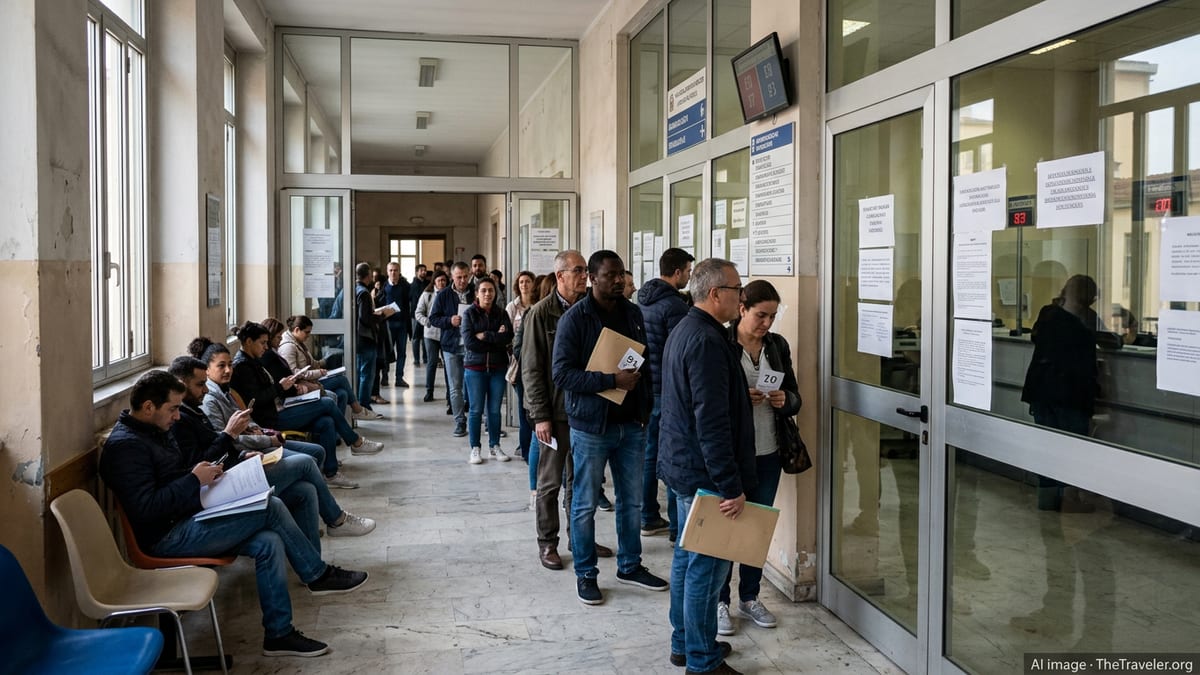
Overall Character of Italian Bureaucracy for Foreign Residents
Foreign residents interact intensively with Italian public administration through residence permits, local population registration, fiscal registration, and social security procedures. These touchpoints expose both the progress made through digitalisation and the persistent structural weaknesses that generate long waiting times and inconsistent decisions.
Italy has invested heavily in e-government platforms in recent years. Digital identity systems such as SPID and the electronic ID card (CIE), the IO public services app, and the pagoPA payment platform have been rolled out nationally. By 2024, more than 10 000 public administrations had integrated services into the IO app and thousands adopted pagoPA for payments, while most municipalities now support digital ID access to online services. This has reduced front-office queues for some tasks and allows online submission and tracking in many areas.
Despite these advances, Italy still ranks as a relatively slow and complex administrative environment compared with other EU countries in multiple comparative assessments of public administration performance. Foreign residents consistently report long lead times for key processes, high dependence on local practices, and a strong need for in-person follow-up. The result is a bureaucracy that can work reasonably smoothly in some locations and situations but becomes highly time-consuming and unpredictable in others, especially when immigration status or cross-agency coordination is involved.
For relocation planning, the critical issue is not only the absolute speed of individual procedures but the cumulative effect. When a residence permit, local registration, tax code, and social security registration each involve separate queues and discretionary interpretations, the total time required to become fully “operational” in Italy can be considerably longer than official guidelines would suggest.
Residence Permit Processing Times: Law vs Reality
Residence permits (permesso di soggiorno) and related titles are administered mainly by local Questura (police headquarters) and Prefettura (prefecture) offices. Legally, many categories of permits should be processed within roughly 60 days from application. In practice, both official statements and on-the-ground reports show that this target is frequently exceeded, sometimes by a wide margin.
Local authorities themselves have acknowledged structural backlogs. In several provinces, prefectures and police headquarters have publicly stated that waiting times for the issuance or renewal of residence permits often extend “well beyond” the 60 days envisaged by law, citing staff shortages and rising application volumes. In some cases, extra opening hours or additional pick-up days have been announced specifically to help clear accumulated residence permit cards.
Media reports from cities such as Brescia have documented situations where foreign residents waited up to two years instead of the theoretical three months for certain permits, prompting organised protests by migrant associations. These accounts describe prolonged delays not only for first-time permits but also for renewals, family reunification clearances, and protection-related titles. Informal evidence from foreign-resident communities and online forums across Italy in 2024 and 2025 shows that multi-month waits are common, with some users reporting total timelines from initial postal application to card collection of 8 to 18 months depending on the province.
From a relocation risk perspective, the key point is that published legal deadlines are not reliable indicators of real-world processing time. Prospective foreign residents should assume that residence permit issuance may take significantly longer than the formal benchmark, with wide regional variation, and that the burden of monitoring progress and pushing for updates often falls on the applicant.
Local Variations and “Postcode Lottery” Effects
One defining feature of Italian bureaucracy for foreign residents is the pronounced variation between provinces and even between individual offices in the same region. While some Questura offices report typical post-fingerprinting waiting times of two to four months for standard permits, others are described as being “up to two years behind” in managing their residency card caseload.
This postcode effect is driven by several factors. Some areas have far higher volumes of immigration-related applications than others relative to staffing levels. In others, internal workflows, appointment systems, and the adoption of digital tools differ markedly. For example, in high-capacity offices, fingerprinting appointments might be scheduled within a few weeks of the initial application and cards produced within a few months. In more congested jurisdictions, applicants may wait many months just for a fingerprinting slot, with total processing stretching well beyond a year.
Consequently, two foreign residents with similar profiles can experience radically different timelines and administrative burdens depending solely on their place of residence in Italy. There is no unified national service standard that is consistently enforced at the operational level. For internationally mobile professionals who need predictable timelines, this local fragmentation is often more problematic than the absolute speed in any single city.
Relocation decision-makers therefore need to evaluate Italy not as a single market but as a patchwork of administrative environments. When assignments are tied to a specific city, understanding local Questura and Prefettura performance from recent experience on the ground becomes a critical part of risk assessment, particularly for time-sensitive roles or school start dates.
Digitalisation: Where It Helps and Where It Does Not
Italy’s public administration has undergone an accelerated digital transformation supported by EU recovery funding. By 2024, national authorities reported thousands of public bodies integrating the pagoPA e-payment platform and over 10 000 administrations offering services via the IO app. Separate analyses of local authorities indicate that more than 90 percent of municipalities have activated digital ID access (SPID or CIE) and a substantial majority use national platforms for payments and notifications.
For foreign residents, these systems can streamline certain interactions. Common benefits include online payment of administrative fees, digital notifications of appointments or decisions, and in some regions the ability to download certificates or check status online rather than queuing in person. The spread of digital ID has also made it easier to access tax, social security, and municipal portals once basic registration steps are completed.
However, digitalisation does not automatically resolve the underlying bottlenecks that drive slowness. Immigration-related decisions, local registry checks, and cross-office verifications still rely heavily on manual workflows, internal file circulation, and staff availability. In multiple cities, even when initial applications are filed or paid for online, applicants still wait months for in-person fingerprinting or document verification appointments, and printed residence cards must be collected physically during narrow time windows.
Digitalisation in Italy therefore tends to reduce front-office friction and repetitive tasks more than it shortens complex, discretionary procedures. From a relocation perspective, online tools can make bureaucracy somewhat more manageable, but they do not remove the need for buffer time in project plans or the operational risk created by backlogs in key offices.
Coordination Between Agencies and Cumulative Delays
Foreign residents typically need to interact with several distinct institutions in the first months after arrival: postal offices handling residence permit kits, police headquarters for fingerprints and card issuance, municipal registries (anagrafe) for local population registration, tax authorities for fiscal codes and registration, and social security offices for certain benefits or contributions. These bodies often operate with their own systems, queues, and documentation practices.
Although Italy has policy objectives aimed at interoperable public databases and shared digital platforms, practical coordination between agencies remains incomplete. For example, municipal registration may depend on evidence of residence permit application or validity, while some social security or welfare decisions require cross-checks with national registry data that are not updated promptly. If one office is delayed, the entire chain of subsequent registrations and rights can be held up.
Civil society reports on foreign residents’ access to benefits describe cases where delays or inconsistent practices at the municipal registry and social security institute have affected hundreds of migrant families, particularly when offices require additional proof of residence beyond what the law prescribes or interpret eligibility criteria restrictively. Even when such practices are ultimately corrected, resolution often requires legal support or repeated visits, adding to the bureaucratic burden.
For relocation planning, the practical implication is that slowness should be assessed as a system property rather than as a series of isolated queues. An extended wait at the Questura can delay local registration, which in turn affects family benefits, school enrolment documentation, and in some cases access to public services that require formal inscription in the local registry. The aggregate effect can be several extra months before a foreign resident’s administrative position is fully regularised, even after arrival with valid entry documentation.
Predictability, Discretion, and the Human Factor
Beyond raw processing times, an important dimension of Italian bureaucracy for foreign residents is the high level of discretion and variability in how rules are applied. The same legal framework can be interpreted differently not only between regions but between individual counters within the same office. Applicants frequently report receiving different answers to the same procedural question from different officials, and having to return with additional documents that were not originally requested.
This unpredictability is partly structural. Italian migration and residence rules are complex, and staff in heavily burdened offices may rely on internal practices rather than detailed statutory interpretation. Training levels and familiarity with specific foreign-resident profiles, such as remote workers, mixed-status families, or long-term residents changing status, can vary considerably. In some cases, written guidance is not fully harmonised with local practice, leaving applicants reliant on informal advice or experienced intermediaries.
The human factor therefore plays a significant role in how slow or fast the bureaucracy feels in practice. Friendly, clear, and experienced staff can partly offset structural delays by giving realistic expectations and helping applicants avoid errors that would trigger rework. Conversely, rigid or inconsistent handling can multiply delays even in offices that are not technically overloaded.
For corporate mobility teams and individual relocators, the operational conclusion is that relying solely on published rules or generic checklists is inadequate. Access to current, location-specific knowledge about how offices actually operate, and where interpretation issues typically arise, is often as important as understanding the formal legal framework.
The Takeaway
For foreign residents, Italian bureaucracy is characterised by a combination of partial modernisation and persistent structural inertia. National digital platforms have simplified some interactions and reduced the need for repeated in-person visits, but they have not eliminated core bottlenecks in immigration-related processing, inter-agency coordination, and local registry functions.
Official deadlines, such as the 60-day guideline for many residence permits, are not reliable indicators of actual processing times in many parts of the country. Documented cases of waits extending to one year or more for certain permits, alongside acknowledged backlogs in multiple provinces, show that lengthy delays are not exceptional outliers but an enduring feature of the system in stressed locations.
The degree of slowness experienced by a foreign resident is heavily dependent on geography and office capacity. Some cities manage to process standard cases in a few months, while others face multi-year backlogs for complex titles. Digital tools improve convenience but do not fully compensate for understaffed offices or fragmented workflows. For decision-grade relocation planning, buffer time for administrative regularisation and awareness of local performance are essential inputs.
In practical terms, Italy remains operationally feasible for relocation, but its bureaucracy should be regarded as high-friction and low-predictability compared with more streamlined EU administrations. Those considering a move should factor in the need for sustained follow-up, tolerance for uncertainty, and, where stakes are high, professional support to navigate the system’s variable speed and interpretation.
FAQ
Q1. How long does it really take to get a residence permit in Italy?
In practice, standard residence permits can take anywhere from a few months to well over a year from initial application to card collection, depending heavily on the province and office workload.
Q2. Are the legal deadlines for residence permit processing respected?
The law often refers to a 60-day deadline, but many local authorities openly acknowledge that this standard is frequently exceeded due to staffing constraints and backlogs, especially in high-demand areas.
Q3. Is Italian bureaucracy improving thanks to digitalisation?
Digital tools have improved access and reduced some front-office queues, but they have not fully resolved core bottlenecks in immigration decisions and inter-agency coordination, so overall speed gains for foreign residents remain limited and uneven.
Q4. Why do processing times vary so much between Italian cities?
Variation is driven by differences in application volumes, staffing levels, internal workflows, and the pace of local digital adoption, leading to a practical “postcode lottery” in how fast or slow procedures move.
Q5. Which bureaucratic step is usually the slowest for foreign residents?
Residence permit issuance and renewal, particularly the period after fingerprinting until the card is ready, is typically the slowest and least predictable step, although local registry and benefit checks can also add delays.
Q6. Does using SPID, CIE, or the IO app significantly speed up procedures?
Digital identity and the IO app often make it easier to submit requests, pay fees, and receive notifications, but they do not by themselves shorten the internal decision-making and production stages that cause most delays.
Q7. Can delays in one office affect access to other services?
Yes. For example, slow residence permit issuance can delay municipal registration, which in turn may affect access to certain benefits, school documentation, or other services that rely on updated registry data.
Q8. How predictable are outcomes when dealing with Italian public offices?
Predictability is relatively low. The same rule may be applied differently across offices or even counters, and applicants often receive inconsistent instructions, which can require repeated visits and add to total processing time.
Q9. Is Italian bureaucracy manageable without professional assistance?
It is manageable for some, especially in better-resourced cities, but the combination of delays, language barriers, and variable interpretation means that professional or experienced local support can substantially reduce risk and uncertainty.
Q10. How should relocation planners factor Italian bureaucracy into timelines?
Relocation planners should assume that full administrative regularisation may take many months beyond arrival, build generous buffers into start dates and access to benefits, and base expectations on recent local experience rather than formal legal deadlines.