


More news on this day
Japan has issued a new wide area alert for the Middle East, urging its citizens to avoid travel to Iran, Iraq and several Gulf destinations as volatile security conditions and rapidly shifting airspace restrictions create renewed uncertainty for international flights across the region.
Get the latest news straight to your inbox!
Heightened Warning Levels for Iran, Iraq and Neighboring States
According to public advisories from Japan’s Ministry of Foreign Affairs, the latest wide area alert centers on the deteriorating security environment linked to the ongoing Iran conflict and spillover tensions across the Middle East. The notice highlights the possibility of a sudden and significant worsening of conditions, particularly in Iran and Iraq, and underscores the risk of further attacks or unrest affecting foreign nationals and transport infrastructure.
Existing travel advisory levels for parts of the region remain at the ministry’s highest classification, which effectively equates to a strong recommendation against all travel and calls for those already in affected territories to consider departure as soon as practicable. Iran, Iraq and several neighboring conflict zones are included in these top-tier categories, reflecting concerns about missile and drone strikes, militia activity, and the potential for rapid escalations that could disrupt civilian movement.
Publicly available information shows that Japanese nationals are being urged to defer nonessential trips to a broader set of Middle Eastern and Gulf locations, even where formal alert levels are slightly lower. Authorities are also drawing attention to the need for travelers already in the region to monitor official updates closely, ensure that they have contingency plans, and be prepared for abrupt changes to local security measures or border controls.
While the wording of the advisory is directed at Japanese citizens, the underlying assessment of regional volatility is likely to be of interest to international travelers more generally, particularly those connecting between Europe, Asia and Africa on routes that typically overfly Iranian or Iraqi airspace.
Aviation Disruptions and Airspace Restrictions Over Iran and Iraq
The renewed warning is closely tied to an unsettled picture in regional aviation. Published aviation and risk assessments from recent weeks indicate that Iran and Iraq remain focal points for airspace restrictions, as regulators and airlines respond to the threat of missile and drone activity and the prospect of miscalculation involving civil aircraft.
European and international aviation safety notices have advised carriers to avoid or severely limit operations in the skies over Iran and Iraq, treating them as high-risk corridors for overflights. Industry bulletins describe “do not operate” guidance or strong precautionary measures covering large swathes of the region, prompting airlines to reroute services that previously crossed the heart of the Middle East en route between Europe and Asia.
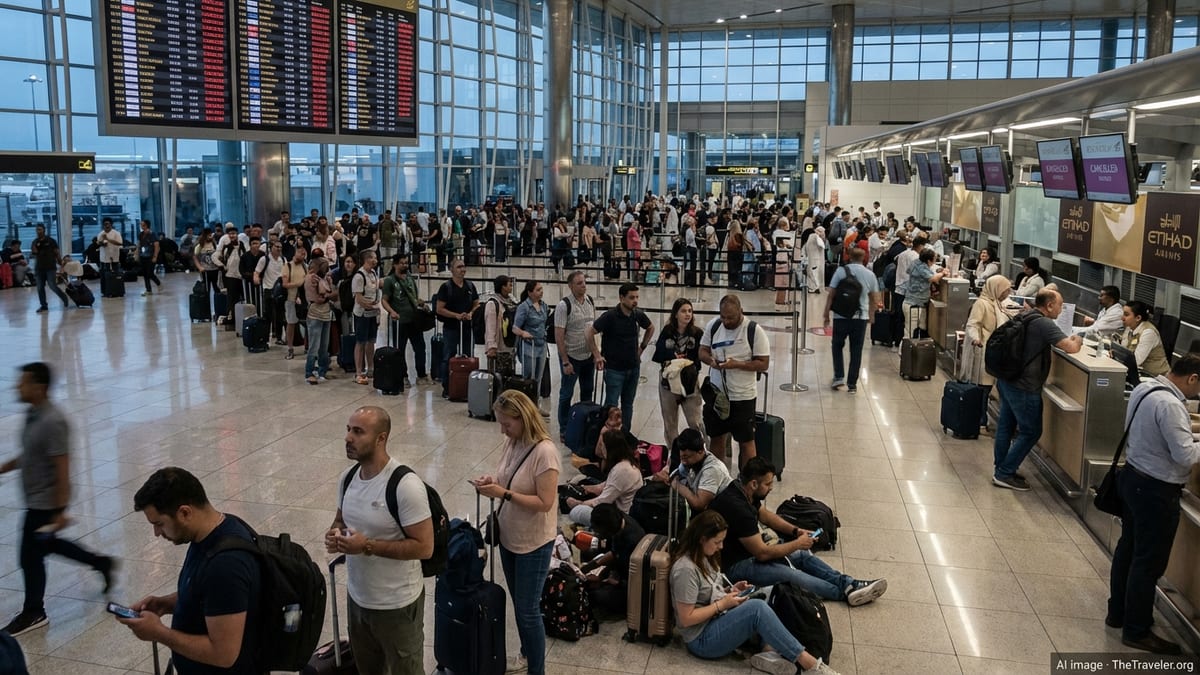
Japan’s updated alert reflects these operational realities by stressing that flights to, from and over Iran and Iraq may be subject to last-minute cancellation, diversion or significant deviation from normal routings. Travelers are being warned that even indirect itineraries that only pass through regional airspace, without landing, could face delays or disruptions if safety regulators or military developments trigger sudden changes in permitted routes.
In some cases, airspace closures and risk assessments have led to longer flight times, higher fuel use and tighter aircraft availability, which in turn can ripple outward to affect schedules on routes far removed from the immediate conflict zone. For time-sensitive travelers or those on complex multi-stop journeys, these knock-on effects are becoming an important planning consideration.
Knock-on Effects for Gulf Hubs and Connecting Itineraries
The Japanese advisory also points to instability affecting major Gulf hubs that function as critical connectors between Asia, Europe, Africa and the Americas. Recent coverage in aviation and regional media has detailed how tensions tied to the Iran conflict have driven waves of airspace reshuffling, forcing carriers to adjust flight paths into and out of the United Arab Emirates, Qatar, Kuwait and other Gulf states.
In the wake of missile and drone incidents and heightened military activity, several Gulf and neighboring states have at various points temporarily closed or restricted portions of their airspace. Reports indicate that these measures, combined with cautionary guidance from European and international aviation regulators, have occasionally reduced traffic flows through key hubs and prompted airlines to cancel or consolidate flights at short notice.
For Japanese travelers and other long-haul passengers who rely on Gulf carriers and airports for one-stop connections between Asia and Europe or Africa, this environment has introduced a new layer of uncertainty. Itineraries that once offered reliable, high-frequency links across continents may now be vulnerable to abrupt changes driven by security alerts, fuel considerations or infrastructure damage elsewhere in the region.
Travel industry analyses suggest that some passengers are already shifting demand toward alternative routings via Europe or Northeast Asia, or are building in longer layovers and flexible tickets to guard against disruption. However, capacity constraints and longer flight times on these alternate paths can mean higher fares and more complex journeys.
Guidance for Travelers Weighing Middle East Routes
Japan’s alert, while aimed at its own citizens, effectively mirrors a broader pattern of heightened caution from governments and corporate risk advisers regarding travel to and through the Middle East. Recent multinational advisory summaries describe a patchwork of national guidance, with several European and Asian states warning against all travel to Iraq and parts of Iran, and urging a high degree of vigilance in Gulf countries that host key aviation and energy infrastructure.
For prospective visitors, the message is not only about security on the ground, but about the practical consequences of a still-evolving aviation landscape. Airlines may adjust routings to avoid certain air corridors, switch to daytime operations on specific routes, or suspend service altogether with limited notice. Travelers are being encouraged by public sources to maintain direct contact with airlines, use official airline and airport channels for real-time updates, and factor in the possibility of missed connections caused by cascading delays.
Corporate travel managers and tour operators are also reassessing itineraries that depend on Gulf connections or require entry into higher-risk states. Industry briefings note a growing emphasis on flexible booking conditions, robust travel insurance that explicitly covers security-related disruptions, and contingency planning that can reroute travelers via alternate hubs if regional conditions deteriorate further.
As governments, airlines and aviation regulators continue to monitor the situation, Japan’s latest warning underlines a wider reality for global travelers: routes that cross or connect through Iran, Iraq and parts of the Gulf are likely to remain subject to elevated risk assessments and potential interruption, even if day-to-day operations in some hubs appear to normalize between flare-ups.