


Johannesburg’s O.R. Tambo International Airport can feel confusing at first glance. Locals still talk about "Terminal A" and "Terminal B," while signs mention international, domestic and a central terminal building. If you are just trying to catch a flight to Cape Town or connect from New York to Durban, you need simple, on-the-ground guidance. This guide breaks down exactly how Terminal A and Terminal B work today, where you should go for international versus domestic flights, and how to navigate check-in, arrivals, baggage, Gautrain, parking and pickups without stressful wrong‑terminal mistakes.
Get the latest updates straight to your inbox!
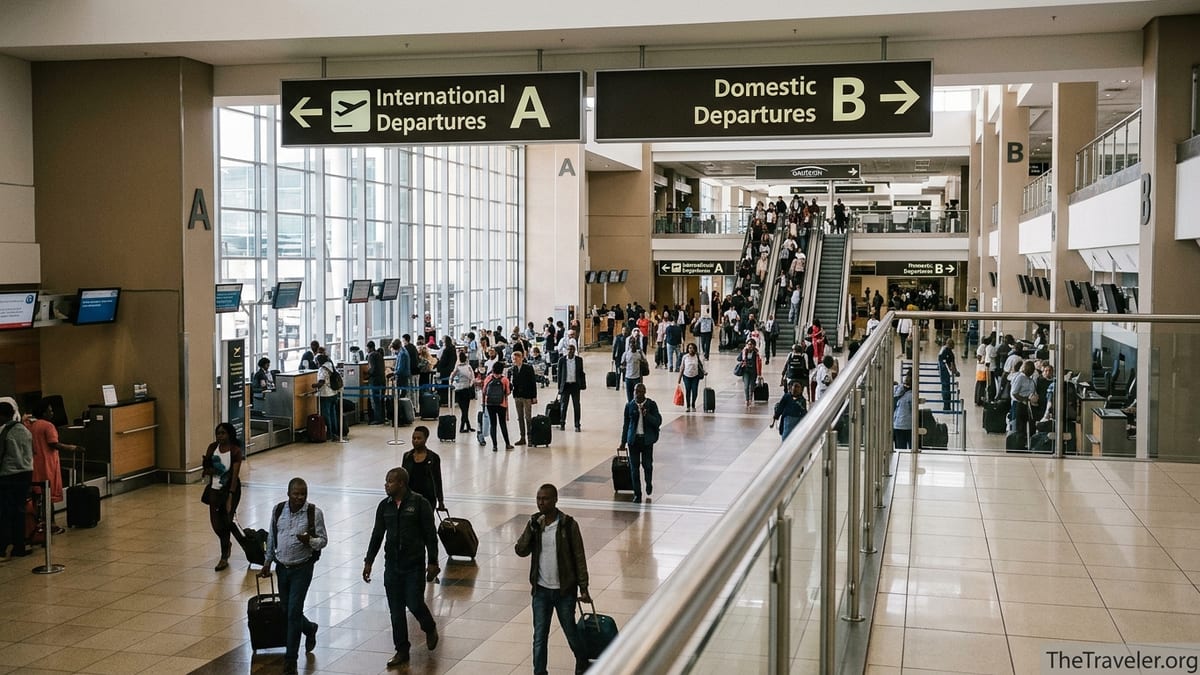
Terminal A vs Terminal B in Plain Language
O.R. Tambo International Airport is one long terminal complex arranged north to south, with a central building in the middle. In day-to-day conversation and on many signs you will still see two main labels: Terminal A and Terminal B. Terminal A is the international side of the complex, historically focused on international departures. Terminal B is the domestic side and also the main arrivals zone, including international arrivals on the lower level and domestic operations further south. In practice the terminals are joined inside, so you can walk between them in a few minutes.
For most travellers, it helps to think of the split this way. Terminal A is where you depart for overseas flights and some regional routes. Terminal B is where you arrive from outside South Africa and where you handle most domestic travel within the country. Airlines and airport operators now talk more about "international departures," "international arrivals" and "domestic departures" rather than rigid A or B labels, but the old names still appear on pillars, lifts and parking signs, which is why confusion persists.
The key structural detail is that departures and arrivals are on different levels. Departures are one level up, across both the international (A) and domestic (B and related) areas. Arrivals are on the ground level, again spanning the whole building. If you arrive at the wrong end, you can usually fix it by walking along the concourse on the correct level instead of going outside and trying to drive around.
The walking distance between the heart of Terminal A and the domestic side near Terminal B is typically 5 to 10 minutes for an able-bodied traveller with a wheeled bag. That means that even if you are dropped on the "wrong" side, you can usually correct the mistake by going inside, following the overhead signs for "Domestic Departures" or "International Arrivals," and walking through the central terminal area.
International vs Domestic: Which Terminal Do You Actually Need?
When you book flights, you will often see simple instructions like "Check-in: Terminal A" or "Arrivals: Terminal B." Broadly, international departures use the Terminal A end of the upper level. That includes long-haul flights on airlines such as Emirates, Qatar Airways, Singapore Airlines, Lufthansa, British Airways’ London service and many others. You will check in at the international counters, then go through outbound immigration and security before reaching the international departure gates.
Domestic flights within South Africa typically use the domestic departure areas toward the Terminal B side of the upper level. This includes popular routes such as Johannesburg to Cape Town or Durban on carriers like FlySafair, South African Airways, Lift and others. Check-in is at domestic counters, security is local only and you will not pass through passport control before boarding. Your boarding pass and the airport’s departure screens will show your gate number, but the terminal signage on-site will direct you to "Domestic Departures" rather than stressing the A/B labels.
International arrivals almost always emerge into the arrivals hall on the Terminal A or central side of the ground floor, after you clear immigration, baggage claim and customs. Domestic arrivals typically emerge farther south on the same ground level, closer to the classic Terminal B signage. If you are meeting someone, the easiest rule is this: meet international passengers at "International Arrivals" and domestic passengers at "Domestic Arrivals" rather than relying on the lettered terminals alone.
There are gray areas. Some regional African flights may check in on the domestic side even though they technically count as international journeys, and some airlines consolidate counters in the central terminal building. When in doubt, check your e-ticket or booking confirmation the day before you fly. Many South Africans will casually say "meet at Terminal A" or "go to Terminal B" but what really matters on the day is what appears on your airline communication and the big black-and-yellow signs when you arrive at the airport.
Check‑In, Security and Departures: How to Navigate Each Side
On the departures level, Terminal A and Terminal B are effectively two wings of one long hall. If you are flying internationally, look for signs to "International Departures" and the check-in zones marked A through H on the northern side. These zones serve full‑service global airlines and can be busy during evening long‑haul waves. For instance, if you are flying to London on British Airways or to Dubai on Emirates in the evening, you should expect queues at the check‑in counters about two to three hours before departure.
Domestic departures for flights to Cape Town, Durban, Port Elizabeth, George and other South African cities are grouped toward the southern side of the same upper level. Airlines such as FlySafair and Lift operate frequent shuttle services on the Johannesburg to Cape Town and Johannesburg to Durban routes, which means early morning and late afternoon can feel crowded as business travellers converge. If you have already checked in online, you can often skip the main lines and use bag‑drop counters, which are clearly marked for each carrier on the domestic side.
Security works slightly differently on each side. For international flights, security screening usually comes after check‑in and just before passport control. You must present your boarding pass, and your carry‑on bags are screened to international standards, including liquids and electronics checks. For domestic departures, you pass through simpler local security with no passport control. The key practical difference is time: for a domestic flight at a quiet time of day, many locals comfortably arrive 90 minutes before departure. For international flights in peak periods, two and a half to three hours is still a sensible target, especially if you need to check luggage.
A useful real‑world example is a morning connection from Bloemfontein to an afternoon flight to Europe. You might land domestically around 09:00 at the southern domestic gates, walk upstairs into the central departures hall, then continue north to the international check‑in zones and security. If everything is on one ticket with a major airline, your bags may be checked through, but many South African travellers still choose to build at least two and a half hours between the domestic arrival and international departure to allow for delays, queues and the walk between sides.
Arrivals, Baggage Claim and Meeting Points
Arrivals are concentrated on the ground floor beneath the departures halls. International passengers land at the international gates, pass through immigration and then proceed to the baggage reclaim hall on the international side. After collecting checked luggage, you pass customs and emerge into a public arrivals area lined with currency exchange desks, car hire counters and meeting points. Overhead, signage clearly indicates "International Arrivals," which many locals still mentally map to Terminal A.
Domestic passengers arrive on the opposite side of the same ground level, closer to the historic Terminal B area. They walk off the aircraft, enter the domestic baggage hall to collect checked luggage and then exit directly into the public arrivals space. There is no passport control and, for most travellers, the process is quicker, although baggage can still take time during busy periods. Family and friends usually wait just outside the sliding doors at "Domestic Arrivals," where digital boards show incoming flights from cities like Cape Town, Durban and Port Elizabeth.
If you are connecting from an international flight to a domestic one, you will almost always collect your checked bag in the international baggage hall before customs, even if your airline has tagged it through. After customs, you exit into the arrivals hall, then follow signs for "Domestic Departures" and take an escalator or lift up one level. This is where many visitors make their first wrong‑terminal mistake. They assume they must leave the building and re‑enter at a different labelled terminal, but in reality the fastest route is to stay indoors, walk through the central atrium and then head south to the domestic check‑in banks.
As a concrete scenario, imagine arriving from New York at 08:00 and flying onwards to Cape Town at 11:00 on a separate ticket. You clear immigration, collect your bag, walk through customs and come out at International Arrivals. Instead of going out to the curb, you turn right toward the interior escalators, go up to the departures level, and follow the signs for Domestic Departures. This indoor route avoids confusion with external road signage and gives you the clearest view of the departure boards, which show your Cape Town flight and gate assignment.
Gautrain, Parking and Pickups: Where Each Terminal Connects
One of O.R. Tambo’s biggest advantages is its direct Gautrain station, the airport terminus of Johannesburg’s rapid rail network. The station entrance is accessed from the upper levels of the central terminal area, slightly nearer the international side. In practice, it serves both Terminal A and Terminal B. Travellers arriving from Sandton, Rosebank or Pretoria by train simply exit the Gautrain station, follow the overhead signs into the terminal building and can then walk a few minutes either north toward International Departures or south toward Domestic Departures.
The Gautrain is especially popular with business travellers and visitors staying in Sandton. For example, a weekday morning train from Sandton to the airport typically takes about 15 minutes on the dedicated airport line. Many locals park their cars at Gautrain stations like Sandton or Marlboro for a day or two and use the train to avoid traffic and high airport parking fees. This can be a cost‑effective alternative to multi‑day parking at the airport itself, particularly if your flights fall within the Gautrain’s operating hours and you are comfortable walking with luggage through the station.
For those arriving by car, O.R. Tambo has a spread of parkades signposted for both the International Terminal (A) and Domestic Terminal (B). Short‑stay parking structures are located close to the terminal entrances for quick drop‑offs and same‑day trips, while long‑stay facilities are slightly farther away and better suited to multi‑day stays. Many visitors are surprised by how quickly costs add up in the closest garages, which is why some Johannesburg residents now pre‑book remote parking or compare it with the cost of leaving a car at a Gautrain station instead.
Pickup areas sit on the roadways directly outside the arrivals level. International arrivals vehicles line up near the northern side, while domestic pickups cluster toward the southern side. Rideshare services such as Uber and Bolt usually direct passengers to specific pickup zones that may require a short walk from the doors. A simple, practical tip if you are collecting someone is to agree in advance whether you are meeting at International Arrivals or Domestic Arrivals, and to use a visible landmark inside, such as a prominent bank, coffee shop or information desk, rather than relying on the often crowded outer curb.
Common Wrong‑Terminal Mistakes and How to Avoid Them
Despite the relatively short distances between Terminal A and Terminal B, wrong‑terminal mistakes are common at O.R. Tambo, especially for first‑time visitors and international students connecting to domestic flights. The most frequent error is being dropped at the domestic side when you are flying internationally, or vice versa. It typically happens when a driver relies only on the big roadside "A" and "B" signs and not the specific details on the ticket. For instance, someone flying to London might be dropped at Domestic Departures because the driver assumes all check‑in happens centrally.
The simplest way to avoid this is to check your booking the night before travel and again on the morning of departure, looking for the words "International Departures" or "Domestic Departures" as shown by your airline. Share that exact wording with whoever drives you to the airport. Once at O.R. Tambo, look up at the overhead signs rather than focusing solely on the lettered columns. If you spot that you are on the wrong side, stay calm, go into the building on the departures level and walk through the central atrium toward the correct section. This is almost always faster than trying to re‑enter via the road system.
Another common mistake comes from transit passengers who do not realise they must clear immigration and collect their bags in Johannesburg before continuing domestically. Many assume their luggage will automatically be sent to Cape Town or Durban and that they will remain in a transit zone. In reality, most travellers arriving from overseas into Johannesburg clear South African passport control at O.R. Tambo, claim their bags in the international baggage hall, pass customs and then walk up to domestic check‑in. If you book separate tickets or mix airlines, you should plan at least two to three hours between flights to allow for this process and for possible delays.
Finally, some visitors get confused between the central terminal building and the older A/B labels, particularly when following online directions or older printed maps. You might read that your airline checks in at Terminal B on the top level, even though you are flying internationally. In practice that can mean the check‑in counters sit in the central area between the historic A and B designations. The safest approach is to follow your airline’s most recent instructions and then rely on the airport’s live departure boards inside, rather than on out‑of‑date diagrams you find online.
Making Domestic and International Connections Smooth
If you are connecting domestically within South Africa, think of O.R. Tambo as a vertical and horizontal journey. Vertically, you go from arrivals on the ground floor up one level to departures. Horizontally, you may walk several hundred metres between the domestic and international ends. With that in mind, build realistic transfer times into your itinerary. Many experienced local travellers avoid connections shorter than two hours between an international arrival and a domestic departure, and they prefer at least 90 minutes for domestic‑to‑domestic connections on separate tickets.
For a typical international to domestic connection, your steps are straightforward. Land at an international gate, proceed to immigration, collect your luggage, clear customs and exit into the International Arrivals hall. From there, head upstairs using the interior escalators or lifts and follow the signs to Domestic Departures. Re‑check your luggage with your domestic airline, pass security and walk to your gate. If you are on a through‑ticket with a single airline alliance, some bags may be tagged through to the final domestic destination, but even then it is wise to check at your origin airport and again on arrival whether you need to re‑check in Johannesburg.
Domestic to international connections work in reverse. You land at the domestic gates, collect your hand luggage and then follow signs upstairs to International Departures on the northern side. If your bags are already tagged through, you may be able to go directly to outbound immigration and the international security checkpoint. If not, you will need to visit your airline’s international check‑in counters first. In either case, aim to arrive at the international side at least two hours before overseas departure so you have time for any additional document checks, duty‑free shopping and the sometimes long walk to far‑end international gates.
When planning tricky itineraries such as a separate low‑cost domestic ticket connecting to a long‑haul flight on another airline, many travellers now use conservative layover times based on lived experience at O.R. Tambo. A three‑hour buffer from scheduled landing to scheduled long‑haul departure is considered comfortable by frequent flyers, particularly during South African holiday seasons such as December and early January when queues can surprise even seasoned Johannesburg residents.
The Takeaway
Johannesburg’s O.R. Tambo International Airport can seem complicated on paper, with its historic Terminal A and Terminal B labels, central terminal building, and separate international and domestic zones. On the ground, though, the logic is simple: international departures and arrivals cluster toward the Terminal A side, domestic operations sit toward the Terminal B side, and everything is joined by one continuous building with departures upstairs and arrivals downstairs.
If you remember that basic structure and follow the black‑and‑yellow overhead signs for "International Departures," "Domestic Departures," "International Arrivals" and "Domestic Arrivals," you will almost always find the right place, even if a driver drops you at the wrong lettered terminal. Add realistic connection times, consider using the Gautrain for easy access from Sandton and Pretoria, and agree clear meeting points with anyone you are collecting. With those simple habits, O.R. Tambo becomes a manageable, even convenient gateway rather than a stressful maze of letters and levels.
FAQ
Q1. Is Terminal A only for international flights and Terminal B only for domestic flights?
Not strictly. Terminal A is focused on international departures and the international arrivals area is nearby, but Terminal B covers domestic operations and also connects to parts of the arrivals hall. In practice the building is continuous, so airlines sometimes use shared check‑in areas in the central section. Always follow the signs for international or domestic rather than relying only on the lettered names.
Q2. I am landing from overseas and connecting to Cape Town. Do I need to collect my luggage in Johannesburg?
In most cases yes. You normally clear immigration, collect your checked bags in the international baggage hall, pass customs and then go up one level to Domestic Departures to re‑check your luggage. Some through‑tickets may allow bags to be tagged to Cape Town, but you should confirm this with your airline before departure and again when you land.
Q3. How long does it take to walk between Terminal A and Terminal B?
For an average traveller with a wheeled suitcase, the walk between the main international side around Terminal A and the domestic side around Terminal B typically takes 5 to 10 minutes on the departures level. The route is indoors, flat and clearly signposted, so even if you are dropped at the wrong side it is usually faster to walk inside than to try to drive around again.
Q4. How much time should I allow for an international to domestic connection at O.R. Tambo?
Many experienced travellers recommend at least two to three hours between scheduled landing and your domestic departure, especially if you are on separate tickets. This allows for queues at immigration, possible baggage delays, customs, the walk up to Domestic Departures and security before your next flight. During peak holiday seasons it is wise to stay on the conservative side.
Q5. Where do I catch the Gautrain at the airport, and is it closer to Terminal A or Terminal B?
The Gautrain station is linked directly to the central terminal complex and is slightly closer to the international side, but it serves both Terminal A and Terminal B. After you leave the train, you follow overhead signs into the main terminal and can then walk a few minutes either north toward International Departures or south toward Domestic Departures.
Q6. Which arrivals area should I use if I am picking someone up?
If the arriving flight is from outside South Africa, meet them at International Arrivals on the ground level, near the northern side of the building. If the flight is from another South African city such as Cape Town or Durban, wait at Domestic Arrivals, which is farther south on the same level. Check the airport’s arrival boards to confirm their flight and look for the word international or domestic.
Q7. Can I change terminals without going outside or taking a shuttle bus?
Yes. Terminal A and Terminal B are part of one connected building. You can walk between them on the departures level upstairs or the arrivals level downstairs by following interior signage. There is no need for a shuttle bus in normal circumstances, and staying inside usually gives you better access to information desks and departure boards.
Q8. Is one hour enough for a domestic to domestic connection at Johannesburg?
It can be enough if everything runs on time and your flights are on a single ticket, but it leaves very little margin for delays, baggage issues or long queues. Many local travellers prefer at least 90 minutes between domestic flights, and longer if they are switching airlines or travelling in busy periods such as school holidays.
Q9. Where is the best place to park if I am flying for a few days?
If you are parking for several days, the long‑stay or pre‑booked parking areas are usually more economical than the closest short‑stay garages next to the terminal. Some travellers instead park at a Gautrain station like Sandton or Marlboro and take the train to the airport, comparing that combined cost with multi‑day airport parking. The best option depends on how many days you will be away and your flight times.
Q10. What should I do if my ticket and an online map disagree about which terminal my airline uses?
Always trust the most recent information from your airline and the live signs at the airport over older maps. Airlines sometimes adjust which counters they use within the central terminal area, and older diagrams can be out of date. When you arrive at O.R. Tambo, check the electronic departure boards, follow the signs for international or domestic departures as appropriate, and ask at an information desk if anything is unclear.