


Landing at Johannesburg’s O. R. Tambo International Airport can feel overwhelming, especially if it is your first time in South Africa. The Gautrain, Gauteng’s modern rapid-rail system, is often the fastest, safest and most predictable way to move between the airport, Sandton’s hotel and business district, Rosebank’s cafes and malls, and central Johannesburg. This guide explains exactly how to use the Gautrain from the airport, how to connect through Sandton and Marlboro, how payment and luggage work, and when it makes more sense to ride the train instead of taking a taxi or e-hailing service.
Get the latest updates straight to your inbox!
Understanding the Gautrain from O. R. Tambo Airport
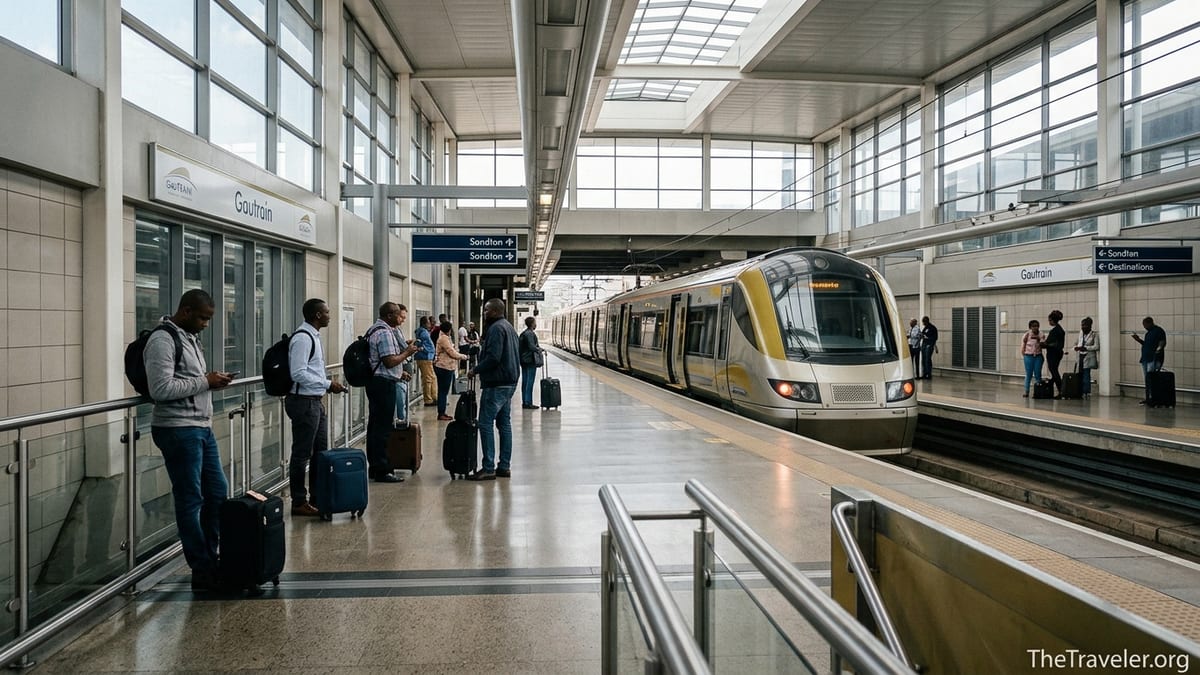
The Gautrain station at O. R. Tambo International Airport sits directly above the arrivals halls, clearly signposted in yellow with the Gautrain logo. From the terminal you follow the “Gautrain” signs through the parking concourse and up an escalator to the ticketing level. The airport station is the eastern end of the network’s airport line and connects first to Rhodesfield and then to Sandton, where you can change to trains running north to Pretoria and south to Rosebank and Park Station in central Johannesburg.
The airport service is specifically designed for air passengers. Trains on this line typically run every 12 to 20 minutes in the daytime, with a journey time of around 14 minutes between the airport and Sandton. Security staff are visible on the platform and in the carriages, CCTV is standard, and access to the paid area is controlled by automatic fare gates. Compared with sitting in traffic on the R24 and N3 highways, using the Gautrain avoids congestion and the stress of negotiating with taxi touts in the arrivals area.
Operating hours are geared to business and leisure travelers rather than being a 24-hour metro. As of mid 2026, the first trains leave around 05:15 to 05:30 and the last airport trains are typically around 20:30 to 20:50 depending on direction and day of week. Because times can shift slightly for public holidays, the safest approach is to confirm exact first and last departures for your travel day using the official Gautrain app or station displays once you land.
The airport platform serves only the dedicated airport service. Standard commuter trains that start and finish at nearby Rhodesfield do not come into the terminal. This simplifies navigation for new arrivals: if you board at the airport station, any train that arrives will take you towards Sandton. You only start dealing with different directions and lines once you change at Sandton or Marlboro.
Routes and Connections: Sandton, Marlboro, Rosebank and Park
The Gautrain network has two main services: the airport line between O. R. Tambo and Sandton, and the north–south commuter line linking Johannesburg Park Station to Pretoria and Hatfield via Rosebank, Sandton, Midrand and Centurion. For most travelers, Sandton is the hub where airport trains meet the rest of the system. The station lies underneath Sandton’s business district near Sandton City and Nelson Mandela Square, making it an easy walk or short hotel shuttle ride to many international hotel brands.
There is no direct train from the airport to Rosebank. To reach Rosebank, you take the airport train to Sandton, walk up one level to the north–south platforms, then board a southbound train signed for Park. Rosebank is usually the first or second stop after leaving Sandton, and the trip takes only a few minutes. This transfer is entirely inside the station, through well signed passageways, with lifts and escalators if you are rolling a suitcase. Many visitors staying at Rosebank hotels such as those around the Zone @ Rosebank or on Oxford Road use this simple two-step route.
Marlboro is the other important junction for some itineraries. Located between the airport and Sandton, it gives access to commuter trains that run west to Sandton and north towards Midrand and Pretoria. A common example is a traveler landing at O. R. Tambo who needs to continue to Pretoria. They take the airport train to Sandton, then change to a northbound train; but at busy times some travelers prefer to change at Marlboro instead, to find emptier carriages before the crowds join at Sandton.
Park Station, at the southern end of the Gautrain line, connects central Johannesburg to the network. Visitors staying in Braamfontein or the inner city can ride from the airport to Sandton, switch to a southbound train to Park, and then connect by hotel shuttle or e-hailing service. Although some local commuters prefer not to linger around Park Station after dark, the Gautrain platforms themselves are inside a controlled area with visible security, and many travelers simply walk upstairs and connect to pre-booked rides.
Tickets, Payment and How Much You Can Expect to Pay
Gautrain fares vary by distance and by time of day. Peak fares are charged during the morning and evening weekday commuter rush, approximately 06:00 to 08:30 and 15:00 to 18:30, while off-peak fares apply outside those windows. Weekends and public holidays are usually priced at the peak level even though trains may run slightly less frequently. Prices are adjusted from time to time, but as a rule the airport line carries a premium compared with ordinary commuter trips.
Most visitors now pay using a contactless bank card. You simply tap your card at the entry gate and again at your exit station. The system calculates the fare and charges your bank card in South African rand. The important detail is to use the same physical card or device when you tap in and tap out. If you enter with one card and exit with another, the system treats each tap as a separate incomplete journey and can charge the maximum default fare on each, which will be noticeably more expensive than a normal point to point fare.
If you prefer not to use your bank card, you can still buy a reloadable Gautrain Card from vending machines or ticket office staff. You load cash value onto the card and then tap in and out in the same way. The card itself has a small upfront cost, so for a very short stay with just one or two trips the contactless bank card option is often more convenient. Longer stays or frequent use can justify getting a Gautrain Card, particularly if you want to combine the train with Gautrain buses and parking products.
For a practical example, a solo traveler arriving on a weekday afternoon and riding from the airport to Sandton will usually pay a higher airport-line fare than a commuter traveling between, say, Rosebank and Park. A couple making the same journey might compare that total Gautrain fare with a ride-hailing quote from an app like Uber or Bolt; during quiet traffic, a door to door car ride can sometimes match or undercut what two separate airport-line tickets would cost, especially if they are heading somewhere not directly next to a station.
Luggage, Onboard Experience and Station Facilities
The airport service trains are built with air passengers in mind. The first and last carriages on these trains have more open space and luggage racks, allowing you to stow medium and large suitcases safely. If you are boarding at the airport, simply walk along the platform and look for the signage indicating the luggage-friendly cars, or observe where most travelers with trolleys are waiting. Smaller bags can go in overhead racks or by your feet, but it is best not to block the doors or aisles.
There is no formal checked luggage system on the Gautrain. You keep your bags with you at all times, as on any metro or regional rail service. Trolleys cannot be taken onto the train itself, so you transfer your bags from a trolley to hand carry just before going through the fare gates. If you are traveling with exceptionally bulky items, such as surfboards or large sports equipment, using a private transfer service or pre-booked shuttle may be more comfortable than attempting to fit them into a busy carriage.
Inside the trains, seating is arranged in a mixture of forward- and backward-facing pairs and fours around small tables. The interior is well lit, air conditioned and relatively quiet. Eating and drinking are formally restricted to keep the trains clean, and local commuters generally expect a calm environment. Loud phone conversations and music are frowned upon, although you will see the usual range of passengers checking messages on their phones or working on laptops during the ride.
Stations like Sandton and Rosebank offer clean restrooms, ticket offices, and staffed information counters during operating hours. Many nearby hotels provide complimentary shuttles to and from their nearest Gautrain station; for instance, several Sandton hotels dispatch small buses timed to airport train arrivals. Others are an easy walk: from Rosebank station it is just a few minutes on foot under street trees to many boutique hotels and guesthouses, and the route is well used during daylight hours.
Schedules, Frequency and Planning Your Transfers
The Gautrain runs to a fixed timetable, but what matters most for visitors is the service window and the rough frequency. Trains on the airport line and the main north–south corridor usually come every 12 minutes during weekday peaks and around every 20 minutes in off-peak periods. Early mornings, late evenings and some weekend slots can see slightly longer gaps. Because of this, a good rule of thumb is to allow at least 30 to 40 minutes between your expected arrival at a station and any critical onward commitment, such as hotel check in times or onward tours.
To plan a typical journey, imagine you land at O. R. Tambo at 09:30 on a Tuesday. It can easily take 30 to 60 minutes to clear immigration and baggage claim, so by the time you walk towards the Gautrain station you might be ready to board between 10:15 and 10:45. The ride to Sandton adds roughly 15 minutes, and changing to the southbound line for Rosebank takes another 5 to 10 minutes including walking time between platforms. You are therefore likely to exit Rosebank station somewhere around 11:00 to 11:30, which helps when arranging a hotel pickup or estimating when you can log in to a remote meeting.
Late-night connections require more care. Since the last trains from the airport generally depart around 20:30 to 20:50, flights landing after 19:30 can leave uncomfortably little margin for delays at immigration or baggage reclaim. If you are booked on such a late arriving flight, it is wise to assume you will need a taxi, e-hailing car or private transfer instead of the train. Similarly, early-morning departures before 08:00 can be tricky from outer suburbs like Pretoria or Centurion, because you need to be on very early trains to make airline check in times.
Weekend schedules remain broadly similar in running hours but may have slightly reduced frequency. Importantly, fares on weekends and public holidays are treated as peak, so you do not save money by traveling at midday. If your stay in Johannesburg includes a major event such as a concert or big sports match, Gautrain sometimes introduces extended late-night services on specific dates, with trains running after midnight between Park, Rosebank, Sandton and the airport. These special timetables are normally announced in advance through the Gautrain app and station notices.
When Gautrain Beats Taxis, and When It Does Not
For many solo travelers and first-time visitors, the Gautrain is the best way to get from O. R. Tambo to Sandton, Rosebank or central Johannesburg during the day. It combines predictable journey times with a controlled station environment and no need to negotiate with drivers. Arriving around midday on a weekday, a single traveler with carry-on and one checked bag can usually reach a Sandton business hotel faster on the train than by road, especially when the highways are heavy with traffic.
For couples and small groups, the comparison is more nuanced. Two or three people paying separate Gautrain fares from the airport to Sandton may find that the total cost approaches or exceeds the quote for an UberX or a reputable metered taxi, particularly outside peak road-traffic times. If your hotel is not immediately next to a station and you would need an additional short ride anyway, a door to door car service can be just as efficient and more convenient, especially late at night when the train is no longer running.
Time of day and your destination neighborhood make a real difference. If you are heading beyond the Gautrain corridor, such as to suburbs like Melville, Linden or suburban areas of Pretoria, the train plus a connecting car ride can still be attractive for daytime arrivals, but a direct pre-booked shuttle may win out for early-morning flights or late-night landings. Many locals will, for example, take the Gautrain from the airport to Rosebank during the afternoon, then use an e-hailing car for the last 10 to 15 minutes into residential areas, balancing cost, safety and convenience.
Comfort with public transport is another factor. The Gautrain is clean, modern and heavily used by professionals, students and families. If you routinely use metro or regional rail systems elsewhere, you will likely find it straightforward. Travelers who feel anxious about any transfer or who are juggling young children, multiple suitcases and perhaps a pet in an approved carrier may prefer the simplicity of stepping straight into a pre-arranged car outside arrivals, even if that costs slightly more than the train.
Practical Safety, Security and Local Etiquette
Within the Gautrain system, safety standards are high by regional comparison. Platforms and trains feature CCTV, security staff patrol the stations, and access is controlled by automated gates. Most incidents reported by commuters involve minor issues such as lost items rather than serious crime. That said, Johannesburg is a big, complex city, and normal big-city precautions apply once you leave the controlled station environment, especially at night.
Inside stations and on the train, keep your bags where you can see and feel them, rather than leaving them unattended in luggage racks far from your seat. Avoid displaying large amounts of cash or leaving phones and laptops on empty seats. In busy periods, consider keeping smaller valuables in a money belt or inner pocket rather than outer backpack pockets that other people can easily access.
On the etiquette front, local commuters appreciate a calm, orderly atmosphere. Stand to one side to let others off the train before boarding. If the carriage is crowded, remove backpacks and hold them by your side to create more space. Priority seats near the doors are intended for older passengers, pregnant women and those with disabilities; most visitors happily follow this convention. While you can use your phone, keeping calls short and voices low is considered considerate.
Outside the station, be cautious with unsolicited offers of taxis or lifts, particularly from individuals who approach passengers inside or just outside the arrivals hall. If you need a taxi after using the train, head to official taxi ranks, hotel shuttle pick up points or summon a ride using a trusted e-hailing app while still inside the station or mall. In Sandton and Rosebank, it is common for hotels to arrange pick ups right at the station entrance, minimizing the time you spend on the street with luggage.
FAQ
Q1. Can I travel directly from O. R. Tambo Airport to Rosebank on the Gautrain?
There is no direct train from the airport to Rosebank. You take the airport train to Sandton, then change to a southbound train to Rosebank.
Q2. How long does the Gautrain take from the airport to Sandton?
The journey between O. R. Tambo Airport and Sandton usually takes around 14 to 15 minutes once you are on the train, plus any waiting time on the platform.
Q3. What are the first and last train times from O. R. Tambo Airport?
As of 2026, first trains are typically around 05:15 to 05:30 and the last between about 20:30 and 20:50, depending on direction and day. Always confirm on the day via the Gautrain app or station notices.
Q4. Is it safe to use the Gautrain at night?
Inside the Gautrain system, security is generally good, with guards and cameras, and many locals use evening trains. The more important consideration is how you travel between the station and your final destination after dark.
Q5. Can I pay for the Gautrain with my contactless credit or debit card?
Yes, most visitors simply tap in and out with a contactless bank card. Just make sure you use the same card or device at entry and exit so your fare is calculated correctly.
Q6. Do Gautrain trains have space for big suitcases?
Airport service trains have dedicated luggage space in certain carriages, and standard trains have reasonable space near doors and seats. Very bulky items may be uncomfortable at busy times.
Q7. How does Gautrain pricing compare with taxis or Uber from the airport?
For solo travelers, Gautrain is often competitive and faster in traffic. For two or more people, especially outside peak road-traffic times, a taxi or Uber can be similar in total cost and more direct.
Q8. Do I need to buy a Gautrain Card for a short visit?
No, you do not have to. For one or two journeys, using your contactless bank card is usually easiest. A Gautrain Card becomes more useful if you ride frequently or also use Gautrain buses.
Q9. How do I get from the Gautrain station to my hotel?
Many Sandton and Rosebank hotels run free shuttles timed to train arrivals. Otherwise, e-hailing services and official taxis are widely used, and in daylight some hotels are an easy and well signposted walk from the station.
Q10. Is the Gautrain affected by load shedding or power cuts?
The Gautrain has dedicated infrastructure and is less affected by load shedding than normal city traffic lights, but occasional disruptions can occur. Checking live updates on the Gautrain app before you travel is sensible.