


More news on this day
Air France flight AF702 from Paris to Abidjan declared an in‑flight emergency on November 17, 2026 and returned safely to Charles de Gaulle Airport after transmitting the 7700 distress code over central France, prompting a precautionary response from French air traffic control and airport emergency services but no reported injuries to passengers or crew.
Get the latest news straight to your inbox!
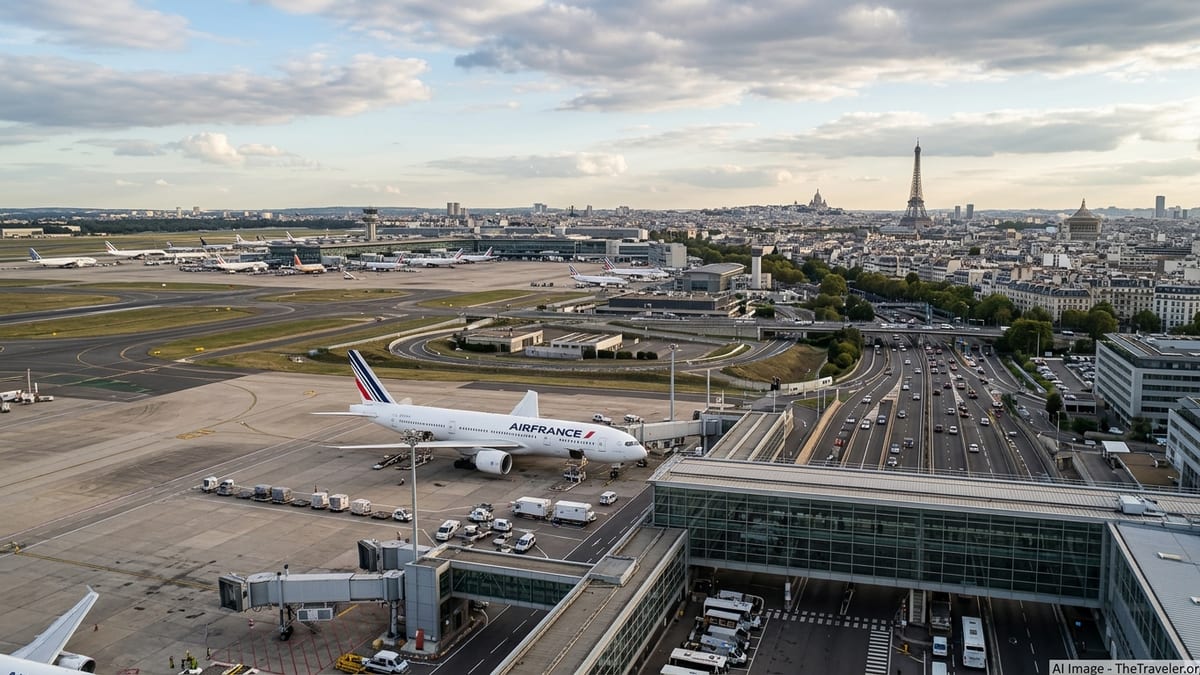
What Is Confirmed About AF702’s Emergency Return To Paris
According to live flight tracking data, AF702 departed Paris Charles de Gaulle for Abidjan on Tuesday, November 17, 2026, operating as a scheduled afternoon service between the French and Ivorian commercial capitals. The flight, operated by a Boeing 777‑300ER, left its stand at CDG shortly after its planned 14:00 departure slot and climbed south over mainland France on what is normally a roughly six and a half hour route to Abidjan.
Specialist aviation outlet Airlive reported that while cruising at about 32,000 feet over the Centre‑Val de Loire region, the crew transmitted the 7700 transponder code, which is used worldwide to signal a general in‑flight emergency requiring priority handling from air traffic control. Flight tracking visualizations from multiple providers showed the aircraft turning away from its planned southwest track and beginning a return toward the Paris area shortly after the emergency signal was registered.
Data from public flight status tools indicate that instead of continuing on to Abidjan, AF702 flew back toward the Paris region and prepared for an unscheduled landing with emergency services on heightened alert. At the time of writing, there are no credible reports of injuries on board, no indication of structural damage to the aircraft and no official confirmation from French or Ivorian authorities of any impact beyond disruption to this single rotation.
Cause Of The Emergency: What Authorities Have And Have Not Said
As of the late afternoon of November 17, neither Air France nor French aviation regulators had issued a detailed technical explanation for AF702’s emergency declaration. The airline’s public channels and operational notices monitored by industry sites did not list a specific cause such as an engine problem, pressurization issue, medical situation or smoke alarm. In the absence of an official bulletin, responsible reporting requires treating any more precise claims circulating on social media as unverified.
The key confirmed fact is the use of the 7700 transponder code, which signals that the crew considered their situation serious enough to request immediate priority from air traffic control. However, this code covers a wide range of scenarios and does not by itself distinguish between, for example, a severe technical failure, a critical medical event, or an abundance‑of‑caution response to cockpit indications that may later prove benign.
French aeronautical information publications set out standardized procedures for declaring an emergency and coordinating with air traffic control, but they do not provide public, real‑time detail on individual cases. Unless the airline, the French BEA accident investigation bureau or another competent authority opens and announces a formal investigation, the precise technical root cause may remain officially undisclosed. For travelers, the most relevant confirmed outcome at this stage is that the aircraft landed safely back in the Paris region after declaring the emergency.
Immediate Impact On Passengers And The Paris–Abidjan Route
Passenger disruption from the incident is concentrated on those booked on AF702’s November 17 rotation and any subsequent services that might rely on the same aircraft or crew. Based on published schedules, AF702 is a daily Paris Charles de Gaulle to Abidjan service, forming one of the main nonstop links between France and Côte d’Ivoire alongside flights operated by Air Côte d’Ivoire. If AF702 could not continue to Abidjan later on November 17, some travelers would likely have to be rebooked on the next day’s AF702, on Air Côte d’Ivoire’s CDG–Abidjan flight, or on connecting routings via other European hubs.
For those actually on board the emergency flight, standard practice in similar events is for the airline to disembark passengers once the aircraft is secured, arrange immigration clearance where needed, and either provide hotel accommodation or same‑day rebooking options depending on onward schedules and curfew constraints. Under European passenger rights rules, travelers flying from Paris on an EU carrier are generally entitled to care such as meals and accommodation during extended disruption, although whether financial compensation applies depends on whether the root cause is deemed within the airline’s control. That assessment is not yet possible in this case without an official statement on the reason for the emergency.
At network level, there is currently no evidence that the AF702 incident has led to broader cancellations or schedule changes on the Paris–Abidjan route. Published timetables for the days following November 17 continue to show AF702 in the system along with Air Côte d’Ivoire’s CDG–Abidjan services, suggesting that the emergency is being treated as a single operational irregularity rather than a structural issue affecting the route or aircraft type.
How Common Are Diversions And What It Means When A Flight Squawks 7700
Commercial flights divert or return to their departure airport for a variety of reasons, many of which never progress to a formal safety investigation. These can range from conservative responses to warning lights through to serious malfunctions or life‑threatening medical emergencies. In all such cases, the guiding principle for crews is to prioritize safety over schedule, even if the issue later proves minor. Declaring a 7700 emergency ensures that controllers can clear nearby traffic, offer the most suitable diversion airfield, and arrange firefighting and medical resources on the ground.
In European airspace, the procedure for handling in‑flight emergencies is governed by common international standards and coordinated nationally by air navigation authorities. Once a 7700 is declared, the affected flight typically receives priority vectors to descend and land at the nearest suitable airport, which in AF702’s case was the Paris region it had departed from earlier in the afternoon. Other aircraft in the vicinity may be slowed or rerouted slightly to create a clear approach path, which usually has little lasting impact on overall traffic flow.
While such events can be unsettling for those on board, they are designed into commercial aviation systems and are one of the reasons why flying remains one of the safest forms of long‑distance travel. The absence so far of reports of injuries or damage in the AF702 incident is consistent with many precautionary diversions where crews act decisively in response to indications that may never escalate into a more serious situation.
What Travelers Booked On Air France To Or From West Africa Should Do Next
For travelers with upcoming bookings on AF702 or connecting itineraries involving the Paris–Abidjan route, the most practical step is to monitor their reservation through Air France’s official channels and check the current status of their specific flight on the day of travel. As of the evening of November 17, schedule data for future dates continues to list AF702 as operating, and there is no sign of a route suspension or long‑term equipment change related to the emergency declaration.
If November 17 passengers are ultimately reprotected onto later flights, availability on popular days around weekends and regional holidays could tighten temporarily. Those planning essential trips between France and Côte d’Ivoire in the coming days may wish to book earlier than usual or consider routing flexibility, for example by using other European connection points if their fare permits changes. However, there is no firm indication at this stage that fares on the route are changing specifically because of the AF702 event, and any such pricing impact would likely be short term and capacity driven rather than a direct response to the emergency itself.
More broadly, the incident serves as a reminder that even on established long‑haul routes, last‑minute operational events can disrupt travel plans. Travelers connecting onward from Abidjan to regional West African destinations, or from Paris to long‑haul services, may reduce risk by allowing additional buffer time between flights where possible and by ensuring they have up‑to‑date contact details in their booking so the airline can send rebooking or disruption notices promptly if a diversion or return to origin occurs.