


More news on this day
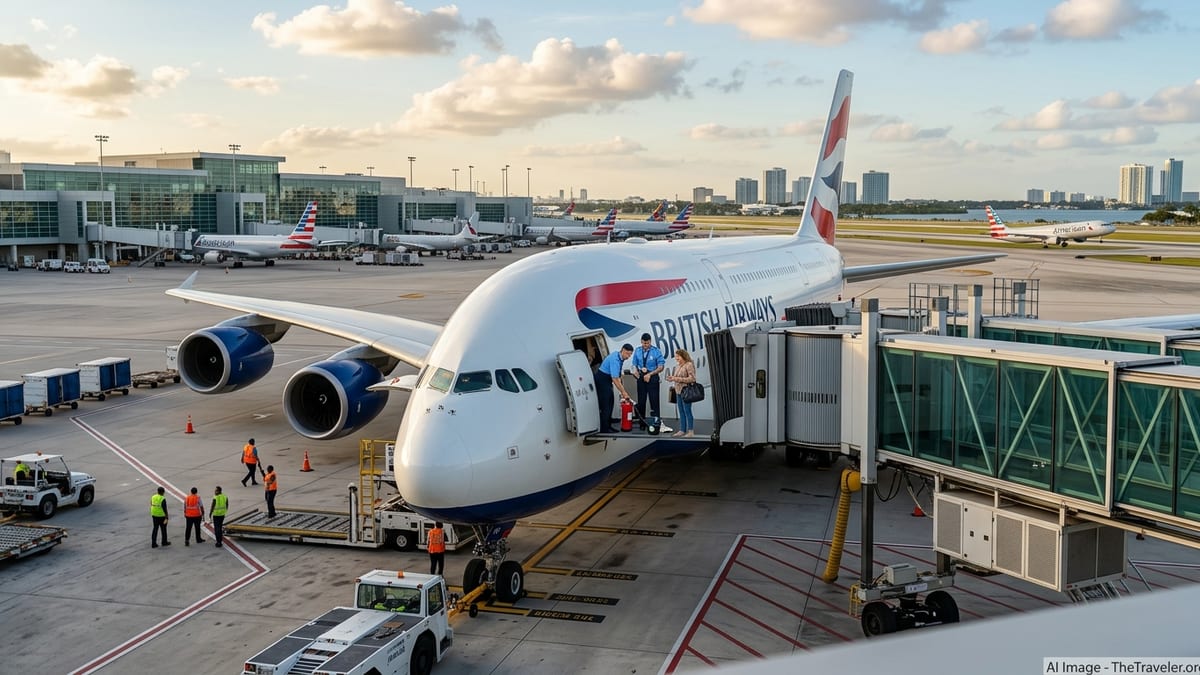
A British Airways Airbus A380 operating flight BA026 from Miami to London Heathrow departed about half an hour late on November 17 after a passenger’s portable power bank overheated during boarding at Miami International Airport, briefly halting pushback while cabin crew and ground staff dealt with the device under lithium battery safety procedures.
Get the latest news straight to your inbox!
What Happened To Flight BA026 In Miami
According to incident reports from aviation-specialist outlets, the London bound BA026 was preparing to leave its gate at Miami International Airport on November 17 when crew were alerted to an overheating power bank in the cabin. The aircraft, an Airbus A380, remained at the stand while the device was located and dealt with, rather than continuing with pushback and taxi. No diversion or emergency landing was involved, because the issue occurred before the aircraft left the gate area.
Flight-tracking data shows that BA026 departed from runway 27 at Miami at about 5:41 p.m. local time, roughly 31 minutes after its scheduled departure slot. The delay was limited to the ground phase and the aircraft then continued normally to London Heathrow. There have been no official reports of injuries, smoke spreading through the cabin or structural damage to the aircraft as a result of the incident, and the flight was not cancelled.
British Airways has not issued a dedicated public statement on this specific flight, and the Federal Aviation Administration’s current list of significant incidents does not separately highlight the case, indicating that regulators are treating it as a contained onboard battery issue rather than a wider safety emergency. For travelers, the most concrete confirmed outcome is a short departure delay from Miami rather than a long disruption or extended knock-on impact to the route.
How Airlines Treat Overheating Power Banks
The response on BA026 reflects standard industry procedures that have been built up over the past decade for dealing with lithium powered devices in passenger cabins. Guidance from the International Air Transport Association and the Federal Aviation Administration classifies power banks and other spare lithium ion batteries as items that must travel in carry on baggage, not in the hold, precisely so that crew can reach them quickly if they overheat. If a device is suspected of entering thermal runaway, cabin crew are trained to cool it, usually with large quantities of water or nonflammable liquids, and to monitor it until the risk subsides.
The FAA’s public advisories on airline passengers and batteries specify that lithium ion batteries carried by passengers are generally limited to 100 watt hours, with higher capacity units requiring explicit airline approval. They also stress that damaged, recalled or visibly overheating devices should not be used or transported. Recent FAA safety alerts to operators describe lithium batteries and power banks as potential ignition sources that can start onboard fires, which is why even small incidents such as localized overheating tend to trigger conservative responses, including pausing a departure at the gate, as appears to have happened on BA026.
Industry and accident investigation reports from earlier cases where power banks or other battery packs have gone into thermal runaway in cabins have reinforced this cautious approach. Although serious events remain relatively rare compared with the volume of flights operated, the potential consequences mean airlines are under pressure from regulators to demonstrate that they respond rapidly and visibly whenever there is a sign of overheating, smoke or a burning smell around electronic devices.
British Airways And International Rules On Power Banks
British Airways’ published baggage rules classify power banks as spare lithium batteries, which are only permitted in hand baggage and are not allowed in checked luggage. The airline follows international norms that limit most passengers to portable batteries up to 100 watt hours, with some larger units between 100 and 160 watt hours allowed only with prior airline approval. The carrier’s guidance also notes that damaged or defective batteries, or those with exposed terminals, should not be carried on its flights.
Global industry guidance from IATA for passengers traveling with lithium batteries similarly limits travelers to a small number of power banks and other spares and makes clear that they should be protected against short circuit and kept under supervision. Separate guidance documents directed at airlines highlight multiple reported cases worldwide of power banks self heating or failing in overhead bins or seat pockets, recommending clear crew procedures for locating and securing the device and, if necessary, using containment bags or cooling methods.
Although there is no public indication that BA026 involved anything beyond a single device overheating, the episode fits a wider pattern of airlines refining their internal rules around how and where passengers may store and use power banks in flight. In some markets carriers have begun explicitly telling passengers during safety briefings not to leave power banks charging unattended in overhead lockers and to inform crew immediately if they notice unusual heat or smoke from any electronic item.
Practical Consequences For Travelers Using Power Banks
For passengers, the most immediate takeaway from the Miami incident is that a single misbehaving power bank can slow down everyone’s journey, even if no one is injured and the aircraft is never in serious danger. A roughly 30 minute delay at departure, as seen with BA026, can still mean missed tight connections at the destination, last train or bus departures from the airport being lost, or late night arrivals pushing travelers into higher taxi fares or additional hotel nights.
The incident underlines the importance of basic precautions when flying with portable chargers. Travelers are expected to keep power banks in their cabin bags rather than checked luggage, avoid covering them with heavy items or blankets while charging, and stop using them immediately if they become unusually hot, emit a smell or show signs of damage. Because capacity limits are expressed in watt hours, passengers may need to check their device labels in advance and, for very high capacity units, seek approval from the airline before travel or leave them at home.
Although aviation authorities emphasize that modern aircraft are equipped with fire extinguishing equipment and that crew are trained for such situations, they also encourage passengers to cooperate fully if crew need to inspect the cabin, identify the source of smoke or heat, or temporarily suspend boarding. Episodes like BA026 demonstrate that following these instructions tends to confine the disruption to a short delay at the gate rather than something more serious mid flight.
What Travelers Should Watch For Next
At this stage there is no public indication that the BA026 incident will lead to immediate timetable changes on the Miami to London route or to new, stricter British Airways specific rules beyond those already in place for lithium batteries. Future developments, if any, are more likely to take the form of updated passenger communications, clearer in flight announcements or revised cabin crew checklists rather than sweeping changes that travelers would see when booking.
Regulators and industry bodies periodically update their guidance as more data emerges on lithium battery incidents, and both the FAA and IATA publish revised documents when they believe airlines or passengers need clearer rules. Travelers who rely heavily on power banks, particularly those flying long haul out of airports such as Miami International, may therefore want to recheck both airline and national authority guidance before upcoming trips, especially if carrying higher capacity devices or multiple spare batteries.
For now, the Miami departure of BA026 illustrates how airlines are likely to handle similar situations in the near future: identify and stabilize the device while the aircraft remains at the gate, accept a modest delay in favor of caution, and aim to complete the flight as scheduled once safety teams are satisfied that the risk from the overheating power bank has passed.