


More news on this day
The Maldivian government is moving to expand mid market and budget tourism through new guesthouse islands and regional airports, seeking to make the Indian Ocean archipelago more accessible to non luxury travelers after tourist arrivals passed 2 million in 2024, according to recent policy statements and official statistics.
Get the latest news straight to your inbox!
Policy Shift: From Exclusive Resorts To “Tourism For All”
Tourism has been the mainstay of the Maldivian economy for decades, but for many years most visitors stayed in secluded “one island, one resort” properties that commanded some of the highest room rates in the world. That model began to change after a 2009 legal reform allowed guesthouses on local islands. Government data show that since then the number of registered guesthouses has risen into the thousands, gradually increasing lower priced options alongside traditional resorts. The current administration is now highlighting this segment as central to a strategy of making the Maldives more inclusive and geographically balanced.
In public addresses since 2024, President Mohamed Muizzu and senior tourism officials have repeatedly framed tourism development as something that should reach atolls beyond the main resort clusters and benefit a wider share of Maldivians. Official tourism and finance reports describe plans to support “island tourism” through infrastructure such as domestic airports and jetties, as well as policies to encourage investment in mid scale hotels and guesthouses. These documents position diversification of price points and locations as a key priority alongside headline targets for total visitor numbers.
According to the Maldives Monetary Authority’s 2024 annual report, the country welcomed just over 2.04 million tourists in 2024, the first time arrivals have exceeded 2 million in a calendar year. The report notes that growth has continued into 2025, supported in part by additional air links from China and other Asian markets. While the bulk of visitor spending still flows to resort islands, officials are using the new arrivals milestone to argue that a broader range of products is needed if growth is to remain sustainable and if more Maldivians are to share in tourism income.
New Guesthouse Islands And Regional Airports Underpin Mid‑Market Push
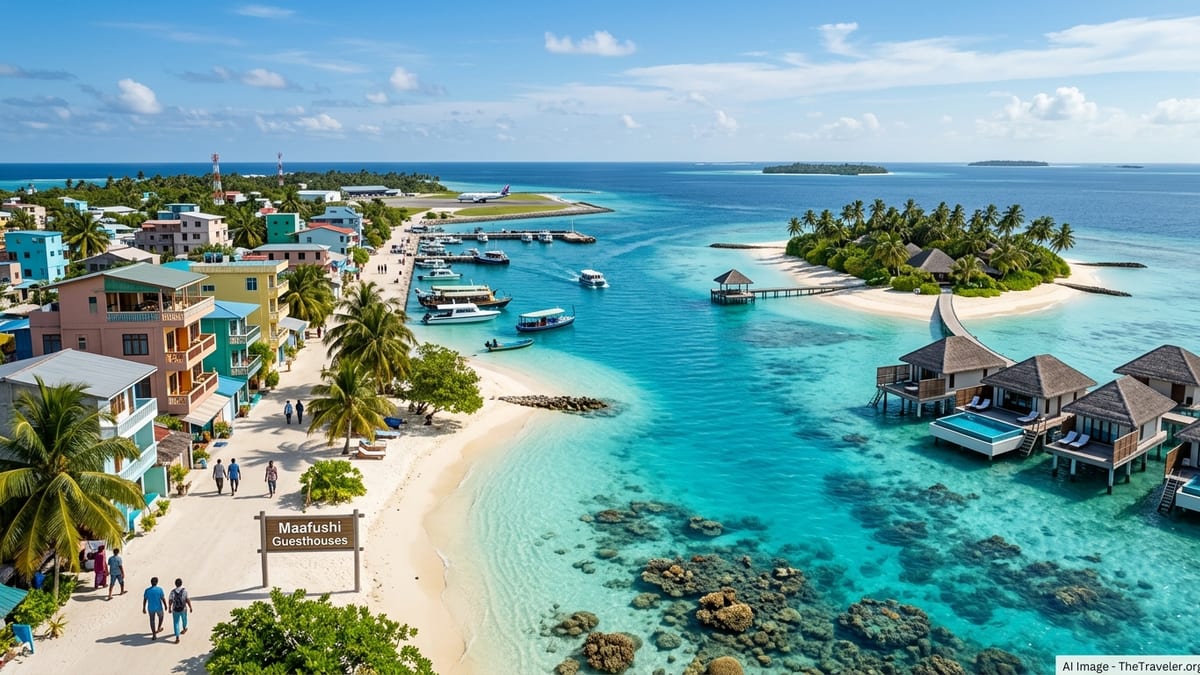
Practical steps toward a more affordable Maldives center on where visitors can stay and how they can move between atolls. Government statistics compiled for tourism yearbooks and the central bank’s statistical appendices show a steady increase in registered beds on inhabited islands, including guesthouses and small hotels. While precise 2025 capacity figures are still being finalized, official tables for 2023 and 2024 already count several tens of thousands of beds in the guesthouse category, compared with virtually none before the 2009 policy change. This growth has created clusters of budget and mid range accommodation in islands such as Maafushi, Thoddoo and Dhiffushi.
Domestic connectivity is being expanded in parallel. The Ministry of Finance’s published tourism indicators for 2024 attribute part of recent arrivals growth to new direct international flights, particularly from China, and to improved internal air services. Maldives Monetary Authority analysis notes that Chinese airlines including Chongqing Airlines and Xiamen Airlines launched scheduled flights to the Maldives in mid 2024, while other carriers increased frequencies to Malé’s Velana International Airport. In addition, the government has announced plans for new or upgraded regional airports in several atolls to support “atoll focused” tourism projects. Some of these airports are operating, while others remain at the construction or planning stage, meaning their full impact on traveler itineraries lies in the future.
Officials link these investments to a strategy of spreading tourism beyond the most developed resort areas. President Muizzu has cited projects in the far south, such as an "Asseyri" tourism concept in Addu City that integrates a seaplane hub and supporting infrastructure, as examples of efforts to open up new regions to visitors. While many of these schemes are still in planning or early rollout stages rather than completed products, they indicate a policy direction in which more islands would host a mix of guesthouses, small hotels and community linked tourism businesses at varying price levels.
Who Is Traveling To The Maldives And What Do They Pay?
The visitor mix to the Maldives has shifted in ways that interact with the affordability debate. The Ministry of Tourism’s published daily statistics for late 2024 and early 2025 show China regaining its position as the single largest source market, with Russia, the United Kingdom, Italy and Germany also among the top contributors. India, which was the leading market in 2021, 2022 and 2023 with just over 200,000 visitors in 2023, has fallen back to around fifth or sixth place in 2024 and 2025. This reflects both political tensions that dampened Indian demand and rapid growth from China following the end of outbound travel restrictions.
Aggregate arrival numbers, however, do not reveal how much individual travelers spend. Official balance of payments data from the Maldives Monetary Authority indicate that total tourism receipts remain high and that resorts still account for much of that revenue. Independent analyses using those figures suggest that average per visitor expenditure is significantly higher than in many competing Indian Ocean destinations, a pattern consistent with the Maldives’ strong concentration of luxury properties. At the same time, government reports note that local island accommodation has gained market share, implying that a growing minority of visitors choose lower priced stays even as overall averages remain skewed by high end resorts.
Concrete, system wide pricing data are limited, but publicly available hotel and guesthouse listings show that rooms on inhabited local islands can often be booked in the range of roughly 50 to 150 US dollars per night outside peak festive periods, compared with rates that commonly start in the several hundreds of dollars per night for private island resorts. Airfare examples published by airlines and route announcements also point to more variability than in the past. Low cost carriers from India and other Asian countries have at times advertised promotional return fares to Malé that compete with budget trips to closer beach destinations, although such deals are typically capacity controlled and not guaranteed for all dates.
How The “Maldives For All” Agenda Changes Trip Planning
For travelers, the main immediate consequence of the government’s mid market focus is a wider range of options rather than a guaranteed drop in prices. The legalisation of guesthouses on local islands and the growth of domestic flights mean that visitors who are willing to trade some seclusion and alcohol availability for lower costs can now choose multi stop itineraries that combine Malé or nearby local islands with a shorter stay at a resort. Ministry statistics on registered establishments confirm that such mixed itineraries are feasible in far more atolls than a decade ago, when almost all tourist beds were on dedicated resort islands.
At the same time, several structural features keep the Maldives from becoming a uniformly low cost destination. The country’s geography requires most international visitors to connect onward by speedboat or domestic flight, which adds mandatory transfer costs that can be substantial compared with destinations where accommodation is reachable by road or short ferry. Government tax policy also includes a tourism goods and services tax and “green tax” that are applied per night, and while these are standardised they add noticeably to final bills. None of the current policy documents suggest that these structural elements will disappear in the near term, meaning that the Maldives is becoming more accessible at the margins rather than transforming into a budget destination across the board.
Travel planners therefore need to engage more actively with product differences. Staying on an inhabited island guesthouse typically means sharing beaches and facilities with local residents and adhering to local customs, including dress codes away from designated bikini beaches and more limited access to alcohol. Resort islands, by contrast, maintain the familiar all inclusive or full board formulas aimed at international tourists but at higher per night costs. The government’s “tourism for all” approach broadens these choices geographically and by price band, but it does not erase the distinction, making pre trip research increasingly important.
What Travelers Should Watch Next
The most concrete developments to monitor are new air routes and officially announced openings of guesthouse islands or regional airports, because these have direct, measurable impacts on itineraries and prices. When airlines such as Chongqing Airlines and Xiamen Airlines inaugurated flights to Malé in mid 2024, for example, official statistics recorded a corresponding rise in arrivals from China and an overall increase in total visitors. Similar patterns could emerge if additional low cost carriers from South Asia or the Middle East launch services, potentially improving fare competition on key routes.
On the accommodation side, investors and government agencies continue to announce new projects in outer atolls, but travelers should distinguish between proposals, sites under construction and islands that are actually open and bookable. Official tourism yearbooks and the Ministry of Tourism’s online establishment registry are the most reliable sources for confirming whether a particular guesthouse island or hotel is operational and licensed. Because delays are common in island infrastructure projects, relying on third party marketing alone can lead to unrealistic expectations about the timing or scale of new mid market offerings.
Prospective visitors who are interested in the more affordable end of Maldivian tourism may benefit from tracking updated government statistics as they are released through late 2025 and 2026. These reports will show whether the share of beds and nights spent on local islands continues to grow and whether new regional airports translate into greater route diversity and lower transfer costs. Until that data is in, the Maldives is best understood as a destination where concrete steps are being taken to broaden access, but where the experience and price level still vary sharply between luxury resorts and an expanding, but not yet dominant, network of guesthouses and mid range hotels.