


Cedar Mesa in southeastern Utah is one of the Southwest’s great open-air museums, a maze of sandstone canyons sheltering thousands of Ancestral Puebloan sites. Two of the most talked-about hikes are the easy walk to House on Fire in Mule Canyon and the longer trek to Junction Ruin in Grand Gulch. Both deliver evocative ruins and big desert scenery, but they offer very different experiences. If you have limited time or energy, it is worth understanding those differences before you point your rental car down a dirt road.
Get the latest updates straight to your inbox!
Getting Oriented: Cedar Mesa, Permits and Practicalities
Cedar Mesa lies west of the town of Blanding in southeastern Utah, within Bears Ears National Monument and managed by the Bureau of Land Management. The landscape is a high, pinyon–juniper mesa cut by deep canyons like Mule Canyon, Kane Gulch and Grand Gulch. Access is mostly via Utah State Route 95 and State Route 261, with trailheads reached on short stretches of graded dirt road. There are no services at most trailheads, so visitors need to arrive self-sufficient with water, food and realistic expectations about desert travel.
Both House on Fire and Junction Ruin sit inside fee areas that require Cedar Mesa day-use permits. The BLM sells single-day passes per person, seven-day passes and annual hang tags, with day-use permits available at self-service fee tubes at major trailheads and at the Kane Gulch Ranger Station in season. Recent trip-planning material notes that during the busiest periods, such as March to mid-June and September to late October, some canyons, including the North and South Forks of Mule Canyon and Grand Gulch, have daily person limits at each trailhead, so picking up permits early in the day or reserving through Recreation.gov is wise.
From Blanding, most travelers reach House on Fire by driving roughly 25 miles west on State Route 95, then turning onto a short dirt road signed for Mule Canyon. The Junction Ruin hike begins farther south off State Route 261 near the Kane Gulch Ranger Station, which doubles as the main information point for Cedar Mesa. Because cellular coverage is patchy across the mesa, it is sensible to download offline maps from services like Gaia GPS or onX in Blanding or Monticello before heading out.
House on Fire: The Iconic, Accessible Cedar Mesa Experience
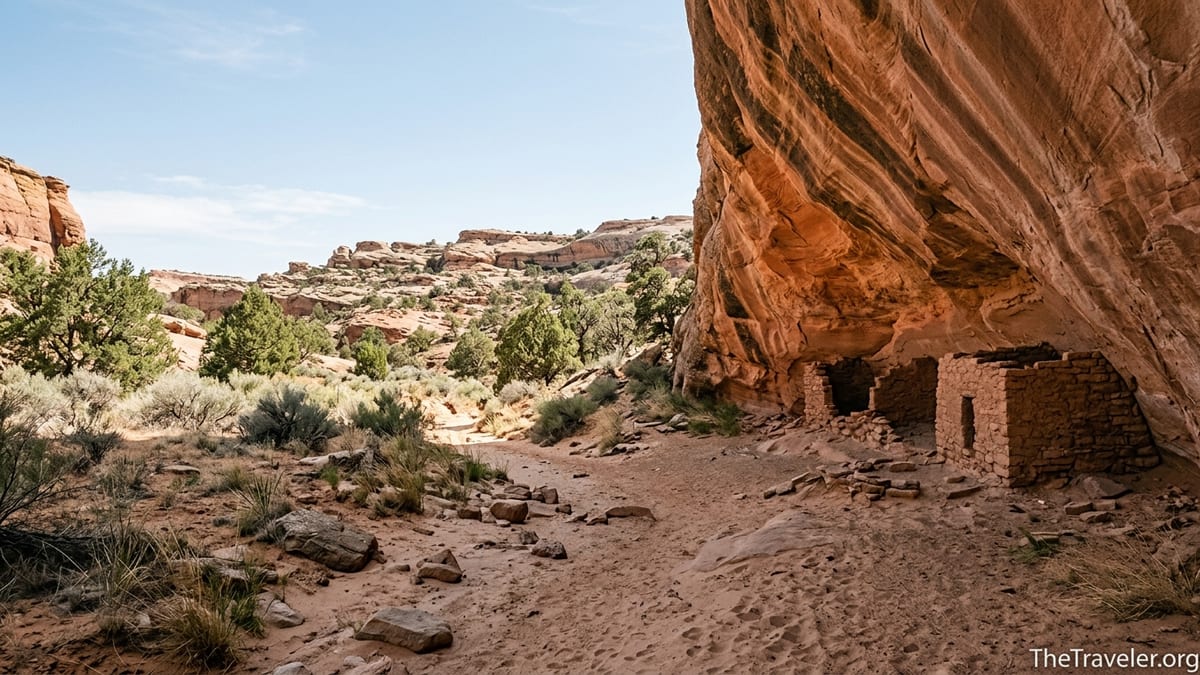
House on Fire is arguably the most photographed ruin on Cedar Mesa. The site is a set of small granaries tucked under an overhanging sandstone alcove in the South Fork of Mule Canyon. In mid-morning light, reflected sunlight bounces off the canyon floor and paints the streaked ceiling in glowing orange and red, creating the illusion that the rock above the granaries is ablaze. This optical effect, together with a short approach hike, has turned House on Fire into a must-stop for road-trippers driving between Moab and Monument Valley.
The hike itself is straightforward. From the dirt parking area near the Mule Canyon causeway, the route follows the sandy wash and a well-worn path up-canyon for about 1 mile each way, with only modest elevation gain. Most fit hikers complete the out-and-back in 1.5 to 2 hours, including time spent at the ruin. Families with school-age children, travelers adjusting to the altitude after flying into Salt Lake City, and visitors who simply prefer a low-commitment outing often find House on Fire a perfect half-day leg-stretcher.
House on Fire’s accessibility also means company. On a sunny April Saturday, it is common to see a dozen cars at the trailhead and a rotating crowd of photographers beneath the alcove, each waiting for a chance at the classic composition. For some travelers, the communal atmosphere adds to the fun. Others, especially those hoping for solitude or a spiritual connection to the place, find the bustle distracting. If you are coming primarily for peace and quiet, this is a key factor in deciding whether House on Fire is your best Cedar Mesa choice.
Junction Ruin: A Full-Day Immersion in Grand Gulch
Junction Ruin sits deep in the confluence area where Kane Gulch meets Grand Gulch, the longest and most storied canyon system on Cedar Mesa. The ruin is a multi-level Ancestral Puebloan cliff dwelling built into an alcove above the canyon floor, surrounded by additional structures, midden deposits and rock art. Conservation organizations that help visitors plan Grand Gulch trips describe the hike to Junction Ruin as about 8 miles round trip, rated advanced because of both distance and route-finding in a rugged canyon.
Access begins at the Kane Gulch trailhead off State Route 261, usually reached by turning west from Highway 95 and driving to the signed ranger station. From the trailhead, hikers descend Kane Gulch, navigating sections of slickrock, sand and occasional minor pour-offs. After approximately 2.5 miles, the canyon opens into Grand Gulch, and the ruins appear near the junction. Unlike the concentrated scene at House on Fire, the approach to Junction Ruin unfolds gradually, with side alcoves, petroglyph panels and smaller sites revealing themselves as you hike.
Because the hike is longer and more committing, visitation is lower than at House on Fire. Even during peak spring season, many parties report seeing only a handful of other hikers. The trade-off is that this is a more serious backcountry outing. Round-trip hiking time commonly runs 5 to 7 hours, and hikers must be prepared for desert heat, limited shade and a complete lack of services. For strong hikers who want to feel enveloped by the scale of Grand Gulch and who appreciate spending extended time in a landscape, Junction Ruin offers an immersion that an hour in Mule Canyon simply cannot match.
Scenery, Atmosphere and Photography: What You Actually See
At House on Fire, the headline attraction is one specific composition. The granaries, shallow foreground ledges and dramatically striated ceiling all align when viewed from a tight spot across the narrow wash. Photographers time their visits for mid-morning, generally between about 10 and 11 a.m. depending on season, when shaded canyon walls are lit by reflected light. That is when the ceiling glows and the “fire” effect is most convincing. On overcast days, or if you arrive very early or late, the ruin is still interesting but the famous look is muted.
Beyond this alcove, the South Fork of Mule Canyon remains scenic but relatively modest in scale. The canyon is shallow compared with Grand Gulch, and the hike often involves walking in or next to a sandy streambed fringed with cottonwoods and willows. Travelers with limited time can photograph House on Fire, explore a bit farther up-canyon to spot additional small ruins, and be back on the highway in time for a late lunch in Blanding.
Junction Ruin offers a broader visual experience. The hike into Kane Gulch and Grand Gulch passes towering sandstone walls, hanging gardens fed by seeps, and occasional pools in spring. In addition to the main ruin, there are side alcoves with masonry walls, kivas and painted or pecked imagery on the rock. Rather than chasing a single iconic shot, photographers tend to work with layered canyon vistas, long lenses on distant ruins and more documentary-style images of the site in its wider context. Light is more varied, with sections of dappled shade in the gulch and sunlit walls high above.
In practical terms, if your goal is to come home with the one instantly recognizable Cedar Mesa image for social media or a living room print, House on Fire’s predictably dramatic scene is appealing. If you are more interested in storytelling photography that captures the sweep of a canyon system and the feel of a full day outside, Junction Ruin provides a richer canvas at the cost of more effort.
Difficulty, Time and Skill: Matching the Hike to Your Group
House on Fire is best thought of as an easy to moderate walk suitable for most reasonably active visitors. The round-trip distance of roughly 2 miles, with gentle elevation change around 200 to 250 feet, means that even travelers unused to hiking can manage it with breaks. The trail alternates between a visible path and the sandy wash, with a few minor rock steps and logs but no exposure. Many families take children as young as five, and dogs are often present, though regulations can vary and it is important to keep pets away from archaeological features.
Because the hike is short, you can start late in the morning to catch the prime light and still finish before the worst afternoon heat. Spring and fall are the most popular seasons, when high temperatures often range from the 60s to 80s Fahrenheit. In summer, heat can climb well into the 90s, so even this short hike demands extra water and sun protection. Winter visits are possible, but cold mornings and occasional snow or ice in the wash change the character of the outing.
Junction Ruin requires more commitment. The 8-mile round trip, combined with the rougher footing of a canyon hike, means you should treat this as a full-day excursion. Parties without much hiking experience often underestimate the time required to hike back uphill out of Kane Gulch when tired and hot. Trekking poles, 2 to 3 liters of water per person in moderate temperatures, and solid footwear are highly recommended. The hike is generally non-technical but includes sections of uneven rock, shallow water crossings in wet periods and limited shade in the middle of the day.
Skill level is not just about fitness. Navigation in Grand Gulch can be confusing because social trails split, rejoin and occasionally disappear in sandy stretches. While the route to Junction Ruin is well traveled enough that most hikers can follow footprints and cairns, the environment rewards people comfortable reading terrain and maps. If your group is new to desert hiking, hiring a local guide service from Blanding or Bluff for Junction Ruin can make the day safer and more educational.
Culture, Respect and Impact: Choosing with Ethics in Mind
Both House on Fire and Junction Ruin are sacred cultural sites for modern Indigenous communities, including Navajo, Hopi, Zuni and Ute peoples whose ancestors built or were related to the builders of these structures. Modern visitation is a privilege, not a right, and in recent years land managers and local advocacy groups have raised concerns about trampling, artifact theft and physical damage. At House on Fire, the combination of social media fame and easy access has led to heavily compacted soils around the alcove and frequent reports of visitors stepping into rooms or sitting on fragile walls for photos.
If you choose House on Fire, your behavior has an outsized impact because of the site’s small footprint and concentrated use. It is essential to stay off the masonry, keep at least several feet back from the granary walls and ceilings, and avoid placing tripods or camera bags on ancient stones. Kneeling in the wash or on modern rock just outside the alcove still allows excellent photos without touching the ruin. Traveling in small groups, keeping voices down and limiting the time you occupy the prime photo spot so others can enjoy it all help reduce cumulative pressure.
Junction Ruin is more robustly situated and less overwhelmed by foot traffic, but it is still vulnerable. Hikers spend longer at the site, often exploring nearby alcoves and studying petroglyph panels. Good practice is the same: never enter rooms or kivas, do not touch rock art, keep children and pets back from walls, and leave any artifacts, including potsherds or corncobs, exactly where they lie. Because Junction Ruin requires a day of effort, many visitors are already inclined toward a more thoughtful, low-impact mindset, but conscious care remains essential.
When deciding which site to visit, some travelers lean toward Junction Ruin precisely because the longer hike spreads people out and reduces crowding at any single cliff dwelling. Others choose House on Fire but visit early or in the shoulder seasons, when numbers are lower. Either approach can be ethical if you commit to strict Leave No Trace principles and recognize that these are not abandoned relics but living cultural landscapes.
Which Should You Visit? Scenarios and Recommendations
For many travelers, the choice between House on Fire and Junction Ruin comes down to time, fitness and what kind of experience they want from Cedar Mesa. If you are driving through on a tight Southwest itinerary, perhaps connecting Arches, Monument Valley and Mesa Verde in a single week, you may only have half a day available. In that case, House on Fire offers a high reward-to-effort ratio: a memorable ruin, classic photograph and a taste of Cedar Mesa without putting serious mileage on your legs or schedule.
Consider a couple flying into Las Vegas, renting a standard SUV and road-tripping through southern Utah in April. After a long drive from Bryce Canyon, they reach Blanding in the evening and want a manageable hike the next morning before heading to Monument Valley. With just a few hours to spare and only light hiking experience, they would almost certainly be better served by the House on Fire walk than attempting the much longer Junction Ruin trek.
On the other hand, picture a pair of experienced backpackers who have already visited major national parks and are seeking a more immersive, less crowded outing. They have a full day set aside, comfortable packs and downloaded maps, and are visiting in late September when temperatures are moderate. For them, the hike into Kane Gulch and Grand Gulch to Junction Ruin offers not just one site but an unfolding narrative of canyon scenery, side ruins and rock art. The added effort feels like an asset rather than a drawback.
If your schedule and fitness allow, the ideal Cedar Mesa visit includes both styles: perhaps an easier outing like House on Fire paired with a more involved canyon hike on another day. For first-time visitors who must choose only one, House on Fire is the safer recommendation for families, casual hikers and those primarily interested in capturing the signature image. Junction Ruin is the better match for strong hikers who prioritize solitude, depth of experience and a closer sense of how these ruins fit into the broader Grand Gulch landscape.
The Takeaway
House on Fire and Junction Ruin each showcase a different face of Cedar Mesa. House on Fire is compact, photogenic and easy to reach, making it ideal for travelers with limited time, mixed abilities or a strong interest in photography. Junction Ruin is remote, physically demanding and expansive, suited to those who want a full day of canyon travel and a more contemplative experience among ruins less shaped by crowds.
Whichever you choose, preparation and respect are non-negotiable. Secure the appropriate Cedar Mesa day-use permit, carry more water than you think you need, and plan your route and timing carefully. Treat every structure, potsherd and panel as part of an irreplaceable cultural record and a living Indigenous landscape. If you do, your visit to either House on Fire or Junction Ruin will not only be memorable for you but also kinder to the fragile canyons of Cedar Mesa and the people who still hold them dear.
FAQ
Q1. Do I need a permit to visit House on Fire and Junction Ruin?
Yes. Both sites lie within Cedar Mesa fee areas. You need a Cedar Mesa day-use permit for day hiking, which you can typically obtain at self-service fee stations at trailheads or at the Kane Gulch Ranger Station in season, and in many cases in advance through Recreation.gov.
Q2. How long are the hikes to House on Fire and Junction Ruin?
House on Fire involves roughly 2 miles round trip on mostly flat terrain and usually takes 1.5 to 2 hours with time at the ruin. Junction Ruin is about 8 miles round trip with more rugged canyon hiking and commonly takes 5 to 7 hours.
Q3. Which site is better for families or casual hikers?
House on Fire is generally better for families and casual hikers. The trail is shorter, easier and closer to the highway, and the payoff is a dramatic, easily appreciated ruin without committing to a full-day canyon hike.
Q4. Which site offers more solitude?
Junction Ruin typically offers more solitude. Because it requires a longer, more strenuous hike into Grand Gulch, fewer people make the trip, and hikers are spread out along the canyon, reducing crowding at the ruin.
Q5. When is the best time of day to photograph House on Fire?
The famous “on fire” effect usually appears in mid-morning, around 10 to 11 a.m., when reflected sunlight lights up the alcove ceiling. On cloudy days or outside this window, the effect is much less pronounced.
Q6. Can I visit either site in a regular rental car?
Most visitors reach the House on Fire and Kane Gulch trailheads in a standard passenger vehicle, driving graded dirt roads off paved highways. Conditions can deteriorate after heavy rain or snow, so it is wise to check with the Kane Gulch Ranger Station or local outfitters before heading out, and avoid muddy roads in low-clearance cars.
Q7. Is it allowed to enter the ruins or touch the walls?
No. Entering rooms, stepping on walls, sitting on kivas or touching rock art and masonry is prohibited and can cause permanent damage. Visitors should remain outside structures, keep a respectful distance and never disturb artifacts or surfaces.
Q8. Which season is best for visiting these Cedar Mesa sites?
Spring and fall are generally best, typically from March to early June and September to late October. Temperatures are milder, and water in canyon pools is more likely. Summer can be dangerously hot, while winter brings cold, shorter days and occasional snow or ice.
Q9. Are guided trips available to House on Fire and Junction Ruin?
Yes. Several outfitters based in Blanding, Bluff and Monticello offer guided day hikes and multi-day trips in Cedar Mesa, including itineraries that visit House on Fire or explore sections of Grand Gulch near Junction Ruin. A guide can add cultural context and improve safety, especially for those new to desert hiking.
Q10. If I only have one day on Cedar Mesa, which site should I choose?
If you want an easier outing with a guaranteed iconic view and you are short on time, choose House on Fire. If you have strong hiking fitness, a full day to spare and a desire for a deeper, quieter canyon experience, Junction Ruin is the more rewarding choice.