


More news on this day
Momentum is building around Nigeria’s Kano–Katsina railway section, as new updates on the wider Kano–Maradi standard gauge corridor point to a transformative shift in how travellers and cargo will soon move across the country’s far north.
Get the latest news straight to your inbox!
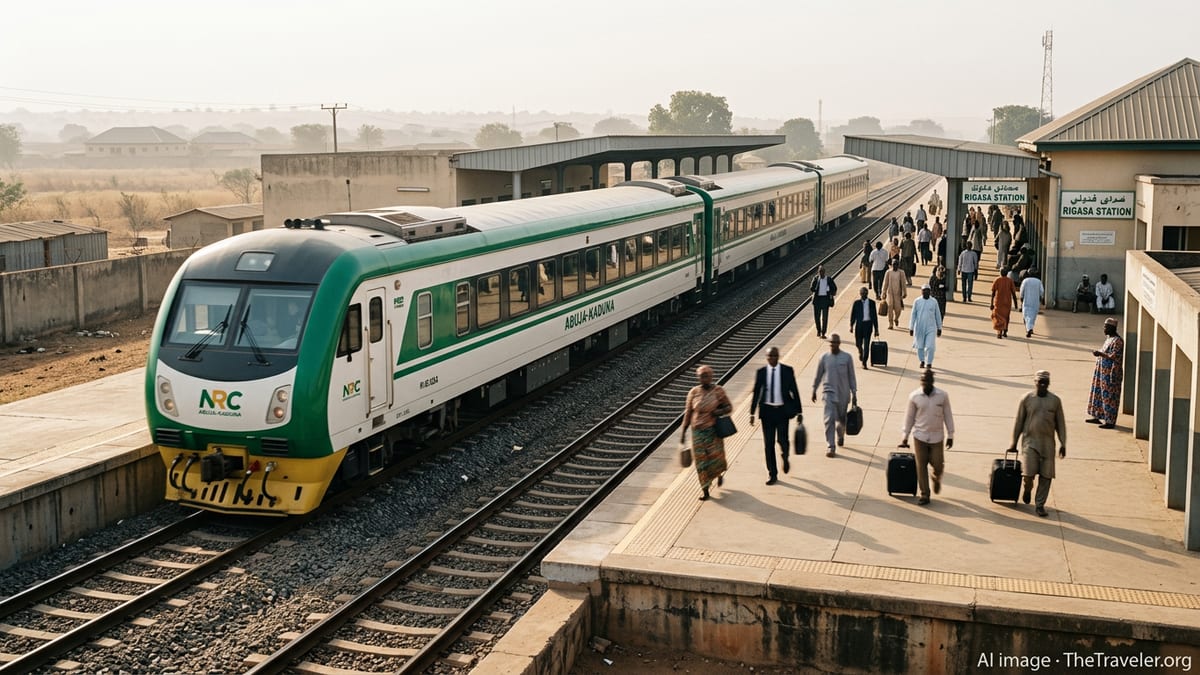
A Strategic Northern Spine Takes Shape
The Kano–Katsina rail link forms a core segment of the 284 kilometre Kano–Maradi standard gauge railway, a flagship project intended to connect Kano in northern Nigeria with Maradi in neighbouring Niger Republic. Publicly available information describes the corridor as running through Kano, Jigawa and Katsina states, with an extension over the border into Niger, positioning it as a key part of a longer Dakar–N’Djamena transport axis across West and Central Africa.
According to published federal fact sheets and subsequent project briefs, the Kano–Maradi line is being built as a single track standard gauge railway with a branch from Kano to Dutse in Jigawa State and a sequence of intermediate stops, including the important trade hub of Katsina near Nigeria’s northern frontier. The Kano–Katsina portion is therefore expected to serve both as a domestic intercity link and as a feeder for future cross border services toward Maradi.
Recent disclosures from Nigeria’s environment and transport authorities outline the project under the name Kano–Katsina–Jibiya–Maradi single track standard gauge railway, underscoring the role of Katsina and Jibiya as key waypoints on the new line. Planning documents highlight the need to integrate rail operations with border logistics and dry port facilities, an indication that long distance freight and regional trade are central to the project’s design.
Timelines Tighten as Construction Advances
While the project was first contracted under the previous administration, more recent updates suggest that the construction timeline has been significantly firmed up. Reports from Nigeria’s Federal Ministry of Information indicate that the Kaduna–Kano and Kano–Daura–Katsina sections of the broader railway programme are currently on track for commissioning in December 2026, signalling that test operations on parts of the corridor could begin within the next two years.
Further government communications describe the Kano–Jigawa–Katsina–Maradi project as about 60 percent completed and projected for full delivery by the end of 2027. In practice, that would place the opening of regular passenger and freight services sometime between late 2026 and 2027, subject to remaining civil works, signalling installation, safety certification and operational readiness. Within that window, the Kano–Katsina stretch is identified in media coverage as one of the earlier segments to become operational as the line is built out northwards.
International financing disclosures give an additional sense of momentum. A recent project summary from a multilateral development bank notes support for the acquisition of railway construction equipment and related working capital to help complete the 378 kilometre Kano–Maradi line, including its sections across Kano, Katsina and Jigawa. The same document characterises the railway as improving connectivity across currently under connected regions, reinforcing the perception that the northern corridor is moving from concept to near term reality.
What the New Link Could Mean for Travellers
For travellers within northern Nigeria, the Kano–Katsina section promises a marked change in journey times and comfort compared with existing road based options. The corridor is being built as a modern standard gauge line, a significant upgrade on the country’s legacy narrow gauge network that dates back to the early and mid twentieth century. Public information from the Nigerian Railway Corporation describes how newer standard gauge routes elsewhere in the country are designed to support higher speeds, purpose built passenger coaches and more reliable timetables.
Once services begin, travellers moving between Kano and Katsina can expect a direct rail alternative to long road drives on heavily used highways that are vulnerable to congestion, weather damage and safety concerns. For business travellers and traders, particularly those linking up with markets in Daura, Jibiya and onward to Niger, rail connectivity could reduce travel uncertainty and open the door to scheduled movements of both people and light cargo.
There are also implications for long distance itineraries. With the Kaduna–Kano standard gauge line targeted for completion in 2026, the Kano–Katsina section would in time plug directly into Nigeria’s growing north south rail spine, which already includes the Abuja–Kaduna and Lagos–Ibadan standard gauge lines. For domestic and international travellers, this raises the prospect of boarding a train in Lagos or Abuja and continuing by rail all the way to Katsina and the border region via coordinated connections.
Freight, Trade and Tourism Along a Reimagined Corridor
Beyond day to day commuting, the Kano–Katsina railway section is poised to reshape freight and logistics patterns across northern Nigeria. Government fact sheets and project analyses have repeatedly framed the Kano–Maradi line as a trade facilitation corridor linking agricultural belts and industrial zones in Kano, Jigawa and Katsina with export gateways and inland dry ports. By providing a rail alternative to long haul trucking, the new line is expected to cut transport costs and reduce pressure on road infrastructure.
In Katsina State, which has strong ties to cross border livestock and grain markets, a functioning standard gauge link to Kano could enable more predictable movement of bulk commodities, including containerised shipments bound for ports on the Atlantic seaboard. Financial and project documentation suggests that the corridor is being designed to handle mixed traffic, combining passenger services with freight trains that can carry everything from construction materials to finished consumer goods.
There are potential tourism spin offs as well. Kano and Katsina are both home to historic city walls, traditional craft markets and cultural festivals, but overland access has often been shaped by road conditions and security perceptions. As rail services extend northwards, tour operators and domestic travellers may find it easier to design itineraries that combine northern heritage sites with urban stays in Lagos, Abuja or Kaduna, using rail for the longer legs and road only for local transfers.
Communities, Safeguards and the Road to Launch
Alongside engineering progress, there has been a parallel focus on how the rail corridor intersects with local communities. Nigeria’s Federal Ministry of Environment has publicly disclosed a Livelihood Restoration Plan for the Kano–Katsina–Jibiya–Maradi railway, detailing timelines for engagement, enrolment in support programmes, delivery of assistance packages and grievance management stretching through 2025 and 2026. The plan frames the railway as a project that should restore or improve livelihoods for people affected by land acquisition or alignment works.
The same documentation shows a structured calendar of activities, from forming implementation committees to monitoring and reporting, and a completion audit to be reviewed by development partners. For travellers and investors watching the corridor, these safeguards are a reminder that the path to opening day involves not only track laying and station building but also the resolution of social and environmental impacts along the right of way.
As construction equipment continues to arrive and track works advance, attention is gradually shifting from whether the Kano–Katsina link will be completed to how soon regular services can start and how they will be integrated into Nigeria’s wider rail timetable. With target dates of late 2026 and 2027 guiding current planning, the coming years are likely to determine how fully this northern rail spine can deliver on its promise of faster, safer and more connected travel across the region.
Guardian Nigeria: Kano–Maradi rail to reach Katsina
Federal Ministry of Information: Kaduna–Kano, Kano–Daura–Katsina rail update
Federal Ministry of Environment: Kano–Katsina–Jibiya–Maradi LRP disclosure
EBRD project summary: Kano–Maradi railway construction support