


More news on this day
Once marketed as a sealed-off space above the world’s troubles, commercial aviation is increasingly absorbing the shock of modern conflicts, as missile threats, drone attacks and electronic warfare push airlines to reroute flights, suspend services and confront new kinds of risk in the skies.
Get the latest news straight to your inbox!
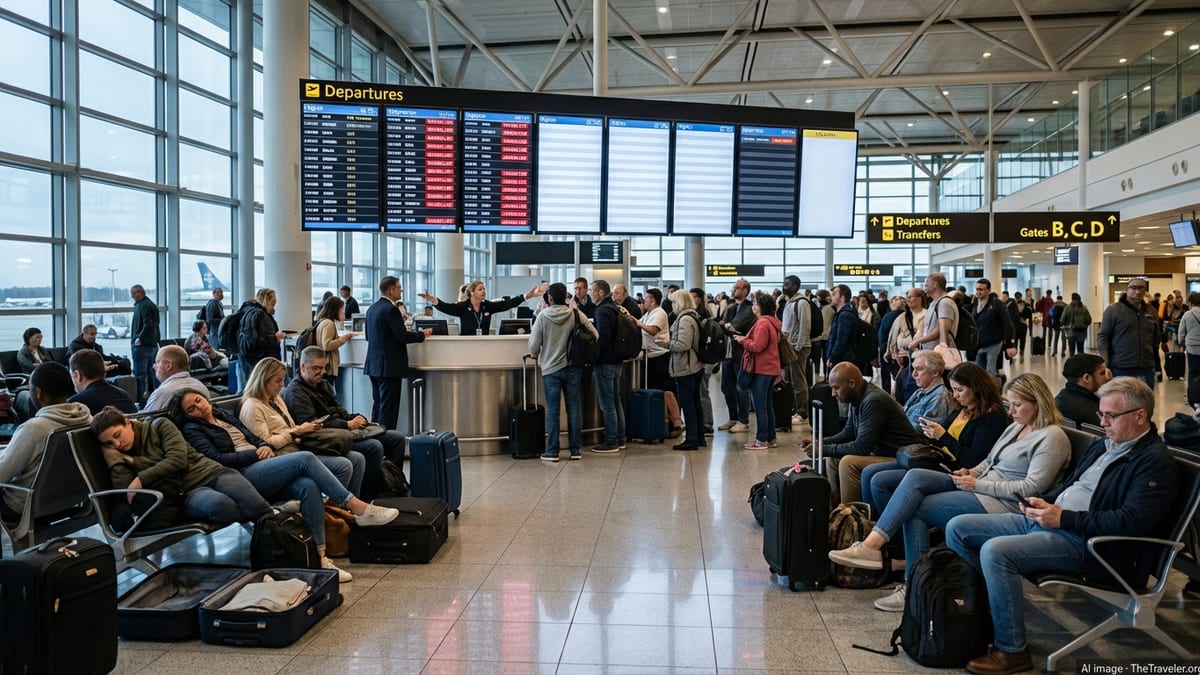
Saudi Airports Under Fire as Yemen Conflict Escalates
Recent attacks linked to Yemen’s Houthi movement have turned major Saudi airports into flashpoints, highlighting how passenger terminals and overflight corridors can become exposed in regional wars. In early October 2026, published coverage from international news agencies described multiple strikes and attempted strikes on King Khalid International Airport in Riyadh and other facilities, with ballistic missiles, cruise missiles and drones reportedly used in closely spaced incidents over several days.
Reports indicate that at least three people were killed in attacks on Riyadh and Abha airports, with debris falling near runways and passenger facilities. In one case, a projectile landed close to the runway shortly before the scheduled arrival of a flight from Cairo, which was later tracked as landing safely after being diverted away from the immediate danger. The incidents revived concerns that had eased during a roughly four-year lull in large-scale fighting involving the Houthis.
Airlines reacted quickly. Publicly available flight-tracking data and carrier statements cited in news reports show that Air India, Lufthansa Group carriers, FlyDubai and Pakistan International Airlines temporarily suspended services to Riyadh and some other Saudi airports in the first week of October 2026. Embassies in the region issued warnings to citizens about the risks of using affected airports, while aviation analysts noted that the attacks coincided with major business and energy events scheduled in the kingdom’s capital.
The United States Federal Aviation Administration already restricts U.S. civil operators from the Sanaa Flight Information Region over Yemen, citing a mix of anti-aircraft weapons, militant activity and missile launches that could threaten aircraft up to at least 25,000 feet. That long-standing limitation, combined with the new attacks aimed at Saudi territory, is narrowing the safe corridors around the southern Red Sea at a time when the same waterway is central to global energy and container shipping.
Redrawing the Map: Airspace Closures and Rerouting Costs
Beyond direct attacks, the wider Middle East and neighboring regions have seen frequent airspace closures and restrictions that push commercial flights into longer and more congested routes. An airspace risk annex in a 2024 safety and economics report by the International Air Transport Association described a pattern of recurrent closures in and around Israel, Iran, Iraq, Jordan and Lebanon as conflicts flared, forcing carriers to stack more traffic into remaining corridors or detour around entire regions.
The cost implications are significant. Each additional hour of widebody flying typically adds tens of thousands of dollars in fuel, crew and maintenance costs, according to industry estimates cited in multiple financial and aviation briefings. For passengers, these reroutings translate into longer block times, higher fares on some city pairs and, in some cases, the loss of nonstop connections where airlines judge the combined security and economic risks to be too high.
Some states have also used airspace restrictions as a political tool. Analysis by airspace disruption trackers and academic researchers points to examples since 2023 in which bilateral disputes between countries led to temporary shutdowns of overflight rights, as well as coordinated closures during episodes such as the exchanges of fire between Iran and Israel across multiple flight information regions. For airlines that once built schedules around the shortest great-circle tracks, the strategic value of flexible contingency routes and fuel planning has increased sharply.
Travelers planning routes that cross or skirt these zones now encounter more frequent schedule changes and last-minute aircraft swaps, as carriers adjust to evolving notices to air missions from regulators. Industry bodies have repeatedly called for stronger data sharing on risk assessments, but responsibility ultimately rests with individual airlines and national authorities to interpret the threat environment and decide which skies remain acceptable for civil traffic.
Invisible Battles: GPS Jamming and Spoofing in Civil Airspace
Even far from active front lines, airliners are increasingly caught inside electronic battles that are largely invisible to passengers. Regulators and technical agencies in Europe and North America have documented sharp increases in interference with Global Navigation Satellite Systems used for aircraft positioning, approach procedures and surveillance. A 2024 resource guide from the U.S. Federal Aviation Administration highlighted clusters of jamming and spoofing events in the eastern Mediterranean, Black Sea, Middle East, Baltic and Arctic regions, with impacts ranging from nuisance warnings on flight decks to diversions when satellite-based landing procedures could not be flown reliably.
European aviation authorities have issued safety bulletins warning that in areas near conflict zones, deliberate interference can disrupt satellite signals across wide regions. The Hellenic Civil Aviation Authority in early 2024 drew attention to outages and altered signals affecting communications, navigation and surveillance in the south and eastern Mediterranean and adjacent conflict areas. The European Union Aviation Safety Agency has similarly noted cases in which aircraft had to reroute or change destination because of unreliable navigation data during critical phases of flight.
Finland’s transport and communications regulator reported around 1,200 notifications of GPS interference in aviation during 2024 alone, many of them in the Baltic Sea region close to Russian territory. Independent studies and think-tank analyses have linked a portion of this activity to electronic warfare systems based in Russia and Belarus, framing it as part of a broader “grey zone” campaign that tests NATO’s tolerance while stopping short of direct armed confrontation with alliance members.
Airlines and air traffic service providers are responding by reinforcing traditional navigation backups and pilots’ manual skills. Industry guidance encourages crews to cross-check satellite data against inertial systems, radio beacons and visual references, and to be prepared to abandon GPS-based procedures quickly if anomalies arise. While commercial aviation remains highly safe by historical standards, safety specialists argue that the spread of sophisticated jamming and spoofing technologies raises the baseline complexity of operating in regions touched by modern conflict.
Passengers Caught Between Perception and Statistical Safety
For travelers, the combination of spectacular incidents and technical warnings can create the perception that flying near conflict zones is becoming uniformly unsafe. Accident statistics published by IATA and national regulators, however, continue to show that commercial air travel remains among the safest transport modes, with very low rates of hull losses and fatal events relative to the number of flights operated each year.
The disconnect between perception and aggregate data is partly explained by the uneven distribution of risk. Public information indicates that the most acute threats today are concentrated in specific bands of airspace close to active fighting or powerful electronic warfare emitters, while vast portions of global routes remain largely unaffected. Airlines generally avoid the highest-risk regions entirely, following regulatory prohibitions and internal security assessments that take into account missile capabilities, recent incidents and the presence of military operations.
At the same time, the trend lines that worry safety experts are less about immediate catastrophe and more about erosion of margins. The expansion of anti-aircraft weapons capable of reaching cruising altitudes, the normalization of GPS interference as a background condition in some theaters and the growing use of drones all complicate what used to be routine overflights. Each layer adds potential points of failure that must be mitigated through equipment, procedures and real-time decision-making.
For now, the main impact on most passengers is more likely to be inconvenience and higher costs rather than direct physical danger. Longer routings, tighter schedules to work around restricted corridors and occasional diversions from preferred hubs are increasingly part of long-haul travel that intersects with conflict-adjacent regions. Yet the recent attacks on Saudi airports, combined with persistent navigation interference in Europe and the Middle East, underscore that the boundary between front line and flight path is thinner than it once seemed.