


More news on this day
A KLM service operating as Flight 123 from Amsterdam to Paris was forced to return to Schiphol shortly after takeoff following a reported bird strike, triggering an emergency response on the ground and a significant delay for passengers on the busy European route.
Get the latest news straight to your inbox!
Mid-Flight Turnback on Amsterdam–Paris Route
According to published coverage and flight-tracking data, the incident occurred over the weekend on a scheduled evening departure from Amsterdam Airport Schiphol to Paris Charles de Gaulle. The aircraft, identified in public timetables as an Airbus A320 operating under the KLM flight number 123, departed as planned before the crew reported a suspected bird strike during the initial climb.
Reports indicate that the jet had been airborne only a short time when the crew stopped its climb and requested to return to Schiphol. Live tracking data showed the aircraft leveling off at a relatively low cruising altitude and entering a holding pattern northwest of Amsterdam while crews assessed the situation.
The flight then followed a standard approach back into Schiphol, where it landed without further incident. Emergency vehicles were positioned alongside the runway in line with routine precautions for a suspected engine or structural issue, but no injuries were reported among passengers or crew.
Publicly available information suggests that the return to Amsterdam resulted in an overall delay of approximately four hours for those traveling to Paris, as KLM worked to arrange onward transport.
Impact on Passengers and Schedule Disruption
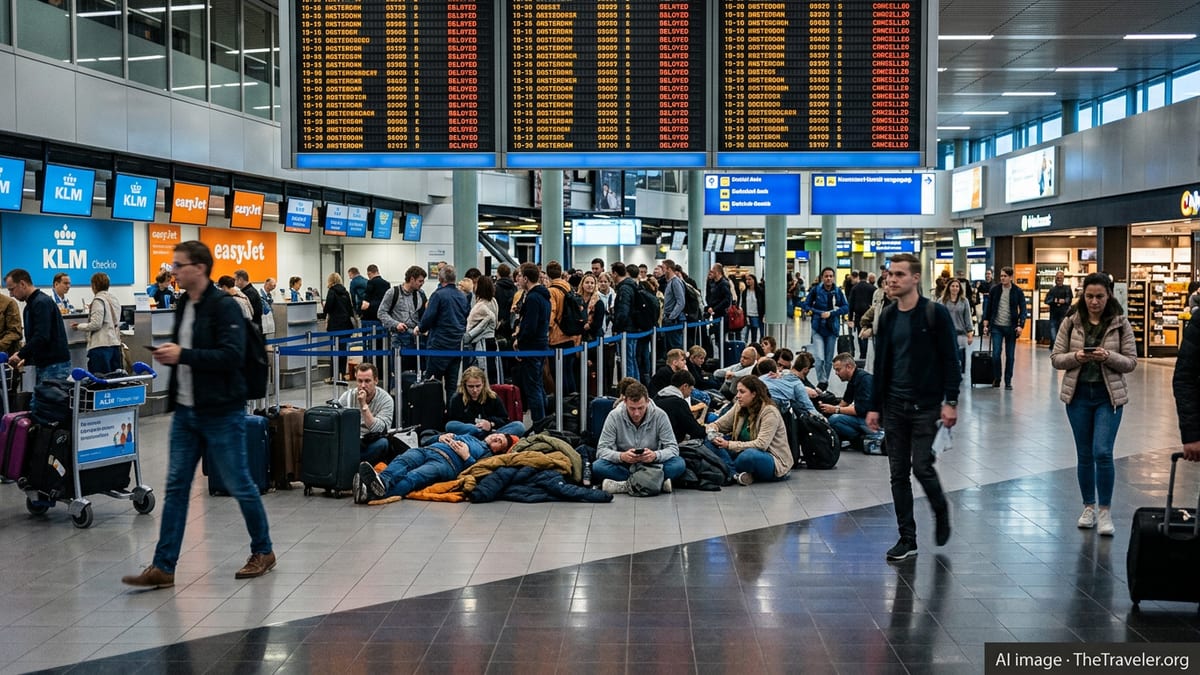
Travelers on Flight 123 faced an extended evening at Schiphol as aircraft inspections and rebooking processes unfolded. Reports from passenger accounts and travel-industry coverage suggest that the original aircraft was taken out of service for detailed technical checks, in line with standard industry practice following a suspected bird strike.
Some passengers were transferred to a later KLM service to Paris, while others were reportedly rebooked into the following day’s flights or rerouted via alternative hubs. The disruption rippled beyond the Amsterdam–Paris segment, affecting missed connections to long-haul destinations and onward European links.
For travelers ticketed on the flight, the disruption falls within the framework of European air passenger rights. Under EU and UK regulations, eligibility for financial compensation following bird strike events can be complex, as wildlife encounters are often categorized as extraordinary circumstances. Many travelers instead focus on receiving timely rebooking, meals, and accommodation where necessary.
The incident added to an already challenging spring travel period at major European hubs, where airlines and airports are juggling strong passenger demand with tight schedules and occasional operational bottlenecks.
Bird Strikes a Persistent Risk Around Schiphol
While the circumstances of Flight 123 are specific, bird strikes are not unusual in global aviation and are a known concern at low altitudes around airports. Schiphol, one of Europe’s busiest hubs, is surrounded by low-lying wetlands and agricultural land that attract large bird populations, including geese and other migratory species.
Aviation safety databases and Dutch media regularly document cases in which aircraft departing Amsterdam must return after contact with birds, particularly during takeoff and initial climb when speeds are high and evasive options are limited. In many cases, crews elect to return as a precaution even if systems appear to function normally, prioritizing detailed inspection on the ground.
Bird strikes can affect engines, leading edges, radomes, and windshields. Even when damage is minor, the potential for unseen issues inside an engine or behind access panels prompts airlines to remove aircraft from service temporarily, which can cascade into delays and cancellations on subsequent rotations.
Industry data shows that modern jet engines are rigorously tested to withstand bird ingestion, but operators treat real-world events with caution. As in the case of KLM Flight 123, a conservative approach typically results in a safe landing and a longer wait for passengers, rather than any compromise on airworthiness.
Safety Protocols and Airline Response
Publicly available information from aviation safety bodies notes that procedures for suspected bird strikes are well defined. Once an impact is suspected or confirmed, flight crews run checklists, monitor engine parameters, and coordinate with air traffic control while deciding whether to continue or return. A return to the departure airport is common when the strike occurs shortly after takeoff and suitable landing infrastructure is close at hand.
For airlines such as KLM, these incidents activate a parallel response on the ground. Maintenance teams prepare for immediate inspection, operations staff revise the schedule and aircraft assignments, and airport partners coordinate handling and gate availability for the unplanned arrival.
In the case of Flight 123, publicly accessible fleet and schedule data indicate that another Airbus A320-family aircraft was eventually assigned to carry passengers onward to Paris once checks on the original jet were underway. The need to reposition aircraft and crew, however, contributed to the multi-hour delay.
Although such events are disruptive, industry safety statistics consistently show that commercial aviation remains one of the safest forms of travel. The conservative handling of Flight 123, with a prompt return and comprehensive ground inspection, aligns with the sector’s focus on risk mitigation and redundancy.
What Travelers Should Know on the Amsterdam–Paris Corridor
The Amsterdam–Paris route is one of Western Europe’s key air corridors, linking two major hubs that also share high-speed rail connections. For many travelers, including business passengers and long-haul transfer customers, flight options such as KLM 123 provide convenient links into broader global networks.
Events like the Flight 123 bird strike highlight the value of flexible travel planning on short intra-European segments. Travel advisers often recommend allowing generous connection times at hubs such as Schiphol and Charles de Gaulle, particularly during peak seasons when any disruption can quickly reduce options for same-day rebooking.
Passengers who experience significant delays are encouraged by consumer organizations to keep boarding passes, receipts for meals or accommodation, and any written communication from airlines. These documents can be helpful when requesting reimbursements for reasonable expenses or clarifying eligibility under passenger-rights rules.
Despite the disruption, publicly available evidence indicates that Flight 123’s bird strike ended with a controlled return, no injuries, and onward travel arranged for those on board. For frequent flyers on the Amsterdam–Paris corridor, it serves as a reminder that while wildlife encounters remain an inherent risk in aviation, established procedures are designed to keep safety at the forefront, even at the cost of major schedule upheaval.