


The KLIA Ekspres is often the first impression travelers get of Kuala Lumpur: a fast, air conditioned train gliding from Kuala Lumpur International Airport to the city in under 35 minutes. With two airport terminals, different ticket types, evolving schedules and the busy KL Sentral hub to navigate, it pays to understand how the system really works before you land. This guide walks you through KLIA Ekspres step by step, from platforms and prices to late night options and when the train is genuinely worth the money compared with a Grab or taxi.
Get the latest updates straight to your inbox!
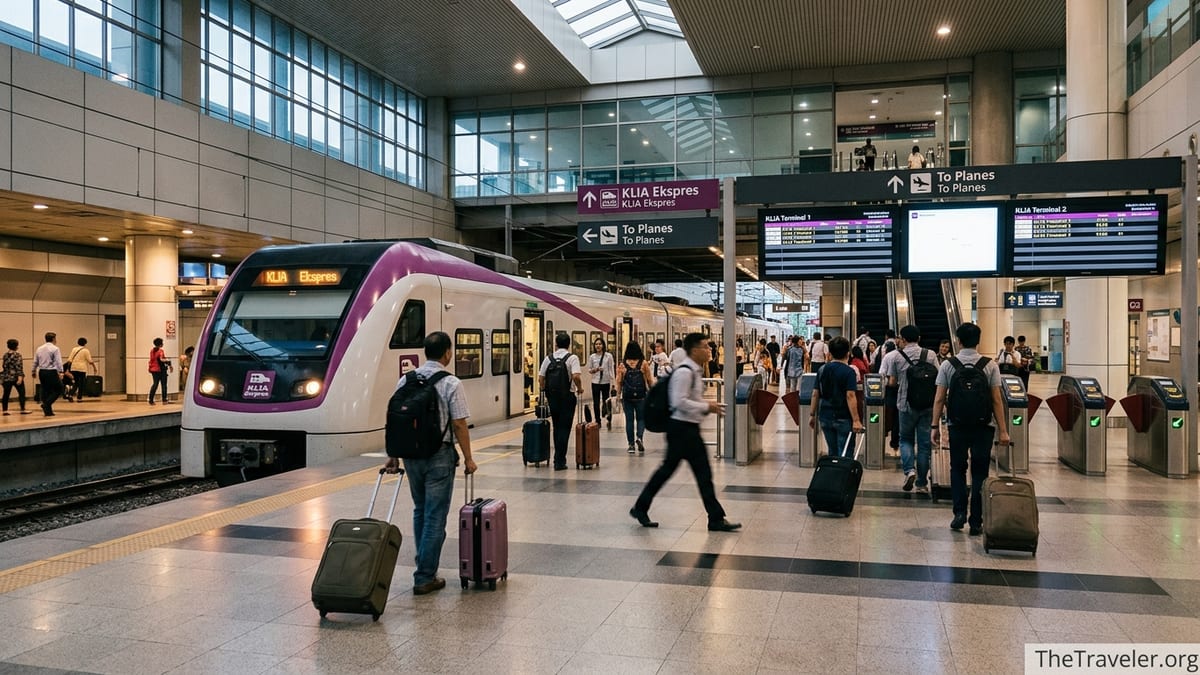
KLIA Ekspres in a nutshell: what the service actually is
KLIA Ekspres is the dedicated airport rail link that connects Kuala Lumpur International Airport to the city’s main rail hub at KL Sentral. Trains run between KLIA Terminal 2 (often still called klia2), KLIA Terminal 1 and KL Sentral on modern electric sets with luggage racks, air conditioning and onboard Wi Fi. The journey time between KL Sentral and KLIA Terminal 1 is advertised at around 28 minutes, and a full run between KL Sentral and Terminal 2 usually takes just under 35 minutes, including the short shuttle segment between the two airport terminals.
Express Rail Link, the operator, also runs a separate service called KLIA Transit that stops at intermediate stations like Putrajaya & Cyberjaya. At various times, especially after the pandemic, both services have been combined so that all trains stop at all stations. At the time of writing in July 2026, KLIA Ekspres is again marketed as the nonstop city to airport option, but travelers should always check the service status and timetable on arrival because KLIA Ekspres and KLIA Transit occasionally share rolling stock and patterns during disruptions or peak events.
For a newly arrived visitor, the biggest advantages of KLIA Ekspres are predictability and separation from road traffic. On a typical weekday afternoon it is common for a Grab car to take 50 minutes to more than an hour to reach central Kuala Lumpur from either terminal, while the train time is fixed. For business travelers heading to offices around KL Sentral, Brickfields, Bangsar or the KLCC area, that reliability is often more valuable than saving a few ringgit on a slower transfer.
Terminals, stations and how to find the platforms
Kuala Lumpur International Airport consists of two main passenger terminals: Terminal 1, which handles most full service and long haul carriers, and Terminal 2, which is heavily used by AirAsia and other low cost airlines. Both terminals have their own KLIA Ekspres / KLIA Transit station, known collectively as KLIA T1 ERL station and KLIA T2 ERL station. At both terminals, the train station is inside the main terminal footprint, so you do not need to go outside or take a shuttle bus.
At KLIA Terminal 1, the ERL station is located on Level 1 of the main terminal building, beneath the Arrival and Departure halls. From international arrivals, you follow the “Trains” and “KLIA Ekspres” signs down the escalators and lifts; the walk typically takes 5 to 8 minutes depending on your gate. The platforms are within the paid area; you will pass ticket counters and ticket machines in the concourse just before the automatic gates.
At KLIA Terminal 2, the ERL station sits at the gateway transport hub under the mall area. From the AirAsia arrival hall, you follow the purple KLIA Ekspres icon through a series of walkways and escalators to Level 1; allow at least 7 to 10 minutes from the baggage claim exit. The station layout is similar, with ticket machines, a ticket counter, and then a set of fare gates leading to an island platform. Both KLIA Ekspres and KLIA Transit use the same tracks here, so you must pay attention to the overhead screens and announcements to ensure you board the correct service.
At KL Sentral, the KLIA Ekspres station is at the western side of the complex and is branded as the KL City Air Terminal (KL CAT). It has its own dedicated departure hall, separate from the KTM Komuter, LRT, MRT and monorail concourses. When you arrive by KLIA Ekspres into KL Sentral, you emerge directly into this hall. If you need to connect to the Kelana Jaya LRT line, it is a short indoor walk using escalators and overhead signs; allow about 5 to 10 minutes to reach the LRT platforms with luggage.
Tickets, fares and how to get the best price
KLIA Ekspres pricing is straightforward but there are a few tricks that can save you money. A standard one way adult ticket between KL Sentral and either KLIA Terminal 1 or Terminal 2 is typically priced around RM55, with children between 6 and 15 paying about half. The operator has gradually moved toward a fully cashless system, and from mid 2024 ticket counters at KL Sentral and the airports no longer accept cash payments. Most travelers now buy tickets using credit or debit cards, Malaysian bank cards, or popular mobile wallets at the staffed counters or the purple ticket vending machines.
The easiest way to save is to purchase your ticket online via the official website or mobile app, which usually offers about a 10 percent discount off the normal adult fare. For example, if the published counter fare is RM55, an advance online purchase might price at roughly RM49 to RM50 depending on seasonal promotions. These app or web tickets are issued as QR codes which you simply scan at the gate. The same QR is used at both entry and exit, so keep it accessible even after boarding.
There are also bundled products aimed at tourists, such as a KL TravelPass that combines a KLIA Ekspres trip with days of unlimited LRT, MRT and monorail travel in Kuala Lumpur. For a short three day visit where you plan to use public transport extensively, this can work out cheaper than buying a separate airport transfer and individual rail tickets. Occasionally airlines and programs such as Enrich by Malaysia Airlines offer KLIA Ekspres e vouchers or miles redemption promotions; if you are a frequent flyer, it is worth checking your airline’s offers page before you travel.
Children under 6 usually travel free when accompanied by an adult but still require a ticket if they need to pass the gates independently. Seniors and Malaysian students may be eligible for concession fares when buying tickets with local ID. If you are arriving late at night or unsure of your plans, you can safely buy a ticket on arrival rather than prebooking; trains are rarely full to the point of turning passengers away, and dynamic pricing is not used in the same way as airlines or ride hailing apps.
Timetable, frequency and late night services
KLIA Ekspres operates from early morning until just after midnight, with small variations between weekdays and weekends. The first trains from KL Sentral to KLIA Terminal 2 typically depart around 5:00 in the morning, reaching Terminal 1 a few minutes later and arriving at Terminal 2 before 5:40. In the opposite direction, the first departures from KLIA Terminal 2 usually leave shortly before 5:00, giving early morning flight crews and passengers a reliable way into the city.
In the main part of the day, trains generally run every 15 to 20 minutes. For instance, mid morning departures from KL Sentral often leave at :00, :15, :30 and :45 past the hour, with some small variations depending on whether KLIA Transit services are operating separately or on a combined schedule. When services are combined, which has happened during certain periods since 2022, journey times may be a few minutes longer because trains stop at intermediate stations, but overall headways can remain similar.
For late arrivals, the last trains are the critical detail. At the time of writing, the last KLIA Ekspres departures from KLIA Terminal 2 toward KL Sentral are a little after midnight, commonly advertised around 00:05 to 00:10. There have also been announcements that from 23:00 onward, trains stop at all ERL stations with service extended to around 1:00 in the morning from both terminals, but such arrangements can change during timetable updates. If your inbound flight is due after 23:00, you should recheck the official schedule shortly before travel and consider a backup plan like a Grab or taxi in case of delays at immigration.
As a working example, imagine landing at KLIA Terminal 2 at 22:15 on a Friday. If your bags arrive quickly and immigration queues are light, you could realistically reach the KLIA Ekspres station by 22:45 and catch a departure before 23:00, arriving at KL Sentral around 23:30. If your flight lands at 23:30 and the last reliable train toward the city is advertised for just after midnight, any delay at passport control could push you onto the road instead, so in that scenario pre booking an airport pickup or budgeting for a taxi is sensible.
Luggage, airport style comfort and onboard experience
The KLIA Ekspres trains are designed specifically for air travelers, so luggage handling is usually straightforward. Each carriage includes multiple luggage racks near the doors as well as overhead shelves above the seats, and the aisles are wide enough to roll standard suitcases. On a full service between KL Sentral and the terminals you will see everything from cabin trolleys to large checked bags. Trolleys are available at KL Sentral and both airport stations right up to the fare gates, making it easier to move heavy cases from baggage reclaim to the platform.
There is no strict weight limit for luggage on the train, but items must be manageable by the passenger and safe for others on board. Very large sports equipment and oversize boxes are accepted on a case by case basis, and certain items like surfboards can require check in at the airport instead of being carried on board. If in doubt, staff at the KLIA Ekspres help desks can advise before you pass through the gates. The general rule is that if your baggage would be accepted on a commercial flight without special freight handling, it will usually fit comfortably on the KLIA Ekspres.
On board, the environment is closer to a modern intercity train than a metro. Seats are arranged in a 2 2 configuration with a mix of forward and backward facing rows, and the ride is quiet and smooth. Air conditioning is strong, which is welcome after Kuala Lumpur’s humidity but can feel cool if you are in shorts and a T shirt. There are power sockets in some cars, enabling you to charge phones or laptops during the journey, and Wi Fi is offered but can vary in reliability depending on passenger load and signal.
Food and drink are not sold on board, so it is worth buying water or a coffee in the terminal before boarding. Many passengers treat the KLIA Ekspres as a decompression space after a long haul flight, catching up on messages or simply watching the palm oil plantations and suburbs slide by. Compared with a busy airport bus, it feels calm and spacious, which is one of the reasons families and older travelers often choose it even if a taxi might work out slightly cheaper for a group.
KL Sentral tips: navigating connections and city check in
KL Sentral can be confusing on a first visit because it is both a railway station and a large commercial complex. The KLIA Ekspres platforms are in the KL City Air Terminal section, which feels like a small airport terminal inside the station. When you arrive from the airport, you exit the train, follow the crowd up the escalators and pass through the automatic fare gates. Immediately in front of you is the KLIA Ekspres departure hall with ticket counters, airline check in counters and digital displays.
For onward travel by rail, you follow signs to either the LRT Kelana Jaya line, MRT Putrajaya line, MRT Kajang line, KTM Komuter or the KL Monorail. For example, to reach KLCC and the Petronas Towers you would usually take the Kelana Jaya LRT line from KL Sentral to KLCC station, which is about a 20 minute indoor journey including the walk. If your hotel is in Bukit Bintang, you might choose the MRT Kajang line to Bukit Bintang or walk via the link bridge to the monorail platform for an alternative route.
One of KLIA Ekspres’s distinctive features is the city check in facility at KL Sentral. As of late 2025, passengers flying with Malaysia Airlines and Batik Air can check in for their flights and drop baggage at the KL CAT counters several hours before departure, then ride the KLIA Ekspres to Terminal 1 where bags will be transferred to the aircraft. This is particularly convenient if you have a late night flight but need to check out of a city hotel at midday. You can leave your bags at KL Sentral, spend the afternoon in nearby Brickfields or Mid Valley, and return to the station 30 to 40 minutes before your chosen train.
In addition to check in, KL Sentral offers practical services for transit passengers: left luggage counters, baggage wrapping, money changers, ATMs, telecoms kiosks for local SIM cards, and numerous cafés and fast food outlets. If you are connecting from an intercity train from Penang or Johor Bahru to a flight out of KLIA, it is realistic to schedule a 60 to 90 minute buffer to allow time for walking between platforms, checking in your bag at KL CAT if your airline supports it, and catching a KLIA Ekspres departure without stress.
KLIA Ekspres vs taxi or Grab: when the train is worth the price
Whether KLIA Ekspres is worth its fare depends heavily on your arrival time, group size and final destination in Kuala Lumpur. For a solo traveler arriving around 17:00 on a weekday, the comparison is often between paying about RM49 to RM55 for a 30 minute train ride to KL Sentral plus perhaps RM10 to RM20 for an LRT or short Grab ride to a central hotel, versus paying around RM75 to RM120 for a Grab car directly from Terminal 1 or 2 to the hotel, with journey times that can vary from 50 minutes to well over an hour in traffic.
In that scenario, KLIA Ekspres usually wins on both time and cost. A realistic door to door travel time from KLIA Terminal 1 to a hotel near KLCC using KLIA Ekspres plus LRT is about 55 minutes: 10 minutes to walk to the station, 30 minutes on the train, 10 minutes to transfer to the LRT and one or two stops to KLCC. The same trip by Grab at peak hour can easily push past 75 minutes, with the cost only slightly lower for a solo traveler if there is surge pricing.
For couples, families or groups of three or four with large luggage, the calculation changes. Four KLIA Ekspres tickets at standard counter prices can reach RM220 for a single journey to KL Sentral. By contrast, a large Grab or airport taxi for four people with bags into central Kuala Lumpur often falls between RM100 and RM160 depending on time and traffic. For a family staying in Bukit Bintang or around KLCC, a direct car can be both cheaper and more convenient, avoiding the need to haul suitcases across multiple sets of escalators and train platforms.
Late at night and very early in the morning, the road can be quiet enough that taxis reach the city in 45 minutes or less, further eroding the train’s time advantage. If you land at 00:30 and the next train is not until 1:00, a taxi waiting outside arrivals can still put you into a city hotel before 2:00, whereas waiting in the terminal for the last train plus transfers at KL Sentral may take just as long. In those fringe hours, KLIA Ekspres is most compelling for solo business travelers or people heading directly to accommodation near KL Sentral itself.
The Takeaway
KLIA Ekspres is one of Southeast Asia’s more efficient airport rail links, offering a clean, fast and generally reliable connection between both KLIA terminals and Kuala Lumpur’s main transport hub. For solo travelers and pairs arriving in daytime or early evening, it usually represents good value, especially when you buy discounted QR tickets online and combine the ride with KL Sentral’s extensive rail connections. The ability to check in for selected airlines and drop bags at the KL City Air Terminal adds a layer of convenience that most airport trains around the region do not yet match.
Yet KLIA Ekspres is not always the obvious choice. Families and small groups may find that a Grab car or taxi is cheaper door to door, particularly if they are staying in areas that require multiple changes from KL Sentral. Very late arrivals also need to pay close attention to last train times and have a backup road transfer plan. The key is to weigh the fixed 30 to 35 minute rail journey against your arrival time, luggage, group size and exact destination.
If you understand the layout of KLIA Terminal 1 and 2 stations, how to navigate KL Sentral and which ticket suits your stay, the train becomes an easy part of your Kuala Lumpur arrival ritual rather than a source of stress. Use it when its strengths align with your plans: predictable timing, air conditioned comfort, and a direct link into the city’s rail network. When they do, KLIA Ekspres can make touching down in Malaysia feel remarkably smooth.
FAQ
Q1. How long does the KLIA Ekspres take from KL Sentral to KLIA?
The typical journey time from KL Sentral to KLIA Terminal 1 is around 28 minutes, and to KLIA Terminal 2 just under 35 minutes including the short segment between terminals.
Q2. What is the first and last KLIA Ekspres train each day?
First trains usually leave around 5:00 in the morning from both KL Sentral and KLIA Terminal 2, while the last services typically depart a little after midnight, but you should always confirm the exact times close to your travel date.
Q3. Can I buy KLIA Ekspres tickets with cash at the station?
No, the service is moving to a fully cashless system, so you pay at counters or machines using cards or e wallets, or buy QR code tickets online in advance.
Q4. Is there a discount for buying KLIA Ekspres tickets online?
Yes, tickets purchased via the official website or mobile app usually include a modest discount of roughly 10 percent compared with standard counter fares, subject to current promotions.
Q5. Do children travel free on KLIA Ekspres?
Children under 6 years old generally travel free when accompanied by a paying adult, while children aged 6 to 15 pay a reduced child fare; if a young child needs their own gate access you should request a free child ticket.
Q6. What is the difference between KLIA Ekspres and KLIA Transit?
KLIA Ekspres runs nonstop between KL Sentral and the airport terminals, while KLIA Transit stops at intermediate stations such as Putrajaya & Cyberjaya, so it takes slightly longer but serves more local destinations.
Q7. Which airlines offer city check in at KL Sentral?
At the time of writing, Malaysia Airlines and Batik Air accept check in and baggage drop at the KL City Air Terminal in KL Sentral for flights departing from KLIA Terminal 1, though participating airlines can change over time.
Q8. Is KLIA Ekspres good value compared with a Grab or taxi?
For solo travelers and couples, especially during daytime traffic, KLIA Ekspres is often faster and competitively priced, while for families or groups of three or four a Grab or taxi can be cheaper and more convenient door to door.
Q9. Can I take large luggage or sports equipment on KLIA Ekspres?
Standard checked suitcases and cabin bags are easily accommodated on the train, but very large or unusual items such as surfboards need to comply with safety rules and may have to be checked at the airport rather than carried on.
Q10. How do I connect from KLIA Ekspres to Bukit Bintang or KLCC?
From KLIA Ekspres at KL Sentral, follow signs to the LRT and MRT; for KLCC take the Kelana Jaya LRT line to KLCC station, and for Bukit Bintang take the MRT Kajang line to Bukit Bintang station or use the monorail from the linked monorail station.