


For many travelers landing at Kuala Lumpur International Airport, the first big decision is simple: train, taxi, or bus into the city. If you are watching your budget, the airport bus to KL Sentral is often the sweet spot between saving money and still arriving in reasonable comfort. This guide walks you through exactly how the KLIA and KLIA2 buses work, what they cost in 2026, and when they make more sense than the faster but pricier airport train.
Get the latest updates straight to your inbox!
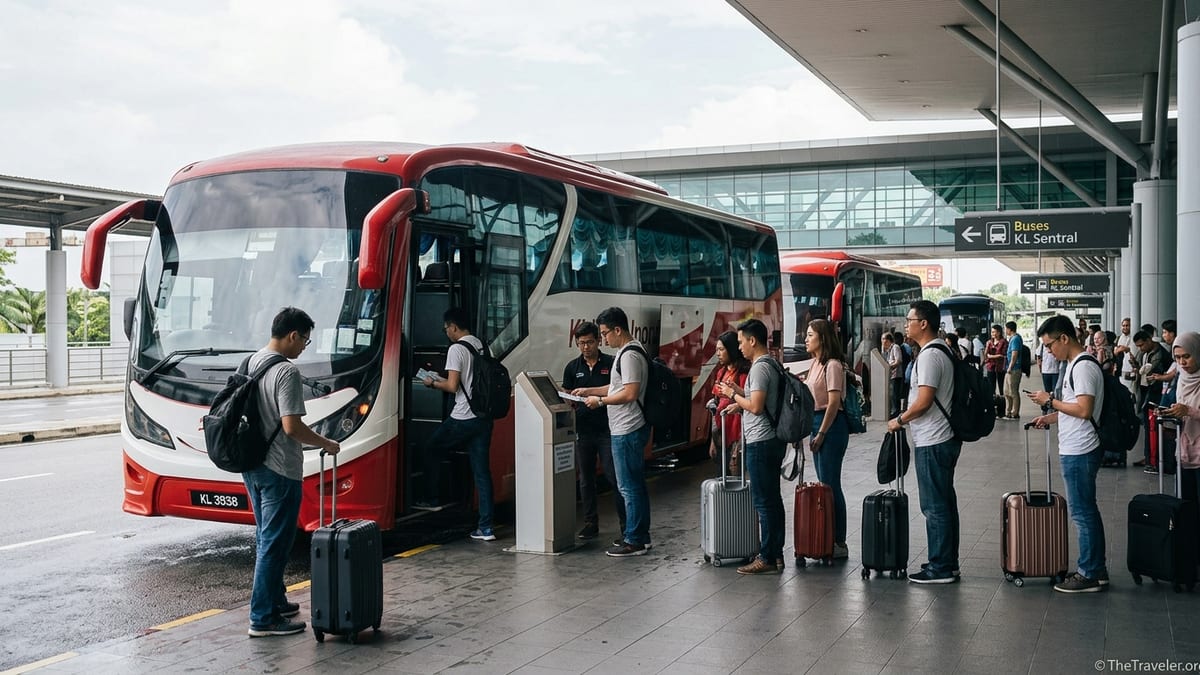
Understanding Your Airport Bus Options
Both main terminals at Kuala Lumpur International Airport, KLIA Terminal 1 and KLIA Terminal 2, have direct bus services to KL Sentral, the city’s main rail and transport hub. Several operators run these airport coaches on the same basic route, including familiar names such as Airport Coach, SkyBus and Aerobus. Services and branding may change over time, but the core concept is consistent: an air conditioned coach shuttling passengers between the airport and KL Sentral at a flat per person fare.
In 2026, typical one way fares on these buses sit in the region of about RM12 to RM18 per adult, depending on operator, time of purchase and any online promotions. By comparison, the non stop KLIA Ekspres train charges about RM55 one way for an adult ticket between KLIA or KLIA2 and KL Sentral, based on current official fares. That large price gap is why solo backpackers, students and long stay visitors so often gravitate to the bus instead of the train.
For most travelers, timing rather than route is the main difference between the bus operators. Coaches usually follow the main highway straight to KL Sentral with no intermediate city stops, and travel times are broadly similar in light traffic. What matters more is aligning your arrival time with a scheduled departure and understanding how late services run if your flight arrives close to midnight.
Because brand names and contracts can shift, especially at KLIA2 where low cost carriers dominate, it is worth checking the latest names and timetables posted inside the terminal when you land. The good news is that airport bus counters are grouped together, signposted as buses to KL Sentral, and you rarely have to walk more than a few minutes from Arrivals to find them.
Where To Find The Buses At KLIA And KLIA2
At KLIA Terminal 1, airport coaches depart from the ground level bus bays below the main arrivals hall. After clearing immigration and customs, you follow signs for "Bus/Taxi" or "Ground Transport" down to Level 1. Ticket counters for the KL Sentral bus are usually positioned near the escalators or entrances to the transport level. Staff are used to confused long haul passengers, so it is perfectly normal to show your hotel booking on your phone and simply say "bus to KL Sentral".
From KLIA2, which serves carriers like AirAsia and other low cost airlines, the process is similar but involves walking through the Gateway@KLIA2 mall. Once you exit the secure arrivals area, follow the clearly marked signs for "Bus" and "Transportation Hub" down to Level 1 of the mall complex. Here, various bus company counters sit side by side, selling tickets to destinations including KL Sentral, Genting Highlands and several regional cities. KL Sentral tickets are among the most prominently advertised, often with large banners showing the fare.
The actual bus bays at KLIA2 are just outside the ticketing area, so you can easily buy a ticket and step straight onto the waiting coach if one is loading. If you miss a departure, staff will direct you to the correct bay and tell you the time of the next bus. As a rule of thumb, you should expect airport buses between the terminals and KL Sentral to run roughly every 20 to 40 minutes in the daytime and evening, although very late night frequencies can drop.
New visitors sometimes worry about picking the "wrong" operator, but in practice the experience is comparable across the main companies. Seats are usually in a standard 2+2 coach layout, bags go in the underfloor luggage hold, and air conditioning is set on the cool side. If you have already been on the road for many hours, treat this sector as a chance to sit back, cool down and adjust before plunging into the bustle around KL Sentral.
Tickets, Payment And Realistic 2026 Prices
In 2026, you should budget roughly RM12 to RM18 per person for a one way bus ticket from either KLIA or KLIA2 to KL Sentral. Some operators quote a single flat fare such as RM15, while others offer a slight discount for online bookings or return tickets. For example, travelers in recent months report paying around RM15 from KLIA2 to KL Sentral when buying at the counter, and similar amounts from KLIA Terminal 1. These real world prices line up closely with current transport comparison sites and local advice from Kuala Lumpur based travelers.
Tickets can be purchased in several ways. The most straightforward is to buy on the spot at the airport bus counter using cash or a card. Malaysia’s touchless payments are widely used, so many counters accept major credit cards and sometimes contactless local methods. If you prefer to prep ahead, some companies sell tickets through their own mobile apps or via airline add ons when you book your flight, occasionally bundling a small discount compared with walk up prices.
Return tickets may offer modest savings versus two separate one way fares, but consider your level of certainty. If your departure date or terminal might change, or you are not sure whether you will leave from KL Sentral, paying slightly more for a one way ticket keeps options open. Unlike the KLIA Ekspres train, which sells fixed return products valid for limited time windows, bus tickets are usually tied to a specific departure or same day use.
One practical detail that catches some travelers by surprise is local currency. While a growing number of counters accept cards, there can be occasional outages or queues at card machines. If you are landing in the evening, it is sensible to withdraw or exchange at least RM50 in the arrivals hall before heading to the transport level so that you can easily pay for bus fare, a bottle of water and perhaps a local SIM card without scrambling for an ATM later.
Luggage, Comfort And Travel Time
Airport coaches on the KLIA and KLIA2 to KL Sentral route are designed to handle typical airline luggage, so bringing a large suitcase is not a problem. Passengers usually store big bags in the underfloor hold before boarding, either placing them there themselves or showing them to the driver, who may tag heavy pieces. Cabin bags, backpacks and smaller roller cases can be taken on board and stored in the overhead racks or on your lap, depending on size and how full the coach is.
In terms of comfort, do not expect luxury, but do expect a standard modern coach with reclining seats, curtains and fairly powerful air conditioning. Most buses are not equipped with onboard toilets, so use airport facilities before you board. The ride into Kuala Lumpur uses major highways, so suspension is generally smooth, but potholes and speed bumps near KL Sentral can cause the occasional jolt. Travelers prone to motion sickness may prefer to sit closer to the front of the coach where movement feels less intense.
Travel time between KLIA or KLIA2 and KL Sentral by bus typically takes around 50 to 70 minutes in light to moderate traffic. In the very early morning, travelers occasionally report making the journey in about 45 minutes. During weekday rush hour or after heavy rain, however, it is prudent to allow at least 90 minutes, as congestion near the city can slow the final stretch considerably. By comparison, the KLIA Ekspres train does the same route non stop in about 30 minutes, which illustrates the time versus money trade off.
If you are arriving after a long haul overnight flight, the additional half hour on the bus versus the train may not matter much, especially if you want to stretch out and nap rather than sit upright on a modern high speed train seat. On the other hand, if you are racing to meet friends for dinner in Bukit Bintang or to catch a domestic connection from another city station, the train’s shorter travel time can justify the higher fare.
Late Night And Early Morning Arrivals
Late arrivals are where the airport bus can either be a lifesaver or a source of stress, depending on your timing. KLIA Ekspres trains generally run from early morning to around midnight, so passengers on flights landing well after midnight often find that the train is no longer an option by the time they clear immigration and collect checked bags. Buses, on the other hand, often have first departures around 3:00 in the morning from KL Sentral to the airport and run until after midnight in the airport to city direction, but exact hours vary by operator and day.
If your scheduled landing time is around 22:30 to 23:30, there is a good chance you will still make either a late train or one of the final buses into the city, provided your flight is not significantly delayed. In these borderline cases, it can help to check the current day’s timetable in advance, but always remember that your actual arrival at the bus bay will depend on immigration queues, baggage delivery and any secondary checks.
For flights arriving after midnight, such as some low cost services reaching KLIA2 at 1:00 or 2:00, you should mentally treat the bus as your main public transport option and have a backup of using an app based ride service like Grab if the last coach of the night has already departed. In 2026, typical late night Grab fares into central Kuala Lumpur often range around RM80 or more for a standard car from the airport, though exact prices swing with demand and tolls. For two or three people traveling together, that shared fare can end up costing roughly the same per person as the train would have.
On the outbound side, travelers catching early morning flights commonly ask if they can rely on the first bus from KL Sentral to reach the airport in time. As a rough guide, first buses around 3:00 or 4:00 give enough margin for flights after 7:00, assuming traffic is light. For departures earlier than that, a pre booked taxi or ride hailing car is safer. When in doubt, reverse engineer your schedule by starting from the airline’s recommended check in time, adding an hour for the bus, then fitting that against the first available departure of your chosen operator.
When The Bus Is Better Than The Train
The KLIA Ekspres train is faster and more predictable than the bus, but that does not make it automatically the best choice in every situation. From a budget traveler’s perspective, the bus wins decisively on price, especially for solo travelers or pairs who do not want to spend a significant portion of their daily budget on a single transfer. Saving roughly RM40 per person by choosing the bus over the train can pay for a decent local meal, a SIM card top up, or part of a night in a guesthouse.
The bus also becomes more attractive when your final destination near KL Sentral requires further transfers anyway. For example, if you are staying around Brickfields, the Little India district that surrounds KL Sentral, you might only need a five to ten minute walk from the final bus stop to your hotel. In such a case, the time advantage of the train largely disappears, because both modes drop you at more or less the same point in the transport hub.
Another scenario where the bus can be better is when you value minimizing transfers and walking with luggage over pure speed. Even though the train is quick, navigating the ticketing machines, gates and platforms at KL Sentral with heavy bags can be tiring, especially when connecting onward to the LRT, MRT or monorail. By contrast, taking the bus straight to KL Sentral and then using a ride hailing car for the final short hop to areas like Bukit Bintang or Chinatown might involve more road time but less physical strain.
Finally, consider the psychological side. For some travelers, especially those who are nervous about unfamiliar metro systems or traveling with small children, the simplicity of walking out of arrivals, buying a paper ticket from a person at a counter and being guided directly to a bus feels less stressful than figuring out train platforms and interchange maps. In a city where ride hailing, trains and buses are all viable, picking the mode that lets you arrive feeling calm can be just as important as shaving ten minutes off your journey.
Comparing Bus, Train And Ride Hailing On Cost
To see the differences in practical terms, imagine you are a solo traveler landing at KLIA2 on a mid afternoon AirAsia flight, heading to a guesthouse in Chinatown near Pasar Seni. Option one is to take the KLIA Ekspres train for about RM55 to KL Sentral, then transfer to the LRT or MRT for a couple of stops, costing perhaps another RM3, or grab a short Grab ride for RM10 to RM20 depending on traffic. Your total ends up around RM60 to RM75.
Option two is to ride the airport bus for around RM15 to KL Sentral and then do the same short onward transfer. Even allowing RM20 for a Grab to Chinatown, your door to door cost is roughly RM35, almost half of the train plus car combination. The trade off is an extra 20 to 30 minutes on the road, possibly sitting in congestion as you approach the city center, but your wallet will feel the difference.
For a couple or small group, the picture shifts slightly. Two people taking the bus might pay around RM30 combined, while the train would cost about RM110. At that point, a standard Grab or taxi from KLIA or KLIA2 to a central hotel for roughly RM80 to RM100 in typical conditions can start to look competitive, especially when you factor in not having to change modes in KL Sentral. Families with children and multiple bags often prefer this door to door convenience even if it is marginally more expensive than the combination of bus and onward transit.
One thing to keep in mind is that all of these prices can move with time, promotions and fuel costs, so treat the numbers as realistic ranges rather than locked in tariffs. The key takeaway is that the airport bus usually sits at the bottom of the cost scale, the KLIA Ekspres near the top for public transport, and ride hailing or taxis somewhere in between or above depending on distance and time of day.
The Takeaway
Using the airport bus from KLIA or KLIA2 to KL Sentral is one of the simplest ways to keep your Kuala Lumpur arrival budget friendly without sacrificing too much comfort. Coaches are frequent by regional standards, generally reliable, and specifically set up to handle typical airport luggage. For many visitors, especially solo travelers and backpackers, the difference between a RM15 bus ticket and a RM55 train fare adds up quickly over the course of a trip.
At the same time, the bus is not the best choice in every scenario. Travelers on tight schedules, those landing very late at night, or anyone who values absolute predictability in travel times may decide that the KLIA Ekspres or a pre booked car is worth the extra cost. The trick is to weigh your arrival time, luggage load, final destination and personal comfort level, and then pick the mode that fits your priorities rather than defaulting to whichever option has the biggest ads at the airport.
If you remember only a few rules, let them be these: buses are cheapest but subject to traffic, the train is fastest but pricier, and ride hailing offers door to door comfort at a mid to high price. With that framework and a rough idea of current 2026 fares, you can land at Kuala Lumpur International Airport confident that you will make a smart, informed choice about how to reach the city.
FAQ
Q1. How much does the airport bus from KLIA or KLIA2 to KL Sentral cost?
The one way fare in 2026 is typically around RM12 to RM18 per adult, depending on operator and whether you buy online or at the airport counter.
Q2. How long does the bus from the airport to KL Sentral take?
In light traffic, the journey usually takes about 50 to 70 minutes. During rush hour or heavy rain, allow at least 90 minutes to be safe.
Q3. Where do I catch the bus at KLIA Terminal 1?
At KLIA T1, follow signs from Arrivals to the bus and taxi area on Level 1. Ticket counters and bus bays for KL Sentral are located together at the ground transport level.
Q4. Where do I catch the bus at KLIA2?
At KLIA2, walk through the Gateway@KLIA2 mall and follow signs for the Transportation Hub on Level 1. Buy your ticket at one of the bus counters marked for KL Sentral, then board at the adjacent bays.
Q5. Do the airport buses run late at night?
Buses generally run until around midnight or slightly later from the airport to KL Sentral, but exact times vary by operator, day of week and terminal. Very late night arrivals should have a backup plan such as a ride hailing car.
Q6. Is the bus safe and suitable if I have a lot of luggage?
Yes. Airport coaches have underfloor luggage holds for large suitcases and space inside for cabin bags. They are widely used by families, backpackers and business travelers alike.
Q7. When is it better to take the train instead of the bus?
The KLIA Ekspres train is better if you are in a hurry, want predictable travel time of about 30 minutes, or are catching a tight onward connection and can justify the higher fare.
Q8. Can I pay for the bus with a credit card?
Many airport bus counters now accept major credit and debit cards, but availability can vary and occasional outages happen, so it is wise to have some Malaysian ringgit in cash as a backup.
Q9. Is the bus or Grab cheaper from the airport to the city?
For solo travelers, the bus is usually cheaper than Grab by a comfortable margin. For two or more people, dividing a typical Grab fare can narrow the gap or sometimes make a car competitive, especially for hotels far from KL Sentral.
Q10. Can I buy bus tickets in advance online?
Some operators sell tickets via their websites or apps, and airlines occasionally bundle bus transfers with flight bookings. Buying in advance can offer minor discounts, but walk up tickets at the airport are easy to get for most flights.