


More news on this day
Jazeera Airways is counting the cost of the unprecedented shutdown at Kuwait International Airport, reporting sharp first quarter losses and widespread schedule disruption as the closure ripples through regional travel networks.
Get the latest news straight to your inbox!
Extended Airport Closure Hits Revenue and Capacity
Publicly available financial disclosures for the first quarter of 2026 show that Jazeera Airways’ operating revenue fell by nearly 16 percent year on year, dropping to about 45 million Kuwaiti dinars as the Kuwait hub went offline at the end of February. The airline reported that the total number of sectors it operated in the quarter declined by more than a quarter, while overall seat capacity shrank by a similar margin.
Traffic figures indicate that passenger numbers slid by roughly 26 percent to just over 925,000 travelers in the period, highlighting the steep impact of the airport shutdown on the carrier’s core point to point model. The company characterized the first two months of the year as comparatively strong, with stable demand across its network before the disruption began, underscoring how quickly conditions reversed once airspace restrictions were imposed.
According to market commentary and airline statements, Kuwait International Airport has been closed or heavily restricted since 28 February following regional security developments and drone strikes, making it one of the longest airport suspensions in the Middle East in recent years. The prolonged halt has left domestic carriers, including Jazeera Airways, managing a rapid transition from a single hub strategy to a fragmented operation spread across neighboring states.
Analysts note that the loss of through traffic and ancillary revenues from Jazeera’s dedicated Terminal 5 facility in Kuwait has added to the financial strain. The terminal, which normally supports high aircraft and passenger throughput for the low cost carrier, operated at a fraction of its usual utilization for much of March and April, pushing fixed infrastructure costs onto a smaller revenue base.
Rerouted Operations Create Travel Havoc
To maintain at least limited connectivity, Jazeera Airways has progressively shifted operations to a series of temporary hubs across the region. Company updates and regional travel coverage indicate the airline has operated from five key airports, including Qaisumah and Dammam in Saudi Arabia, as well as Jeddah, Medina and Cairo, in an effort to keep flights running while Kuwait’s main gateway remains constrained.
Operational data released by the airline show that more than 1,500 flights were mounted during the disruption period using this makeshift network. The carrier reports that nearly 200,000 passengers were transported via these alternative routings, supported by around 500 staff and a subfleet of 14 aircraft that were repositioned away from Kuwait. While this helped preserve a degree of continuity, it also created complex itineraries, longer journey times and irregular schedules for many travelers.
Regional travel media and passenger accounts describe a patchwork of delays, short notice cancellations and rebookings as the airline adjusted frequencies in line with changing airspace permissions and airport slots. In several cases, travelers reported that Jazeera services originally scheduled to depart Kuwait were moved to Saudi Arabian departure points, requiring cross border coach transfers that could take several hours each way.
Industry observers point out that such detours have been particularly disruptive for budget conscious passengers who chose Jazeera Airways for direct, no frills services from Kuwait. With the core hub out of action, many journeys have involved extra connections, overnight stays or extended ground transport segments, eroding both the cost and time advantages that low cost operations typically provide.
Stranded Passengers and Mounting Logistics Challenges
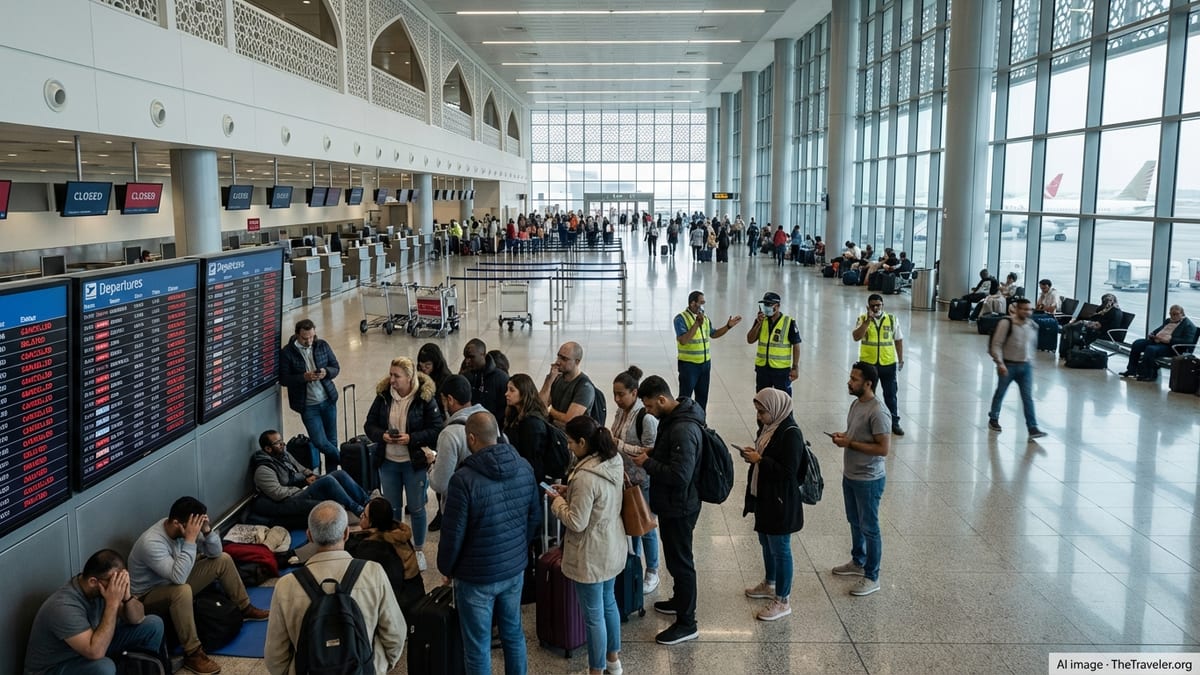
The rapid closure of Kuwait International Airport left airlines and passengers with limited warning, leading to an immediate backlog of stranded travelers across multiple countries. Reports on regional consumer forums show that some Jazeera Airways customers experienced cancellations just hours before scheduled departure times, while others received rebooking offers several days or even more than a week later.
Discussions on public platforms detail cases of families and workers stuck in transit points without clear onward options, particularly in airports where entry visas are restricted and travelers are limited to airside facilities. In some instances, passengers describe being informed that refunds would be processed as credit shells or future travel vouchers, adding financial uncertainty on top of disrupted plans.
The airline has emphasized, in public updates, the scale of the logistical exercise required to reposition aircraft, crews and ground staff to multiple temporary locations while handling tens of thousands of schedule changes. Operating a dispersed network from hubs in different jurisdictions, each with its own regulatory and operational constraints, has required significant coordination with local ground handlers and airport authorities.
Travel agents and tour operators in Kuwait and neighboring markets have also reported pressure as they attempt to re-accommodate clients, often at short notice and during peak school holiday booking windows. Some are directing passengers toward alternative carriers flying via more distant hubs in the Gulf and beyond, further fragmenting traditional traffic flows through Kuwait.
From Record Profits to Sudden Setback
The disruption at Kuwait International Airport comes on the heels of a period of exceptional financial performance for Jazeera Airways. Industry publications and company reporting show that the low cost carrier posted record full year profits in 2025, with net income more than doubling compared with 2024. The airline carried over five million passengers that year, maintaining one of the largest market shares at its home airport.
These strong results followed years of expansion that saw Jazeera build a network spanning the Middle East, South Asia, North Africa and parts of Europe, supported by a growing Airbus A320 family fleet and its dedicated Terminal 5 base in Kuwait. The carrier has framed this growth as validation of its low cost strategy in a region long dominated by full service network airlines.
The sudden closure of its main hub has therefore marked a sharp reversal in momentum, at least in the short term. While the airline’s recent earnings statements stress that it retains healthy liquidity and access to financing, the need to defer dividend decisions and absorb a double digit revenue decline in the first quarter indicates clear financial stress compared with the trajectory envisaged at the start of the year.
Analysts suggest that the episode highlights the vulnerability of single hub low cost carriers to concentrated infrastructure shocks in politically sensitive regions. Jazeera’s experience is being closely watched by investors and competitors as a test case in whether a highly centralized business model can adapt to repeated security driven disruptions that may persist for months rather than days.
Regional Aviation Faces Prolonged Uncertainty
The situation at Kuwait International Airport is unfolding against a wider backdrop of regional instability that has affected airspace across parts of the Gulf and beyond. Economic analysis of the ongoing conflict in and around Iran indicates that Middle Eastern airports, which handle a substantial share of global long haul traffic, have seen extensive closures and capacity reductions since early 2026.
Airlines ranging from large Gulf network carriers to smaller point to point operators are contending with rising insurance premiums, rerouting costs and weaker demand from cautious travelers. In this environment, Jazeera Airways’ losses and service disruption are being viewed as part of a broader shock to the regional aviation ecosystem rather than an isolated corporate setback.
For travelers, the immediate effect has been a sharp reduction in direct options to and from Kuwait, along with increased reliance on secondary airports and multi stop itineraries. Industry trackers report that some traffic has shifted toward alternative hubs perceived as more stable, including airports on the eastern Mediterranean and in South Asia, although these facilities lack the capacity to fully replicate Gulf connectivity.
Looking ahead, Jazeera Airways has begun phased restorations of service from Kuwait’s Terminal 5 as operating windows reopen, with flights currently concentrated in daytime hours and to a limited set of destinations. Aviation analysts expect a gradual ramp up in schedules if security conditions allow, but caution that demand recovery could lag supply as travelers and corporate clients reassess risk and flexibility in their travel planning.