


Remote, austere and quietly spectacular, Lake Inari in Finnish Lapland rewards travelers who venture north with a mix of wild nature, Sámi culture and unexpected comforts. Whether you come for a midnight sun cruise in July, a northern lights boat trip in September, or a frozen-lake adventure in February, Inari’s thousand islands and big skies feel a world away from southern Finland’s busier lakes. This guide focuses on the most useful on-the-ground information for visitors: the main attractions on and around Lake Inari, how to choose a boat trip, what to expect in each season, and the logistics that make a short Arctic getaway run smoothly.
Get the latest updates straight to your inbox!
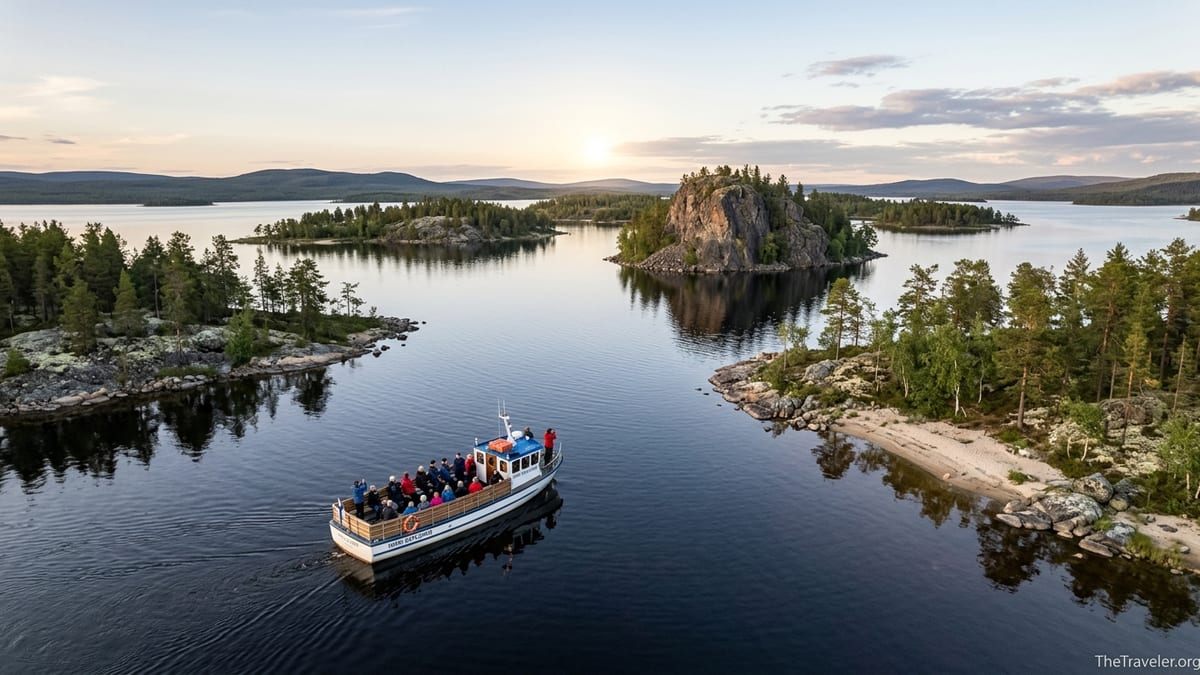
Why Lake Inari Belongs on Your Lapland Itinerary
Lake Inari sits far above the Arctic Circle in the municipality of Inari, roughly 300 kilometers north of Rovaniemi. It is Finland’s third-largest lake and the largest lake in Sápmi, the broader homeland of the Sámi people. Vast and sparsely developed, it stretches around 100 kilometers from south to north, with a maze of more than 3,000 islands scattered across its dark waters. You do not come here for resort buzz. You come for quiet horizons, low timberline forests, and skies that glow either with the midnight sun in summer or with auroras as nights return.
For most visitors, the practical base is Inari village on the lake’s southwestern shore. Here you find a small cluster of accommodation, cafes, the excellent Siida Sámi Museum and Nature Centre, and the piers used by local cruise companies. Many organized tours bundle a lake cruise with a visit to Siida, so you can spend the morning learning about Sámi history and then board an afternoon boat out to the islands. The scale of the lake means you get a wilderness feeling only a short ride from the harbor.
What makes Lake Inari different from other Finnish lakes is the combination of cultural depth and raw subarctic conditions. On a short cruise you might pass Ukko Island, once a sacred sacrificial site, before stopping at a pine-covered islet to brew coffee over an open fire. In winter, some companies tow warm cabins or sledges onto the frozen surface so you can sleep, fish or watch the northern lights with 12 meters of water beneath a meter of ice. Experiences like these are difficult to replicate elsewhere in Lapland.
Because tourism here is still relatively low-key, many services are locally owned and groups tend to be small. For independent travelers used to big Alpine resorts or Norwegian fjord ports, Lake Inari often feels pleasantly under-commercialized. That also means you should plan a bit further ahead, especially in the short peak windows of late December to early January and during the main summer holiday period in July.
Top Lake Inari Attractions and Scenic Highlights
The headline attraction on the water itself is the labyrinth of islands. One of the most visited is Ukko, also known as Ukonsaari or Ukonkivi, a steep rocky island that was historically used by the Sámi as a sacrificial site. Most scheduled sightseeing cruises from Inari village circle past Ukko so passengers can see its cliffs and hear stories about its spiritual significance. On some small-boat tours, the skipper will land on a nearby islet for a shore break, keeping Ukko itself undisturbed out of respect for local customs.
Another draw is the lake’s sense of wilderness at the edge of the Vätsäri Wilderness Area on the northeast shores. On longer day trips in summer, local guides may navigate through narrow channels between small forested islands, where you can spot common mergansers, terns or, with luck, an osprey hunting over the water. The scenery is not dramatic in a high-mountain sense, but the combination of wide horizons and low, rounded islands can be mesmerizing in the late-evening light of June and July.
On shore, the Siida Sámi Museum and Nature Centre in Inari village is an essential stop before or after any boat tour. Exhibits explain Sámi livelihoods, from reindeer herding to traditional fishing and handicrafts, and outline how people have used Lake Inari for travel and subsistence. Many visitors combine Siida with a short lake cruise in one day, either on a package offered by local operators or by buying a museum ticket and cruise ticket separately once in the village.
Beyond the museum and the harbor promenades, simple pleasures like walking along the lakeside paths near Holiday Village Inari or Hotel Inari, or finding a quiet rocky point to sit and watch the light shift over the water, often end up being trip highlights. In winter, the frozen lake becomes an attraction in itself, with maintained ice roads, marked snowmobile trails and dedicated northern lights viewing spots a short ride from the village.
Lake Inari Boat Trips: Cruise Types and What to Expect
Boat trips on Lake Inari range from one-hour sightseeing cruises to private full-day expeditions that include island picnics and fishing. In the summer season, which typically starts in early June and runs into September depending on weather, a classic option is the scheduled lake cruise departing from the main pier in Inari village. As an example, a common format is a 2 to 2.5 hour daytime cruise that passes key islands such as Ukko and offers commentary in English and sometimes other languages. Tickets are usually sold at the lakeside hotels and directly at the pier, with adult prices often a bit under 100 euros and child discounts available.
Travelers who prefer smaller groups often opt for private or semi-private speedboat tours. Local companies use sturdy aluminum or fiberglass boats that seat between 4 and 10 passengers. A private full-day Lake Inari tour that includes several island stops, a campfire lunch and time to fish might run in the ballpark of 180 to 250 euros per adult, with a minimum group size, for example three adults or a set minimum fee for two travelers. Because these tours are tailored, you can ask to focus on photography, birdlife, more remote parts of the lake, or simply a relaxed cruise with swimming time in August when the surface water is at its warmest, even if still refreshing by most standards.
In early autumn, once nights are dark again but the lake is still open, some operators switch to evening northern lights cruises. A typical outing might depart around 21:00 and last about two hours. You board a covered fishing boat or similar vessel, are given thermal overalls if needed, and head away from the village lights to anchor in a dark section of the lake. Even if the aurora does not appear, the experience of being on a black, mirror-like lake under a bright star field is memorable. Prices for these themed cruises tend to be higher than daytime sightseeing, often in the range of around 180 to 200 euros per adult including guiding, gear and hot drinks.
Families with children or travelers short on time might appreciate compact combination tours that add a lake segment onto a broader day out. Examples include transfers from nearby resort areas like Saariselkä or Ivalo that bundle a visit to Siida, a lunch stop in Inari village and a shorter cruise. These can be cost effective once you factor in the included transport from your hotel, particularly if you are not renting a car.
Fishing, Winter Adventures and Aurora Experiences on the Lake
Lake Inari is considered one of Lapland’s classic fishing destinations, with species such as trout, Arctic char, grayling and pike attracting both casual anglers and enthusiasts. Several local companies offer trolling or spinning trips on open water during summer, leaving from harbors like Inari or Nellim on the eastern side. A half-day trolling excursion might include all fishing gear, life jackets and guiding, with guests only needing to bring warm layers and a camera. While exact catch rates vary with conditions, operators will typically be upfront about what is realistic at different times of the season, from early summer post-ice-out to the peak of long, bright July evenings.
In winter, the focus shifts to ice fishing and snowmobile-assisted trips on the frozen lake. From roughly late December or January, once the ice is thick enough and local authorities deem routes safe, companies begin running guided excursions that use snowmobiles and sleds to reach sheltered islands or mid-lake spots. Participants are usually provided with thermal overalls, boots and mittens, then shown how to drill a hole, bait a hook and wait in a small group around the holes, often with a fire or heated kota hut nearby. Many tours last three to four hours and include hot drinks and snacks; some full-day options add a simple lunch cooked over the coals.
One of Lake Inari’s more unusual offerings is the chance to stay overnight in mobile aurora cabins set directly on the winter ice. These small, heated units, typically designed for two guests, are towed onto the lake surface from a base camp a couple of kilometers from Inari village. Inside, you generally find a double bed, clear roof or generous windows for sky viewing, a compact heater and a basic toilet. Guests have access to showers and sauna back at the base. This style of accommodation tends to be priced as a special experience rather than a budget option, but it allows you to sleep in silence, with no light pollution and a direct view of any auroral displays that happen to flare overhead.
Aurora-focused visitors also have the option of northern lights hunting trips that use the lake primarily as a dark-sky platform. Some tours depart from Ivalo or Saariselkä and include transport to the lakeshore, then continue by snowmobile-drawn sleigh or by foot to a private island with a laavu shelter or cabin. In these cases, the emphasis is less on the lake geography itself and more on maximizing your chances of a clear horizon and minimal artificial light. Because winter conditions can be extreme, with temperatures sometimes dropping below minus 20 Celsius, guided outings are usually recommended over independent lake excursions after dark.
When to Visit: Seasons, Weather and Lake Conditions
Picking the right season for Lake Inari is less about finding a shoulder period to avoid crowds and more about matching your expectations to what the lake is actually doing. From roughly June to early September, the water is open, and boat cruises, paddling and fishing dominate. In late June and early July the midnight sun means there is essentially no darkness, so evening cruises take place in soft, golden light rather than under stars. By August, nights become dark enough that you can sometimes see early auroras on clear evenings, although the lake is still navigable by boat.
Autumn is short but vivid. September often brings blazing colors to the birch and willow around the shore, and the combination of darker nights and relatively mild temperatures makes it an appealing month for northern lights boat trips. By late October or November, ice formation becomes a factor. Exact timing varies each year, but there is usually a shoulder phase when the lake is neither reliably open for boating nor safe for guided travel on the ice. Tour companies in Inari and Ivalo update their schedules accordingly, sometimes pausing lake-based trips until conditions stabilize.
Winter proper, from roughly late December through March, is the realm of snowmobiles, ice roads and northern lights viewed from frozen surfaces. Daylight hours are extremely limited around the December solstice, expanding steadily through January and February. Many travelers target late January to mid-March because the days are longer, the ice cover is generally thick, and there is still enough darkness for long aurora viewing windows. Daytime temperatures can remain well below freezing throughout this period, and wind across the open lake can make conditions feel significantly colder than in the forest.
Spring on Lake Inari is particular. The ice often lingers into April or even May, creating possibilities like cross-country ski traverses across the lake’s wide expanses. Specialized outfitters occasionally organize multi-day ski crossings that treat the frozen surface like a polar plateau, with participants camping on the ice and hauling pulks. For most casual visitors, though, spring is still considered winter territory in practical terms. If your main goal is open-water cruising among the islands, you will be more comfortable planning from June onward.
Practical Visitor Information: Getting There, Staying and Local Services
Despite its remote feel, Lake Inari is reasonably accessible. The nearest airport is Ivalo, served by year-round flights from Helsinki and additional seasonal services. From Ivalo, it is around a 40-minute drive north along Highway 4 to Inari village. Travelers without a rental car can use pre-booked airport transfers, taxi services, or scheduled bus routes that follow the main road. Some winter and summer tour packages include return transfers from Ivalo Airport to your accommodation in Inari, which can simplify logistics if you are arriving on an evening flight.
Accommodation options around Lake Inari range from traditional hotel rooms to cabins, holiday villages and the more unconventional ice or glass-roofed options. Inari village itself has lakeside hotels whose restaurants and reception desks often double as ticket offices for local cruises. A short distance outside the village, you find small family-run guesthouses and wilderness farms on or near the shore that act as bases for tailored boat trips, fishing packages and snowmobile safaris. Booking early is prudent for peak winter weeks between Christmas and early January and for July when Finnish holidaymakers head north.
Daily services in Inari remain compact but adequate for most visitors. There is a grocery store, fuel station, several cafes and restaurants, and shops selling Sámi handicrafts. English is widely spoken in tourism businesses. Card payment is accepted almost everywhere, including on many boats and at fishing camps, but it is still sensible to carry a small amount of cash for occasional smaller purchases. Dress codes are entirely practical; even in nicer hotel restaurants, you will not feel out of place in clean outdoor clothes, and many people head straight to dinner after returning from a lake tour.
Because the lake environment is more exposed than the surrounding forest, clothing and gear choices matter. In summer, even if air temperatures are comfortable, it can be windy and noticeably cooler out on the open water. A windproof shell, hat and gloves are advisable on all but the warmest days. In winter and during northern lights cruises, layering is essential. Most reputable operators provide thermal suits and boots, but you should bring a warm base layer, mid-layer fleece or wool, and thin gloves to wear under the big mittens so you can operate a camera or phone without bare skin exposed to the cold.
Choosing Responsible Operators and Respecting Sámi Culture
Lake Inari lies at the heart of Sámi homeland, and many of the most meaningful experiences here involve some encounter with local culture, whether that is a guided visit to a reindeer farm, handicraft demonstrations, or storytelling by a Sámi guide on a boat trip. When booking tours, it is worth taking a moment to check who owns and runs the business. Several companies in and around Inari are locally owned, and choosing them helps ensure that income from tourism remains in the community, supporting reindeer herders and other traditional livelihoods that coexist with visitor activity.
Respecting culture also means accepting that some places are not for climbing or loud photo sessions. Ukko Island is the clearest example. While boats may pass close and guides explain its history as a sacrificial site, you will often be advised not to land on the island itself or to behave quietly and respectfully if a landing is permitted to a specific, designated spot. Listening to your guide’s instructions, asking before photographing individuals in traditional dress, and avoiding the urge to treat cultural objects as props all contribute to a better atmosphere for everyone.
From an environmental perspective, Lake Inari remains relatively pristine, and local authorities are keen to keep it that way. Many tour providers participate in sustainability schemes or hold certifications that set standards for waste management, fuel use and group sizes. As a guest, you can support this by sticking to marked routes, packing out any litter, using toilets before boarding a boat if there are limited facilities on the islands, and being cautious with campfires. Fire is part of the traditional way of spending time by the lake, but open flames are typically restricted to established fire pits, and guides will check local restrictions during dry periods.
Finally, it is worth preparing for the slower pace that defines life around Lake Inari. Weather can and does alter plans from one day to the next. A strong wind may cancel a small-boat excursion or make a northern lights cruise uncomfortable. When that happens, most operators will try to reschedule or switch you to an inland activity like a forest snowshoe walk or museum visit. Building one flexible day into your itinerary gives you the best chance of experiencing the lake in decent conditions rather than squeezing everything into a tight, non-movable schedule.
The Takeaway
Planning a trip to Lake Inari is not about ticking off a long list of attractions. It is about allowing enough time and flexibility to let the place work on you, whether that happens during a quiet hour watching low cloud drift across a chain of islands, or in the burst of excitement when a curtain of green aurora appears above the frozen lake. Boat trips, from short cruises past Ukko Island to full-day private adventures with campfire lunches, are the simplest way to understand the lake’s scale and character, and they can be tailored to almost any level of comfort and interest.
By pairing time on the water with a visit to the Siida Sámi Museum and local cultural experiences, you gain a fuller sense of how people have lived with Lake Inari for centuries. Choosing responsible local operators, dressing for the conditions and keeping your plans adaptable will go a long way toward making even a brief visit rewarding. For travelers willing to travel this far north, Lake Inari remains one of Lapland’s most atmospheric destinations, where the line between everyday life and wilderness is still beautifully thin.
FAQ
Q1. Do I need to book Lake Inari boat trips in advance?
In summer and the main winter holiday weeks it is wise to book at least a few weeks ahead, especially for small-group or private tours. Outside peak dates, you can sometimes reserve a day or two in advance once you see the weather forecast.
Q2. Can I explore Lake Inari independently without a guide?
In summer, experienced paddlers and boaters sometimes explore sections of the lake independently using rental kayaks or motorboats, but you must be confident with navigation and weather changes. In winter, independent travel on the ice is strongly discouraged unless you have local knowledge and proper safety equipment.
Q3. What should I wear on a Lake Inari cruise?
Even in July it can be cool and windy on the water, so pack a windproof jacket, hat and light gloves. For autumn and winter cruises, dress in layers with a warm base layer and mid-layer; most operators provide additional thermal overalls and boots.
Q4. Are Lake Inari boat trips suitable for children?
Yes, many cruises welcome families and provide life jackets in children’s sizes. Shorter daytime sightseeing trips are usually the best fit for younger kids, while late-night aurora cruises may be more suitable for older children and teenagers who can handle the cold and late hours.
Q5. Is motion sickness a problem on Lake Inari?
Conditions are often calm, but wind can create choppy water. If you are prone to seasickness, choose larger boats for your first trip, sit outside or near fresh air when possible, and consider bringing motion sickness remedies recommended by your doctor.
Q6. When is the best time to see the northern lights on Lake Inari?
The main viewing season runs roughly from late August to early April, when nights are dark. Many visitors aim for late September or from late January to March, when there is a balance of darkness and manageable temperatures.
Q7. Do I need special permits to fish on Lake Inari?
Recreational fishing in Finland usually requires a national fishing fee and, in some cases, local permits. When you book a guided fishing trip, the operator typically arranges the necessary permits and provides all gear as part of the package.
Q8. How cold does it get on the lake in winter?
Daytime temperatures around Lake Inari commonly drop below minus 10 Celsius in midwinter and can occasionally fall much lower. Out on the open lake, windchill can make it feel significantly colder than in the forest, which is why high-quality clothing and the thermal gear provided by tour companies are so important.
Q9. Are there vegetarian or special diet options on lake tours with meals?
Many operators can accommodate vegetarian, vegan or gluten-free diets for tours that include meals, such as campfire lunches or island dinners, as long as you inform them when booking. Options may be simple but are usually hearty and based on local ingredients where possible.
Q10. Is Lake Inari accessible year-round for visitors?
Yes, Inari village and the surrounding area are accessible year-round by road and via flights to nearby Ivalo. However, specific lake activities change with the seasons, and there can be short periods in late autumn or spring when neither boating nor ice-based tours operate due to changing ice conditions.