


Flying out of Las Vegas can feel chaotic, especially when you are juggling a late hotel checkout, Strip traffic and worries about long security lines. Harry Reid International Airport (LAS) is busy, but with a little planning you can move from casino floor to departure gate with far less stress. This guide focuses on real, on-the-ground details for departing passengers: how early to arrive, what the terminals are like, where to eat, and how to time your rideshare from the Strip.
Get the latest updates straight to your inbox!
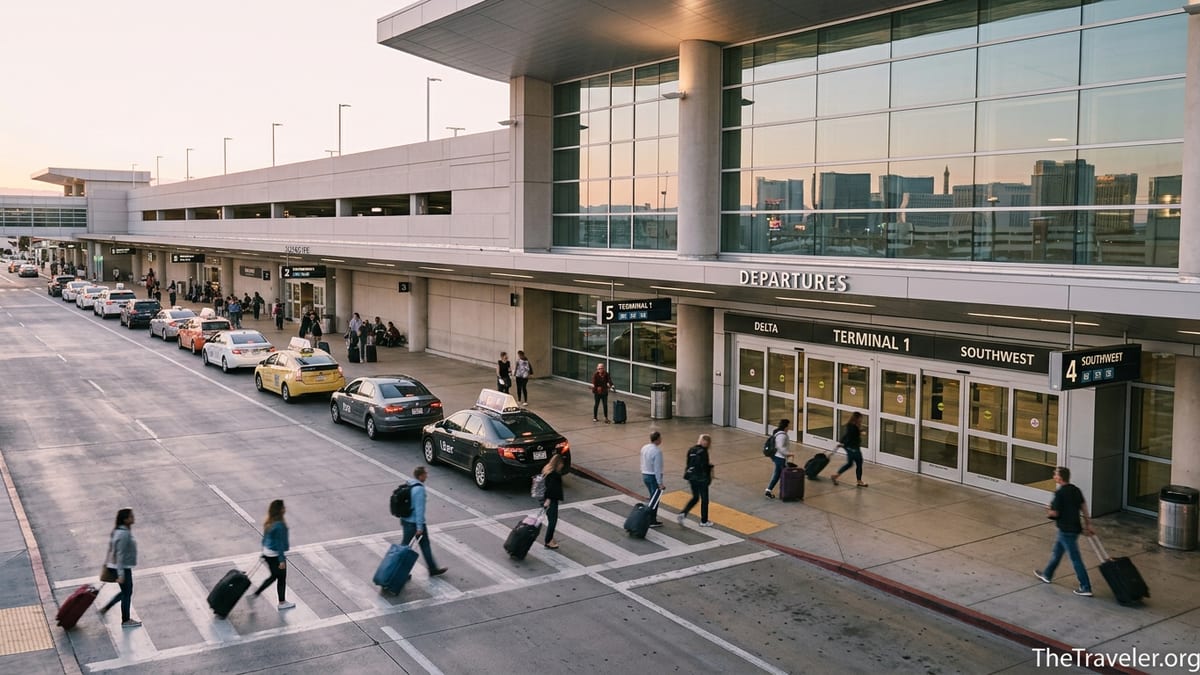
Understanding Harry Reid Airport: Terminals, Gates and Layout
Harry Reid International Airport has two main terminals for departing passengers: Terminal 1 and Terminal 3. There is no Terminal 2, which confuses many first-time visitors. Terminal 1 handles most domestic airlines, while Terminal 3 handles many international flights plus a smaller set of domestic carriers. Both terminals are connected airside to the D gates, which serve multiple airlines and can involve an extra tram ride after security.
Terminal 1 is the older and busier side of the airport. It has ticketing and check-in on one main departures level, with three concourses of gates reachable after security: A, B and C. A separate tram from inside Terminal 1 connects to the D gates. Airlines commonly using Terminal 1 include Southwest, American and Spirit, though you should always confirm with your airline because assignments can change.
Terminal 3 is newer and often feels less hectic, especially early in the day. It has a large ticketing hall, its own security checkpoints and E gates directly attached. A different tram line from Terminal 3 leads to the shared D gates. Carriers such as Delta, United and many international airlines typically operate from Terminal 3. If you are flying an international route on a carrier like British Airways, Air Canada or Condor, you will almost certainly depart from here.
An important practical detail is that there is a free interterminal shuttle on the landside roadway connecting Terminal 1 and Terminal 3. If someone drops you at the wrong terminal, or if you parked at one but are flying from the other, you can use this shuttle rather than re-entering city traffic. Once you are through security, trams connect the concourses, so if you land at a D gate and depart later from a different gate the same day, you may not need to clear security again.
How Early to Arrive: Check-In and Security Timing
TSA and the airport advise passengers to arrive about two hours before scheduled departure for domestic flights and about three hours before international flights. This guidance is similar to other large U.S. airports and is a good baseline for most trips. LAS has become one of the busiest airports in the country, setting passenger records in 2024, so crowds are not just a holiday phenomenon. Morning banks of departures, especially between 5 and 8 a.m., can produce noticeably longer queues.
Real-world experience matters here. Local travelers often report that for a routine midweek domestic flight without checked luggage, arriving 75 to 90 minutes before departure is usually sufficient in Terminal 3. Terminal 1, which handles a heavy volume of leisure traffic on low-cost carriers, tends to have the longest lines at peak times. Flights between 6 and 8 a.m., as well as late Sunday afternoons when weekend visitors leave, are when you should stick closer to the full two-hour recommendation, and possibly a bit more if you need to check bags with a budget carrier that has stricter cutoffs.
Harry Reid has rolled out real-time security wait time displays on its website and on monitors in Terminal 1, with expansion to Terminal 3 following. These systems use sensors to estimate the length of queues at each checkpoint and give you a live estimate, like “15 to 25 minutes,” before you commit to a line. If the airport’s own display or your airline app shows unusually long waits due to staffing shortages or a special event, give yourself more buffer. During major conventions or big sports weekends, such as large fights or Formula 1 events, err toward arriving 30 minutes earlier than usual.
Your airline’s check-in policies also affect timing. For example, low-cost carriers may close bag drop as early as 45 minutes before departure, and they can be strict. If you are flying out on an early morning Frontier or Spirit flight from Terminal 1 with checked bags, aim to arrive at the curb about two hours before departure time, not boarding time. Conversely, if you are flying domestically on Delta from Terminal 3 with only a carry-on and mobile boarding pass, arriving 75 minutes ahead at a non-peak time is often workable, though still not risk-free.
Security Checkpoints, TSA PreCheck and Typical Waits
Harry Reid has five TSA security checkpoints: three in Terminal 1 and two in Terminal 3. In Terminal 1, the main checkpoint handles the bulk of passengers, with separate lanes for standard screening, TSA PreCheck and airline priority passengers. At busy times, agents may direct you to alternate checkpoints within the same building that might look out of the way but often move faster. In Terminal 3, two checkpoints serve both domestic and international departures, and these lines are often a bit shorter, though that can vary by time of day.
TSA PreCheck is widely supported at LAS. If you have PreCheck printed on your boarding pass, look for the green signage at either terminal. In practice, PreCheck at LAS often reduces screening to around 5 to 15 minutes outside of peak holiday crushes, and you can typically keep your laptop in your bag and shoes on, which speeds things further. CLEAR lanes are also present in Terminal 1 and Terminal 3 for enrolled travelers, who can use biometric screening to jump to the front of the physical security line.
For travelers without any expedited security program, timing is more variable. Morning peaks between roughly 5 and 7 a.m. can see standard waits of 20 to 30 minutes, sometimes longer when staffing is constrained. Midday periods on weekdays can drop below 10 minutes, especially in Terminal 3. Sunday afternoon and early evening departures, when weekend visitors head home, are another consistently busy time. Watching the airport’s posted wait times on the day of travel while you are still on the Strip can help you decide whether to leave the hotel a bit earlier.
Preparation matters as much as timing. Security officers at LAS frequently remind passengers traveling with large souvenir items, casino chips and electronics to pack them so they can be easily screened. For example, if you are carrying poker chips home in a backpack, place them in a separate pouch you can pull out quickly if asked. Liquids purchased at your hotel or on the Strip, such as full-size sunscreen or large bottles of alcohol, should go in checked luggage, not carry-ons. Being “ready for the bin” often makes the difference between a smooth 10-minute experience and getting pulled aside for additional screening when you are already tight on time.
Food, Shops and Lounges After Security
Because Harry Reid serves a leisure-heavy market, food and shopping options are more extensive than at many airports of a similar size. In Terminal 1, the A, B and C concourses have a mix of national brands and local flavors, from Starbucks and Shake Shack to Las Vegas-themed bars that serve cocktails from early morning. Eater Las Vegas regularly highlights airport spots like Rachel’s Kitchen and The Village Pub as solid pre-flight choices on that side of the airport. Many of these outlets open very early, often by 4 or 5 a.m., to serve the sunrise wave of departures.
The D gates, accessed by tram from either terminal, have become a dining hub for many airlines. Here you can find additional sit-down restaurants, coffee shops and grab-and-go markets, which is helpful if your gate assignment moves from one concourse to another after you have already cleared security. Because the D gates serve multiple airlines and terminals, they are also a good place to regroup and eat if you are connecting through LAS.
Terminal 3, serving many international flights and premium carriers, has its own set of eateries and bars post-security. There are coffee kiosks near the checkpoints for quick caffeine before early departures, along with casual dining options within a short walk of most E gates. Hours can vary slightly by day and season, so if you have a very late-night or very early-morning flight, plan for the possibility that only a limited set of outlets will be open and consider grabbing a snack in the terminal lobby before security.
Several lounges serve departing passengers. An American Express Centurion Lounge is located near the D gates, accessible via tram from either terminal for eligible cardholders. Airlines such as Delta and United operate their own branded lounges in Terminal 3 for premium and elite customers. These lounges typically offer quieter seating, complimentary food and beverages, Wi-Fi and dedicated customer service desks that can be very helpful during irregular operations. If you hold a premium credit card with lounge access, it can be worth checking which lounge is closest to your departure gate before you arrive at the airport so you can plan your time after security.
Rideshare, Taxi and Drop-Off Tips from the Strip
For most visitors staying on the Strip or in downtown Las Vegas, rideshare services like Uber and Lyft are the easiest way to reach the airport. Harry Reid authorizes both companies, and drivers are allowed to drop passengers directly at the departures curb at both Terminal 1 and Terminal 3. There is no separate rideshare drop-off zone; you simply select the correct terminal in the app, and your driver follows airport signage to the normal departures level.
From the central Strip, a typical rideshare trip to the airport takes around 10 to 20 minutes in light traffic and can cost roughly 15 to 25 dollars before tip for a standard car, depending on surge pricing and time of day. A ride from downtown Las Vegas or the Fremont Street area usually takes 20 to 30 minutes and costs somewhat more. When major events wrap up, such as large conventions at the Las Vegas Convention Center or Sunday afternoon home games, travel times and prices can spike, so it is wise to order your car slightly earlier and be prepared for surge fares.
If someone is dropping you off in a personal vehicle, they can use the same departures curb areas as rideshare. At Terminal 1, there is a height restriction at parts of the departures curb, which matters for tall vans or RVs, so drivers of oversized vehicles should pay close attention to posted clearance signs and may need to coordinate a different drop-off point or use the parking garage and walk. Terminal 3’s departures area is newer and generally easier for large vehicles to navigate, but drivers should still follow airport guidance and avoid stopping for long periods to prevent being moved along by traffic officers.
Travelers using hotel shuttles or shared airport shuttles are usually dropped at Terminal 1 or 3 depending on airline. Many large resorts on the Strip no longer run free airport shuttles, but third-party shuttle companies operate from hotel areas and from downtown hotels, with prices that are often competitive for solo travelers. For a family or group of three or four, a rideshare or taxi from the Strip is often more economical and usually faster. Regardless of your transportation choice, confirm your airline and terminal in advance so you are not dropped at the wrong side of the airport during a busy departure period.
Check-In Strategies, Bag Drop and Gate Changes
Online check-in is the single best time saver at Harry Reid. Most airlines allow you to check in via app or website starting 24 hours before departure. If you are traveling with only a carry-on, this means you can bypass the ticketing counters entirely and proceed straight to security. At a busy airport like LAS, skipping the check-in hall at Terminal 1, where lines for budget carriers can easily run 30 minutes or more at peak times, can be the difference between a calm morning and a scramble to reach your gate.
For travelers with checked baggage, build in enough time not only for the security line but also for bag drop. For example, if your domestic flight closes bag acceptance 45 minutes before departure, aim to reach the airline counter 75 to 90 minutes before departure. That allows time for a queue plus contingencies like kiosk malfunctions or a problem with your ID. At LAS, airlines with a heavy mix of leisure travelers can face particularly congested bag-drop areas on Sunday mornings and during convention checkout days.
Gate changes are common, especially for flights using the shared D gates. It is not unusual for a flight initially assigned to a C gate in Terminal 1 to move to a D gate a couple of hours before boarding, or for a D gate departure to switch between positions in the same concourse. Always keep an eye on the screens in the terminal and on your airline’s app. If your gate moves from one concourse to another after you have settled into a restaurant, you may need to factor in an extra 5 to 10 minutes to reach the new location, particularly if it involves a tram ride.
Travelers connecting through LAS should be especially aware of timing between gates. If you arrive at a D gate and depart from another D or E gate, you can usually stay airside and move via trams and walkways, which is straightforward in 10 to 20 minutes of walking depending on distance. If your flights arrive and depart from different terminals on separate tickets, you may have to exit, collect bags and recheck, which will require passing through security again. In that scenario, allow a more generous connection time or plan to spend a long layover in a lounge or restaurant.
Timing Your Departure from the Strip
When to leave your hotel is one of the most common questions for Las Vegas departures. A practical way to think about it is to work backward. Start with your scheduled departure time, subtract your target arrival time at the airport based on whether your flight is domestic or international, then subtract a realistic estimate for ground travel and a buffer for traffic and elevator time. For a typical domestic flight at 11 a.m. from Terminal 1, you might aim to be at the airport by 9 a.m., expect 20 minutes of travel from a mid-Strip resort and add a 15-minute buffer, meaning you should call your rideshare around 8:25 a.m.
Time of day and day of week matter. Early morning flights require special attention because many hotels experience a wave of checkouts and bell desk requests for stored luggage at similar times. If you have a 6 a.m. departure, for instance, and you are staying at a large Strip megaresort, you may want to settle your bill the night before, sleep in a bit of clothing that is easy to travel in, and request your rideshare no later than 4 a.m. This accounts for potential waits at the elevator bank, walking distance from your room to the main rideshare pickup area and any line of other departures at that hour.
Major conventions, big sports events and long holiday weekends can clog both the Strip and the airport. During events like the Consumer Electronics Show in January or a large fight weekend, travel times from mid-Strip hotels to the airport can double. In those cases, it is reasonable to add another 15 to 30 minutes to your usual plan. Watching traffic apps for red zones between your hotel and the airport on the morning of departure can help you decide whether to leave earlier, but it is safer to err on the side of extra time when flights are heavily booked and same-day alternatives are limited.
Finally, remember that “arrive two hours early” means at the airport, not leaving your hotel. Visitors sometimes misinterpret this and find themselves stepping out of a Bellagio or Luxor elevator exactly two hours before departure with a 20-minute drive still ahead. Think of your morning as a chain: check out, walk to rideshare area, drive to airport, check bags if needed, clear security and reach gate. Each link can encounter delays. Building in a modest cushion at each stage will make your last morning in Las Vegas feel less like a race and more like part of the trip.
The Takeaway
Departing from Harry Reid International Airport does not have to be stressful, even during peak leisure and convention seasons. Understanding the difference between Terminal 1 and Terminal 3, watching the airport’s real-time security wait estimates and using your airline’s app for check-in and gate updates will cover most of your bases. If you treat the TSA guideline of two hours for domestic flights and three for international as a baseline, then adjust slightly for your own risk tolerance, time of day and whether you are checking bags, you are unlikely to cut it too close.
From a practical standpoint, think in real-world terms. A traveler leaving a mid-Strip hotel on a Tuesday for a midmorning Southwest flight with only a carry-on can comfortably call a rideshare about two and a half hours before departure and expect a smooth journey. A family flying a low-cost carrier with multiple checked bags on a Sunday morning, or anyone leaving right after a major event, should pad that schedule by at least 30 minutes. Add in a mental note about where you might want to grab breakfast or a coffee after security and which lounge you can use, and your departure from Las Vegas becomes another memorable part of the trip rather than a blur of lines and rushing.
FAQ
Q1. How early should I arrive at Harry Reid Airport for a domestic flight?
Most travelers should plan to arrive at the airport around two hours before a domestic departure, especially if they need to check bags or are flying from busy Terminal 1.
Q2. Do I need more time for an international flight from Las Vegas?
Yes, for international departures you should usually arrive about three hours before scheduled takeoff to allow time for check-in, document checks and security.
Q3. Which airlines use Terminal 1 versus Terminal 3 at Harry Reid?
Terminal 1 generally handles many domestic carriers such as Southwest and some low-cost airlines, while Terminal 3 serves numerous international carriers and some domestic airlines like Delta and United.
Q4. How long does security usually take at LAS?
Security waits vary, but outside peak periods many travelers experience 10 to 25 minutes in standard lines, with shorter waits at off-peak times and in TSA PreCheck lanes.
Q5. Is there TSA PreCheck and CLEAR at Harry Reid Airport?
Yes, both TSA PreCheck and CLEAR operate at LAS, with dedicated lanes at Terminal 1 and Terminal 3 that can significantly reduce security wait times for enrolled travelers.
Q6. Can I get dropped off by Uber or Lyft at the normal departures curb?
Yes, rideshare drivers are allowed to drop passengers directly at the departures curbs at both Terminal 1 and Terminal 3, just like personal vehicles and taxis.
Q7. How long is the ride from the Strip to the airport?
From most mid-Strip resorts, the drive to Harry Reid usually takes 10 to 20 minutes in light traffic, but it can take longer during major events or rush periods.
Q8. Are there good food options after security at LAS?
Yes, both terminals and the D gates have a mix of national chains and local spots, including coffee shops, bars and sit-down restaurants suitable for pre-flight meals.
Q9. Does Harry Reid Airport have lounges I can use?
Yes, there are airline lounges and an American Express Centurion Lounge for eligible guests, primarily near the D gates and in Terminal 3, offering food, drinks and quiet seating.
Q10. What should I do if I am dropped at the wrong terminal?
If you end up at the wrong terminal, use the free interterminal shuttle on the airport roadway or follow signs for the shuttle so you can reach the correct terminal without re-entering city traffic.