


Landing in Las Vegas is exciting. Figuring out whether you need Terminal 1 or Terminal 3 at Harry Reid International Airport is less so. The airport uses a split-terminal layout that can be confusing, especially if you are trying to meet someone, book a rideshare, or decide where to park. This guide breaks down the real-world differences between Terminal 1 and Terminal 3 so you can go exactly where you need, without last-minute stress.
Get the latest updates straight to your inbox!
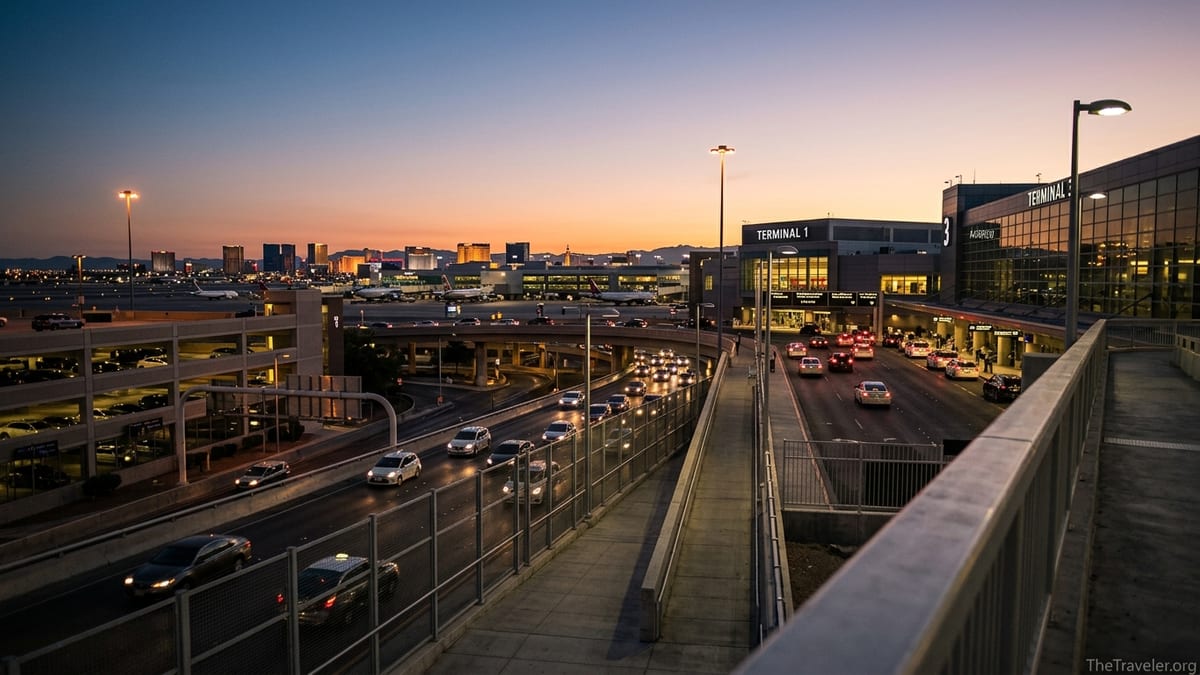
Terminal 1 vs Terminal 3: The Big Picture
Harry Reid International Airport, still called McCarran by many locals, has two main passenger terminals in use: Terminal 1 and Terminal 3. They sit on the same airfield but function like two separate mini airports, each with its own check in, security, gates, baggage claim, parking garage, and rideshare pickup. There is no shared central hall where everything connects, so going to the correct terminal from the start saves a lot of time.
Terminal 1 is the older and busier domestic terminal. It serves many major U.S. carriers and ultra low cost airlines. Inside, you will find ticketing, security, baggage claim, and four concourses labeled A, B, C, and D. Concourse D is a shared concourse that also connects to Terminal 3 via an airside tram.
Terminal 3 is the newer building on the east side of the airfield. It is the primary gateway for most international flights and also handles several domestic airlines. Terminal 3 has its own check in, security, and baggage claim plus E gates, and it also connects airside to Concourse D, which serves both terminals.
In practice, this split means you should always check your airline and flight details before you order a taxi or rideshare or tell friends where to meet you. Showing up at the wrong terminal usually means a shuttle ride or a long walk before you can even start check in.
Which Airlines Use Terminal 1 and Which Use Terminal 3
Airline assignment is the number one factor for choosing the right terminal. Most travelers never need to decide; your airline dictates where you go. As of mid 2026, many big U.S. carriers such as American Airlines and Allegiant Air operate from Terminal 1, using the A, B, C, or D gates. If you are flying a low cost domestic airline that often serves vacation routes, there is a good chance you will be in Terminal 1.
Terminal 3, by contrast, is home to most foreign flag airlines and a mix of U.S. and Latin American carriers. Major brands such as Air Canada, British Airways, and Aeromexico use Terminal 3, along with several others that fly nonstop to Europe, Canada, and Mexico. Terminal 3 also houses some domestic service on carriers that share the newer facilities and E gates.
A useful rule of thumb is this: if your ticket shows an international airline or a long haul route such as London, Toronto, or Mexico City, expect Terminal 3. If you are flying a mainstream U.S. airline on a domestic route like Dallas, Los Angeles, or Denver, you are more likely to be in Terminal 1, though there are exceptions. Because airlines can reshuffle or add codeshares, always confirm on your airline app or the airport’s flight information the day you travel.
For a concrete example, imagine two friends leaving Las Vegas on the same evening: one flying American Airlines to Phoenix and another on British Airways to London. The American Airlines traveler will check in at Terminal 1 and likely depart from a C or D gate. The British Airways traveler will start in Terminal 3 and use the E gates. If they plan to share a taxi to the airport, they cannot simply “get off in the middle”; they must pick one terminal and then move between terminals using the shuttle or tram if needed.
Gates, Layout, and How International Arrivals Work
Understanding the gate structure helps you navigate once you are inside. Terminal 1 is connected to A, B, and C concourses directly and to Concourse D by tram. Terminal 3 is connected to the E gates directly and also uses Concourse D via its own separate tram line. Concourse D is essentially a shared central island of gates reached from both terminals after security.
For departing passengers, this means that even if your boarding pass shows a D gate, you must still enter the airport and pass security in the terminal assigned to your airline. For example, a domestic flight on a Terminal 1 carrier might depart from D20, while an international flight on a Terminal 3 carrier might depart from D8. Each group of passengers uses their own terminal’s security and tram system to reach Concourse D; you do not mix until you are already airside.
International arrivals are centered in Terminal 3, which houses the main U.S. Customs and Border Protection facilities. Many international flights, whether they use E gates or certain D gates, will funnel arriving travelers into the customs and immigration hall in Terminal 3. After clearing passport control and customs, you exit into Terminal 3 baggage claim and then landside arrivals. So if a family on a nonstop flight from London lands at a D gate, they will still follow signs to immigration that lead them into the Terminal 3 arrivals area, not Terminal 1.
This has practical consequences for airport pickups. If you are meeting someone arriving from abroad, you should plan to meet them at Terminal 3 even if their boarding pass said “D gate.” For domestic flights, though, passengers exit into the baggage claim and curbside areas of the terminal their airline uses. Checking whether the flight is domestic or international can save you a wait at the wrong curb.
Baggage Claim, Meet and Greet, and Ground Level Layout
Baggage claim in both Terminal 1 and Terminal 3 is located on the arrivals level, but the experience feels slightly different in each building. Terminal 1’s baggage claim is longer and busier, with multiple carousels serving simultaneous domestic flights. Overhead monitors list the carousel number for each flight, and you will see signage pointing to taxi, shuttle, and rideshare bridges as soon as you step out with your luggage.
Terminal 3’s baggage claim is more compact and modern, which many travelers find easier to navigate, especially late at night when several international flights arrive close together. Carousels for international flights feed directly toward the customs exit, so everyone leaving the secure area flows into the same general hall where friends and family can wait behind clear barriers.
If you are picking someone up inside the terminal, a practical strategy is to agree on a landmark near baggage claim. In Terminal 1, this might be near a specific door number or an obvious feature such as the escalators leading up toward parking and rideshare signs. In Terminal 3, you might choose a column number or a point near the information desk once they clear customs. This helps if their mobile data is slow to reconnect after landing.
Once you have bags, follow the overhead signs for “Ground Transportation,” “Parking Garage,” or “Ride Share.” At Terminal 1, you will usually head toward doors labeled with low numbers (such as Door 2) for the elevators to the parking garage and rideshare area. At Terminal 3, signage will direct you toward specific doors with higher numbers (often in the 50s) to reach the parking garage bridge. These small details matter when you are tired after a long flight and just want to get out of the airport quickly.
Parking at Terminal 1 vs Terminal 3
Both terminals have their own attached parking garages directly across from the building, which is one of the biggest conveniences of Harry Reid Airport. For most short trips, drivers simply park in the garage for the terminal their airline uses. The garages offer hourly and daily rates that are broadly similar at Terminal 1 and Terminal 3, with prices increasing as of mid 2026. Exact dollar amounts can change, but you can expect hourly parking to be more expensive than economy or long term options farther from the terminal.
Terminal 1’s garage is large and busy, with multiple levels and clearly marked pedestrian bridges that lead straight into the departures and baggage claim levels. If you are dropping someone off for a domestic flight and want to walk them in, you can park for an hour or two here and be at the ticket counters within a few minutes. However, finding a space close to the pedestrian bridge during peak times can require circling, especially on weekends or around large conventions.
Terminal 3’s garage is often a better choice for those who value a calmer experience. It is directly across from the terminal as well, with elevator access to the pedestrian bridge and a valet level used for certain services. Many frequent Vegas visitors choose to park at Terminal 3 even when flying a Terminal 1 carrier, then take the free inter terminal shuttle, because they find it easier to navigate and slightly less congested.
For real world planning, imagine you are a local dropping off a friend for a 7 am domestic departure. If your friend flies out of Terminal 1, you might drive into the Terminal 1 garage and budget 15 to 20 minutes from the time you pull a ticket to when you are standing with them at the check in line. If they are on an early morning international flight from Terminal 3, you might do the same on that side, expecting slightly smoother traffic but leaving extra time for the longer international check in process.
Rideshare, Taxis, and Passenger Pickup Zones
Uber and Lyft are widely used at Harry Reid Airport, and both terminals have designated rideshare pickup zones in their parking garages. At Terminal 1, rideshare pickup is located on Level 2 of the parking garage. After you collect baggage, you take the elevator or escalator near the lower numbered doors, go up, then cross the pedestrian bridge into the garage. Once across, you turn to the right to find a large, signed rideshare area with multiple lanes for cars to pull in.
Terminal 3’s rideshare pickup is located on the valet level of its parking garage. From baggage claim, you follow signs to the parking garage, usually heading toward doors numbered in the 50s. You cross the pedestrian bridge to the garage, then go down by elevator or stairs to the valet level. There, a clearly marked rideshare zone serves both Uber and Lyft. The airport has invested in better lighting and signage in these areas in recent years to keep up with the volume of app based rides.
Traditional passenger pickup by private vehicle is separate from rideshare. Each terminal has a passenger pickup curb located across from the arrivals level on the first level of the garage. Drivers meeting arriving passengers can wait in a free cell phone lot a few minutes away, then pull up to the designated pickup curb only after the traveler is outside and ready. This avoids circling the terminal and reduces congestion, which is especially helpful at Terminal 1 during busy evening hours when multiple domestic flights land at once.
For example, if you are arriving on a domestic flight into Terminal 1 and your friend is picking you up, they might wait in the cell phone lot until you text that you have your bags. Then they would follow signs to “Passenger Pickup Terminal 1,” pull into the ground level curb area, and watch for you near a specific door number. If instead you are taking Uber, you would follow the “Ride Share” signs to the garage level pickup area and only request your ride once you are physically in the zone so the driver can find you quickly.
How to Transfer Between Terminal 1 and Terminal 3
Despite being part of the same airport, Terminal 1 and Terminal 3 are not connected by a simple indoor walkway on the secure side. If you arrive at the wrong terminal for departure, or need to change terminals to make a connection on separate tickets, you have two main options: the free inter terminal shuttle and a signed pedestrian route. In both cases you are landside, which means you will go through security again at your departure terminal.
The airport operates a complimentary shuttle service between Terminal 1 and Terminal 3 that runs regularly from the ground transportation level. Buses pick up on Level 0 at each terminal. The ride takes roughly 10 to 15 minutes depending on traffic. This is generally the easiest option if you have luggage or are not familiar with the airport road layout. For instance, if a traveler mistakenly gets dropped at Terminal 1 for a flight that actually leaves from Terminal 3, they can go down to Level 0, board the shuttle, and be at the correct terminal with time to spare if they arrived early enough.
There is also a pedestrian route between the terminals that some travelers use when they have a long layover or prefer walking. The walk can take around 15 minutes and follows signed paths along airport roads and sidewalks. While this is comfortable in cooler months, summer temperatures in Las Vegas regularly exceed 100 degrees Fahrenheit, so the shuttle is usually the safer choice in the heat, especially if you are carrying bags.
Airside, a tram connects each terminal to Concourse D, but it is not designed as a public inter terminal transfer without leaving security. You cannot simply ride the D gate tram from Terminal 1 to Terminal 3 and exit there. Practical planning means treating each terminal as a separate building: if your airline or check in desk is in the other one, assume you will need to use the landside shuttle or walk and then clear security again.
Domestic vs International: Which Terminal Is Better for You
For most U.S. domestic travelers, Terminal 1 is the default, simply because more domestic carriers use it. It has more food and retail options overall, and the atmosphere is that of a busy, traditional American airport. If you are flying to nearby hubs like Los Angeles, Phoenix, or Salt Lake City on a major U.S. airline, you will probably enjoy shorter walking distances to A, B, or C gates and easy access to baggage claim on your return.
Terminal 3 shines for international travelers and for those who value a calmer, more modern environment. The main customs hall is there, and many of the facilities were built with long haul flights in mind. Lounges, gate seating, and general layout often feel less crowded outside peak arrival banks. Travelers connecting from an international flight to a domestic leg on a different ticket sometimes prefer to schedule enough time to clear customs in Terminal 3, then collect their bags and recheck with a domestic carrier, possibly changing terminals if necessary.
Consider an example: a couple flies in from Toronto on a morning flight using Terminal 3. After clearing customs and picking up luggage, they have a separate domestic ticket that departs from Terminal 1 in the afternoon. They might choose to use the free inter terminal shuttle, transfer to Terminal 1, recheck bags, and then pass through security again. Scheduling at least three hours between these flights is wise, because customs, baggage waiting times, and shuttle frequency can all vary.
If you have flexibility when booking, you may find it simpler to use the same terminal for both arrival and departure. For instance, booking a round trip on a carrier that consistently uses Terminal 3 for flights to your home city means you can get familiar with one check in area, one parking garage, and one rideshare pickup zone rather than switching back and forth.
The Takeaway
Harry Reid International Airport’s split between Terminal 1 and Terminal 3 is less complicated once you understand the core idea: your airline and route determine your terminal. Terminal 1 is the older, busier domestic hub with A, B, C, and shared D gates. Terminal 3 is the newer, more international focused terminal with E gates and its own link to D gates and customs.
Before you head to the airport, check your airline and flight information to confirm the terminal. Plan your parking or drop off accordingly, use the correct rideshare pickup level in each garage, and remember that transfers between terminals are managed landside by shuttle or a signed walk. Meeting someone from an international flight almost always means going to Terminal 3 arrivals, even if they deplane at a D gate.
With a bit of advance planning and an understanding of how the two terminals differ in airlines, baggage claim, gates, parking, and ground transport, you can smooth out the least glamorous part of your Vegas trip and spend more time enjoying the city itself.
FAQ
Q1. How do I know if my flight uses Terminal 1 or Terminal 3 at Harry Reid Airport?
Check your airline and your booking confirmation. Most domestic flights on major U.S. carriers use Terminal 1, while many international and some domestic flights use Terminal 3. Your airline app or the airport’s flight information will list the exact terminal on the day of travel.
Q2. Can I walk between Terminal 1 and Terminal 3?
Yes, there is a signed pedestrian route between the terminals, and the walk typically takes around 15 minutes. However, temperatures in Las Vegas can be very high, so the free inter terminal shuttle on Level 0 is often more comfortable, especially if you have luggage.
Q3. Is there a tram or train that connects Terminal 1 and Terminal 3 after security?
No. Each terminal has its own tram line to Concourse D, but you cannot use these trams to move freely between terminals and then exit. To change terminals, you must go landside, use the shuttle or walk, and pass through security again at your departure terminal.
Q4. Where is rideshare pickup for Uber and Lyft at Terminal 1?
At Terminal 1, rideshare pickup is on Level 2 of the parking garage. From baggage claim, follow the “Ride Share” signs, take the elevator or escalator up, cross the pedestrian bridge to the garage, and then turn right to reach the designated pickup lanes.
Q5. Where is rideshare pickup at Terminal 3?
At Terminal 3, the rideshare pickup zone is on the valet level of the parking garage. After collecting your bags, follow signs to the parking garage, cross the pedestrian bridge from baggage claim, then go down to the valet level where the Uber and Lyft area is clearly marked.
Q6. If my friend is arriving from overseas, which terminal should I go to for pickup?
Plan to meet them at Terminal 3, which handles most international arrivals and houses the main customs and immigration facilities. Even if their flight arrives at a D gate, they will typically be directed to exit through the Terminal 3 arrivals and baggage claim area.
Q7. Can I park in one terminal’s garage and fly from the other terminal?
Yes, you can. Some travelers prefer parking at Terminal 3’s garage and then taking the free inter terminal shuttle to Terminal 1. Just remember to allow extra time for the shuttle ride and for walking from the shuttle stop to check in.
Q8. What should I do if I am dropped off at the wrong terminal?
If you realize you are at the wrong terminal, follow signs to Level 0 for the inter terminal shuttle. Take the shuttle to the correct terminal, then proceed to your airline’s check in and security. Build enough buffer into your schedule so that this does not jeopardize your departure.
Q9. Are the parking rates different between Terminal 1 and Terminal 3?
Parking rates are broadly similar between the two terminals and can change over time. Both garages offer hourly and daily options. For exact prices near your travel date, check current information and compare with off airport parking if you are planning a longer stay.
Q10. Which terminal is better if I want a calmer experience?
Many travelers find Terminal 3 to be somewhat calmer and more modern, especially outside peak international arrival times. Terminal 1 has more overall traffic and more flights, so it tends to feel busier. However, your airline and route usually decide your terminal, so it is best to focus on planning ahead rather than trying to “choose” a terminal.