


Landing at Las Vegas Harry Reid International Airport and heading straight to the Strip is easier than ever, thanks to regulated taxi flat fares and clearly marked hotel zones. Still, first-time visitors are often unsure where to find the official taxi ranks, what they should expect to pay, or whether they would be better off opening a rideshare app. This guide walks you through taxis from the airport to the Strip step by step, with concrete fare examples, hotel zone coverage, queue tips, and when a cab actually beats Uber or Lyft.
Get the latest updates straight to your inbox!
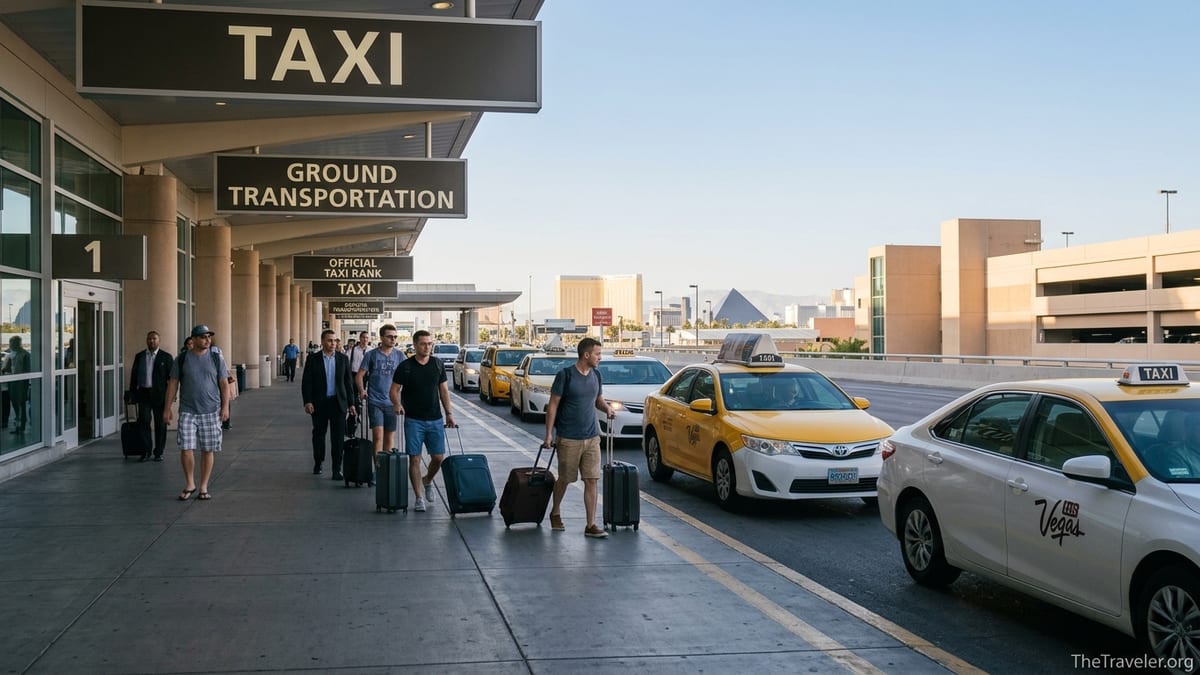
How the Las Vegas airport taxi system works
Taxi service at Harry Reid International Airport is tightly regulated by the Nevada Taxicab Authority. Only licensed cab companies can pick up at the airport, and they operate from designated taxi ranks at both Terminal 1 and Terminal 3. You cannot legally hail a random cab at the curb or arrange an off-the-books cash ride; all legitimate taxis display a roof light, company name, and a Nevada Taxicab Authority decal.
For trips between the airport and hotels on the main Las Vegas Strip, taxis use a flat zone pricing system instead of a running meter. The zone fares were updated after late 2025 meetings of the Taxicab Authority and are designed to prevent the “long hauling” that used to be common when drivers took unnecessary freeway routes to inflate metered fares. Today, going from Harry Reid to the Strip should feel predictable: you know the price band before you step into the cab, based on which part of the Strip you are staying on.
Outside of the Strip zones, taxis revert to a standard meter that charges a base drop fee plus a per-mile rate and small airport pickup surcharge. That matters if, for example, you are going from the airport to off-Strip neighborhoods like Summerlin or Henderson, or to downtown Fremont Street. But if your hotel is Mandalay Bay, Bellagio, Caesars Palace, Resorts World, or another classic Strip property, the flat zone rules will likely apply.
Every taxi has a printed fare card inside showing the current flat rates and any surcharges. Drivers are required to use these and should select the correct zone for your hotel. If you are unsure, ask the driver which zone your hotel is in and confirm the flat fare verbally before the vehicle moves.
Airport to Strip zones and real-world fare examples
The Taxicab Authority divides the Strip into three airport zones with fixed fares that include the airport pickup fee. Exact numbers can shift slightly with regulatory changes, but as of mid 2026 the typical ranges are around the low 20 dollars for the south Strip, the mid 20s for the central Strip, and the high 20s to around 30 dollars for the north Strip. This covers the taxi ride for up to five passengers in a standard cab, not per person.
Zone 1 broadly covers the south Strip, from the area around the airport’s Sunset Road up toward Tropicana Avenue. In practice, this includes hotels such as Mandalay Bay, Luxor, Excalibur, MGM Grand, Tropicana and OYO. A typical flat fare here is roughly 21 to 23 dollars before tip. For example, a late-evening ride from Terminal 1 to Mandalay Bay or Luxor generally falls in this lowest zone price.
Zone 2 covers the busy center Strip area between Tropicana and roughly Flamingo. This includes properties like New York-New York, Park MGM, Aria, Vdara, Planet Hollywood, Paris, Bellagio and The Cosmopolitan. The flat fare to these hotels tends to land in the mid 20s. A couple taking a cab from the airport to Bellagio or Aria, for instance, can expect something in the ballpark of 24 to 26 dollars plus tip, regardless of whether there is traffic on Las Vegas Boulevard.
Zone 3 generally covers the north center and northern Strip, from around Flamingo up past Sahara Avenue. Hotels such as Caesars Palace, The Cromwell, Flamingo, The LINQ, Harrah’s, The Venetian, The Palazzo, Wynn, Encore, Circus Circus, Sahara and Resorts World sit in this band. The flat fare for this furthest Strip zone usually runs from the high 20s to about 30 dollars. A family heading to The Venetian or Wynn, for example, might pay around 28 to 30 dollars plus tip, even if they arrive at 11 pm on a busy Friday.
Finding the official taxi ranks at Harry Reid Airport
At Terminal 1, the main terminal used by many domestic airlines, the taxi rank is on the ground level outside baggage claim. After collecting your luggage, follow the overhead signs marked “Ground Transportation” and then “Taxis.” You will pass escalators and elevators that lead down to the traffic lanes where vehicles pull in. The official queue is a roped area with airport staff directing passengers to the next available cab. You should not need to cross any public roads to get there.
Terminal 3, which handles many international arrivals as well as some domestic carriers, has a separate taxi area. Once you exit customs or baggage claim, again follow the “Ground Transportation” and “Taxi” signage to the lower level. The setup is similar: a controlled taxi stand with signage, lighting and staff. If you arrive on a late-night international flight from Europe or Latin America, you may find a shorter queue here than at Terminal 1, but taxis serve both terminals 24 hours a day.
Always join the official line rather than accepting offers from anyone approaching you inside the terminal. Legitimate taxi drivers wait in a holding lot and are dispatched into the rank by airport staff; they do not solicit riders inside. Cars lined up at the official stand will be clearly marked with numbered roof lights and company branding such as Yellow Checker Star, Whittlesea or Nellis Cab.
If you have mobility needs or heavy luggage, you can request the next van-style taxi at the head of the queue. The airport typically has a mix of sedans and minivans, and attendants can help you into a vehicle that has easier access and more cargo space for items like golf clubs or large suitcases.
What affects your taxi fare: luggage, time of day and tipping
The flat airport-to-Strip zone fares make costs predictable, but there are still a few additional elements to keep in mind. The posted flat fare usually includes the airport pickup surcharge that every taxi pays to enter the property. It does not include tip. For good service, most visitors tip around 15 to 20 percent of the fare. On a 24 dollar center Strip ride, that might mean handing the driver 28 dollars total in cash or adding a similar amount when paying by card.
Standard checked suitcases, carry-ons, and personal items are included in the flat fare. Las Vegas taxis are accustomed to passengers with multiple bags, and there is no separate per-bag charge in usual circumstances. If you have extremely bulky items that require the driver to fold seats or make special arrangements, they may appreciate a slightly higher tip, but the meter or flat rate itself should not change.
Late arrivals do not change the flat fare when you are going between the airport and a Strip zone hotel. Whether you land at 8 am on a Tuesday or 1 am on a Saturday, the zone-based price remains the same, even if traffic conditions differ. The main difference late at night is queue length. After midnight, you may walk straight into a cab at Terminal 1 with no line at all, while in the late afternoon and early evening you might wait 10 to 20 minutes behind a convention crowd.
If you are going somewhere outside the flat zones and your ride is on the meter, time of day and traffic matter more. For example, a taxi from the airport to downtown Fremont Street, which is metered rather than zoned, might cost around the high 20s to low 30s in light traffic, but creep higher if the freeway is jammed at rush hour. In those cases, you can ask the driver which route they plan to take and opt for the more direct surface streets if congestion is heavy.
Taxi queues, peak times and smart line strategies
Taxi queues at Harry Reid Airport fluctuate dramatically depending on when your flight lands. Mid-morning on a weekday outside convention season, you might step directly into a waiting cab, with more taxis idling than there are passengers. But on Sunday afternoons, when weekend visitors return home and new guests arrive, or during major events like the Consumer Electronics Show and big fight weekends, queues can stretch far down the sidewalk.
If you arrive during a peak period and see a long rideshare pickup crowd, sometimes the taxi line is actually the faster option despite being more visible. There have been many days when the Uber and Lyft pickup areas at the airport parking garages have had 50 or more people waiting, while the taxi rank moves steadily with dedicated vehicles cycling through. Travelers who attempt to summon a rideshare during these surges often face 20 to 40 minute waits and dynamic pricing, while those who join the taxi queue can be in a cab within 10 to 15 minutes at a guaranteed flat fare.
To minimize waiting, it helps to be decisive. Once you collect your bags, choose quickly between taxi and rideshare rather than checking both areas back and forth. If you see the taxi line looping multiple times outside the terminal and rideshare showing a driver five minutes away at a modest price, the app may be a better bet. Conversely, if your app shows UberX or Lyft prices to Bellagio at over 40 dollars and a 25 minute ETA, walking directly to the taxi queue will probably be faster and cheaper for a Strip hotel.
Consider your luggage and party size too. A solo traveler with a backpack might be comfortable walking to the far end of the parking garage for rideshare pickup. A family of four with roller bags, strollers and carry-ons may prefer the more straightforward taxi queue right outside baggage claim, especially if they have been in transit all day. In many real-world cases, parents with tired children arriving around 9 pm report that getting in a cab from the taxi stand feels simpler and more predictable, even if an app quote is slightly lower.
Taxi vs rideshare from Harry Reid to the Strip
From a pure price perspective, rideshare services like Uber and Lyft are often slightly cheaper than taxis for airport to Strip trips during off-peak hours. Recent fare tracking shows typical UberX or Lyft rides from Harry Reid to center Strip hotels landing in the 18 to 30 dollar range before tip, with many journeys around 22 to 26 dollars when demand is normal. By contrast, zone-based taxi fares to similar hotels might come in a few dollars higher, especially once you add a credit card processing fee that some cab companies charge.
However, during busy periods or when surge pricing kicks in, taxis can instantly become the better deal. It is not unusual on a Friday night or just after a major convention session lets out to see UberX quotes above 40 dollars from the airport to a mid-Strip property like Caesars Palace, while the taxi zone fare to the same area remains in the high 20s. In those situations, a party of three or four can save 10 to 15 dollars by joining the taxi line and still arrive in roughly the same amount of time.
There are also practical considerations beyond cost. Taxis have highly visible, easy-to-find pickup points at both terminals, which is valuable if your phone battery is low, your data roaming is unreliable, or you simply do not want to install another app. You can pay cash in a taxi, unlike rideshare where a registered card is mandatory. On the other hand, rideshare drivers will drop you precisely at a pin within your resort complex, which can sometimes be closer to your specific tower or entrance than the hotel’s main taxi loop.
For many travelers, the most sensible approach is to quickly check both options when they land. Open your rideshare app as you walk toward baggage claim to see an estimated price and wait time to your hotel. Then, once you have your luggage, glance at the visible length of the taxi queue. If UberX to The Cosmopolitan is 19 dollars with a driver 7 minutes away and the taxi line is 80 people deep, rideshare likely wins. If UberX shows 38 dollars and a 22 minute wait while the taxi rank is moving steadily, the flat-fare cab will almost certainly be the better choice.
When a taxi makes the most sense from Harry Reid
There are specific scenarios where a taxi is the clear winner from Harry Reid to the Strip. One is late-night arrivals with checked luggage, particularly for visitors unfamiliar with the airport layout. When you land after midnight, rideshare driver availability may be thinner, and the walk to the rideshare pickup areas in the parking structures can feel long. In contrast, the taxi rank outside baggage claim usually has cabs ready to go around the clock, and you can be at Mandalay Bay or MGM Grand in less than 10 minutes once you get into the car.
Another situation is during major events and bad weather. On days when thunderstorms or high winds delay flights, or when enormous conventions push demand through the roof, rideshare prices can spike dramatically. Visitors have reported UberX quotes over 45 dollars to mid-Strip hotels under these conditions, while taxis still charge the standard zone fare in the 20s. If you are traveling as a group and value predictability, a taxi’s fixed rate can be reassuring at times like these.
Taxis can also be preferable if you are traveling with someone who struggles with technology, or if you simply prefer not to link your primary credit card to a rideshare account. Las Vegas taxis accept major credit and debit cards as well as cash, and you receive a printed receipt. For business travelers needing an expense report, that receipt can be useful, particularly if you want a clear line item showing “Airport to Bellagio” instead of a generic app charge.
Finally, if you are arriving at Terminal 3 on an international flight and are concerned about cell service, a taxi is often the least stressful way to reach your hotel. You do not have to worry about your phone finding a local network or your eSIM activating in time. Just follow the taxi signs, join the queue, and have the driver confirm the flat fare for your Strip zone before you depart.
Common taxi pitfalls and how to avoid them
Although the introduction of flat airport zones has greatly reduced long-hauling from Harry Reid to the Strip, it is still worth knowing how to protect yourself from problems. The most important step is to confirm that your hotel is in a zone and ask the driver what the flat fare is before the vehicle starts moving. If a driver insists on using the meter to reach a Strip hotel that should be zoned, politely say that you understand the airport-to-Strip trips are flat rate and ask them to apply the correct zone.
If you suspect you have been charged incorrectly, either at a higher zone or outside the rules, you can request a receipt that shows the taxi company name, medallion number, and fare. Keep this as documentation. The Nevada Taxicab Authority publishes contact details, including a phone number where you can report suspected overcharging. Filing a complaint after the fact is often easier if you can quote the medallion number and the approximate time of your trip.
Another pitfall is confusion around drop-off locations at mega-resorts. Some properties stretch over a large area, with multiple entrances serving different towers. If you are staying in a specific tower at Caesars Palace or The Venetian, tell the driver exactly where you need to go. Most drivers know the property layouts well, but you can avoid being dropped at the wrong door and having to haul bags across a casino floor by clearly stating, for example, “Venetian, main hotel check-in” instead of just “The Strip.”
Finally, be prepared for payment. While nearly all Las Vegas taxis now accept cards, some still charge a small processing fee, often around 3 dollars. If you want to avoid this, have enough cash on hand to cover the flat fare plus tip. Either way, check the total on the payment terminal before finalizing the transaction, and make sure the tip amount entered matches what you intend to give.
The Takeaway
Taking a taxi from Harry Reid International Airport to the Las Vegas Strip in 2026 is straightforward, regulated and usually fast. The three-zone flat fare system means that whether you are headed to Mandalay Bay, Bellagio or Wynn, you can estimate your cost within a few dollars before you even leave baggage claim. Official taxi ranks at both terminals are easy to find, operate 24 hours a day, and provide an especially smooth option during late-night arrivals or high-demand periods when rideshare prices surge.
In many off-peak situations, Uber and Lyft can be slightly cheaper to the Strip, particularly for solo travelers arriving at quieter times. But taxis remain highly competitive when you factor in flat pricing, shorter queues during rideshare surges and the ability to pay cash. For families with luggage, groups arriving after long flights, or anyone who values simplicity and predictability, joining the taxi line is often the most comfortable way to begin a Las Vegas trip.
The smartest strategy is flexible: check your rideshare app for a quick snapshot of price and wait time, glance at the taxi queue when you exit baggage claim, and choose whichever makes more sense at that moment. With a basic understanding of the airport zones, queues and payment nuances, you can be confident you are getting a fair deal on the short hop from runway to roulette wheel.
FAQ
Q1. How much is a taxi from Harry Reid Airport to the Las Vegas Strip?
The flat fare from Harry Reid to most Strip hotels generally ranges from the low 20 dollars for south Strip properties to around 30 dollars for the far north Strip, before tip.
Q2. Are taxi fares from the airport to the Strip fixed or metered?
For trips between the airport and Strip hotels, taxis use fixed zone pricing. Once you leave the zones, such as going to downtown or local neighborhoods, the meter applies instead.
Q3. Where do I find the taxi rank at Harry Reid Airport?
At Terminal 1, the taxi rank is on the ground level outside baggage claim under “Ground Transportation” and “Taxi” signs. At Terminal 3, follow similar signs down to the lower level taxi area.
Q4. Do Las Vegas airport taxis take credit cards?
Yes, nearly all airport taxis accept major credit and debit cards, but some add a small card processing fee. If you want to avoid that, you can pay cash instead.
Q5. Is it cheaper to use Uber or Lyft instead of a taxi from the airport?
During off-peak times, Uber or Lyft are often slightly cheaper than taxis for airport to Strip trips. During busy periods or surge pricing, the flat taxi zone fares can be equal or cheaper.
Q6. Do I need to tip my taxi driver from the airport?
Tipping is customary. Most visitors tip around 15 to 20 percent of the fare, depending on service and help with luggage, on top of the flat zone price.
Q7. Can taxis charge extra for luggage from the airport?
No, standard luggage is included in the fare. There is no separate charge per bag for typical suitcases and carry-ons on airport to Strip trips.
Q8. Are taxis available late at night at Harry Reid Airport?
Yes, taxi service from the airport runs 24 hours a day. Even if you land after midnight, you should find cabs in the official ranks at both terminals.
Q9. What if I think my taxi overcharged me for the airport ride?
Ask for a receipt showing the fare, taxi company and medallion number, then contact the Nevada Taxicab Authority to report the issue and have the fare reviewed.
Q10. Can I hail a taxi on the street outside the airport?
No, you must use the official taxi ranks at the airport. Street hailing is not how airport pickups work in Las Vegas, and offers of rides from inside the terminal should be avoided.