


Planning a northern-lights escape to Finnish Lapland often comes down to a single question: Levi or Rovaniemi? Both offer snow, reindeer and a realistic chance of seeing the aurora, but neither can control the two biggest variables: cloud cover and solar activity. In practice, what you choose is less important for aurora probability than whether you have dark, clear skies and enough nights to wait out the weather. Where Levi and Rovaniemi really diverge is in atmosphere, activities and logistics.
Get the latest updates straight to your inbox!
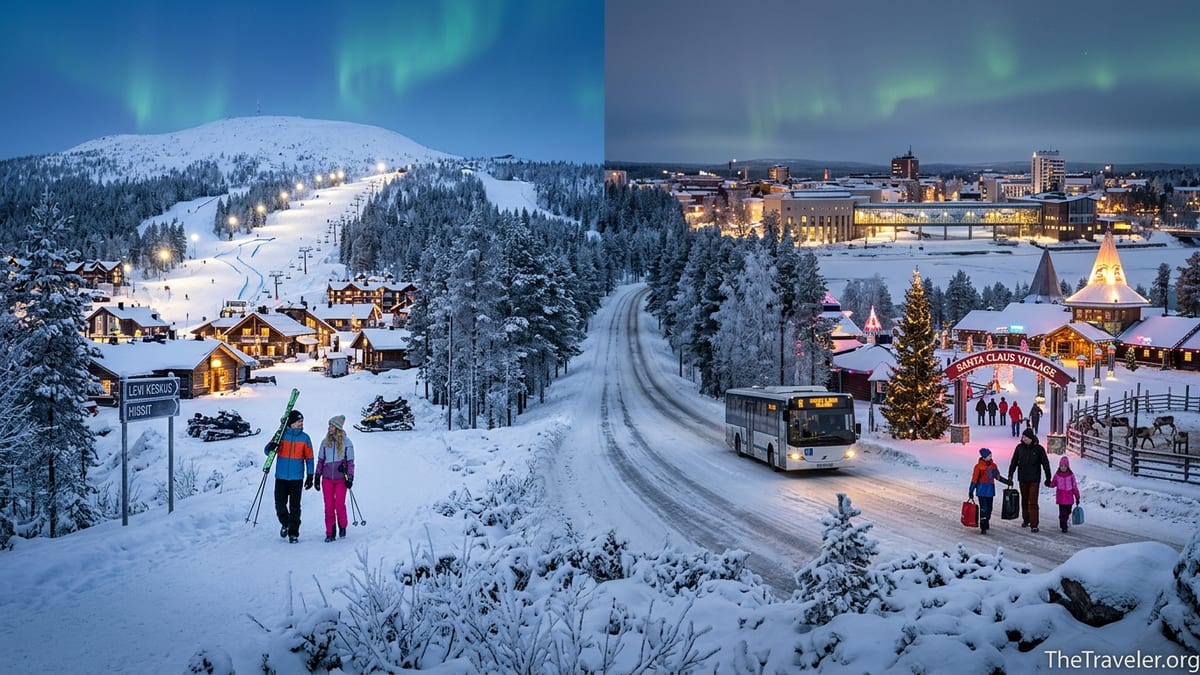
Practical verdict: two strong bases for different styles of trip
Levi is a compact ski resort built on and around a fell, about 15 kilometres from Kittilä Airport. The village has a clear mountain-holiday feel, with accommodation wrapped closely around ski lifts, cross-country tracks and snowmobile routes. Within 10 to 15 minutes by car or taxi you can be away from the main lights among open fells and frozen marshes, which helps for darker-sky aurora viewing on marginal nights. The trade-off is that Levi itself is relatively small and quiet once you step away from the slopes and bars.
Rovaniemi is the regional capital of Lapland and a much larger transport hub, sitting directly on the Arctic Circle. The airport is on the edge of town and right beside Santa Claus Village, which has grown into a substantial visitor complex of souvenir shops, family activities and seasonal attractions. Rovaniemi’s strength is the range of things to do within 30 minutes of your hotel: Santa-themed experiences, the Arktikum museum, riverfront walks, Ounasvaara ski hill and a wide choice of cafés and restaurants. You will, however, need to make more effort to escape street lighting for the best northern-lights conditions.
For a short northern-lights holiday, Levi is the stronger choice if you care as much about skiing and dark fell landscapes as you do about Santa. Rovaniemi suits first-time visitors to Lapland, especially families with younger children who want convenient airport access, Santa Claus Village and varied daytime activities, accepting that you may need to join an aurora tour to get truly dark skies.
Getting there: flights and airport transfers
Kittilä Airport serves Levi and the surrounding ski area. As of winter 2026–2027, it has scheduled winter-season flights from around 20 European airports alongside Helsinki connections, including routes operated by airlines such as Finnair, easyJet, TUI, Eurowings, Discover Airlines, KLM and others. Flight schedules are heavily seasonal, with most international routes operating roughly from late November to late March, so it is essential to check your exact travel dates before committing to accommodation or activities.
From Kittilä Airport to Levi, the distance is about 15 kilometres by road. The resort’s official information confirms that an airport bus runs between Kittilä Airport and Levi to meet scheduled flights, stopping at major hotels in the village. This service is typically operated by regional companies such as Tunturilinjat, with a journey time of around 20 to 30 minutes and fares usually under 15 euros per adult each way. For private transfers or taxis, local operators and taxi co-operatives based in Kittilä and Levi quote one-way prices that often fall in the 45 to 70 euro range for up to four passengers late in the evening, with higher rates at peak holiday times. It is wise to pre-book if you arrive on the last flights of the night so that you are not queuing behind several plane-loads of skiers.
Rovaniemi Airport is Finland’s busiest airport in Lapland and has a broader spread of flights, including domestic connections from Helsinki and seasonal international services by airlines such as Finnair, Norwegian, Ryanair, easyJet, British Airways and charter operators. Recent winter schedules include direct flights from multiple UK airports and major European hubs, especially in December and February. The attractive point here is frequency: compared with Kittilä, Rovaniemi tends to have more daily options and a longer winter season of international services.
Getting from Rovaniemi Airport to town and Santa Claus Village is straightforward. The terminal is about 9 kilometres from the city centre and only a couple of kilometres from Santa Claus Village. A dedicated Airport Express bus and seasonal shuttles such as the Elves Express run between the airport, Santa Claus Village and central hotels, typically timed to meet arriving flights. A single ticket for these services usually costs in the region of 10 to 15 euros per adult. Local bus route 8 also runs between Rovaniemi centre and Santa Claus Village in winter, giving a low-cost option for independent travel to the Arctic Circle. Taxis from the airport to central hotels or Santa Claus Village often come in around 30 to 40 euros per car in normal conditions, again with higher prices possible at peak Christmas times or late at night.
Where to stay: resort centres, quiet cabins and darker outskirts
In Levi, most visitors either stay in the central village around the main slopes or in cabins scattered in the surrounding forested neighbourhoods. Central Levi offers hotels such as Levi Hotel Spa and Panorama, self-catering apartments near the pedestrian streets and easy walking access to restaurants, ski lifts and ski-bus stops. This is ideal if you want a car-free stay and convenient access to guided tours that pick up in the centre.
For darker skies and quieter nights in Levi, many travellers look to cabins in areas such as Utsuvaara, Levijärvi or along the minor roads north and west of the main village. These often sit in lightly forested plots where local lighting is limited to a driveway lamp or two. You are still within a 10 to 20 minute drive of Levi’s services, but on a clear night you can step outside and see the Milky Way if the moon is not too bright. Cabins range from simple timber cottages sleeping two to four to high-end glass igloos and designer villas with saunas and outdoor hot tubs. Prices rise sharply over Christmas and New Year; a mid-range two-bedroom cabin in January can easily cost 180 to 250 euros per night, while the same property in late March may be significantly cheaper.
Rovaniemi’s accommodation is more urban in character. In the city centre you will find chain hotels, hostels and modern serviced apartments clustered around the pedestrian streets and riverside. This is convenient for museums, dining and bus connections, but street lighting and building floodlights mean the sky rarely gets as dark as in a small resort. A short taxi ride away, Ounasvaara hill has hotels and cabins near its small ski slopes and forest trails. Here, light pollution is lower than in the core of town, but you are still looking across a city of more than 60,000 people, so you will want to walk or drive a little way into the forest or onto quieter roads for the best aurora visibility.
For those who prioritise dark skies near Rovaniemi, there are lodges and glass-roofed cabins dotted outside the city, particularly along the roads towards Ranua, Sodankylä and Kuusamo. These properties market themselves heavily as northern-lights bases, and many include on-site aurora alerts or viewing decks. However, they usually sit 20 to 40 minutes from the city by road, and prices during December and early January can rival or exceed high-end cabins in Levi. A realistic strategy is to combine one or two nights in a more remote aurora-focused property with nights in central Rovaniemi so you can enjoy both dark skies and easy access to family activities.
Aurora conditions: darkness helps, clouds decide
On a map, Levi sits slightly farther north than Rovaniemi, but for northern-lights purposes both are well inside the auroral oval. The main constraints on what you will actually see on any given night are cloud cover, the brightness of the moon and the strength of the geomagnetic activity. A pitch-black cabin in the forest cannot compensate for dense snow clouds, and even on a starry night there may be no aurora if the Sun has been quiet. This is why experienced guides in both destinations describe the lights as a bonus rather than a guarantee.
Dark surroundings do make a difference to what your eyes and camera can pick up when the aurora is weak. In a brightly lit area of Rovaniemi, a faint green arc low on the horizon may be washed out by streetlights. In the same conditions on the edge of Levi’s fells, that arc can become a visible band with subtle structure, and your camera on a tripod can record stronger colour and movement. The same logic explains why many Rovaniemi tour operators drive 30 to 60 minutes away from town even on clear nights, often in the direction of smaller villages and forest roads, while Levi-based guides can often stop much closer to home.
For independent viewing, the key is to get away from direct light sources without putting yourself in danger. Around Levi, safe options include roadside lay-bys on ploughed minor roads, signposted viewpoints on the fell and open fields where you remain close to a maintained route. Around Rovaniemi, locals often recommend the darker stretches of road near Ounasvaara, lay-bys along the river away from the main bridges or open spaces on the edge of the forest. In both areas you should avoid walking onto unmarked frozen lakes or rivers, where ice thickness varies, and you should not wander far along remote winter roads without reflective clothing, a charged phone and knowledge of the area.
Many visitors are tempted to hike out alone into deep snow to find “perfect darkness”. In practice this can mean stumbling into knee-deep drifts, losing sense of direction and underestimating how cold it feels on a windy fell at minus 20 degrees Celsius. For most short-stay travellers, a realistic compromise is to use guided tours to access safe dark locations while also choosing accommodation with reasonably low light pollution so that, if an aurora appears at 1 a.m., you can at least see and photograph it from near your door.
Guided aurora tours and independent options
Both Levi and Rovaniemi have a mature ecosystem of aurora-focused tours ranging from budget minibus outings to premium small-group photography safaris. In Levi, local safari companies and activity centres typically offer 3 to 4 hour minibus aurora chasing experiences in groups of 8 to 16 people. Recent winter price lists from Levi operators show shared minibus tours in the region of 100 to 140 euros per adult, including warm drinks, thermal clothing and basic photography help. Longer snowmobile-based aurora safaris, which combine a short chase with off-road riding, often cost closer to 160 to 220 euros per adult, reflecting the fuel, equipment and guiding costs.
Rovaniemi has a similar price structure but a wider choice of operators, including international brands and local family businesses. Standard “northern lights hunting” trips by minibus generally last 3 to 5 hours, include hot drinks and a snack, and cost in the 90 to 150 euro range per adult depending on group size and whether professional photos are included. Some operators offer premium small-group tours of no more than eight guests with more flexible itineraries and personalised camera support; prices for these can reach 170 to 220 euros per person.
Cancellation and rebooking policies vary considerably, so this is an important detail to check before booking. Many Lapland operators will still run a tour even if the forecast is poor, describing it as an “aurora and Arctic night experience,” and they usually do not offer automatic refunds if the lights do not appear. A smaller number advertise a reduced-price or complimentary second attempt if your first outing is unsuccessful, but this is subject to availability and weather. When you book, look carefully at whether free cancellation is possible up to 24 or 48 hours before departure and whether there is any promise of a second chance in the event of thick cloud.
Independent aurora hunting is feasible from both bases if you are comfortable driving on snow and ice, have winter tyres and understand local road etiquette. Car rental offices operate at both Kittilä and Rovaniemi airports and in the towns themselves, and a compact car in January without extras may start around 70 to 90 euros per day, with studded tyres included. However, local authorities often advise visitors with no winter-driving experience to think carefully before heading out onto unlit forest roads at night, particularly when temperatures can drop below minus 25 degrees and distances between villages are long. If you do drive, stick to main roads, avoid sudden braking and always keep a shovel, warm clothes and snacks in the car.
Winter activities: skiing, Santa, huskies and more
Levi is first and foremost a ski resort, with a modern lift system, floodlit pistes and more than 200 kilometres of cross-country ski tracks in the wider area. Downhill skiing in Levi can keep a mixed-ability couple or family happy for several days, with wide blue runs, some steeper reds and a modest snowpark. A typical adult day pass in recent winters costs well over 50 euros, with discounts for multi-day passes and online purchase. The resort runs an efficient ski bus that loops around accommodation areas and lifts during the season; many lift passes or hotel stays include free or discounted use of this bus, allowing visitors to stay without a car and still reach the slopes.
In addition to skiing, Levi offers snowshoe tours, snowmobile safaris, reindeer sleigh rides and husky safaris through local ranches and kennels. A 2-hour husky experience with 2 people per sled commonly runs around 180 to 230 euros for two adults, while short reindeer sleigh rides of 1 to 2 kilometres may cost 40 to 60 euros per adult and less for children. These prices reflect the labour and animal care involved and are broadly similar in Rovaniemi.
Rovaniemi’s downhill skiing at Ounasvaara is smaller in scale than Levi but perfectly adequate for a day or two of recreational runs, especially for beginners and families. Here a day pass tends to be slightly cheaper than Levi, and you can reach the slopes by local bus or even on foot from some city hotels. The city excels in non-ski attractions: Santa Claus Village near the airport is effectively a winter theme village with free entry, paid encounters with Santa, extensive souvenir shops, sledding hills and family-friendly restaurants. Just outside the centre, the Arktikum museum and science centre offers engaging exhibits on Arctic cultures and climate, providing a warm indoor counterpoint to outdoor activities.
Both destinations support a full menu of classic Lapland experiences. In and around Rovaniemi, multiple husky and reindeer farms operate along the main roads, each offering sled rides, farm visits and photo stops. Some combine activities, allowing a half-day excursion with a short husky run, reindeer sled and lunch in a kota hut for around 160 to 230 euros per adult, discounted for children. From Levi, snowmobile tours often head into the surrounding fells or towards the Pallas-Yllästunturi National Park, giving more of a backcountry feel. For visitors who are more interested in landscapes than Santa, Levi’s immediate surroundings feel wilder, while Rovaniemi provides greater cultural and family variety.
Seasonal conditions, clothing and accessibility
In both Levi and Rovaniemi, December is characterised by very short days or polar night conditions. Around mid-December, you can expect only a few hours of blue twilight, with the sun barely rising above the horizon or not at all depending on your exact dates. This darkness creates atmospheric soft light on snow and means that, when the skies are clear, you have long windows for potential aurora viewing. It also means that first-time visitors can underestimate how tiring it is to be outdoors for long hours without full daylight, especially with children.
January often brings the coldest temperatures. It is not unusual for both destinations to see nights below minus 25 degrees Celsius and occasional cold snaps approaching minus 35. In these conditions, exposed skin can become painful within minutes, camera batteries drain very quickly and waiting outside for the aurora without proper clothing is uncomfortable at best. February and March usually bring more daylight, with 7 to 10 hours of usable light, more intense sun on the slopes and often more stable weather, at the expense of slightly shorter dark windows for the northern lights. Many repeat visitors consider late February or early March the sweet spot for a balance of light, snow quality and aurora chances.
Because of the climate, almost all safari companies in Levi and Rovaniemi provide thermal overalls, boots and gloves included in their tour prices, and many accommodation providers offer rental clothing to guests. Daily rental for a full thermal set might range from 20 to 35 euros per person, with discounts for multi-day use. For travellers flying in from milder climates, this can be more practical than buying specialist gear, as long as you still bring a warm base layer of merino or synthetic long underwear, socks and mid-layers.
In terms of accessibility, both destinations work well for car-free travellers. In Levi, the airport bus, resort ski bus and central compactness make it easy to manage with luggage and children, and most tours include central pick-ups. In Rovaniemi, airport buses, local city buses and tour pickups from major hotels cover most needs, supplemented by widely available taxis. If you have pushchairs, mobility needs or simply prefer not to walk on packed snow, look for accommodation directly on bus routes 8 or the airport shuttle routes in Rovaniemi, and near the Levi village core or ski bus stops in Levi.
Two-night sample itineraries and indicative costs
For a couple visiting Levi for two nights in mid-winter without a car, one realistic itinerary could look like this. Day 1: arrive at Kittilä Airport in the afternoon, take the scheduled airport bus to a mid-range hotel or apartment in central Levi. After check-in, rent thermal clothing if not included, explore the village and take an evening walk to a darker edge of the resort in case of clear skies. Day 2: spend the day skiing or snowshoeing, then join a 3 to 4 hour small-group aurora-chasing minibus tour in the evening, including warm drinks and guidance on photography. Day 3: enjoy a short reindeer or husky experience before taking the airport bus back to Kittilä.
Cost-wise, return airport bus transfers for two might come to roughly 60 euros in total. Two nights in a central mid-range hotel in Levi in January can easily be 350 to 500 euros for a double room including breakfast, depending on exact dates and demand. A shared aurora tour for two adults at 120 euros per person would add around 240 euros. One half-day ski pass each plus rental equipment could add around 200 to 260 euros, while a short reindeer or husky trip might add 150 to 200 euros for two. Food costs will vary, but allowing 70 to 100 euros per day for café lunches and casual restaurant dinners is realistic. Overall, a two-night Levi stay for a couple can quickly land in the 1,100 to 1,400 euro range before flights.
For a family of four in Levi, costs scale up but some items become relatively cheaper per person. A self-catering apartment for two nights could cost 400 to 600 euros, and many ski resorts offer discounted child lift passes and rental. Airport bus transfers for four might be around 100 euros in total, and a family-focused aurora tour that accepts children might charge perhaps 80 to 110 euros per adult and 50 to 80 euros per child, adding 260 to 380 euros. Reindeer and husky experiences often have family packages that reduce the per-person price. Cooking some meals in the apartment can significantly reduce dining costs compared with restaurant-only eating.
In Rovaniemi, a two-night itinerary for a couple might focus less on skiing and more on Santa and culture. Day 1: arrive at Rovaniemi Airport, take the Airport Express or Elves Express shuttle to the city centre for around 25 to 30 euros for two, check into a mid-range hotel and visit the Arktikum museum. In the evening, join a small-group aurora minibus tour that drives 30 to 60 minutes out of town for dark skies. Day 2: take a local bus or shuttle to Santa Claus Village, spend the day visiting Santa, sending postcards and enjoying gentle sledding and short reindeer rides, then either book a second, shorter aurora excursion or watch the sky from a darker riverside spot. Day 3: stroll the riverfront or Ounasvaara before shuttling back to the airport.
Central hotel prices in Rovaniemi during peak December dates are high. Two nights for a couple close to Christmas can easily exceed 500 euros, while January and March are somewhat less. An aurora tour for two adults could again be around 200 to 260 euros in total if priced around 100 to 130 euros per person. Transfers by bus between airport, city and Santa Claus Village over two days might add 40 to 60 euros in total, while a day at Santa Claus Village with paid activities such as photos with Santa, short reindeer rides and meals can add another 150 to 250 euros for two depending on choices. Restaurant meals and cafés in Rovaniemi are broadly comparable in price to Levi, so a couple might again spend 70 to 100 euros per day on food if eating out.
For a family of four based in central Rovaniemi, two nights in a family room or small apartment may range from 450 to well over 650 euros in peak December or New Year periods. Airport and local bus transfers could total 80 to 120 euros, depending on how many Santa shuttles are used. A family-friendly aurora tour might cost in the region of 300 to 450 euros in total with child discounts. A full day at Santa Claus Village, considering meals, souvenirs and paid experiences, can become the largest single cost line after accommodation, especially with multiple children. As in Levi, self-catering accommodation and supermarket shopping can reduce overall expenses if you are prepared to cook some meals.
Final comparison: who should choose Levi, who should choose Rovaniemi?
For aurora photography and darker landscapes, Levi has the edge. The resort is small, and within minutes by car you can reach open fell areas and unlit fields that combine dark skies with relatively easy access. Photographers who want foreground elements such as silhouetted trees, ski slopes or distant fells will find plenty of compositions close at hand without needing to drive an hour from a city. Rovaniemi-based photographers can certainly capture excellent aurora images, but they will nearly always be planning to leave the city lights by tour or car when conditions look promising.
For family holidays, especially with Santa-focused younger children, Rovaniemi is the more rounded choice. The proximity of the airport to Santa Claus Village, the density of family-friendly attractions and the relative ease of moving between indoor and outdoor activities in a city environment all work in its favour. Parents can mix short, manageable bursts of cold-weather fun with museum visits, cafés and hotel pool time without long transfers. Levi is still family-friendly, particularly for families who enjoy skiing, but it lacks the same concentration of Santa experiences and city comforts.
For skiing, Levi is clearly ahead. Its larger lift system, longer pistes and extensive cross-country network provide several days of varied skiing and snowboarding. Ounasvaara in Rovaniemi is enjoyable, but it is more of a local hill than a destination ski resort. Visitors whose main aim is skiing with aurora as a bonus are better served in Levi or elsewhere in Lapland’s dedicated ski areas.
For car-free travel, both are feasible, but Rovaniemi’s role as a regional hub gives it slightly more resilience. If flights are delayed or changed, you have more accommodation choices, more frequent buses and trains to other Finnish cities and a wider range of services within walking distance. Levi works very well without a car for a straightforward ski-and-safari stay, helped by the airport bus and ski bus networks, but it is more dependent on specific flights into Kittilä and feels more like a resort bubble.
For budget-conscious visitors, neither destination is cheap in winter, but it is often possible to find slightly better-value accommodation in Rovaniemi outside the peak Christmas weeks, particularly in simple city hotels or hostels. At the same time, food and activity prices are similar between the two, and Levi’s self-catering cabins can be good value for groups who share costs and cook. Ultimately, your largest savings come from travelling outside the most expensive weeks, limiting high-cost animal safaris and perhaps choosing one guided aurora tour rather than several.
Above all, both Levi and Rovaniemi can deliver unforgettable northern-lights memories, yet neither can guarantee them. The most reliable strategy is to give yourself several nights in Lapland, stay flexible with your evenings, accept that clouds may win some nights and enjoy the winter landscapes, activities and cultural experiences regardless of what the sky decides to do.