


More news on this day
Light rail service through Seattle’s Chinatown–International District Station was severely disrupted on Sunday evening after a train derailed near a track switch close to the station, stranding large crowds of riders leaving a nearby arena concert and triggering extensive delays across the network.
Get the latest news straight to your inbox!
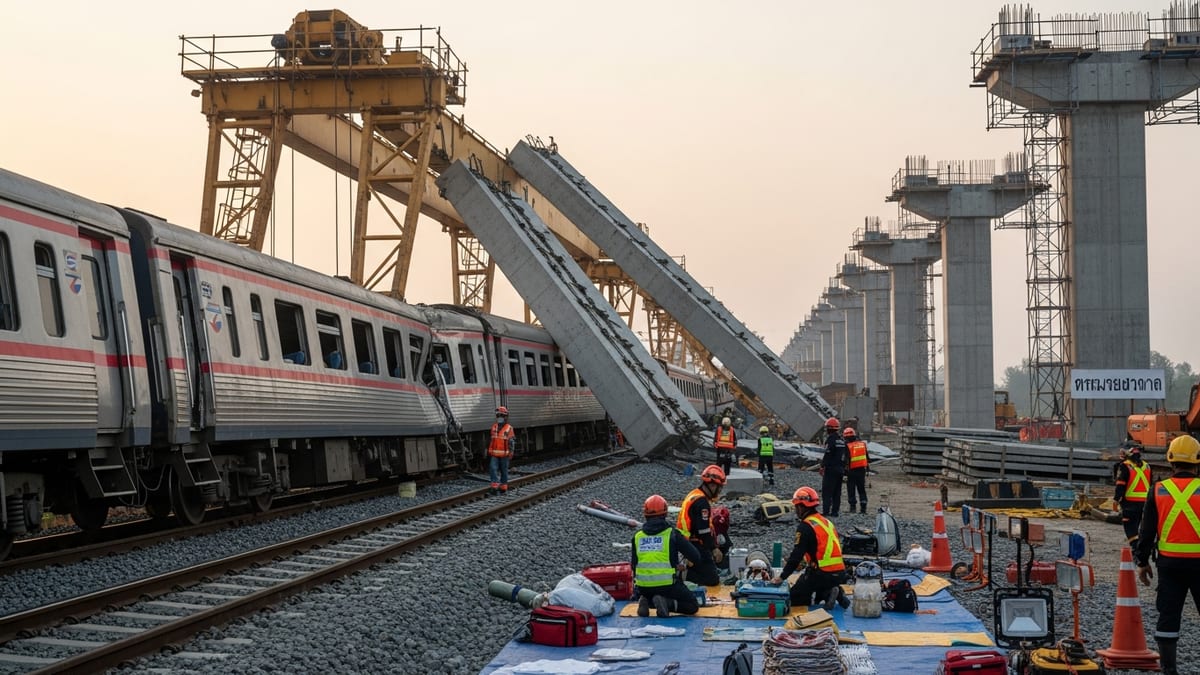
Train leaves rails near turnaround track by CID Station
Early reports from riders and on-the-ground observations indicate that an out-of-service light rail train derailed near the center turnaround track at Chinatown–International District (CID) Station shortly after the end of a major downtown concert. The train was reportedly moving without passengers, heading back toward a storage or maintenance facility, when it encountered trouble at or near a track switch.
Images and descriptions shared on social media show at least one car visibly off the running rail but still upright, with emergency staff and transit personnel inspecting the site. The incident occurred within the tight confines of the downtown transit tunnel, where the station platforms, switches, and center track are closely spaced to allow trains to reverse direction.
Publicly available information suggests the derailment happened as the train transitioned through a switch connecting the mainline to the center track that is used for turning trains back. Enthusiast mapping tools that detail local rail infrastructure have previously shown a center pocket track in this location, designed for operational flexibility but also representing one of the more complex sections of track in the core system.
No injuries had been publicly reported in the immediate aftermath of the incident, and early rider accounts consistently described the affected train as being out of service, meaning regular passengers were not on board when the wheels left the rails.
Service suspensions, packed platforms and long waits
The derailment quickly translated into a serious operational challenge on what was already a high-demand evening. Riders returning from the nearby concert venue and downtown events reported waiting on crowded CID Station platforms as arrival boards showed no incoming trains or repeated delay messages.
With the train blocking a key section of track and the surrounding tunnel area under inspection, regular through service on at least one line was halted for a time. Passengers posted accounts of being directed to alternative stations or replacement bus options, while others chose to walk north or south to less congested parts of the network in hopes of finding a functioning train.
Some travelers described more than an hour of waiting before being able to board an eastbound train, while others abandoned the light rail system entirely in favor of surface buses or rideshare services. The timing, coinciding with a concert that had filled trains earlier in the evening, contributed to unusually dense crowds in and around the CID Station area.
The disruption also rippled outward, with subsequent trains forced to hold outside the station or be short-turned at earlier stops to keep them away from the blocked track segment. Riders along the affected line reported slower-than-usual trips and extended headways even after limited service resumed.
Early indications point to switch-related derailment
While a full technical explanation is expected to take time, preliminary descriptions from local rail observers highlight the role of the complex switching layout near CID Station. The center track that allows trains to turn back toward the north or east is controlled by a series of switches that route wheels from one alignment to another over a short distance.
Several rail-knowledgeable commentators noted that derailments in such areas can occur if a switch is not fully aligned, if wheels reach a movable point before it locks, or if there is an unexpected change in the switch position while a train is passing over it. Past investigations of similar light rail incidents in other cities have frequently cited switch issues, human-factor errors in operating procedures, or a combination of both as contributing elements.
According to widely used safety guidance for rail systems, modern automatic train protection and signaling are designed to make collision and derailment scenarios at low speed extremely rare, particularly in controlled tunnel environments. However, out-of-service moves, complex turnbacks, and maintenance-related operations can present additional operational risks that agencies attempt to manage through strict rules and redundant checks.
In this case, the train remained upright and early visual accounts did not indicate severe structural damage, suggesting a relatively low-speed event near the switch. Nonetheless, any instance of wheels leaving the rail demands a thorough technical review of track condition, switch hardware, train handling, and control-system performance.
Crowded event night magnifies passenger frustration
The derailment landed at a sensitive moment for the region’s transit riders. The concert at a nearby arena had already pushed capacity on newly extended light rail lines, with some passengers sharing that trains and platforms were as crowded as they had ever seen them, including on previous milestone opening days or major sports events.
When the derailment stopped trains just as thousands of people sought to go home, frustration quickly mounted. Riders described confusion about when service might resume, with station announcements emphasizing delays and disruptions but offering few specific timelines for clearing the incident.
Some passengers adjusted by walking to Pioneer Square Station or further north to Westlake and other downtown stops in search of less congested platforms and alternate lines. Others criticized the lack of more robust event-night planning and contingency operations, suggesting that the system’s current configuration leaves little room for error when a key station like CID goes offline.
The crowding also underscored how dependent the region’s growing population has become on light rail for late-night travel to and from major cultural events, and how a single infrastructure failure near a central node can rapidly cascade into a systemwide disruption.
Investigation and recovery efforts expected to shape future operations
Transit agencies are typically required to conduct detailed incident reviews after any derailment, even those that result in no injuries. That process generally includes close inspection of the track, switches, signaling, and vehicle components involved, as well as a reconstruction of train movements and operating decisions leading up to the event.
Publicly available summaries from previous derailments in other American light rail systems show that agencies often respond by adjusting operating rules around complex track segments, re-training operators on procedures for using crossovers and pocket tracks, and scheduling additional inspections or hardware upgrades where needed.
For passengers on Sunday night, the most immediate concern was simply getting home. As recovery crews worked to re-rail the affected car and verify the integrity of the surrounding infrastructure, transit managers gradually restored limited service through the area, with full normal operations expected only after a complete safety sign-off.
In the longer term, the derailment near CID Station is likely to feed into broader debates about capacity, resilience, and maintenance investment in the region’s light rail network. The incident highlights both the importance of robust event-night planning and the vulnerability of a system that relies heavily on a few central chokepoints to move thousands of people efficiently through the urban core.