


More news on this day
Passengers booked on a Scandinavian Airlines flight from New York John F. Kennedy International Airport to Copenhagen faced an unexpected ordeal after the transatlantic service turned back mid-route and returned to the United States, leaving travelers stranded at the airport well past midnight.
Get the latest news straight to your inbox!
Transatlantic Turnback Disrupts SAS Link Between New York and Copenhagen
Publicly available flight-tracking data show that Scandinavian Airlines flight SK916, operating between New York JFK and Copenhagen, departed on a recent Friday evening before reversing course over the North Atlantic and heading back toward the New York area instead of continuing to Denmark. The service is marketed by Air France as AF4350 and is one of the primary overnight links between New York and the Danish capital.
Live trackers such as Flightradar24 and commercial status services indicate that SK916 pushed back from JFK on the evening of October 23, 2026, several hours after its scheduled early-evening departure slot. The Airbus widebody crossed into the North Atlantic before the track curved back toward North America, with the aircraft ultimately returning to the New York region rather than continuing on to Copenhagen as planned.
Separate status tools covering recent SK916 operations list subsequent services on the route as disrupted, with at least one later New York–Copenhagen departure cancelled or showing incomplete arrival data. These patterns suggest knock-on operational effects for the carrier’s transatlantic program, as aircraft and crews assigned to SK916 would normally feed a dense morning bank of European and Scandinavian connections from Copenhagen.
As of October 31, 2026, online timetables still list SK916 as a regular overnight JFK–Copenhagen service, using an Airbus A330-300 and targeting an early morning arrival into Copenhagen Airport’s Terminal 3. However, recent irregular operations on the route highlight the vulnerability of long-haul schedules when a single flight experiences an in-flight issue that forces a return.
Reports Describe Technical Problem and Midnight Stranding
According to published coverage on specialist travel sites that reviewed the incident using passenger accounts and tracking data, the turnback of SK916 appears to have been prompted by a technical concern detected after the flight was already over the Atlantic. The aircraft reportedly reversed course partway across, with passengers noting on onboard maps that the route line had shifted back toward New York instead of continuing toward Greenland and Scandinavia.
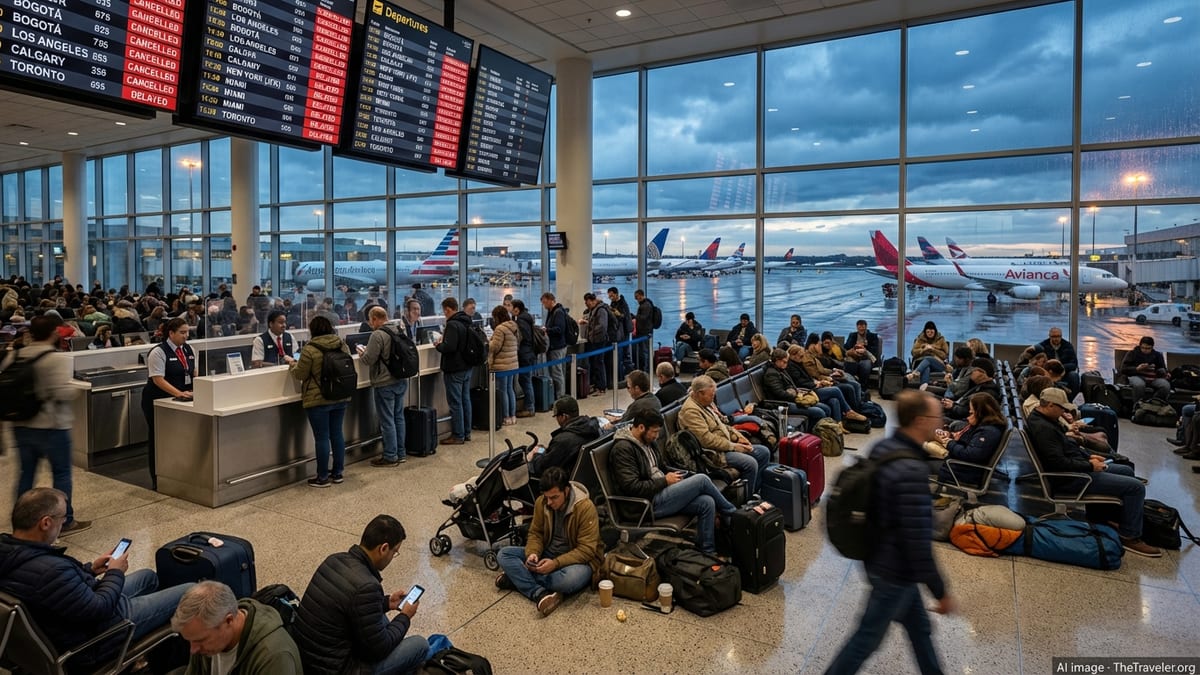
Reports indicate that the aircraft landed back in the New York area after midnight local time. Passengers arriving into the terminal then faced the challenge of rebookings and overnight arrangements, at a time when many airport services, including food outlets and ground transport links into Manhattan and New Jersey, were running limited late-night operations.
Blog posts and social media discussion around the incident describe travelers waiting for information on whether a rescue flight or same-night continuation to Copenhagen would be provided. In the end, publicly available data suggest that no onward departure to Denmark operated in the early morning hours following the diversion, leaving many passengers to overnight either at or near the airport.
Some accounts mention that families with children and travelers with onward connections to other Scandinavian and European cities were especially affected, as the missed morning arrival into Copenhagen disrupted complex itineraries built around SAS’s hub schedule. With Copenhagen serving as a key transfer point for destinations across the Nordic region and continental Europe, a lost overnight sector can cascade into missed cruises, tours, and regional flights.
Knock-On Impact on SAS Schedules and Passengers
Operational data for the days following the diversion suggest that SAS’s New York–Copenhagen schedule did not immediately return to normal. Flight-status aggregators show at least one SK916 rotation as cancelled on October 30, 2026, while the corresponding westbound service SK915 from Copenhagen to JFK also appears as cancelled in timetable archives for the same date.
These disruptions indicate that the aircraft involved in the diversion may have required additional maintenance checks after its unscheduled return, or that SAS needed to reposition widebody capacity within its long-haul network. For passengers, that translated into further cancellations and rebookings on one of the airline’s key transatlantic routes, with some travelers shifted to alternative departures from Newark or rerouted via other European hubs.
Because Copenhagen is an important connecting point for SAS flights into Scandinavia, the Baltic states, and parts of Central Europe, interruptions on SK916 can quickly affect travelers far beyond Denmark itself. A delayed or cancelled arrival from JFK means missed morning departures to cities such as Stockholm, Oslo, Helsinki, and Berlin, often requiring overnight stays or substantial itinerary changes.
Flight history summaries for SK916 also show that the route has contended with punctuality challenges in recent months, with average departure delays of several dozen minutes even on days without major disruptions. While arrival performance has generally been more reliable thanks to schedule padding, the October diversion underscores how a single technical incident can overshadow otherwise steady on-time statistics.
What Stranded Travelers Can Expect Under EU Air Passenger Rules
The diversion of SK916 raises familiar questions for transatlantic passengers about care, assistance, and potential compensation when a long-haul flight turns back or is cancelled. The journey involved an EU-registered carrier operating from the United States to Europe, which brings the flight within the scope of EU Regulation 261/2004 for the Europe-bound leg.
Under that framework, travelers on affected SAS services can generally expect the airline to provide meals, refreshments, and hotel accommodation when an overnight stay becomes necessary due to disruption. Transport between the airport and accommodation is typically included, along with the right to rebooking at the earliest opportunity or a refund of the unused portion of the ticket if passengers choose not to travel.
Whether additional cash compensation is due depends on the cause of the disruption. If the technical problem that prompted the turnback is considered inherent to the normal operation of the aircraft and not an extraordinary circumstance, passengers may be eligible for standardized payments tied to flight distance and delay length. If, however, the issue is classified as extraordinary, compensation may be limited to care and rerouting, rather than fixed monetary sums.
Specialist passenger-rights organizations and national enforcement bodies in Scandinavia and the wider European Union provide guidance on how travelers can document their case, gather evidence such as boarding passes and written notifications, and submit formal claims. Many advise keeping itemized receipts for out-of-pocket expenses, such as meals purchased when airport vouchers are insufficient, to support later reimbursement requests.
Practical Advice for Future SAS JFK–Copenhagen Passengers
For travelers still planning to fly between New York and Copenhagen with SAS in the coming weeks, publicly available schedules show SK916 continuing to appear as an overnight departure from JFK, generally leaving in the evening and arriving in Denmark early the following morning. The route remains an important link for both leisure and business travelers connecting onward through Copenhagen.
Consumer travel guides recommend checking the real-time status of SK916 on multiple platforms before leaving for the airport, including the carrier’s own channels and independent flight-tracking services. Monitoring both the inbound aircraft from Copenhagen and the outbound JFK departure can provide early warning of delays or potential irregular operations.
Travel advisers also suggest building extra flexibility into same-day connections in Copenhagen after a transatlantic arrival, particularly in light of recent disruptions. Allowing a longer layover window or planning an overnight in Denmark before onward travel can reduce the risk that a diversion or delay on SK916 unravels an entire trip.
Finally, passengers concerned about disruption risk may want to review ticket conditions, travel insurance coverage, and credit card protections before flying. Policies that explicitly mention missed connections, overnight delays, or airline-caused diversions can offer an additional financial backstop if an incident similar to the recent SK916 turnback leaves travelers unexpectedly stranded far from their final destination.