


Landing at Casablanca Mohammed V International Airport and heading into Morocco’s largest city can feel hectic at first glance, but the airport train makes the journey surprisingly straightforward. With a station directly beneath Terminal 1 and frequent ONCF services into the city, you can be downtown in under an hour for a fraction of the cost of a taxi. This guide walks you through every step, from buying tickets and handling luggage to choosing the best city station for your hotel or onward connection.
Get the latest updates straight to your inbox!
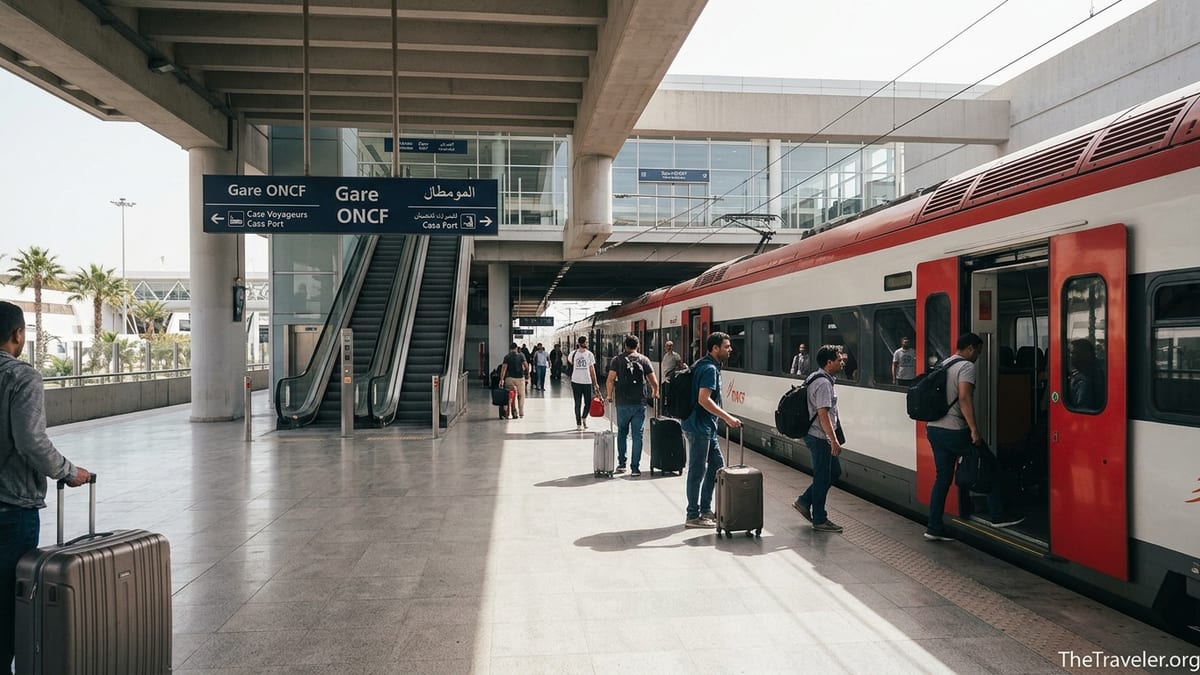
How the Casablanca Airport Train Works
Casablanca Mohammed V International Airport (CMN) is linked to the city by a suburban/intercity rail service operated by ONCF, Morocco’s national railway. The airport station is called “Aéroport Mohammed V” and sits on a dedicated branch that runs through L’Oasis and Casa Voyageurs to Casa Port in the city center. Trains typically run from early morning until late evening, with intervals that are usually around 30 to 60 minutes depending on the time of day and season.
The journey from the airport to Casa Voyageurs usually takes around 35 to 45 minutes, and continuing on to Casa Port adds roughly another 10 to 15 minutes. In practice, visitors landing on common European arrivals around midday can often be at Casa Voyageurs within one hour of clearing passport control if they catch the next train. This compares favorably with traffic-prone road journeys into central Casablanca, especially during weekday rush hours.
ONCF treats the airport line as part of its wider network, so the same trains that serve the airport also continue beyond Casablanca to other cities such as Rabat, Fez and Marrakesh. Many travelers use the airport train for an immediate onward connection: for example, landing at CMN in the morning, riding the train to Casa Voyageurs, then boarding a high-speed Al Boraq service to Tangier or an Al Atlas train to Marrakesh later the same day.
Schedules and rolling stock can change, so it is wise to double-check departure times shortly before you travel. ONCF provides a timetable search on its official platform where you can verify the first and last trains on your specific date. If you are landing late at night or very early in the morning, always confirm that a train is running close to your arrival time before you commit to relying on rail.
Terminal 1 Station: Access, Layout and What to Expect
The airport train station is located directly underneath Terminal 1, in the basement level that is connected to the main arrivals concourse via escalators and elevators. Once you clear customs and collect your bags, follow signs in French and English for “Train / Gare ONCF.” The walk from baggage claim to the station typically takes five to ten minutes at a normal pace, entirely indoors and step-free if you use the lifts, which is helpful for travelers with heavy luggage or strollers.
At station level you will find a ticket counter, automatic ticket machines, platforms and basic amenities such as seating and information screens. The station is relatively compact, so you do not need to worry about getting lost. Many visitors arriving for the first time are surprised to find how close the platforms are to the terminal: you simply buy your ticket, descend to the correct platform and board. There is no separate security screening at the station beyond the standard presence of railway staff and, occasionally, police.
The platforms are covered, which is important in Casablanca’s hot summers and during occasional winter rain. Trains usually stop long enough to allow passengers with suitcases to board without rushing, but when the train arrives it is best to move promptly to your carriage because doors can close automatically after a short dwell time. During busy periods, especially around national holidays, you may see a mix of airport passengers with wheeled luggage and local commuters using the same service.
If your flight arrives into Terminal 2, you do not need a shuttle bus to reach the train. Terminals 1 and 2 are connected landside, and most travelers simply walk from Terminal 2 arrivals to the Terminal 1 concourse and down to the station. Allow a few extra minutes if you are traveling with children or heavy bags, but the route is well signposted and commonly used by passengers making this transfer.
Key City Stations: Casa Voyageurs, Casa Port and L’Oasis
Choosing the right station in Casablanca makes your onward journey much easier. The main hub is Casa Voyageurs, located in the Belvédère district east of the city center. This is Casablanca’s primary intercity station, with direct trains to Rabat, Tangier (via high-speed Al Boraq), Fez, Marrakesh and other major destinations. If you are planning to leave Casablanca soon after landing, or if your hotel is near the eastern neighborhoods, Casa Voyageurs is often the most practical stop.
Casa Port station lies closer to the historic downtown, the port and areas such as the Old Medina, the business district around Avenue des FAR and many international-brand hotels. The airport trains that continue past Casa Voyageurs to Casa Port are convenient if you want to reach these central districts with minimal need for a taxi. Many business travelers arriving for meetings in central office towers choose to stay near Casa Port precisely because of this straightforward rail access.
L’Oasis (often signed as Casa-Oasis) sits in a largely residential and business area south of the center. It is a useful stop if you are staying in neighborhoods like L’Oasis, Maarif extension or near some of the city’s private clinics and offices. It is also a common intermediate stop for travelers who are continuing by taxi or ride-hailing service into the western suburbs, since traffic congestion there can make a direct airport taxi slower and more expensive.
In addition to these three, the airport trains also call at other intermediate stations such as Bouskoura and Facultés on their way into the city. These stops are not typical tourist hubs, but they can be relevant if you have work at the university district around Facultés or if you are staying in a suburban guesthouse. When checking timetables, look for services listing “Aéroport Mohammed V” at one end and “Casa Voyageurs” or “Casa Port” at the other, then verify the intermediate stops to see which fits your plans.
Tickets, Classes and How to Buy
Tickets for the airport train operate on a simple distance-based fare system. Prices are usually quoted in Moroccan dirhams and are subject to change, but as a broad reference a one-way second-class ticket from Aéroport Mohammed V to Casa Voyageurs has recently been in the ballpark of a few dozen dirhams, often less than the cost of an airport coffee. Continuing to Casa Port costs slightly more. First-class tickets are more expensive but still modest by Western European standards, offering reserved seating and a bit more comfort.
You can buy tickets at staffed counters in the airport station using cash or commonly accepted credit cards. There are also ticket machines that allow you to select your destination (for instance “Casa Voyageurs” or “Casa Port”), class and number of passengers. Many travelers prefer to pay in cash, particularly if their card sometimes triggers extra verification abroad, but card payments are widely used. If you are connecting onward by train to another city, you can usually purchase a combined ticket from the airport to your final destination, such as Marrakesh or Rabat, in a single transaction at the counter.
ONCF also sells tickets online, including through its official booking platform and mobile app. Buying ahead can be useful if you are traveling at peak times or want to lock in a first-class seat on a long-distance leg from Casa Voyageurs. In practice, many visitors simply buy on arrival, as airport-to-city trains rarely sell out in the way that high-speed or popular intercity services might. For same-day travel, staff at Aéroport Mohammed V station are accustomed to helping newly arrived travelers choose the right ticket and connection.
Tickets are checked either at station gates or on board by conductors. Keep your ticket handy until the end of your trip, especially if you are continuing beyond Casablanca, as inspectors may pass through the carriages more than once on longer legs. If you unexpectedly board the wrong train or overshoot your station, speak to the conductor as soon as possible; in many cases they will advise on paying any fare difference or where to change for the next service back.
Luggage, Comfort and Onboard Experience
Airport trains are used to passengers with suitcases, backpacks and sports gear. Carriages typically have overhead racks suitable for cabin-size luggage and some open spaces near doors where larger suitcases can be placed without blocking the aisles. Unlike airport-specific express trains in some countries, there is not usually a separate luggage car, so be prepared to keep an eye on your belongings just as you would on any busy regional service.
Standard second-class carriages usually feature 2+2 seating with a mix of forward and backward-facing seats. First-class cars offer slightly wider seats, more legroom and, on many services, a quieter atmosphere, which can be appreciated after an overnight flight. Air conditioning is standard, but as with any rail system, temperatures can vary slightly between coaches. If a particular carriage feels crowded or warm, you can typically move to another once the train is underway, as long as you remain in the correct class.
Eating and drinking simple snacks on board is common, and you will often see local commuters with small pastries or bottled water. There is not usually a full dining car on the airport run itself, though some longer intercity services connected to Casa Voyageurs may feature café options. If you are arriving after a long flight, it is sensible to pick up a bottle of water or a light snack in the terminal before boarding. Many travelers also use the train ride to purchase or validate local SIM cards on their phones, using the time to get connected before arriving in the city.
Security is generally straightforward. You may occasionally encounter ticket checks on the platform as well as on the train, and it is normal to see a visible presence of railway staff. As in any busy urban rail system, keep wallets and phones secure and do not leave bags unattended near doors. Late-evening trains from the airport tend to have a mix of arriving tourists and locals heading home, and many solo travelers report feeling comfortable, though those arriving after the last train of the night will need to switch to taxis or private transfers instead.
Typical Travel Times, Frequency and Realistic Scenarios
On paper, the airport-to-city journey can be surprisingly quick. The train ride from Aéroport Mohammed V to Casa Voyageurs is usually around 40 minutes, and Casa Voyageurs to Casa Port adds roughly 10 to 15 minutes. Factoring in a 15- to 30-minute wait for the next train, you can realistically expect to be in central Casablanca 60 to 80 minutes after leaving the arrivals hall on an average day. This timing assumes no unusual delays at immigration or baggage claim.
Numerous recent accounts and schedules highlight that trains often run at intervals around the half-hour mark during the day on the dedicated airport line, with less frequent services early in the morning and later at night. For example, a traveler landing from Paris around 10:00 could reasonably expect to catch an airport train close to 11:00, arrive at Casa Voyageurs before midday and board a midday or early afternoon connection to Marrakesh. Another common pattern is an evening arrival from Europe around 19:00, catching an 20:00-ish train into the city and reaching a hotel near Casa Port before 21:00.
Delays can happen, particularly during peak holiday periods or when there are infrastructure works near Casablanca. The safest approach is to build in at least one train’s worth of buffer if you have a long-distance connection, such as a high-speed Al Boraq to Tangier. If your long-haul flight is due in at 13:00 and the Al Boraq you want leaves Casa Voyageurs at 15:00, consider aiming for the 16:00 departure instead. This reduces stress if passport control is busy or if you just miss an airport train by a few minutes.
For very early flights departing Casablanca, many travelers take a late-evening train to the airport the night before and sleep at an airport hotel, or they plan to be on a train that arrives two to three hours before check-in closes. A common example is a 07:00 European departure: passengers staying near Casa Port might board a train around 04:30 to 05:00, giving enough time for the ride to the airport and standard airline check-in and security procedures without rushing.
Train vs Taxi: Costs, Convenience and When Each Wins
From a cost perspective, the airport train is usually significantly cheaper than taxis. Recent fare boards and local reports indicate that official grand taxi rides from Casablanca Mohammed V Airport to the city center often quote fixed prices in the region of a couple of hundred dirhams or more, especially to popular hotel areas or during late-night hours. By contrast, a second-class train ticket to Casa Voyageurs or Casa Port typically costs only a fraction of that amount per person. For solo travelers or couples arriving during train operating hours, the savings are substantial.
Time competitiveness depends heavily on road traffic. In light traffic, a taxi from the airport to central neighborhoods such as Maarif or the business district can take around 35 to 45 minutes. During weekday rush hours, especially late afternoon and early evening, the same ride may stretch well past an hour as vehicles queue on the main highway into the city. The train’s journey time is more predictable, which is why many business travelers and locals prefer rail if their schedules align, particularly when they need to make a train connection at Casa Voyageurs.
There are, however, clear cases where a taxi or private transfer makes more sense. If your flight lands after the last train of the night or departs before the first morning service, rail simply is not an option. Families with small children and multiple large suitcases sometimes prefer a door-to-door car even at a higher cost, because it removes the need to navigate stations. Travelers with mobility limitations may find that arranging an accessible vehicle directly to their hotel in neighborhoods without easy rail access, such as parts of Anfa or Ain Diab, is worth the extra expense.
A practical compromise is to combine both modes. For instance, you might take the train from the airport to Casa Voyageurs, then use a short taxi ride to reach a hotel in the Gauthier or Racine districts. In this scenario, you benefit from the speed and low cost of the train for most of the distance while minimizing time spent in traffic and the overall taxi fare. Similarly, if you are heading straight to Marrakesh, the train from the airport to Casa Voyageurs followed by an intercity service south is often more efficient and less tiring than a long taxi ride on the motorway immediately after a flight.
Practical Tips, Safety and Real-World Use Cases
To make the most of the airport train, consider a few simple strategies used by frequent travelers. First, check the ONCF timetable for your exact date a day or two before your trip and take a screenshot of the relevant departures in case mobile data is slow at the airport. Second, keep some small denominations of dirhams handy for buying tickets and small items on arrival, even if you plan to use a card for most expenses. Currency exchange desks and ATMs are available in the terminal before you reach the station.
When traveling with heavy luggage, aim for carriages near the middle of the train, which often have more open floor space by the doors. Avoid placing valuable items in external pockets of backpacks or suitcases that will be out of your direct line of sight. In busy periods you may need to stand for part of the journey in second class; if this is a concern after a long flight, consider paying the modest supplement for first class, especially if you are continuing beyond Casablanca on the same train.
Solo travelers arriving at night commonly use the train without issue, but general urban common sense applies. Stay in well-lit areas of the station, follow the flow of other passengers and avoid leaving the station precincts with unofficial touts. If you arrive late and decide the station surroundings feel too quiet, choosing a licensed taxi directly outside the terminal instead of walking to off-site transport hubs is entirely reasonable, even if it costs more than the train would have.
For those planning onward journeys the same day, think through one or two backup options. For example, if you intend to catch the airport train into Casa Voyageurs and then the high-speed train to Tangier, identify what you will do if your incoming flight is delayed and you miss your planned connection. This might mean buying a flexible ticket type, being prepared to purchase a new ticket at the station or, in the worst case of very late arrival, booking a hotel near Casa Voyageurs and continuing the next morning. Planning these contingencies in advance makes the realities of travel delays much less stressful.
FAQ
Q1. How much does the train from Casablanca Airport to the city cost?
The exact fare varies over time, but a one-way second-class ticket from Aéroport Mohammed V to Casa Voyageurs or Casa Port is generally priced at a modest level, typically only a small fraction of what an airport taxi would cost. First class costs more but remains affordable by European standards.
Q2. How often does the train run between Casablanca Airport and the city?
Trains usually run from early morning until late evening, with typical intervals around 30 to 60 minutes depending on the time of day and season. Service can be less frequent very early or very late, so always check the current timetable before traveling.
Q3. How long does the train take from the airport to central Casablanca?
The journey from Aéroport Mohammed V to Casa Voyageurs usually takes about 35 to 45 minutes, and continuing on to Casa Port adds another 10 to 15 minutes. Including waiting time for the next departure, most travelers reach the city in roughly one hour.
Q4. Which station should I use: Casa Voyageurs, Casa Port or L’Oasis?
Casa Voyageurs is best for onward trains to cities like Marrakesh, Tangier, Rabat and Fez. Casa Port is ideal for hotels and offices in the historic center and business district. L’Oasis suits those staying in nearby residential areas or connecting by taxi to western suburbs.
Q5. Can I buy my ticket online before I arrive?
Yes. ONCF sells tickets online and via its app, which is useful if you want to secure seats on onward intercity trains. Many travelers, however, simply buy their airport-to-city ticket at the station on arrival without issues.
Q6. Is it safe to take the train from Casablanca Airport at night?
Many solo travelers use the airport train in the evening without problems, and stations are staffed. As in any big city, use normal precautions: keep valuables secure, stay in well-lit areas and consider a taxi instead if your arrival is very late or after the last scheduled train.
Q7. What if my flight is delayed and I miss the last train?
If your flight arrives after the last train has departed, you will need to use a taxi or pre-booked private transfer from the airport. For late-night arrivals it is wise to confirm the final train time in advance and have a backup transfer plan just in case.
Q8. Is there space for large suitcases on the train?
Yes. Trains have overhead racks for smaller bags and open floor areas near doors where large suitcases can be placed. There is no dedicated luggage car, so keep your belongings in sight and avoid blocking aisles or doors.
Q9. When is a taxi better than the train from Casablanca Airport?
A taxi makes more sense if you arrive outside train operating hours, are traveling with very young children or have mobility issues, or if your accommodation is far from any rail station. A door-to-door ride can be easier in these cases, despite the higher cost.
Q10. Can I connect directly from the airport train to high-speed services?
Yes. Many travelers ride the airport train to Casa Voyageurs, then transfer to high-speed Al Boraq trains to Tangier or other intercity services to Marrakesh, Rabat and Fez. Allow extra time between trains to account for possible flight or airport delays.