


More news on this day
Deadly missile strikes, airport attacks and escalating regional conflict have prompted a fresh round of security warnings for 13 countries across the Middle East, with governments urging travelers to reassess plans and prepare for rapid shifts in risk.
Get the latest news straight to your inbox!
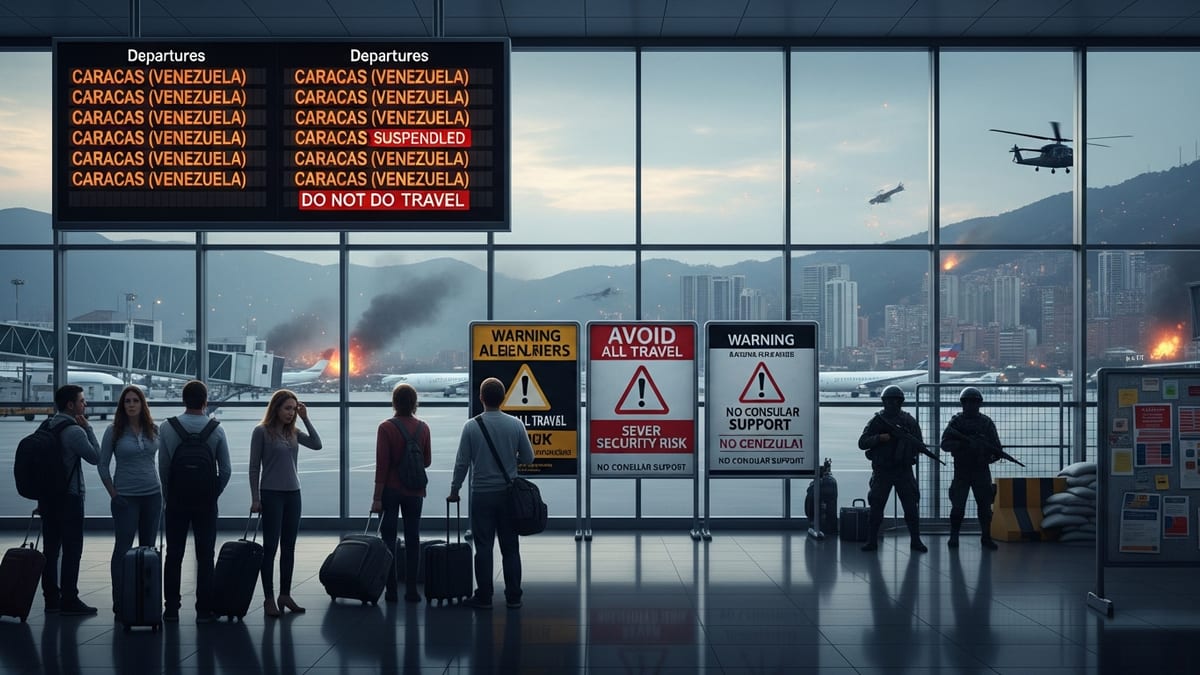
Coordinated advisory updates across a volatile region
Publicly available notices from late October 2026 show that the United States has revised detailed travel advisories covering a belt of 13 states that includes Saudi Arabia, Bahrain, Iran, Iraq, Jordan, Lebanon, Kuwait, Oman, the United Arab Emirates, Qatar, Syria, Yemen and Israel. The changes, issued around October 23 to 26, do not create new destination categories but refresh threat descriptions to reflect the latest round of attacks linked to the Iran war and Houthi activity.
Coverage by international outlets indicates that the U.S. moves came in parallel with updated guidance from the United Kingdom and other allies, which have also highlighted growing risks from missile and drone strikes, cross-border attacks and unrest around key infrastructure. In several of the 13 countries, large portions of territory are already subject to strong “do not travel” or “reconsider travel” guidance because of conflict, terrorism, kidnapping and limited access to emergency assistance.
Travel-security risk maps published for 2026 by major insurers and assistance providers show much of this corridor classified at the highest or second-highest security tiers. The changes in official advisories align with those commercial assessments, particularly for locations where conflict has pushed aviation hubs, energy facilities and diplomatic missions into the line of fire.
Recent attacks highlight lethal threats to airports and cities
The advisory updates follow a succession of deadly incidents in and around key transport nodes. Earlier in October, a series of attacks on Riyadh’s main airport in Saudi Arabia culminated in a strike that killed at least a dozen people and injured hundreds more, according to international news reporting. The blast, attributed to Houthi forces, damaged civilian facilities and caused widespread disruption to flights serving one of the region’s busiest hubs.
In response, a new U.S. alert for Saudi Arabia cited repeated Houthi attacks on civilian airports and other critical infrastructure, warning of further incidents that could cause mass casualties and severe travel delays. The State Department also ordered some nonessential diplomatic staff and family members to depart the country, underscoring concern that the threat to foreign citizens and personnel had reached a new level.
Beyond Saudi Arabia, the broader conflict involving Iran and its regional partners has produced missile and drone strikes near ports, airfields and urban centers in several of the 13 countries. Public casualty data for 2026 from open sources documents large-scale attacks across the wider region, reinforcing government concerns that bystanders, airline passengers and road travelers may face life-threatening danger simply by being in the wrong place at the wrong time.
How advisory levels shape decisions for travelers
The United States uses a four-tier system for country advisories, ranging from Level 1, which calls for normal precautions, to Level 4, which urges people not to travel. Background material from the State Department notes that higher levels reflect a combination of terrorism, crime, civil unrest, health risks and limitations on government assistance, among other factors. Several of the 13 Middle Eastern countries now subject to revised wording have long been placed at Level 3 or Level 4, with the latest updates refining descriptions rather than changing the numeric level.
Independent tracking sites that aggregate official advisories from the United States, United Kingdom and Canada indicate that, as of October 31, 2026, dozens of destinations worldwide fall under some form of “do not travel” or “avoid non-essential travel” guidance. Within that broader picture, the cluster of 13 Middle Eastern countries stands out because so many are facing overlapping threats linked to the same conflicts, militant groups and regional rivalries.
Analysts cited in public reporting emphasize that advisory changes of this kind do not necessarily signal an imminent new military operation. Instead, they document how existing dangers are evolving, especially for foreigners who may lack local knowledge, language skills or secure ground transport. For travelers and organizations with operations in the region, the revised wording can affect insurance coverage, corporate duty-of-care assessments and aviation routing decisions.
Practical implications for flights, itineraries and insurance
For many visitors, the most immediate impact of the updated warnings is disruption to air travel. Airline route maps and flight-tracking data over recent months show carriers adjusting schedules, adding detours to avoid contested airspace and in some cases suspending services entirely to specific airports within the 13-country belt. Each additional diversion can lengthen flight times and increase operating costs, while periodic airport closures after attacks force last-minute cancellations.
Insurance and risk advisory firms note that heightened official warnings can trigger changes in policy terms. Some travel insurance products limit coverage in places under Level 4 or equivalent guidance, particularly for claims arising directly from war, terrorism or civil unrest. Companies that send staff into higher-risk areas may be required to demonstrate robust security planning, including vetted local partners, secure accommodation and contingency plans for evacuation if conditions suddenly deteriorate.
Travelers who proceed despite the warnings are encouraged in public guidance documents to register with consular services, maintain flexible itineraries and have alternative exit routes in mind. Recent advisories for the 13 countries stress that roads, border crossings and airspace corridors can close on short notice, making it difficult to leave during a crisis and potentially stranding visitors far from embassies or consulates.
Steps travelers can take when risk escalates
Security toolkits produced for travelers heading into potential crisis zones outline practical measures that are increasingly relevant across the affected Middle Eastern states. Recommendations include reviewing official advisories for each stop on an itinerary, monitoring local news in multiple languages where possible and identifying safe shelter options near accommodation and transit hubs.
These resources also highlight the importance of understanding where consular support is realistically available. In several of the 13 countries, embassies operate with reduced staff or limited ability to provide on-the-ground assistance outside major cities. Public information makes clear that visitors should not assume rescue in the event of kidnapping, airstrikes or sudden border closures, and should instead plan self-help measures such as secure communications, backup funds and medical kits.
Travelers looking to avoid the highest-risk locations may consult global peace indices and commercial risk maps that rank destinations by overall security environment. While such tools cannot predict specific incidents, they place the current Middle Eastern warnings in context by showing that, even amid rising geopolitical tension, many parts of the world remain comparatively stable for tourism and business travel.