


Lisbon’s Humberto Delgado Airport is one of Europe’s most congested hubs, and travelers routinely report long, unpredictable waits at security, immigration, and check-in. With a little planning, though, you can avoid the worst bottlenecks and easily save one to three hours on your next trip. This guide gathers current, real-world tips from official information and recent traveler experiences so you can move through Lisbon Airport with far less stress.
Get the latest updates straight to your inbox!
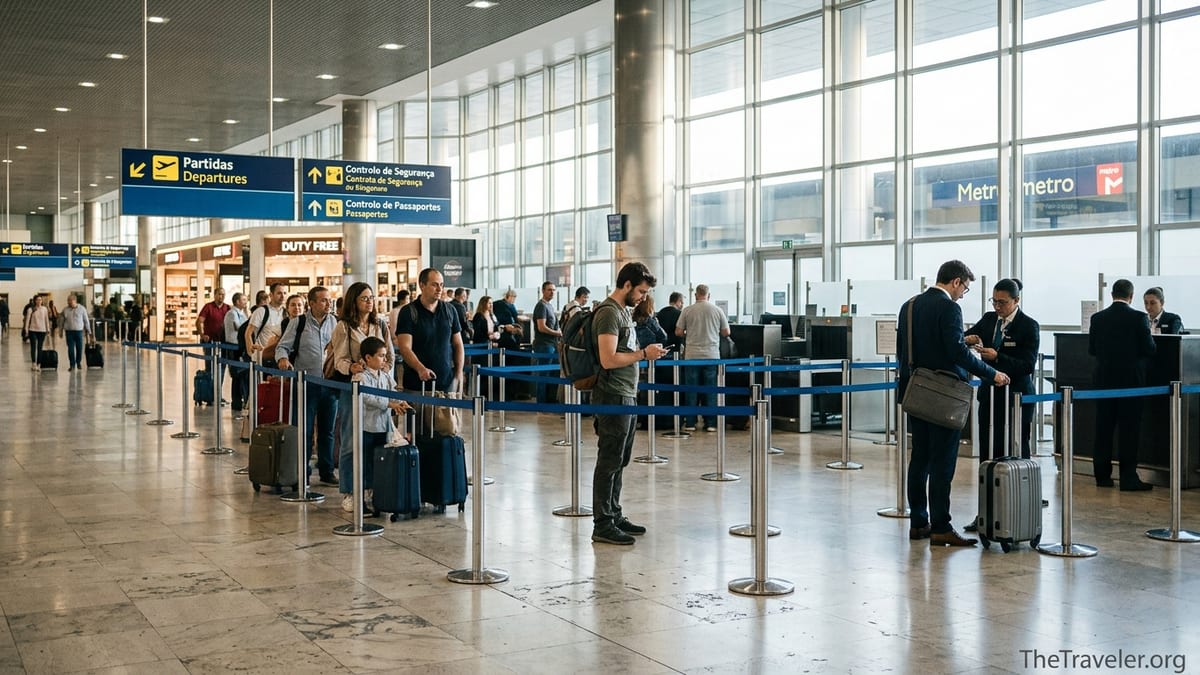
Know Your Terminals Before You Even Book
Lisbon Airport has two passenger terminals: Terminal 1 and Terminal 2. Terminal 1 is the main building used for all arrivals and most full-service and long-haul flights, while Terminal 2 is a separate, smaller facility used almost exclusively for low-cost European departures. Every flight, even the low-cost airlines, arrives into Terminal 1, which is why that building can feel crowded at almost any hour. Before you even buy a ticket, check which terminal your prospective airline normally uses so you know what kind of airport experience to expect.
As of mid-2026, TAP Air Portugal, Lufthansa, Iberia, Air Canada, Azores Airlines and most non-low-cost carriers depart from Terminal 1. Airlines such as Ryanair, easyJet, Transavia, Vueling, Wizz Air and other budget carriers typically depart from Terminal 2. If you are connecting in Lisbon from a long-haul TAP flight from North America to a cheap Ryanair or easyJet ticket bought separately, you will almost certainly land in Terminal 1, collect your bags, and then need to transfer to Terminal 2 for your onward European flight.
The terminals are linked by a free shuttle bus that runs from outside the arrivals area of Terminal 1 to the departures level of Terminal 2. In normal traffic this shuttle ride takes about 10 minutes, but at peak times you should allow 25 to 30 minutes from the time you walk out into arrivals at Terminal 1 to the time you find yourself at the check-in desks in Terminal 2. That figure includes waiting for the bus, dealing with crowds at the stops, and re-entering the building.
This matters a lot when planning flight connections. If you book a single through-ticket with the same airline or alliance, your bags are usually checked to your final destination and you will stay airside. But if you stitch together separate tickets, especially involving a change from a Terminal 1 airline to a Terminal 2 low-cost carrier, you must factor in the time to clear immigration, wait for your bags, walk to the shuttle, ride over to Terminal 2, check in again, clear security, and possibly pass through passport control a second time.
Timing Is Everything: When To Arrive To Beat the Queues
Lisbon Airport’s daily pattern is remarkably consistent. The peak departure window for non-Schengen long-haul flights runs roughly from 7:00 to 10:00 in the morning and again in the late afternoon to early evening. During these windows, multiple large aircraft to North America, Brazil and other long-haul destinations are all trying to feed passengers through the same security and passport control funnels. Travelers have reported passport control lines that take one to two hours in the morning rush, even when airport screens advertise far shorter wait times.
For an early morning long-haul flight to the United States or Canada departing around 6:30 to 8:30, many recent travelers who arrived three hours early cleared everything within 60 to 90 minutes, leaving them time for a quick breakfast at the gate. Others who showed up closer to two hours before departure found themselves watching boarding start while still inching through passport control. Because the airport now also has the new entry and exit system for many non-EU passengers, arrival and departure queues can fluctuate rapidly if one set of e-gates is taken offline.
For mid-morning and mid-afternoon flights within the Schengen area, the picture is usually less intense but still unpredictable. A domestic Lisbon to Madeira flight, for example, may only require regular security screening and no passport control, meaning some passengers report being at the gate in under 30 minutes outside peak times. However, if your flight time overlaps with the long-haul rush, even Schengen travelers are walking through the same terminal concourse and may encounter slower security queues and crowded check-in islands.
As a conservative rule of thumb, aim to arrive at least three hours before long-haul departures and at least two and a half hours before busy-season European flights, especially if you must check luggage. If you are traveling at Christmas, Easter, peak summer or on a Sunday evening, consider adding an extra half hour buffer. This does not guarantee there will be a line, but it protects you on the days when immigration suddenly stretches back into the shopping mall area after duty free.
Security, Fast Track and How To Avoid the Worst Lines
Security at Lisbon Airport has a mixed reputation. On some days and at some hours you can be through in under 15 minutes; on others, particularly in the early morning when multiple low-cost flights leave from Terminal 2, queues can snake backwards long before the screening lanes even open. Parents with small children often do slightly better thanks to family-designated lanes, but they still have to pass through the same checkpoint area and can be delayed if lanes are understaffed.
Fast Track is one of the few tools that reliably saves time when security is overwhelmed. Lisbon Airport sells a dedicated Fast Track lane, and many business-class and elite-status passengers receive access automatically through their airline. The entry to these lanes is normally on the right-hand side of the main security checkpoint in Terminal 1, with a separate entrance in the check-in hall of Terminal 2. On several recent busy days, travelers with Fast Track reported getting through security in about 10 to 15 minutes while the regular line to the same scanners stretched back for nearly an hour.
If you are flying economy but want to reduce your risk, consider buying Fast Track access when you purchase your ticket or afterwards through the airport’s premium services channel. You will receive a QR code to present at the special gate next to the regular security line. It does not exempt you from standard screening rules, but it usually puts you into a much shorter queue. This can be particularly valuable if you are making a same-day connection in Lisbon and your inbound flight arrives slightly late.
Regardless of whether you use Fast Track, you can shave minutes off security by packing smart. Lisbon security staff are strict about removing laptops and larger electronics, placing liquids in a single transparent bag, and avoiding large volumes of loose coins or cables in your pockets. At Terminal 2, where queues are often formed well before the early morning opening times, travelers recommend keeping boarding passes and passports accessible, and having your liquids and electronics already separated in your hand luggage before the conveyor belt. Every prepared passenger helps the line move faster, which in turn reduces the risk of missing an early departure when just one or two scanners are open.
Passport Control, EES and the Hidden Second Bottleneck
One of the biggest surprises for travelers leaving Lisbon for a non-Schengen destination is that there are effectively two main hurdles after check-in: first security, then passport control. After you pass through security in Terminal 1, you walk through the large duty free shop and a shopping mall-like concourse. Many people assume the hard part is over and settle into a café. In reality, for flights to the United States, United Kingdom, Canada, Brazil and other non-Schengen countries, you must still go through border control at the end of this commercial area before you reach your gate.
This second control point can be the single largest source of delay. Travelers have shared recent experiences where the screens above the line displayed an estimated wait time of around 20 minutes, yet they spent closer to an hour slowly shuffling forward. On some days, e-passport gates for EU citizens or other eligible travelers work smoothly and shave the time considerably. On other days, multiple e-gates have been out of order, forcing everyone into manual processing booths and creating a dense bottleneck even though they had already cleared security without drama.
The new EU entry and exit system, gradually rolling out as of 2026, also adds complexity. First-time entries for many non-EU, non-EEA travelers now involve capturing fingerprints and facial data, which takes longer than a simple passport stamp and can lead to spikes in waiting time whenever a large wave of long-haul arrivals or departures hits at once. Some travelers report that, on their first trip after the system was activated, they allowed three hours at the airport and ended up using nearly all of it between check-in, security, EES kiosks and the subsequent passport check.
To protect yourself, treat passport control as a separate task that may take as long as, or longer than, security. After clearing security, walk directly toward border control and evaluate the line before sitting down for a meal or shopping. If the line is already stretching back into the mall, it is wise to join it immediately and keep your snacks or coffee for the other side. If things look unusually quiet, you can then calculate how much time you have to browse or eat and still be at the gate 30 to 40 minutes before boarding.
Smart Ground Transport: Getting To and From Lisbon Airport Faster
Lingering too long in city traffic is another way to lose unnecessary time around Lisbon Airport. Fortunately, the airport is very close to the city center and has several efficient public transport links. The Aeroporto station on the red line of the Lisbon Metro is located directly at Terminal 1 and connects you to downtown hubs like Alameda and São Sebastião in about 20 to 25 minutes. For most travelers staying near central areas such as Baixa, Chiado or Avenida, taking the metro to Saldanha or São Sebastião and then changing lines is often faster and more predictable than a taxi in rush hour.
City buses operated by Carris also serve the airport, stopping outside Terminal 1 and connecting to areas not directly on the metro. These are cheaper than most dedicated airport coaches, but they can be crowded and slower if you happen to travel during peak commuting times. If you are catching an early morning flight, the first metro trains might not run early enough, so a pre-booked taxi or ride-hailing service is usually the better option. For very late-night departures from Terminal 2, when some airport restaurants and services close, night buses and ride-hailing again become the main options, so check their schedules the day before.
Ride-hailing apps such as Uber and Bolt are widely used in Lisbon. Depending on the time of day, a trip from the historic center to the airport usually takes around 15 to 30 minutes and costs significantly less than in many other European capitals, although surge pricing during a festival or heavy rain can push fares higher. One recurring complaint is that signage for ride-hailing pick-up zones at the airport can be confusing, causing drivers and passengers to circle around and lose time. When you order a car, carefully read the app’s pick-up instructions and stand in the designated area to avoid delays and additional charges.
If you are renting a car, factor in extra time for the return process at Lisbon. Several travelers have noted that car rental return lanes route you through the same traffic-choked access roads used by private vehicles dropping off passengers. Returning a car at 8:00 on a Monday morning, for example, can involve waiting in a queue of vehicles just to reach the rental company’s parking area. Add another 20 to 30 minutes for the inspection and paperwork, then your walk back to the terminal. If you budget only a few minutes for car return at a peak hour, you may end up arriving late at check-in despite having left your hotel in what seemed like good time.
Overnight, Early-Morning and Tight-Connection Strategies
Some of the longest and most stressful waits at Lisbon Airport happen at the edges of the day: late at night and very early in the morning. Terminal 2 in particular is notorious for limited overnight services. Food outlets and shops often close, leaving only vending machines or a single café open, if that. If you have a 6:00 or 7:00 departure from Terminal 2 and plan to arrive at 3:30 or 4:00, it is worth having a bottle of water and a small snack already in your bag. That way, if the security line has not opened yet and the only seating is on cold metal benches, you are at least not hunting for an open kiosk.
For those with tight connections booked on a single ticket, the most important rule is to follow airport staff instructions and signage immediately on arrival. If you land from a non-Schengen flight into Terminal 1 and connect onward to another non-Schengen destination, you may be directed through a separate transit security and passport control area rather than all the way out to baggage claim. Do not pause in the duty free zone or leave the transit path unless your airline explicitly instructs you to go landside to re-check your luggage.
Passengers on separate tickets should treat Lisbon as a full stop, not a seamless transfer point. For example, imagine you arrive from New York to Lisbon on a TAP Air Portugal flight landing at 8:00, and you have a separate low-cost ticket from Lisbon to Barcelona on Ryanair leaving at 10:30 from Terminal 2. You will likely need to clear immigration, collect your bags, ride the shuttle to Terminal 2, check in again, clear security, and then (if Barcelona is considered a Schengen destination without additional passport control on departure that day) head to your gate. In practice, this 2.5-hour window is extremely tight, and any delay on the inbound flight or at passport control could make you miss your connection entirely.
If your budget permits, consider building in a longer layover or even an overnight stay in Lisbon when combining full-service and low-cost airlines on separate tickets. The city center is only a short metro or taxi ride from the airport, so spending an extra night in town can be both more relaxing and safer than gambling on a tight same-day self-transfer that depends on every step, from immigration to the shuttle bus, running perfectly on schedule.
The Takeaway
Lisbon’s Humberto Delgado Airport is far from a smooth, frictionless hub, but with realistic expectations and a handful of practical strategies you can avoid most of the horror stories. Understanding the split between Terminal 1 and Terminal 2, respecting the peak hours, and remembering that passport control is a second major bottleneck after security are the core time-saving insights. Add in smart transport choices from the city, a plan for car rental returns, and a buffer for the quirks of the new entry and exit system, and you dramatically reduce your chances of sprinting to the gate.
Arrive early, travel light when you can, consider Fast Track during peak seasons, and always walk straight to passport control before settling into a café for non-Schengen departures. Above all, avoid building tight self-connects between full-service and low-cost airlines, particularly when a terminal transfer is involved. With those precautions in place, Lisbon Airport becomes much less of an obstacle and more of a manageable gateway to the rest of Portugal and Europe.
FAQ
Q1. How early should I arrive at Lisbon Airport for an international flight?
For long-haul or non-Schengen flights, arriving about three hours before departure is a sensible minimum, and during peak holiday periods many travelers prefer three and a half to four hours.
Q2. Is two hours enough for a Schengen or domestic flight from Lisbon?
Outside peak times, two hours may be enough for a Schengen or domestic flight if you have only carry-on luggage, but two and a half hours is a safer target, especially if you must check bags.
Q3. Do I really need to go through passport control after security at Lisbon for non-Schengen departures?
Yes. For flights to destinations outside the Schengen area, you first pass security, then walk through duty free and the shopping concourse, and finally clear passport control before reaching your gate.
Q4. How long does the shuttle between Terminal 1 and Terminal 2 take?
The free shuttle between Terminal 1 and Terminal 2 usually takes around 10 minutes in motion, but you should allow 25 to 30 minutes in total to account for waiting, boarding, and walking at each end.
Q5. Is Fast Track security at Lisbon Airport worth paying for?
During busy morning and evening peaks, Fast Track can cut security wait times from around an hour to roughly 10 to 15 minutes, so it is often worth it if you value a predictable experience.
Q6. What is the best way to get from central Lisbon to the airport quickly?
The red line of the Lisbon Metro runs directly to the Aeroporto station at Terminal 1 and typically takes about 20 to 25 minutes from central interchange stations, avoiding most surface traffic.
Q7. Are there 24-hour food options at Lisbon Airport?
Some outlets in Terminal 1 stay open late, but Terminal 2 often has very limited overnight options, so for very early or late flights it is wise to bring water and snacks.
Q8. How much time should I allow to return a rental car at Lisbon Airport?
At busy times, plan at least 45 to 60 minutes between arriving at the car rental return area and being back inside the terminal, including traffic near the airport, inspection and paperwork.
Q9. Is Lisbon Airport a good place to book tight self-transfers on separate tickets?
Lisbon is risky for tight self-transfers, especially when switching from a Terminal 1 airline to a low-cost carrier in Terminal 2, because you must often reclaim bags, ride the shuttle and clear security again.
Q10. Does the new EU entry and exit system affect departure times at Lisbon?
The new system can lengthen border checks for some non-EU travelers, particularly on their first trip, so allowing extra time for passport control at departure is prudent until procedures fully stabilize.